Arkham Horror: The Card Game
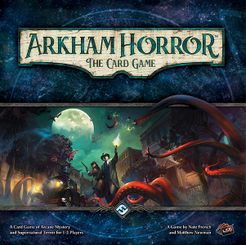
Cooperate with investigator decks and chaos-bag tests, then carry experience, upgraded cards, and lasting trauma between scenarios.
Arkham Horror: The Card Game supports 1–2 players; community best: 2 players; playing time: 60–120 minutes. A WANGO browser trial is available.
Background & introduction
Arkham Horror: The Card Game combines cooperative investigation with deck construction. Each player controls an investigator with distinct abilities, deckbuilding restrictions, and weaknesses. The group searches connected locations for clues while handling enemies and encounter cards. The Revised Core Set supports one to four players; a solo investigator must balance investigation and survival.
Each scenario has its own act, agenda, and encounter decks. Investigators usually spend clues to advance the act, while the agenda tracks opposing forces. The scenario determines advancement requirements, locations, and resolutions. Limited actions must cover investigation, movement, equipment, fighting, and evasion; committed cards and revealed chaos tokens influence skill tests.
A campaign links scenarios through a campaign log. Experience buys or upgrades cards, while trauma and recorded choices can affect later scenarios. Defeat does not always end the campaign immediately, so the group must balance a favorable outcome against preserving its investigators. No scenario resolutions are revealed here.
Core rules & scoring
Setup: Follow the investigator back for deck size, permitted cards, and required inclusions. Core investigators normally have 30 cards counting toward deck size, plus required signature cards and weaknesses; normally include no more than two player cards of the same title. Follow campaign or scenario instructions for difficulty, chaos tokens, locations, and decks. Normally start with five resources and five cards, with one mulligan; replace weaknesses drawn during setup as instructed.
Round structure: Resolve Mythos, Investigation, Enemy, and Upkeep in order, skipping Mythos in the first round. The group chooses investigator turn order during Investigation. Each investigator completes their entire turn, normally taking up to three actions. Actions may repeat, and unused actions cannot be saved.
Actions and cards: Draw a card, gain a resource, move to a connecting location, investigate, engage, fight, evade, play an asset or event, or activate an action ability. Playing cards also requires their resource and other costs. Assets normally stay in play; events are discarded after resolution; skill cards are committed to tests. Fast cards do not use a play action but still obey timing and costs.
Skill tests: Commit cards with matching or wild icons before revealing a chaos token and resolving its effects. A modified skill value equal to or above the difficulty succeeds; the auto-fail token follows its special rule. The testing investigator may commit any number of eligible cards; each other investigator at the same location may commit one. Discard committed cards and return revealed tokens when the test ends.
Clues and advancement: A basic investigate action tests intellect against the location’s shroud and discovers one clue there on success. Investigators usually spend the required clues as a group to advance the act, but Objective text and per-investigator values apply. One scenario’s clue requirement is not universal.
Enemies and evasion: A basic fight tests combat against enemy fight and deals one damage on success, subject to weapons and other modifiers. Evading tests agility against enemy evade; success exhausts and disengages the enemy rather than defeating it. While engaged with ready enemies, actions other than fighting, evading, or activating parley or resign abilities normally provoke attacks of opportunity from each such enemy.
Pressure and upkeep: Mythos adds one doom, checks the current agenda against all doom in play, then has investigators draw encounters in player order. Unless a card says otherwise, doom advances the agenda only at the specified check. During Enemy, ready unengaged hunters move, then ready engaged enemies attack. Upkeep resets actions, readies exhausted cards, gives each investigator one card and one resource, and requires discarding down to eight cards.
Resolutions and progression: Follow the scenario’s resolution instructions, or its no-resolution entry if all investigators are eliminated. Damage reaching health or horror reaching sanity defeats an investigator and normally causes corresponding trauma in a campaign. Resolve experience, deck upgrades, and subsequent progress through the rules and campaign log.
Rules & gameplay questions
Can I commit more cards after revealing a chaos token?
Normally no: commitment precedes revealing the token. There is no general one-card limit for the testing investigator. Each other investigator at the same location normally may commit only one card, and card-specific restrictions still apply.
Does a successful investigation take every clue at the location?
A basic investigation discovers one clue there. Card effects can change that number. Each act also has its own advancement requirements and possible per-investigator values.
Does evading and leaving permanently remove an enemy?
Not necessarily. Evasion exhausts and disengages the enemy; it may engage again when it readies, and a hunter may pursue investigators during the Enemy phase. Simply moving does not automatically break an existing engagement.
Must we restart the campaign when an investigator is defeated?
Not necessarily. Resolve the scenario or its no-resolution entry and record trauma and other consequences. Defeat, death, and insanity are different conditions and do not all mean the same campaign failure.
Is this the site tutorial or the 2026 core set?
This covers the original 2016 game’s core mechanisms using the 2021 Revised Core Set rules. The site tutorial’s fixed clue, doom, or commitment limits are not physical-game rules. The 2026 core set and expansions are outside scope, and the optional Taboo List is not assumed.
Rules & introduction sources
- Edition
- Physical-game overview using the 2021 Revised Core Set Learn to Play and Rules Reference, covering mechanisms shared with the 2016 original. Excludes expansions, the 2026 core set, the optional Taboo List, and scenario-resolution spoilers; not the site’s simplified tutorial.
- Rule references
- Introduction source
- BoardGameGeek
WANGO editorial
| Parameter | Recorded value |
|---|---|
| BGG overall rank (snapshot) | #33 |
| Complexity Weight | 3.57 / 5 |
| Best player count (community) | 2 |
| Player range | 1–2 |
| Playing time (minutes) | 60–120 |
| Core mechanisms | Action Points · Area Movement · Communication Limits · Cooperative Game · Deck Construction · Events · Hand Management · Map Deformation · Modular Board · Player Elimination · Push Your Luck · Role Playing · Scenario / Mission / Campaign Game · Solo / Solitaire Game · Stat Check Resolution · Variable Player Powers |
| Chinese publication | Unconfirmed |
| WANGO browser play | Available · browser trial |
| Year published | 2016 |
| Suggested age | 14+ |
BGG statistics are stored snapshots, not live rankings. Source checked:2026-09-27
Player questions
What is the best player count for Arkham Horror: The Card Game, and can I play online?
Arkham Horror: The Card Game supports 1–2 players; community best: 2 players; playing time: 60–120 minutes. A WANGO browser trial is available. Recorded mechanism tags: Solo / Solitaire Game.
How complex is Arkham Horror: The Card Game, and which mechanisms does it use?
Weight: 3.57 / 5. Mechanisms: Action Points · Area Movement · Communication Limits · Cooperative Game · Deck Construction · Events · Hand Management · Map Deformation · Modular Board · Player Elimination · Push Your Luck · Role Playing · Scenario / Mission / Campaign Game · Solo / Solitaire Game · Stat Check Resolution · Variable Player Powers. Chinese publication: Unconfirmed.
Where can I learn Arkham Horror: The Card Game?
Available resources: Rule guide https://wangogame.com/wiki/games/arkham-horror-lcg?tab=howto;Strategy https://wangogame.com/wiki/analysis/arkham-horror-lcg;Play online https://play.wangogame.com/arkham-horror/