Go
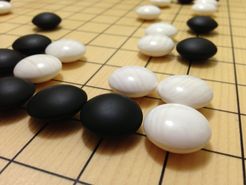
Alternate black and white stones to build connections and surround space. This account uses an explicit physical AGA rules framework for liberties, capture, self-capture, situational superko, and area scoring.
Go supports 2 players; community best: 2 players; playing time: 30–180 minutes. A WANGO browser trial has not been confirmed.
Background & introduction
Go stones ordinarily stay where they are placed, yet each play changes the conditions under which nearby groups survive. Orthogonally connected stones share liberties, making cuts, connections, and enclosure different changes to the same network. An apparently local contact can alter the freedom of more distant groups.
This account selects an even 19-line AGA game with area counting agreed in advance. Final value comes from living stones and empty points surrounded by one color. Captures change shape and control rather than adding a separate bonus to the area score; White also receives 7.5 points of compensation for playing second.
A legal play does not establish that a group will ultimately live. The prohibitions on self-capture and repeated situations constrain moves but do not guarantee safety. After passing, players must still establish agreement about dead stones and resume play if necessary, extending a short rules framework into substantial judgment.
Core rules & scoring
This summary selects a two-player even AGA game on a 19-by-19 grid, initially empty. Black plays first and turns alternate. Place a stone on an empty intersection, including edges and corners; stones do not make ordinary moves after placement.
Agree on the counting method before play; this entry selects the area method permitted by AGA rules. Under current AGA even-game compensation, White adds 7.5 points. The greater adjusted final score wins. Without prior agreement on counting, AGA defaults to territory counting.
Stones of the same color form a string through horizontal or vertical adjacency only. Diagonal contact does not connect them. Orthogonally adjacent empty intersections are liberties shared by the entire connected string.
After a play, remove every opposing string left without liberties. Those stones become prisoners. One play can capture several separate opposing strings at once.
After removing opposing strings captured by the play, the string containing the newly played stone must still have a liberty. Otherwise the move is illegal self-capture. A play into an apparently surrounded point can therefore be legal if capture first creates liberties.
AGA uses situational superko: a play must not recreate an earlier whole-board position with the same player to move. This reaches beyond immediate recapture and differs from positional superko, which ignores whose turn it is. Passing is always legal.
Instead of placing a stone, pass and hand the opponent one of your stones as a pass stone, added to their prisoners. If the opponent continues playing, the player who passed may subsequently play again.
Two consecutive passes normally begin the ending procedure. Agree on the status of all strings, then remove mutually agreed dead stones as the opponent's prisoners. One player's assertion alone does not authorize removing a disputed string.
If status remains disputed, resume play with the opponent of the last passer moving first. Agreement ends the game; if each player passes twice in succession during the unresolved procedure, all remaining stones are deemed alive. White must make the final move, adding a pass and pass stone if necessary.
Count area as living stones on the board plus empty territory entirely surrounded by that color. Neutral empty regions touching living stones of both colors belong to neither side. Do not add prisoners separately under area counting. Add White's 7.5 compensation and compare totals; handicap compensation is outside this summary.
Rules & gameplay questions
Do two diagonally touching stones share liberties?
Not through diagonal contact alone. Connections run horizontally or vertically through same-color stones. They belong to one string only if another orthogonal same-color path connects them.
Is playing inside an enemy enclosure always self-capture?
No. Remove opposing strings deprived of liberties by that play first, then check your own string. Capturing may create the liberty needed for legality, although the move must also satisfy the repetition rule.
Does AGA superko compare only the stone arrangement?
No. It also compares which player is next to move. The prohibited repetition combines the same whole-board arrangement and the same player to move. This describes AGA situational superko and does not claim to describe WANGO's implementation.
Do ten captured stones add another ten points under area counting?
No. Count living stones and surrounded empty points without adding prisoners again. Capture already changes space and surviving stones. The selected physical AGA procedure still retains pass stones and White's final pass.
Can I declare an opposing group dead after both players pass?
Not unilaterally. After consecutive passes, establish agreement on status; resume play to resolve disagreement. AGA does not let one player's declaration alone remove a disputed group.
Rules & introduction sources
- Edition
- Scope: physical AGA rules, even 19-line game, area counting agreed in advance, White7.5, situational superko, pass stones, and White's final move. Actually read the BGA association's complete reproduction of AGA1991 rules1-12 and current official AGA Congress summary items1-6. The reproduction's historical5.5 komi is replaced here by current AGA7.5. The current AGA library PDF returned403 and is not claimed read. Does not describe WANGO's implementation or cover handicaps, time penalties, or special differences in Japanese and Chinese rules.
- Rule references
- Introduction source
- BoardGameGeek
WANGO editorial
| Parameter | Recorded value |
|---|---|
| BGG overall rank (snapshot) | #238 |
| Complexity Weight | 3.91 / 5 |
| Best player count (community) | 2 |
| Player range | 2 |
| Playing time (minutes) | 30–180 |
| Core mechanisms | Area Majority / Influence · Chaining · Enclosure · Pattern Building · Pattern Recognition · Square Grid |
| Chinese publication | Unconfirmed |
| WANGO browser play | No confirmed WANGO trial |
| Year published | Not available |
| Suggested age | 8+ |
BGG statistics are stored snapshots, not live rankings. Source checked:2026-09-27
Player questions
What is the best player count for Go, and can I play online?
Go supports 2 players; community best: 2 players; playing time: 30–180 minutes. A WANGO browser trial has not been confirmed.
How complex is Go, and which mechanisms does it use?
Weight: 3.91 / 5. Mechanisms: Area Majority / Influence · Chaining · Enclosure · Pattern Building · Pattern Recognition · Square Grid. Chinese publication: Unconfirmed.
Where can I learn Go?
Available resources: Rule guide https://wangogame.com/wiki/games/go?tab=howto;Strategy https://wangogame.com/wiki/analysis/go