How to play Agricola: rules, scoring and beginner strategy
Learn Agricola Revised Edition (2016): player-count setup, worker placement, sowing, family growth, harvest feeding and final scoring, with interactive lessons, strategy comparisons and rules reference.
What is Agricola? Choose the right edition
How many people can play Agricola, and how long does it take?
Agricola is a worker-placement farming game designed by Uwe Rosenberg. The 2016 Revised Edition base game supports 1–4 players, ages 12+, with an estimated 30 minutes per player in the rulebook.
The multiplayer rules here cover 2–4 players; solo changes feeding and resources. Teaching can take longer. The publisher’s overview lists about 90 minutes, not a fixed duration for every player count.
For two players, use the rulebook estimate of about 60 minutes and allow extra teaching time.
SourceCan I mix the Revised Edition with other Agricola editions?
This guide covers the 2016 Revised Edition. The original 2007 base game supports 1–5 players; Family Edition is a separate simplified version, and All Creatures Big and Small is a standalone two-player game.
Similar names do not make action boards, cards or scoring interchangeable. The publisher advises against mixing original and revised material for general play. This page excludes Farmers of the Moor and the 5–6 player expansion.
Do not apply an older occupation’s wording to a revised card with the same name; check the edition and card number first.
SourceSetup for 2, 3 and 4 players
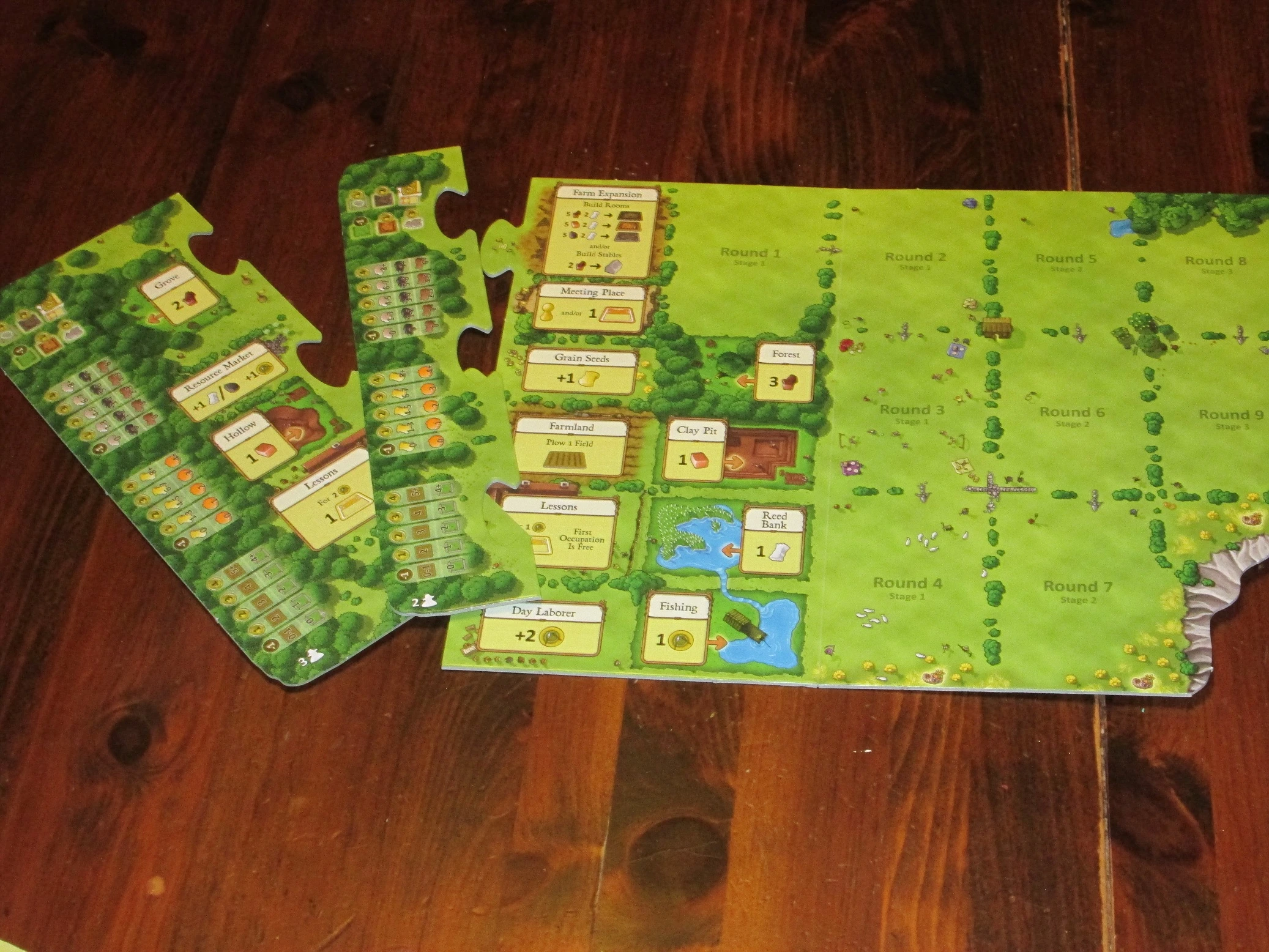
Start with the ten common base spaces, then use the extension spaces for the actual player count. Round cards and harvest timing do not change with player count.
Player counts, extra spaces and occupation costs
| Players | Extra action spaces | Lessons costs |
|---|---|---|
| 2 | No 3/4-player extension spaces. | Basic Lessons: your first occupation is free, then one food each. |
| 3 | Grove: +2 wood/round; Hollow: +1 clay; Resource Market: choose one reed or one stone, plus one food; extra Lessons. | Basic Lessons is unchanged. Extra Lessons always costs two food, including your first occupation. |
| 4 | Copse: +1 wood/round; Grove: +2 wood; Hollow: +2 clay; Resource Market: one reed + one stone + one food; extra Lessons; Traveling Players: +1 food/round. | Basic Lessons is unchanged. Extra Lessons: your first two occupations cost one food each, later ones two. |
What else should I check before dealing?
Filter occupations by their player-count markings, then deal seven occupations and seven minors per player. Start with two people and two wood rooms; the starting player gets two food, others three.
Pay any separate card cost as well as the Lessons fee. Starting player does not rotate automatically; take Meeting Place to claim it.
In four-player extra Lessons, playing your second occupation costs one food; your third costs two.
SourceHow should I plan the first four rounds?
These are conditional WANGO suggestions, not a fixed action sequence. Check remaining actions, open spaces and your hand before choosing a route. The first harvest is after round four.
How do I avoid a food shortage at the first harvest?
Update your food shortfall each round: two adults need four food. The starting player begins with two food, others with three. Count only food already held or reliably convertible before harvest.
Round 1: assess your hand and accumulation spaces. Round 2: select an affordable food route. Round 3: check equipment and seeds. Round 4: cover the actual shortfall first. Recalculate if an opponent takes your space.
With no other income the starting player lacks two food, which Day Laborer covers. Eating sheep requires a conversion improvement first. A seed or an empty field is not three immediately available food.
SourceMust I rush a room in the first four rounds?
No. Prepare a third wood room if you can cover the first harvest and afford five wood plus two reed; otherwise secure food first.
Basic family growth appears in one of rounds 5–7. A room neither adds a person immediately nor guarantees access to growth next round.
If building leaves no food and one action, cover feeding first. Do not count an unrevealed growth space as a worker already gained.
SourceLearn by playing
Place a family member
Select a family member in the house, then take wood from the Forest.
Placing a worker occupies the space. Take all six accumulated wood; your other person can still act.
Plow your first field
Select a person, then an empty farmyard space.
The first field may be anywhere empty. Later fields must border a field orthogonally. Plowing does not provide seeds.
Sow a seed
Choose a person, an empty field and a crop.
One grain seed makes a stack of three; one vegetable makes two. Pay the seed from your supply; crops in fields are unavailable until harvested.
Build another room
Choose a person, then an empty space next to the house.
Each wood room costs five wood and two reed and must border your house. Building a room does not grow your family.
Grow your family
You already have a third room. Send a person to family growth with room.
The newborn does not act this round and needs only one food if a harvest follows. From next round it acts and feeds normally.
Cook with a Fireplace
You own a Fireplace. Select a sheep and convert it into two food.
Cooking with a Fireplace is an anytime action and needs no worker. Animals are not food by themselves; cooking during breeding is forbidden.
Resolve a harvest
Inspect the field and pasture, then resolve field, feeding and breeding phases.
Harvest one crop per field, feed each adult two food, then breed at most one per eligible species. This position has four food and capacity for four sheep, so it ends with three sheep.
Turn empty space into points
This is your final action. Plow, then inspect the final scoring changes.
One field is still in the 0–1 field bracket (−1), but filling an unused space gains one point. Food itself scores nothing.
Decisions
Food now or wood for later?
One action remains, no food is stored, and harvest is next. Compare Forest and Fishing.
Fishing covers two adults. Wood supports future building, but without another food source the shortage is four begging markers (−12 points). This compares only the stated public position.
What should one empty field grow?
You have one of each seed. Compare sowing either crop in the same field.
Grain makes three layers and vegetables two, both costing one seed. Scoring, baking and remaining harvests matter; three layers are not three immediately available food.
Build a room or plow first?
From identical resources and one person, compare a room with a field.
A room costs five wood and two reed and prepares later family growth. Plowing keeps resources and opens a field. Neither action immediately adds a person or food.
Renovate or extend?
With two wood rooms, compare renovation for two clay and one reed against extension for five wood and two reed.
Two clay rooms score two points but add no room. Extending prepares growth, but wood rooms score zero. Your house type determines future room costs.
How do cards, food and growth compare?
The following is WANGO strategy analysis. Compare verifiable gains and costs, then consider competition for spaces. No fixed opening fits every hand.
Is a card worth playing now?
Count the worker action, Lessons fee, printed cost and prerequisite actions, then count how many remaining rounds or harvests can actually trigger the effect.
Count effects only when their printed conditions are met. Consider printed points, endgame bonuses and contested spaces separately. Resources spent on a room cannot also pay for an improvement.
A hypothetical card giving one food each harvest can trigger three more times before round-11 harvest, but only twice afterward. The Well pays in later rounds, so count rounds instead of harvests.
SourceWANGO strategy analysis
What is an extra family member worth?
A person born in round r normally acts from round r+1, giving 14−r later actions through round 14 and three endgame points. Subtract the growth action, room and feeding costs.
The newborn cannot act immediately; it needs one food if that round has a harvest, then two at each later multiplayer harvest. Extra actions do not guarantee ideal spaces.
Growth in round seven yields seven later actions in rounds 8–14. It costs one food at that harvest, then two at rounds 9, 11, 13 and 14: nine additional food total.
SourceWANGO strategy analysis
Should I bake grain or raise animals?
Compare the actions in the whole food route. Grain needs seeds, fields, sowing and baking opportunities; animals need a source and conversion improvement, plus housing if retained for breeding.
An oven does not allow unrestricted baking. Breeding follows feeding, so this harvest’s offspring cannot feed people earlier in the same harvest.
A Clay Oven bakes one stored grain into five food; a Fireplace turns one sheep into two. Compare the actions needed for the equipment and goods, not just five versus two.
SourceWANGO strategy analysis
How do I compare my last actions by net points?
Compute the before-and-after score, including removed empty-space and missing-category penalties. Cover feeding, then compare net points rather than raw goods taken.
Goods add category points only at thresholds, or via card bonuses. Subtract any lost animals, crops or bonus points.
Plowing a second field on an unused space changes fields from −1 to +1 and removes a −1 space penalty: +3. The first field remains at −1 and normally gains only the saved space point.
SourceWANGO strategy analysis
Components and actions
People
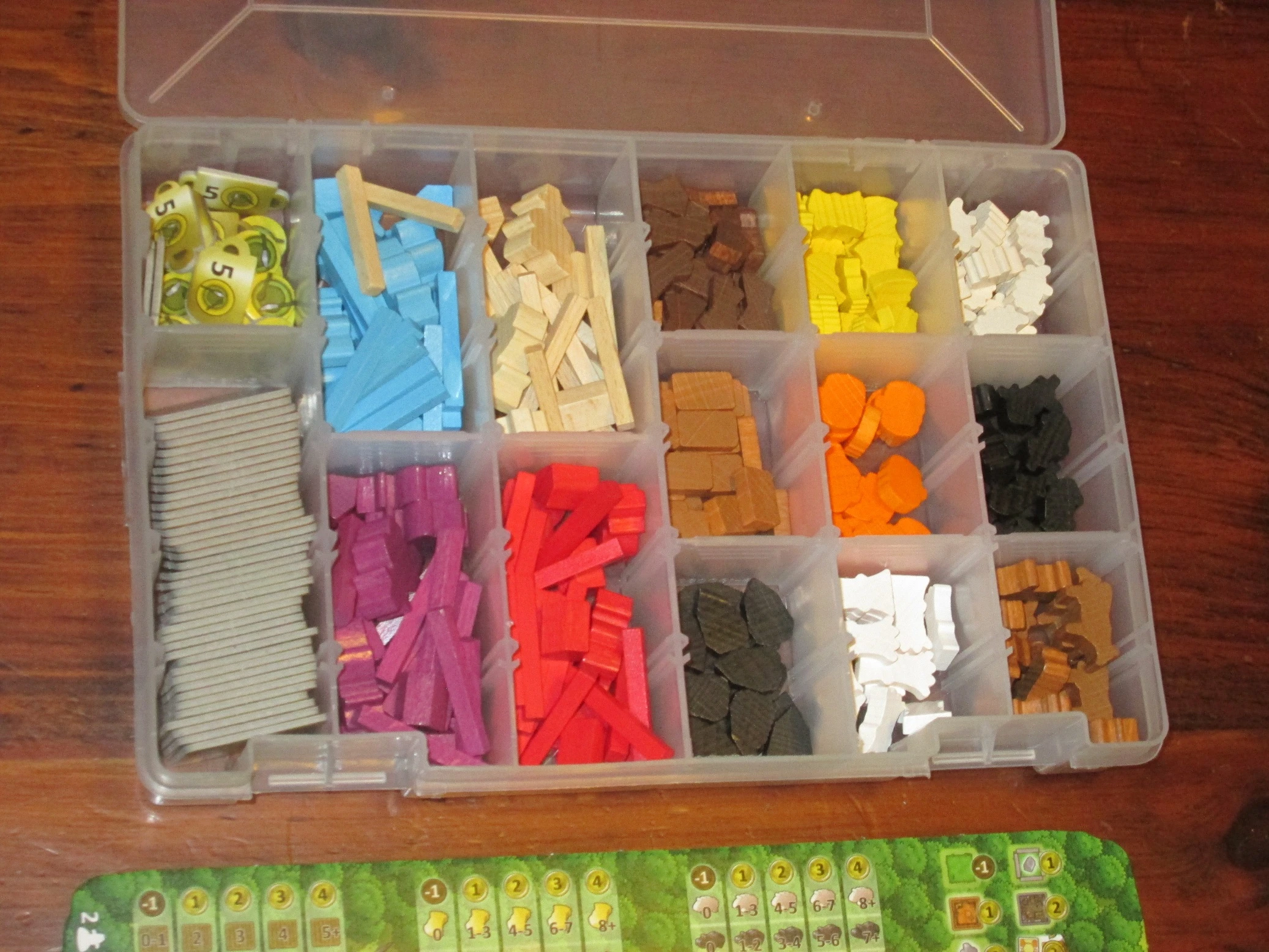
Five per color, 20 total; two start in play and take work turns.
Stables and fences
Four stables and 15 fences per color: 16 stables, 60 fences.
Building resources
30 wood, 24 clay, 14 reed, 16 stone for construction and improvements.
Grain and vegetables
24 grain and 16 vegetables; sow seeds or convert them into food.
Three animal species
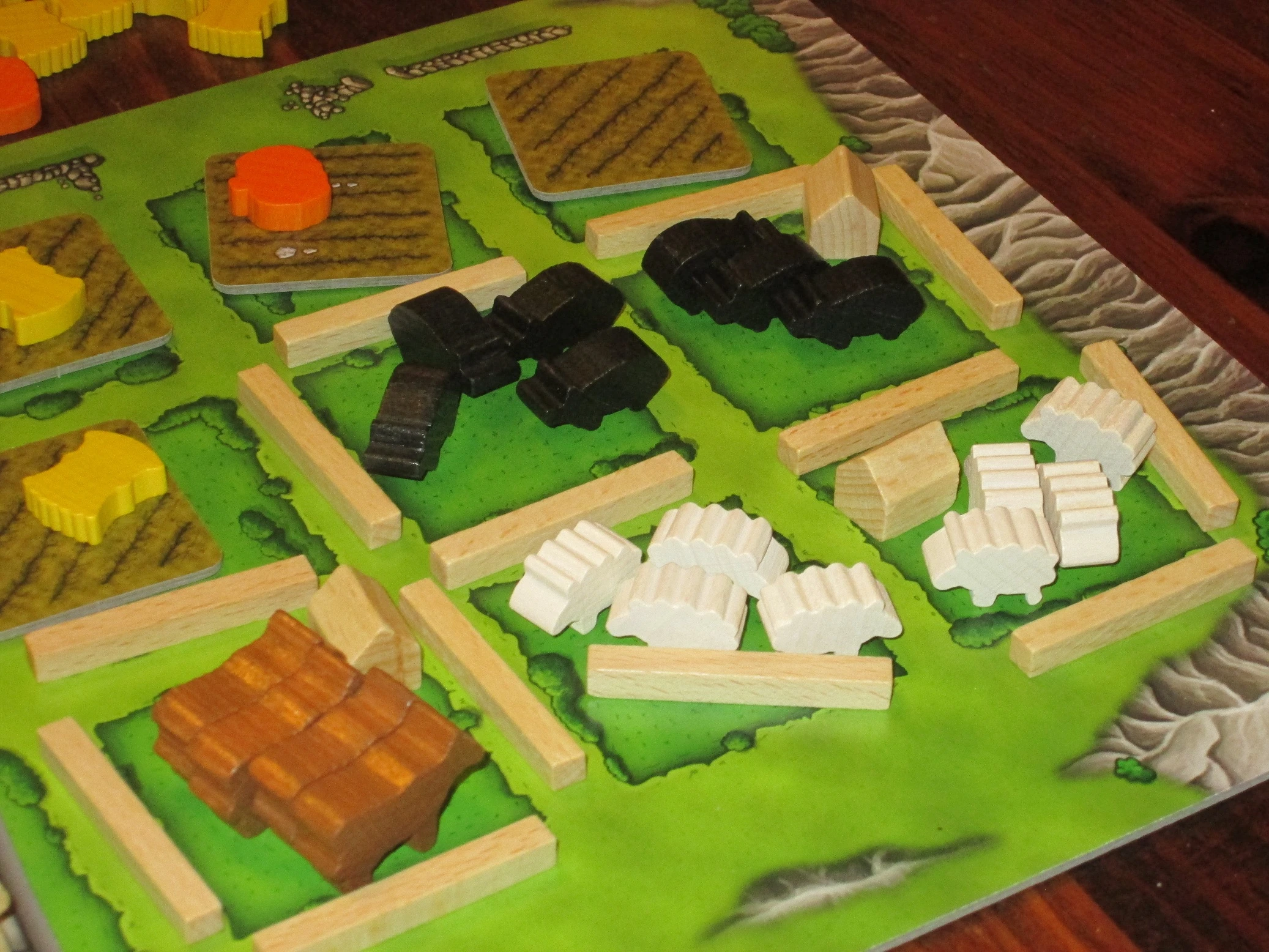
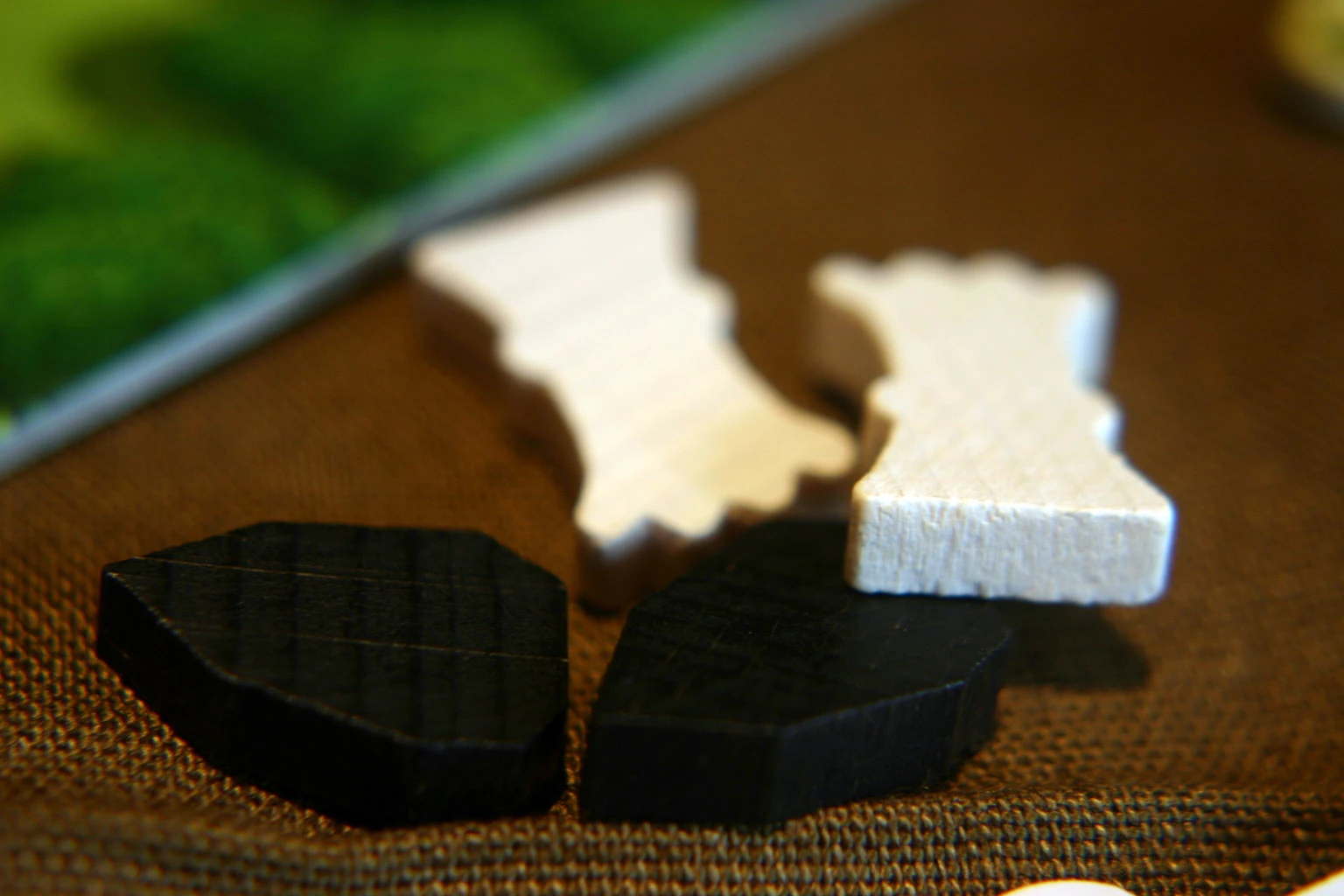
18 sheep, 15 boar, 13 cattle; accommodation is required, one offspring per species per harvest.
Farmyards and boards
Four farmyards, one action board, one major-improvement board, two extensions. Choose the player-count layout.
Room and field tiles
23 wood-room/field tiles, 16 clay/stone-room tiles, two variant tiles and one Side Job tile.
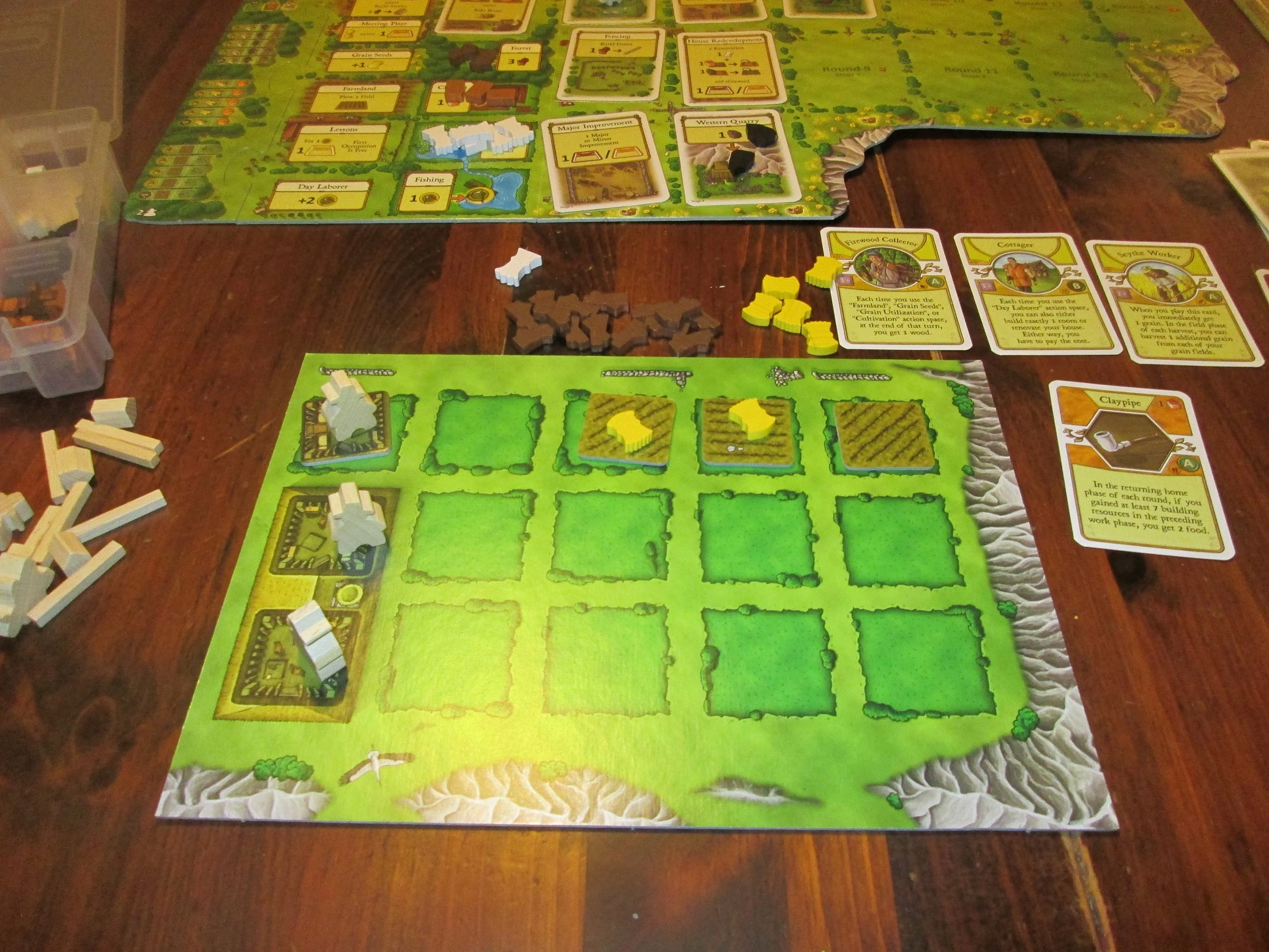
120 cards
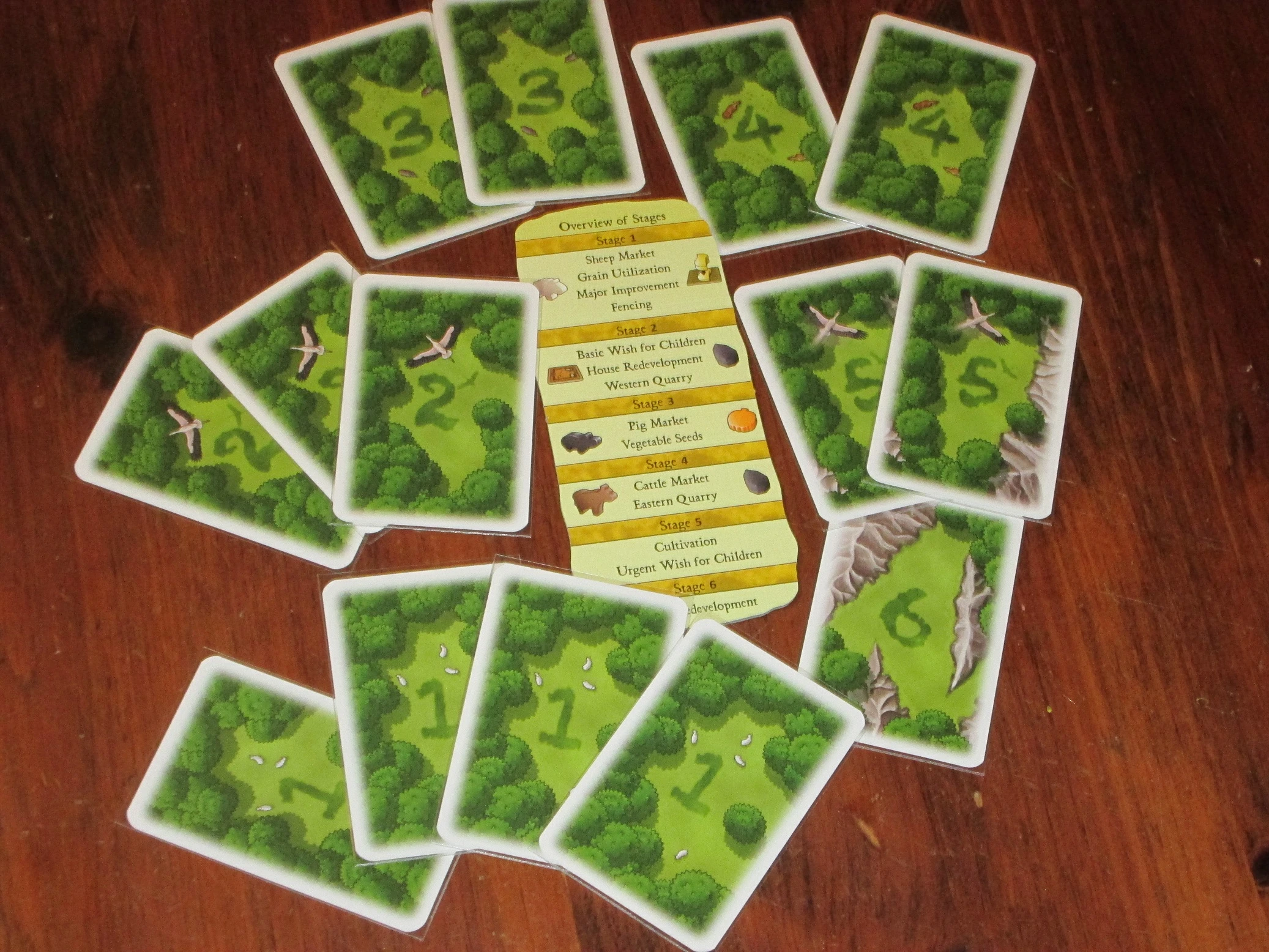
14 round-action cards, 10 majors, 48 occupations, 48 minors; deal seven occupations and seven minors per player.
Food and other markers
36 one-food and eight five-food markers; ten goods/begging tiles, three suggestion markers and one starting-player token.
Reference material
Score pad, ten bags, twelve-page rulebook and twelve-page appendix.
Major Improvement
Stage 1
Build one major or play one minor
Fencing
Stage 1
Build enclosed pastures for one wood per fence
Grain Utilization
Stage 1
Sow and/or Bake Bread
Sheep Market
Stage 1
Accumulate one sheep each round; take all and house them
Basic Wish for Children
Stage 2
Grow with room, then optionally play one minor
House Redevelopment
Stage 2
Renovate, then optionally build a major or minor
Western Quarry
Stage 2
Accumulate one stone each round
Vegetable Seeds
Stage 3
Take one vegetable into supply
Pig Market
Stage 3
Accumulate one boar each round
Cattle Market
Stage 4
Accumulate one cattle each round
Eastern Quarry
Stage 4
Accumulate one stone each round
Cultivation
Stage 5
Plow one field and/or Sow
Urgent Wish for Children
Stage 5
Grow even without room, still at most five people
Farm Redevelopment
Stage 6
Renovate, then optionally build fences
Fireplace (cheap)
2 clay · 1 VP
Sheep 2 / boar 2 / cattle 3 / vegetable 2; baked grain 2
Fireplace
3 clay · 1 VP
Same conversion rates as cheap Fireplace
Cooking Hearth (cheap)
4 clay or return a Fireplace · 1 VP
Sheep 2 / boar 3 / cattle 4 / vegetable 3; baked grain 3
Cooking Hearth
5 clay or return a Fireplace · 1 VP
Same conversion rates as cheap Cooking Hearth
Clay Oven
3 clay + 1 stone · 2 VP
Bake at most one grain for five food; building grants a Bake action
Stone Oven
1 clay + 3 stone · 3 VP
Bake at most two grain for four food each; building grants a Bake action
Joinery
2 wood + 2 stone · 2 VP
Each harvest 1 wood → 2 food; supply wood 3/5/7 earns 1/2/3 bonus points
Pottery
2 clay + 2 stone · 2 VP
Each harvest 1 clay → 2 food; supply clay 3/5/7 earns 1/2/3 bonus points
Basketmaker’s Workshop
2 reed + 2 stone · 2 VP
Each harvest 1 reed → 3 food; supply reed 2/4/5 earns 1/2/3 bonus points
Well
1 wood + 3 stone · 4 VP
Gain one food in preparation of each of the next five remaining rounds
Rule questions
How do you win?
After the harvest of round 14, the highest farm score wins.
Ties go to more building resources in supply; remaining ties share a rank. Food itself scores no points.
Wood, clay, reed and stone break ties; crops and animals are not building resources.
What does each player start with?
Each player starts with a farmyard and one person in each of two wood rooms. The starting player gets two food; others get three.
Each color has five people, four stables and 15 fences; unused pieces remain in personal supply.
Deal seven occupations and seven minor improvements per player, filtering occupations for the player count.
What happens in a round?
Prepare and replenish accumulation spaces, place people in turn, return them home, then harvest if marked.
Reveal one new action card each round, randomized within its stage. Starting player does not rotate automatically.
The newly revealed action is available this round; placed workers cannot move to another action.
Can I use an occupied action space?
Normally no. Place one unused person on one empty action space and resolve it immediately.
Only an explicit card effect overrides this. Once you run out of people you take no more work turns.
If an opponent occupies Forest, you cannot place another person there.
How do accumulation spaces work?
Add the printed resources each preparation phase; a visiting person takes all accumulated goods.
Fixed rewards do not accumulate; unused accumulated goods remain.
Forest adds three wood twice with no visit: the next visitor takes six.
Where can I plow a field?
The first field may occupy any empty space; later fields must share an edge with an existing field.
Fields are permanent and cannot replace rooms, stables or pastures.
Touching only at a corner is not adjacency.
How many crops does sowing create?
Pay one seed from supply per empty field: stack three grain or two vegetables on it.
One Sow action can plant several empty fields or leave some fallow; do not mix crops in one field.
Sowing a grain does not grant three grain to supply; the stack stays on the field until harvest.
What does a new room cost?
Each room costs five matching building resources plus two reed and must border your house.
Use wood for a wood house, clay for clay, stone for stone. Build several rooms successively in one action if affordable.
Extending a two-room wood house costs five wood and two reed and does not change family size.
Can I renovate directly from wood to stone?
No. Renovate wood to clay, then clay to stone, transforming every room together.
Pay one clay or stone per room plus one reed for the whole roof; a renovation normally upgrades one step.
Three wood rooms become clay for three clay and one reed, not three reed.
Does an empty room automatically add a person?
No. Use a Family Growth action; ordinary growth requires more rooms than people.
Maximum five people. A newborn does not act that round. Urgent Wish for Children appears in round 12 or 13 and needs no room.
Growing from two to three people this round gives three regular work turns next round.
How do fences make a pasture?
Spend one wood per fence to fully enclose a pasture; each pasture space holds two animals of one species.
You have 15 fences; one species per pasture. New pastures must border existing pastures.
A two-space pasture holds four animals but scores as one pasture.
What do stables and pets hold?
An unfenced stable holds one animal. Each fenced stable doubles its pasture capacity. Your entire house holds one pet.
A stable normally costs two wood, maximum four per player, one per space.
A two-space pasture with one stable holds eight; with two, sixteen.
When and in what order do you harvest?
Harvest after rounds 4, 7, 9, 11, 13 and 14: field phase, feeding, then breeding.
Take exactly one crop from every planted field into supply; you cannot skip one.
A harvested grain can be used in feeding, but newborn animals arrive later.
How much food does each person need?
In multiplayer each adult needs two food; a person born this round needs one.
Each missing food takes one begging marker worth −3 points; later food does not remove it.
Two adults and a newborn need five food; three existing adults need six.
Can animals be eaten without an improvement?
No: animals need a conversion improvement such as a Fireplace. Grain and vegetables in supply can each become one food.
Crops still in fields cannot be consumed; baking needs an appropriate action and improvement.
With a Fireplace one sheep becomes two food; without it the sheep is not food.
Does an oven let me bake anytime?
No. Baking needs a Bake Bread action; building a Clay or Stone Oven grants one immediately.
Fireplace yields two food per grain and Cooking Hearth three. Clay Oven bakes at most one for five; Stone Oven at most two for four each.
You cannot freely bake a grain into five food during feeding just because you own a Clay Oven.
Do four sheep produce two lambs?
No. At least two animals of a species produce at most one offspring per harvest, only if it can be accommodated.
Parents need not share a space. During breeding neither parents nor offspring can be converted to food.
A full two-space pasture with four sheep and no other room cannot breed another.
How do I play an occupation and find its cost?
Use Lessons to play one occupation from hand, paying the action-space cost and any separate printed cost.
On the basic Lessons space your first occupation is free, later ones cost one food; extra multiplayer Lessons have different costs.
An occupation in hand has no effect; occupations normally have no printed points.
Are minor-improvement prerequisites a cost?
No. A prerequisite requires something you have; a cost is something you pay.
Play minors via Meeting Place, a growth bonus or an improvement action. Pass traveling cards left after resolving them.
A prerequisite of two occupations does not discard those occupations.
What if a card contradicts a general rule?
Specific effects on played cards override general rules.
Use the matching revised card number and errata, not an older card with the same name.
Only an explicit effect can override the normal occupied-space restriction.
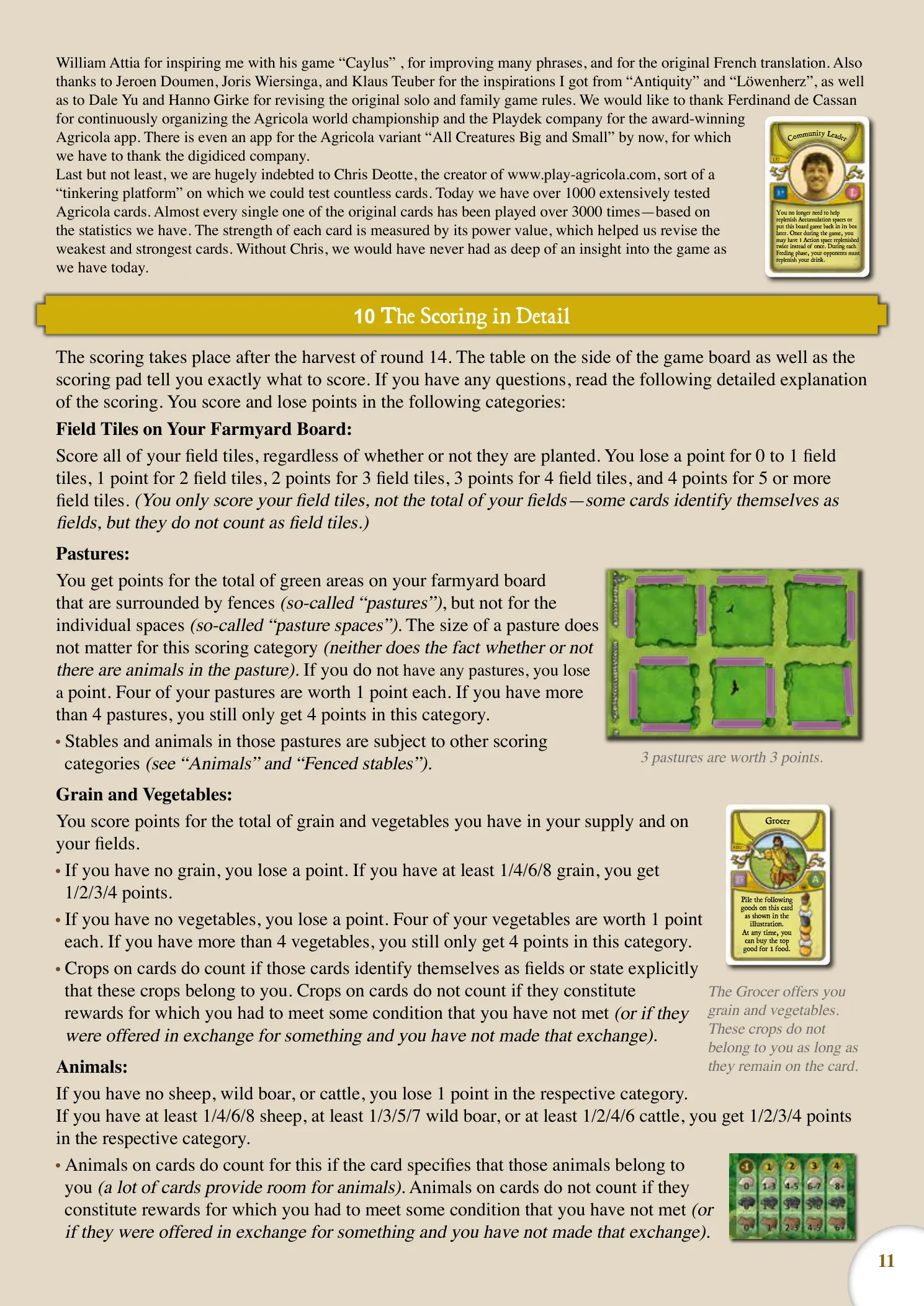
How are fields and pastures scored?
Fields 0–1/2/3/4/5+ score −1/1/2/3/4. Pastures 0/1/2/3/4+ score −1/1/2/3/4.
A fallow field still counts. Count enclosed pastures, not pasture spaces.
One large four-space pasture scores one pasture point.
How are crops and animals scored?
Thresholds for 1/2/3/4 points: grain and sheep 1/4/6/8+, boar 1/3/5/7+, cattle 1/2/4/6+. Zero scores −1 in each category.
Vegetables 1/2/3/4+ score 1/2/3/4. Count crops in supply and remaining on fields.
One grain in supply plus three on fields totals four, scoring two points.
How do empty spaces, rooms and people score?
Each unused space is −1; each fenced stable +1; each clay room +1, stone room +2, and person +3.
Wood rooms score zero. An unfenced stable scores no stable point but uses its space. Add printed improvement and bonus points separately.
An unfenced stable saves one unused-space penalty but gains no fenced-stable point.
What changes in the solo game?
Use the two-player board; start with zero food. Adults need three food, newborns still one.
Forest adds two wood each round. Remove traveling minors after use.
Interactive positions here use multiplayer feeding; do not apply two-food adults to solo.
Can the first game omit hand cards?
Yes, the official introductory variant omits hand cards to focus on farming, workers and food.
Meeting Place accumulates one food per round; add Side Job: build one stable for one wood and/or bake bread.
The one-wood stable belongs to Side Job; it does not change the normal two-wood stable cost.
Which components are limited?
Each player is limited to five people, four stables and 15 fences; substitute markers for exhausted shared goods.
A depleted shared supply does not prevent gaining goods; individual cards remain unique copies.
A five-goods marker can represent wood when tokens run short.
What happens to sheep I cannot house?
With a suitable improvement you may cook them immediately; return any remaining animals you cannot legally accommodate to the general supply. You cannot leave them on the action space for later.
Take all animals from the accumulation space. Returned animals give no food without a conversion effect. You may rearrange animals but must obey capacities and species restrictions.
Taking three sheep with only an empty house-pet space and no pasture, stable or Fireplace leaves one housed sheep and two returned.
Can I skip A in “A and afterward B”?
No. Playing a minor after basic growth requires growth first. Building an improvement or fences after renovation requires renovation first.
The second part is normally optional, but cannot be taken alone. Do not confuse this with “and/or”, which permits the stated separate choices.
Without a spare room, you cannot take basic growth just to play a minor. Without renovation materials, you cannot take Farm Redevelopment just to fence.
How many fences do adjacent pastures share?
Each grid edge takes one fence; adjoining pastures share that fence without paying twice. The personal limit remains 15 fences.
Count enclosed regions. Built fences cannot be demolished, but extra fences may subdivide a pasture. Each pasture houses one species.
Two adjacent single-space pastures need 4+4−1=7 fences, not eight. One two-space pasture needs six fences but counts as only one pasture.
Does taking a seed automatically sow it?
No. Grain Seeds and Vegetable Seeds add crops to your supply. You still need an empty field and a Sow action.
Plowing gives no seed either. Sowing moves a stored crop to a field and completes its stack, rather than adding edible crops to supply.
If your last person takes one grain in round four and you do not sow it, the harvest leaves that one grain in supply with no field yield.
After roomless growth, does one new room allow ordinary growth?
Ordinary growth requires rooms for all existing people plus a spare room. New rooms first accommodate people who previously had no room.
Urgent Wish for Children does not waive the room requirement for later ordinary growth, and the five-person limit remains.
With two rooms and three people, a third room is not spare. You need four rooms before ordinary growth to four people.
Complete scoring example
Worked example: why does this farm score 28?
A hypothetical legal farm after round-14 harvest: three people, three clay rooms, four fields and two pastures. A four-space sheep pasture has one stable and three sheep; a two-space cattle pasture holds two cattle; an unfenced stable holds one boar; one space is unused. The two pastures use 12 fences, below the limit of 15.
| 1 | 2 | 3 | 4 | 5 |
|---|---|---|---|---|
| Clay room | Grain field: 2 | Veg field: 1 | Sheep A + stable | Sheep A |
| Clay room | Fallow field | Fallow field | Sheep A | Sheep A |
| Clay room | Stable: 1 boar | Unused | Cattle B | Cattle B |
| Category | Quantity / calculation | Points |
|---|---|---|
| Fields | 4 fields | 3 |
| Pastures | 2 enclosed regions | 2 |
| Grain | 4 stored + 2 planted = 6 | 3 |
| Vegetables | 1 stored + 1 planted = 2 | 2 |
| Sheep | 3 | 1 |
| Boar | 1 | 1 |
| Cattle | 2 | 2 |
| Unused spaces | 1 × −1 | -1 |
| Clay rooms | 3 × 1 | 3 |
| People | 3 × 3 | 9 |
| Fenced stables | 1; unfenced stable adds no stable point | 1 |
| Card points | Fireplace 1 + Well 4; no bonus points | 5 |
| Begging | 1 × −3 | -3 |
| Total | 28 |
Leftover two wood, one clay and food give no direct points. This example has no resource-bonus card, so bonus points are zero; add any actual occupation or improvement bonuses separately. This grid is a WANGO teaching diagram, not a printed publisher board.
Edition and sources
2016 Revised Edition base game; 2–4-player rules, with solo differences separately explained.
Fixed public teaching positions, not unrestricted play. Occupations and minors are explained by category, prerequisites and official examples; this guide does not implement all 96 hand-card effects.
Compiled and taught by WANGO. Rules checked: 2026-11-05. Strategy advice is WANGO analysis.
Official rulebook · Official appendix · Lookout Games