Agricola (Revised Edition)
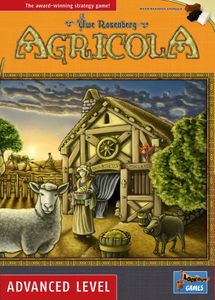
Assign your family across fourteen farming rounds, balancing expansion, crops, livestock, and food for each harvest.
Agricola (Revised Edition) supports 1–4 players; community best: 3–4 players; playing time: 30–120 minutes. A WANGO browser trial has not been confirmed.
Background & introduction
Agricola Revised Edition takes players to seventeenth-century Central Europe. Each household begins with two people and two wooden rooms, then develops fields, livestock, and a better home.
Each public action space normally admits only one person per round. A larger family provides more actions in later rounds but also needs more food, so every development competes with immediate opportunities.
Harvests bring crops, family feeding, and animal breeding in that order. Final scoring rewards a developed farm through fields, pastures, people, rooms, and improvements, while unused land costs points.
Core rules & scoring
Set up your farm: use the board appropriate to the player count. Each player starts with two people, two wooden rooms, seven occupations, and seven minor improvements; filter occupations by player count. The starting player receives two food and everyone else three.
Work for fourteen rounds: reveal a new action card and replenish accumulation spaces each round. Starting with the starting player, place one person at a time clockwise on an empty space and immediately take at least one offered action. Take all goods from an accumulation space; everyone returns home after placement finishes.
Build and grow: new rooms must connect to the house and cost five of its current building material plus two reed each. Ordinary family growth requires spare room; newborns act starting next round. A later action allows growth without room, up to five people. Renovate the entire house from wood to clay, then stone.
Plow and sow: place the first field on an empty space and later fields adjacent to existing fields. Sow one grain and add two grain, or sow one vegetable and add one vegetable, per empty field. One action can sow several fields; planted crops remain inaccessible until harvested.
House livestock: each fully fenced pasture holds one animal type, initially two animals per space. Each stable inside doubles that pasture’s capacity. An unfenced stable holds one animal and the whole house can keep one pet; animals without accommodation must be legally cooked or discarded.
Harvest six times: after rounds 4, 7, 9, 11, 13, and 14, take one crop from each planted field, feed the family, then breed animals. In multiplayer, each adult needs two food and a newborn from this round one. Take a permanent begging marker worth minus three points for each missing food.
Use cards and breed: play occupations and improvements through suitable actions, paying their costs; cards in hand do nothing. Cooking animals needs a suitable improvement, and baking grain also needs a Bake Bread action. During breeding, at least two animals of a type produce exactly one offspring if it fits; neither parents nor newborns may be cooked during that phase.
Score after the final harvest: use the scoring table for fields, pastures, crops, animals, rooms, people, improvements, and bonuses. Each unused space loses one point, missing categories can also lose points, and food itself scores nothing. Highest score wins; ties favor more building resources remaining in personal supply, then share the rank.
Rules & gameplay questions
Must I feed my family every round?
No. Feed only during the harvests after rounds 4, 7, 9, 11, 13, and 14. Field harvesting comes first, feeding second, and breeding last, so newborn animals from that harvest cannot pay for the feeding that already happened.
Does owning a cooking improvement let me bake grain whenever I want?
No. Grain or vegetables in your supply can always become one food each, but an improvement’s baking rate requires a Bake Bread action. Fireplaces and Cooking Hearths can process animals and vegetables at their printed rates at any time, except for parents and newborn animals during breeding.
Do four sheep produce two lambs in one harvest?
No. At least two animals of a type produce only one offspring if there is legal accommodation; the parents need not occupy the same pasture. You cannot cook parents or offspring during breeding to create space.
Does the starting player rotate automatically?
No. Use Meeting Place to take the starting player token. If nobody uses it, its current holder keeps it.
What changes in a solo game?
Use the two-player board but start with zero food; adults require three food per harvest, while newborns still require one. Forest accumulates only two wood per round. Remove traveling minor improvements after playing them rather than passing them to yourself. This covers a single game, not the appendix campaign.
Rules & introduction sources
- Edition
- 2016 Agricola Revised Edition core game for 1–4 players. The summary uses the standard 2–4-player game with hand cards; the FAQ explains solo differences. Excludes original-edition five-player rules, the 5–6-player expansion, Farmers of the Moor, extra decks, the no-hand-cards variant, and solo campaigns. Explicit card effects can override general rules.
- Rule references
- Introduction source
- BoardGameGeek
WANGO editorial
| Parameter | Recorded value |
|---|---|
| BGG overall rank (snapshot) | #87 |
| Complexity Weight | 3.45 / 5 |
| Best player count (community) | 3–4 |
| Player range | 1–4 |
| Playing time (minutes) | 30–120 |
| Core mechanisms | Enclosure · Hand Management · Worker Placement · Advantage Token · Automatic Resource Growth · Closed Drafting · Increase Value of Unchosen Resources · Solo / Solitaire Game · Team-Based Game · Turn Order: Claim Action · Variable Player Powers |
| Chinese publication | Unconfirmed |
| WANGO browser play | No confirmed WANGO trial |
| Year published | 2016 |
| Suggested age | 12+ |
BGG statistics are stored snapshots, not live rankings. Source checked:2026-09-27
Player questions
What is the best player count for Agricola (Revised Edition), and can I play online?
Agricola (Revised Edition) supports 1–4 players; community best: 3–4 players; playing time: 30–120 minutes. A WANGO browser trial has not been confirmed. Recorded mechanism tags: Solo / Solitaire Game, Team-Based Game.
How complex is Agricola (Revised Edition), and which mechanisms does it use?
Weight: 3.45 / 5. Mechanisms: Enclosure · Hand Management · Worker Placement · Advantage Token · Automatic Resource Growth · Closed Drafting · Increase Value of Unchosen Resources · Solo / Solitaire Game · Team-Based Game · Turn Order: Claim Action · Variable Player Powers. Chinese publication: Unconfirmed.
Where can I learn Agricola (Revised Edition)?
No rule guide, strategy article or WANGO trial has been confirmed for this record.