Hello everyone in the community, I'm KK.
The other day, I read chengcheng's designer story on Alexander Pfister, and its exploration of "why the same road feels different each time" was deeply evocative. Alexander Pfister integrated the philosophy of economic cycles and trail growth into the rules, turning Great Western Trail (GWT) into a monumental milestone of modern heavy Euro design.
Combined with Honghong's earlier breakdown of the cattle calculus and linlin's comprehensive strategic guide, the game's mechanical framework and macro archetypes have already been thoroughly analyzed.
But in actual high-rank ladder and offline tournament matches, countless confident advanced players often fall into an extremely frustrating "chronic death trap":
Many novice players treat this game as a romantic Western road movie, stopping and going along the way, wanting to step into every neutral building for a bit of profit. They slowly buy a few cheap mixed cattle, cobble together two small houses, and even take detours into the valley to pick up Indian tents.
As a result, a game drags on for more than two hours, and they have just barely driven their herd to Kansas City to make 3 deliveries;
while the ladder veteran sitting across from them completely ignores the conventional playbook! They cruise along at the highest gear, cross most of the map in two or three steps, and make 7-8 deliveries in a single game!
What's even more despairing is that at key chokepoints on the map, the opponent has long since planted high-tier private buildings marked with black hand symbols. Every time you pass, you are forcibly stripped of $2 in bridge toll; when your pockets are cleaner than your face and you grit your teeth and are forced into Kansas City, because your hand is clogged with a bunch of same-color duplicate inferior cattle, the delivery value is extremely low, and you can't even reach Albuquerque, the closest city to you, so you are forced to place your disc in the Kansas City slums that deduct 6 points!
Today KK is going to tear off the warm veil of slow, self-isolating operation in the [Tactical Breakdown] column and fully reveal the practical hole cards of high-rank ladder play in "Great Western Trail":
On the surface, "Great Western Trail" is a leisurely cattle-driving journey, but at its core it is an extremely brutal "deck turnover rate bombardment and board route-rights blockade war"!
Today we will comprehensively break down the four major practical formulas and board-control laws that the top 1% national players on the ladder must master.
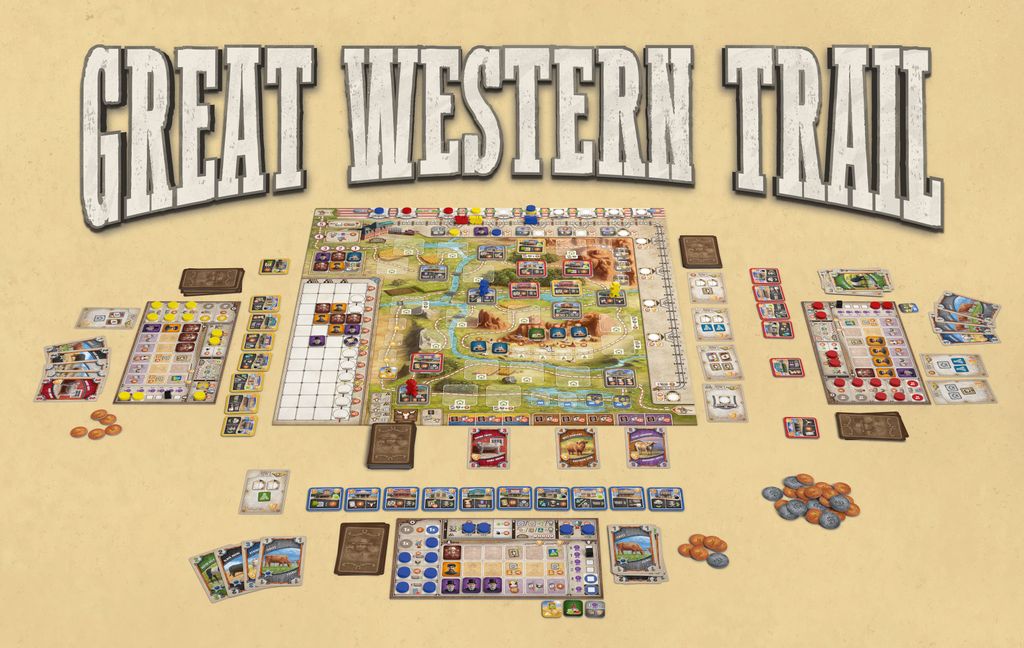
1. The Kansas Clock and the "Full-Circle Tempo Compression Formula"
The first fatal mistake novice GWT players most often make is treating actions as "isolated single-point gains," suffering from severe [Tourist Syndrome].
In their eyes, walking 1 step and getting $1 is profit, and walking 2 steps to build a small house is also profit. But in the game theory of high-tier players, the real invisible resource of the whole game is not gold coins, but [Tempo]!
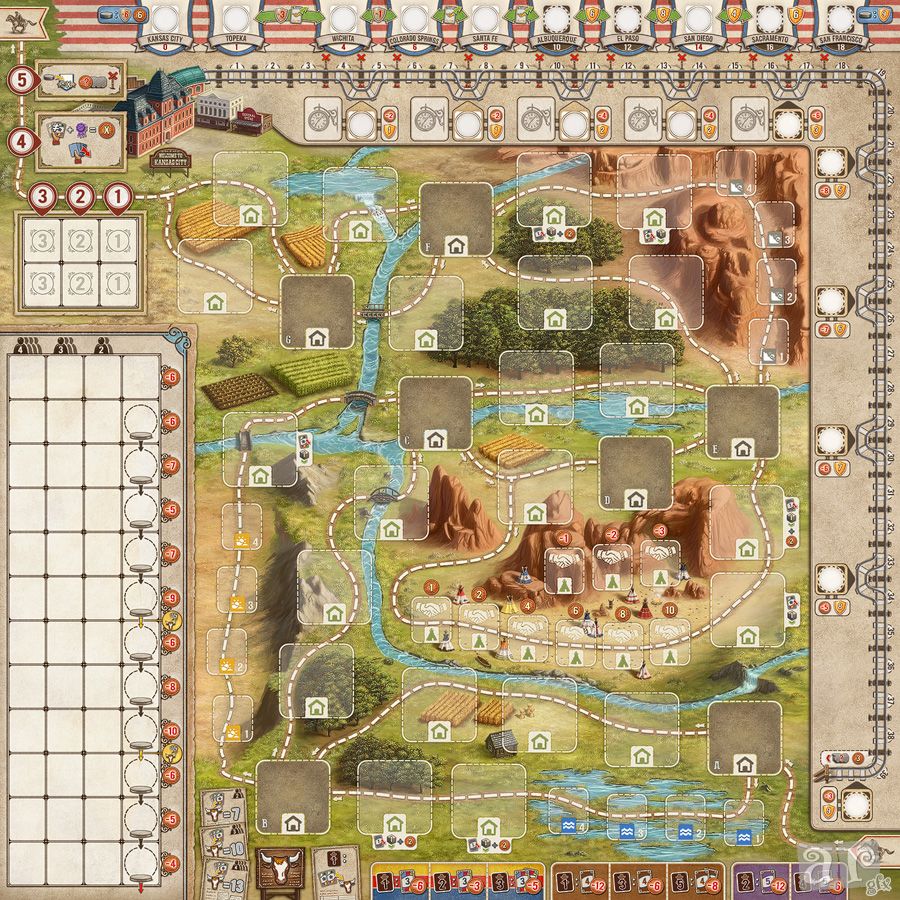
We must clarify the core time law of the ladder—the [Kansas Clock Mechanism]: Every time a player reaches Kansas City and completes a delivery, the system forcibly flips new tiles from the worker/disaster/cattle market supply strip and advances the labor employment strip. When the employment marker slides off the end, the endgame whistle is immediately triggered for the whole table!
This means: the fastest runner always holds absolute initiative over pulling the whole table's death trigger!
From this derives the high-tier player's [Full-Circle Tempo Compression Formula]:
Average number of stops per lap N_stops ≤ 3-4 stops
A ladder expert's single-lap route is extremely streamlined: First stop: hire workers/buy cattle (inject water into the deck and engine); Second stop: perform hand filtering/auxiliary actions (targetedly discard duplicate mixed cattle, precisely grab high-star cattle); Third stop: head straight for the gates of Kansas City!
Ordinary players stop at 7-8 stations per lap and can only run 4 trips in the whole game; while experts stop only 3-4 stations per lap and steadily make 7-8 deliveries over the whole game!
Running fast brings you three absolutely overwhelming advantages: 1. Endgame harvest window compression: before slow players' heavy-industry engines and large buildings have time to generate compound interest, directly detonate the endgame and suffocate the opponent's large number of unfinished objective cards in their hand for penalties; 2. Early withdrawal of city disc dividends: the best high-score cities (such as San Francisco 20 points, San Diego 18 points, El Paso 16 points) and the most important auxiliary action unlock slots (such as raising hand limit from 4 cards to 5 cards, unlocking movement from 3 steps to 4-5 steps) are removed early by fast-attack players; 3. Station master multiplier blockade: the player whose train is farthest ahead not only can occupy stations first and grab high-value endgame multiplier tiles, but also never has to pay the huge reverse penalty at Kansas delivery caused by "the train being behind the delivery city"!
2. Deck Purity and the "Cattle Deduplication Turnover Calculus"
Many friends who have just encountered the DBG (deck-building) mechanism treat buying cattle as "collecting the entire encyclopedia." When they see all kinds of colorful cattle refreshed in the cattle market, they can't resist spending money to buy them, and as a result the deck swells to more than 20 cards, and by the endgame they are still holding a hand of garbage cards.
We must understand the harsh scoring law of Kansas City: [Delivery value = the total value of all cattle of "mutually different breeds" in hand + Certificates points]!
If you are holding three green cattle (Dutch Belt) worth 2 each, they can only contribute a mere 2 points of value at delivery, and the other two are equivalent to pure waste paper!
From this we derive the ladder's [Hand Purity Expectation Formula]:
Expected delivery value E[Value] = Σ [ Distinct(Cattle_in_hand) ] + Certificates
Quantitative mathematical model: The initial deck has a total of 14 cattle (including 5 gray Jersey cattle worth 1, and 3 each of green, white, and red cattle worth 2). Under the base hand limit of 4 cards, the probability of drawing at least 2 duplicate cattle (causing individual cards to become waste paper) is as high as 68.4%! If you completely trash the 5 gray Jersey cattle worth 1 and unlock the hand limit to 5 cards: the probability of drawing 4 or more different purebred cattle instantly jumps to 89.2%!
To achieve this qualitative change, you must master the [Three Great Cattle Purification Patterns]:
1. The "Targeted Shattering Technique" for initial blank mixed cattle The high-tier player's primary strategic task is to use auxiliary actions on the board (such as discard 1 green cattle for $2, discard 1 white cattle to draw 1 card) and the "Trash a card on delivery" slots unlocked at delivery to completely uproot all 5 useless 1-value Jersey cattle from the deck within the first 3 laps! As long as the total deck size is compressed to around 10-12 cards, every time you reshuffle, your probability of drawing high-star cattle will approach 100%.
2. "Precision Sniping" of 4-star and 5-star divine cattle The core value of the Cowboy profession is absolutely not just discounts, but [crossing star thresholds]: as long as you recruit the 2nd and 3rd cowboys, you can directly grab 3-value and 4-value purebred cattle (such as Brown Swiss, West Highland, Texas Longhorn) into your deck at extremely low prices. Even if you only buy 3 high-tier cattle over the whole game, as long as the initial mixed cattle are cleaned out, combined with a hand limit of 5 or even 6 cards, you can steadily play 4-5 mutually non-repeating excellent breeds every time you enter the city, directly and steadily blasting out an ultra-high delivery value of 16+!
3. "Spring Charging and Overload Release" of the certificate track Certificates are the ultimate lever for crossing city thresholds. Never casually spend precious certificates in normal times just to deliver to an irrelevant 8-point or 10-point city! The true ladder killer always, after maxing the certificate track to the upper limit (4 points or 6 points), on the turn when they have drawn a 14-point herd in hand, releases it all at once, directly leaping from 14 to blast San Francisco's 20 points! With one strike, slam down the black core large disc, unlock permanent global movement, and at the same time steadily pocket the highest single-delivery score on the table.
3. Board Chokepoint Geopolitics: "Black Hand Toll Stations" and Forced Rerouting Traps
If you think GWT is just about calculating hands on your own little board, then you are greatly underestimating the malice Pfister injected into the central board.
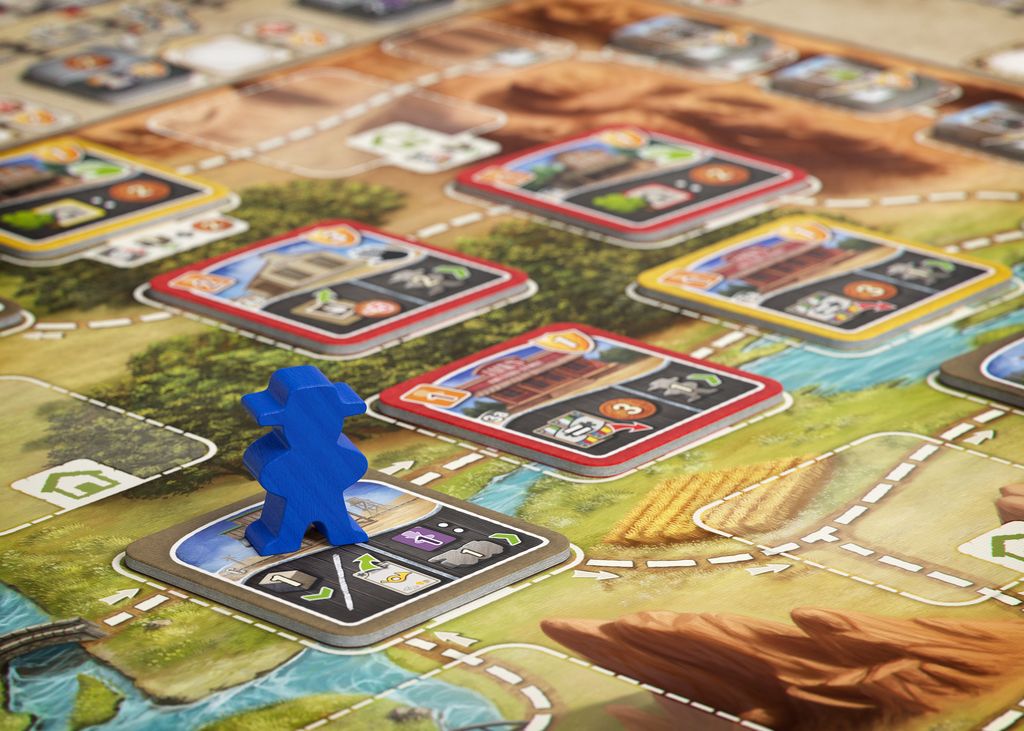
The entire Kansas board is composed of a complex one-way fork network, with several [geographic chokepoints] that all players on the table cannot avoid (for example, the mandatory main road right in front of the Kansas City gates, or the one-way single-log bridge where mountains and rivers meet).
On these core routes are distributed the most deadly geopolitical games—[Black Hand/Green Hand toll buildings]:
1. Green Hand guards against gentlemen, Black Hand cuts off livelihoods The rules clearly state: when an opponent passes a private building with hand symbols, for each hand symbol, they must forcibly pay a toll! Green Hand buildings pay $1 to the bank; although it doesn't enrich yourself, it effectively consumes the opponent's cash reserves; while Black Hand buildings directly require the passing opponent to [pay cash in full to the building owner] ($2 per black hand)!
2. Toll Station Payback Period and Chokepoint Windfall Profits In a 4-player game, building a No. 4 or No. 8 high-tier building with a black hand costs only 2-4 craftsmen plus $4-$8 cash; once you plant it on the one-way chokepoint section leading straight to Kansas City: 3 opponents pass each lap, directly paying you $6 cash back per lap! It takes only 1-1.5 laps for the entire construction cost of this building to be fully recouped, and afterward every round it continuously drains blood from all opponents on the table, while also completing 1 important personal board disc unlock!
3. The "Ticket Deadlock Lock" in Front of the Kansas City Gates The most classic killing move of craftsman-flow or hybrid-flow experts is to be the first to place two Black Hand buildings on the two mandatory forks of the entry passage into Kansas City. This creates an extremely desperate "ticket deadlock": the opponent has gone through untold hardships to drive cattle to the city gates, and is already short of money; at this point, whether they go left or right, they must first pay you an expensive toll of $2-$4! If the opponent cannot produce the money, they must perform emergency discards or sell livestock; by the time they step into Kansas City, they may not even have enough in their pocket to pay the basic city cost of placing a disc, and immediately fall into economic shock!
4. Borrowing the Knife to Kill with Hazard Tiles Falling rocks, floods, and droughts on the map superficially look like negative obstacles (each one passed requires an extra 1 movement point, or payment of a toll). But high-tier players will, according to their own route, deliberately use craftsmen to leave hazard tiles on the golden main road the opponent most wants to take, directly stretching the opponent's route that originally could enter the city in 3 steps into a muddy swamp requiring 2 full turns!
4. The "Speed Matching Negative Feedback Model" of Railways and Delivery Cities
Many pure cowboy-flow novices sprint wildly in the first half of the game, but in the second half they become poorer and poorer, and their final total score is a mess. The root cause lies in [the disconnect between train station advancement speed and delivery cities]:
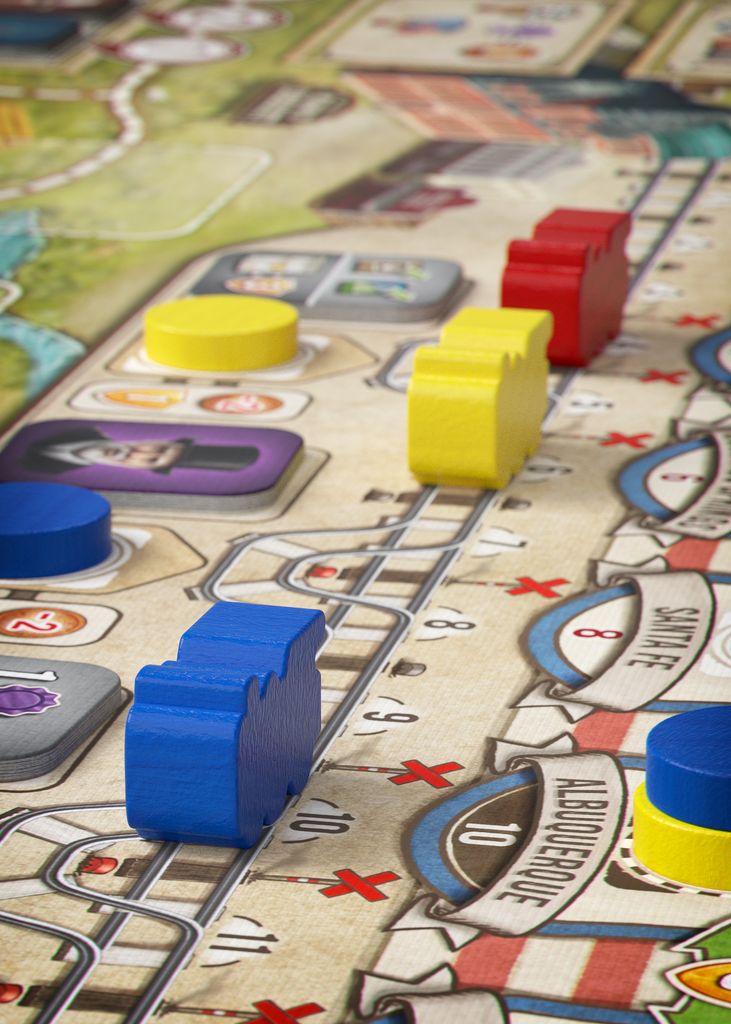
The rules strictly stipulate: when delivering in Kansas, if the target city's position on the railway line is ahead of your train, for each station with a red cross mark in between, you must pay a $1 penalty to the bank! If cash is insufficient, your train will be forced to move backward, and you may even suffer a huge point penalty!
From this derives the high-tier player's [Dynamic Train-Delivery Matching Model]:
Train station advancement speed V_train ≥ delivery target city advancement speed V_city
1. The engineer's true marginal value: Recruiting 1–2 Engineers is by no means a dispensable support role—it is to protect your delivery net profit! For every 2 train steps advanced, you not only save a potential $2 penalty, but also enable yourself to claim intermediate stations along the way and upgrade station masters, seizing the crucial [Station Master Tiles]; Station Master Tiles not only provide 2–3 VP themselves, but also come with powerful end-game multipliers (for example, +3 points per pair of workers, +3 points per pair of black-and-white discs), which is often the decisive factor that opens a 15–20 point gap in the endgame.
2. The strategic sacrifice of the Kansas City penalty disc: If in the first round, due to poor hand cards or tight cash flow, your hand value is only a mere 4–5 points and you cannot reach any high-quality city: An expert will never grit their teeth and deliver to an awkward 6-point Topeka; They will decisively place the disc directly on [Kansas City's own -6 VP space]! Although 6 points are deducted, you immediately take $6 in starting cash on the spot and instantly unlock the double auxiliary action slots on the left. Use this life-saving funds to immediately recruit core cowboys and craftsmen in round 2, quickly complete engine ignition, and earn 10 more points per round over the following 6 rounds—this is the great wisdom of 'sacrificing the pawn to save the rook' of top ladder players!
V. Conclusion: Pull the stopwatch in the wasteland storm
Just as chengcheng summarized in the main creator story, the circular road designed by Alexander Pfister is never just meant to let you revisit old places. Every time you set foot again on this long dirt road to Kansas, what you face is a more crowded board, more dangerous toll gates, and a more urgent endgame stopwatch.
A true Western cowboy never relies on brute force to run wild across the wasteland; They use the coldest calculation to prune their deck, and use the most precise geometric vision to drive nails into the throat of the board; Then, at the moment when all opponents have not yet woken from their dreams, they sound the endgame whistle of the train entering the station.
Hello cowboys of the community, in your actual battles in 《Great Western Trail》, do you prefer the pure cowboy buy-cows-and-run-laps style, the pure engineer push-the-train style, or the craftsman seal-the-toll-gate style? At the life-or-death moment of delivering in Kansas City, what kind of limit-breaking '20-point San Francisco game-winner' have you pulled off?
Welcome to leave your cattle-driving review logs in the comments section, see you next time!
#GreatWesternTrail# #TacticalBreakdown# #HeavyEuroStrategy# #DeckBuilding# #CompetitiveAdvanced# #CalculationGame#