Carcassonne
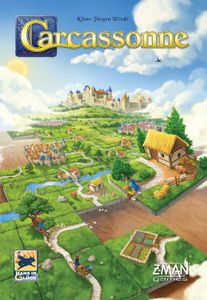
Draw and place tiles depicting southern France, then send followers to claim cities, roads, monasteries and fields as the shared landscape grows.
Carcassonne supports 2–5 players; community best: 2 players; playing time: 30–45 minutes. A WANGO browser trial is available.
Background & introduction
Carcassonne takes its setting from the fortified city in southern France and uses tile placement and control of connected features. Starting with no preprinted board, players build a medieval landscape of winding roads, walled cities, monasteries and fields around the starting tile. The base landscape uses 72 tiles and the familiar wooden meeple in five colours.
Each turn begins by drawing one tile and placing it so every touching edge matches: roads continue roads, cities continue cities and fields continue fields. You may then place one available follower on the new tile: a traveler on a road, a knight in a city, a monk in a monastery or, when fields are included, a farmer lying down in a field. Completed roads, enclosed cities and monasteries surrounded by eight tiles score immediately, returning their followers for later use.
Farmers remain in their fields until the end of the game and score for completed cities touching those fields, making them an important long-term commitment. Later tile placements can merge separately occupied features and create competition or tied majorities. When all land tiles have been used, final scoring adds unfinished features and, if included, farmers; the highest total wins.
Core rules & scoring
Use the 72 base land tiles without the River. Each player has eight meeple of one colour: one on the scoreboard and seven in their supply. Place the starting tile centrally and shuffle the rest facedown. Leave abbots out.
Take clockwise turns: draw and place one tile, optionally place one meeple, then score features completed by this placement. A tile must share an edge with the existing landscape, and every touching road, city and field edge must match.
You must place the drawn tile legally. If no legal position exists anywhere, return it to the box and draw another. Touching only at a corner does not connect a tile to the landscape.
Place at most one supply meeple on the tile just placed, choosing a road, city or monastery. You cannot place directly into a connected road or city occupied by any player’s meeple. You cannot retrieve an old meeple first to place it on the new tile.
A road completes when both ends are closed by features or it forms a loop. It scores one per road tile. Eligible followers on that road determine who scores, regardless of whose placement completed it.
A city completes when walls fully enclose it with no internal gaps. Score two per city tile and two per shield. A monastery completes with eight surrounding tiles and scores nine including its own tile.
Score every feature completed by the turn’s tile placement, then return all meeple from those features to their owners. An occupied feature can still be extended, and having no supply meeple does not prevent drawing and placing tiles.
Later tiles can merge separately occupied features. The player with the most meeple scores the full feature value; players tied for the most each receive the full value rather than splitting it.
Introductory play may omit fields. When included, lay a farmer on an unoccupied connected field on the new tile. Roads, cities and other dividers separate fields. Farmers remain until final scoring; each field scores three per completed city touching it, using farmer majority or tied majority.
The game ends when tiles run out and the next player cannot draw and place one. Unfinished roads score one per tile; unfinished cities one per tile and shield; unfinished monasteries one plus surrounding tiles. Add field scoring if included. The highest total wins, with tied players sharing victory.
Rules & gameplay questions
Can I place a meeple whenever the new tile itself is empty?
Not necessarily. Check the entire connected feature, including both your own and other players’ meeple. Direct placement into an occupied feature is forbidden; later connecting separately occupied features is legal.
Do equally represented players split a merged feature’s points?
No. Only the largest representation scores, and every player tied for the largest receives the full feature value.
Can I place on an empty feature completed this turn and score immediately?
Yes: place the tile, optionally place a legal meeple, then score and retrieve it. You cannot retrieve a meeple from a completed feature before this turn’s placement step to make it available for placement.
Do fields score per tile, or return farmers whenever a city completes?
Neither. Farmers stay until the end. Each field scores three per distinct completed city touching it; incomplete cities do not count, and field tile count gives no direct points.
Must a first game include Farmers, the River and the Abbot?
No. The main rules teach roads, cities and monasteries first and recommend adding farmers after two or three games. This entry separately explains fields for later play, while excluding the River and the Abbot throughout.
Rules & introduction sources
- Edition
- Official Carcassonne v3 English main rules (copyright 2023), pages 1–6, and Farmers on supplemental page 1. Uses 72 base land tiles and seven available meeple plus one scoring meeple. Distinguishes introductory play without fields from play with farmers. Excludes River/Abbot on supplemental page 2, other expansions, older farmer scoring and WANGO implementation. Chinese description and three introductory paragraphs are preserved verbatim as requested; the detailed rules and scope identify the edition.
- Rule references
- Introduction source
- BoardGameGeek
WANGO editorial
| Parameter | Recorded value |
|---|---|
| BGG overall rank (snapshot) | #241 |
| Complexity Weight | 1.88 / 5 |
| Best player count (community) | 2 |
| Player range | 2–5 |
| Playing time (minutes) | 30–45 |
| Core mechanisms | Area Majority / Influence · Enclosure · Kill Steal · Map Addition · Pattern Building · Square Grid · Tile Placement |
| Chinese publication | Unconfirmed |
| WANGO browser play | Available · browser trial |
| Year published | 2000 |
| Suggested age | 7+ |
BGG statistics are stored snapshots, not live rankings. Source checked:2026-09-26
Player questions
What is the best player count for Carcassonne, and can I play online?
Carcassonne supports 2–5 players; community best: 2 players; playing time: 30–45 minutes. A WANGO browser trial is available.
How complex is Carcassonne, and which mechanisms does it use?
Weight: 1.88 / 5. Mechanisms: Area Majority / Influence · Enclosure · Kill Steal · Map Addition · Pattern Building · Square Grid · Tile Placement. Chinese publication: Unconfirmed.
Where can I learn Carcassonne?
Available resources: Rule guide https://wangogame.com/wiki/games/carcassonne?tab=howto;Strategy https://wangogame.com/wiki/analysis/carcassonne;Play online https://play.wangogame.com/carcassonne/