Dune: Imperium – Uprising
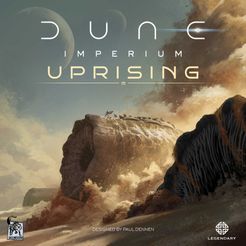
Combine deck-building and worker placement in a struggle for power on Arrakis, with Spies, sandworms, and an optional contract module.
Dune: Imperium – Uprising supports 1–6 players; community best: 4 players; playing time: 60–120 minutes. A WANGO browser trial has not been confirmed.
Background & introduction
Uprising returns to the power struggle on Arrakis as a standalone base game combining deck-building and worker placement. Political relationships, economic preparation, and military commitments shape the contest, while acquired cards determine which opportunities your Agents can pursue.
This game introduces Spies, the possibility of sending sandworms into battle, and contracts in the optional CHOAM Module. These provide new ways to prepare actions, gather resources, and influence Conflicts. Planning requires watching both the board and what your opponents appear to be preparing.
Alongside standard competitive play, Uprising includes a six-player team mode and supports Rise of Ix, Immortality, and many cards from the original Dune: Imperium. It is a standalone base game and does not require the earlier game.
Core rules & scoring
Setup and round structure: Each player begins with the same 10-card starting deck and two Agents. Each round has five phases: Round Start, Player Turns, Combat, Makers, and Recall. Reveal a Conflict card and draw five cards each at Round Start. In clockwise order, players choose Agent or Reveal turns. After revealing, you take no more turns in this phase; Combat begins once everyone has revealed.
Cards and acquisitions: On an Agent turn, play one card and send one Agent to a space with a matching icon. Pay its costs and meet its requirements before resolving the space and the card’s Agent box. On a Reveal turn, resolve only the Reveal boxes of your remaining hand for Persuasion, swords, and other effects. Acquired cards enter your discard pile, unused Persuasion is lost, and cleanup discards the cards you played and revealed. If your deck cannot supply a draw, reshuffle your discard pile and continue drawing.
Influence and Alliances: A Faction space normally grants one Influence with that Faction. Reaching two grants one Victory Point, lost if you fall below two. Reaching four grants the track bonus; the first player to reach four takes the Alliance and an additional point. An opponent must move strictly higher than the holder to take the Alliance and its point; a tie is insufficient. Some spaces also require at least two Influence with the relevant Faction. A holder who loses Influence also loses the Alliance if they fall below a previously tied opponent or below four; transfer or return the token as directed by the official FAQ.
Spies: Place Spies on unoccupied observation posts. Recall your Spy from a connected post to Infiltrate a space occupied by an opponent’s Agent. Alternatively, after placing an Agent on a connected space but before resolving the space or card effects, recall a Spy to draw one card. The same Spy cannot pay for both Infiltrate and Gather Intelligence. A card’s Spy Agent icon can also grant access to a space connected to your Spy without recalling it.
Troops and sandworms: When sending an Agent to a Combat space, you may deploy units gained that turn, plus up to two units already in your garrison. Each troop in the Conflict provides two strength, each sandworm three, and each revealed sword one. Without a unit in the Conflict, your strength is zero. Check the summoning effect for requirements such as Maker Hooks. Sandworms enter the Conflict directly and cannot stay in a garrison. While the Shield Wall remains, sandworms cannot be summoned to Conflicts at Arrakeen, Spice Refinery, or Imperial Basin.
Combat and rewards: Participants take turns playing Combat Intrigue cards or passing; after all pass consecutively, award rewards by strength. Zero strength earns nothing. Players tied for first each take the second reward and nobody wins the Conflict; those tied for second each take the third; those tied for third receive nothing. Normally, the third reward is available only in four-player games, but a tie for second can still award it. Having at least one sandworm in the Conflict doubles your Conflict-card rewards, but not control or battle icons. A reward that requires payment must be paid for again to receive it a second time.
Battle icons and round cleanup: The Conflict winner takes its card. If its battle icon matches one on another face-up Conflict or Objective card in their supply, they must flip the matching pair face down and gain one Victory Point. After Combat, troops return to their owners’ supplies and sandworms to the bank. During Makers, unoccupied Maker spaces gain one bonus spice. During Recall, if play continues, Agents return to Leaders and the First Player marker passes clockwise.
Ending and scope: During Recall, enter the endgame if anyone has at least 10 points or the Conflict Deck is empty. Resolve Endgame Intrigue cards and match the wild battle icon as instructed. The highest final score wins; break ties by spice, then Solari, water, and garrisoned troops. Contracts belong to the optional CHOAM Module. Six-player teams, solo, and two-player games use separate supplements; their changes are not applied here. If all listed endgame tiebreakers remain tied, the final tiebreaker favors the player who most recently took a Reveal turn.
Rules & gameplay questions
Do I need the original game to play Uprising, and are contracts mandatory?
No. Uprising is a standalone base game. Contracts belong to the optional CHOAM Module, and the rules recommend playing at least once without it. Six-player games use separate team rules. Follow the compatibility adjustments when adding Rise of Ix, Immortality, or original-game cards, rather than mixing every component directly.
Can one Spy both Infiltrate and draw a card?
No. Recalling the same Spy can pay for only one use. Some spaces connect to two of your Spies, allowing you to recall one to Infiltrate and another to Gather Intelligence. Choose to draw immediately after placing the Agent, before resolving space or card effects. Using a Spy Agent icon to access a connected space does not itself recall the Spy.
Must the Shield Wall be destroyed before using sandworms, and do they double every reward?
It does not need to be destroyed for every Conflict: it protects only Arrakeen, Spice Refinery, and Imperial Basin. Still check the summoning effect for requirements such as Maker Hooks. At least one sandworm in the Conflict doubles the Conflict-card rewards you earn, including eligible second- or third-place rewards. It does not double control or battle icons, and rewards requiring payment are not repeated for free.
How do battle icons score after winning a Conflict?
After taking the Conflict card, check your face-up Conflict and Objective cards. If an icon matches, you must flip the pair face down and gain one point. Face-down cards cannot be matched again, and sandworms do not double this point. During the endgame, the wild icon can match one icon as instructed. Winning a Conflict does not automatically grant an extra point every time.
Rules & introduction sources
- Edition
- Dune: Imperium – Uprising (2023), using Dire Wolf’s official English main rules dated 2023-10-12. Covers the 3–4-player competitive base game without the optional CHOAM Module, while identifying that module’s boundary. Solo, two-player, and six-player team games use separate supplements. Does not combine components or special procedures from original Dune: Imperium or other expansions. Also incorporates relevant clarifications from the official FAQ dated 2025-01-13.
- Rule references
- Introduction source
- BoardGameGeek
WANGO editorial
| Parameter | Recorded value |
|---|---|
| BGG overall rank (snapshot) | #5 |
| Complexity Weight | 3.53 / 5 |
| Best player count (community) | 4 |
| Player range | 1–6 |
| Playing time (minutes) | 60–120 |
| Core mechanisms | Automatic Resource Growth · Card Play Conflict Resolution · Contracts · Deck, Bag, and Pool Building · Delayed Purchase · Force Commitment · Increase Value of Unchosen Resources · Multi-Use Cards · Open Drafting · Solo / Solitaire Game · Tags · Team-Based Game · Turn Order: Progressive · Variable Player Powers · Worker Placement |
| Chinese publication | Unconfirmed |
| WANGO browser play | No confirmed WANGO trial |
| Year published | 2023 |
| Suggested age | 13+ |
BGG statistics are stored snapshots, not live rankings. Source checked:2026-09-26
Player questions
What is the best player count for Dune: Imperium – Uprising, and can I play online?
Dune: Imperium – Uprising supports 1–6 players; community best: 4 players; playing time: 60–120 minutes. A WANGO browser trial has not been confirmed. Recorded mechanism tags: Solo / Solitaire Game, Team-Based Game.
How complex is Dune: Imperium – Uprising, and which mechanisms does it use?
Weight: 3.53 / 5. Mechanisms: Automatic Resource Growth · Card Play Conflict Resolution · Contracts · Deck, Bag, and Pool Building · Delayed Purchase · Force Commitment · Increase Value of Unchosen Resources · Multi-Use Cards · Open Drafting · Solo / Solitaire Game · Tags · Team-Based Game · Turn Order: Progressive · Variable Player Powers · Worker Placement. Chinese publication: Unconfirmed.
Where can I learn Dune: Imperium – Uprising?
Available resources: Rule guide https://wangogame.com/wiki/games/dune-imperium-uprising