A Feast for Odin
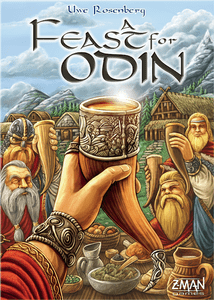
Assign Vikings to production, trade, hunting and voyages, then puzzle goods into your home and islands while balancing feasts with the race for the most valuable estate.
A Feast for Odin supports 1–4 players; community best: 3 players; playing time: 30–120 minutes. A WANGO browser trial has not been confirmed.
Background & introduction
A Feast for Odin combines Viking farming, production, trade and seafaring with worker placement and spatial planning. Players acquire goods of different colors and shapes to cover negative spaces on their home and exploration boards.
Actions requiring more Vikings often yield stronger rewards but consume a larger share of each round’s workforce. Upgrading and trading determine which tiles are available for the puzzle, with different adjacency restrictions for green and blue goods. Occupations suggest development paths, but must be played before their abilities apply.
Income, surrounded-symbol bonuses and the feast are three separate checks. Expanding to islands means weighing the remaining rounds and ability to cover their negative spaces. The final result compares the value of possessions after uncovered spaces and penalties are deducted.
Core rules & scoring
The long game lasts seven rounds and the short game six. In multiplayer, gain one Viking every round, including round one. During actions, take turns occupying one empty space with one to four Vikings as required by its column, then resolve it immediately. Passing ends your placements for that round; the last player to place becomes next round’s start player.
Place green and blue goods, silver and ore on home and exploration boards at any time, without overlap or overhang; placed pieces cannot be reclaimed. Green tiles cannot touch orthogonally, but may touch diagonally; blue tiles have no such restriction. Covering an income number also requires covering all spaces to its left, below it and in its bottom-left square.
Income pays silver based on each board’s smallest uncovered income number. The later Bonus phase awards uncovered goods symbols whose surrounding spaces are all filled. Each phase produces simultaneously across boards, so one board’s newly received income or bonus cannot increase another board’s production within that phase.
The feast fills Banquet Table spaces without Vikings using orange farm products, red animal products and silver only. Orange cannot touch orange, and red cannot touch red. Only one tile of each food type may lie horizontally; additional copies stand vertically, except square tiles. Each gap gives one permanent penalty worth minus three points. Served goods return to the supply.
Upgrades follow orange to red to green to blue while preserving shape and size. Upgrading two goods once does not upgrade one good twice. Overseas Trading requires a knarr and one silver to flip any number of different green goods in your supply, one of each type, to blue; tiles already placed on boards cannot be upgraded.
Buy ships for silver at any time or build them through actions. Exploration needs the indicated Vikings and ship type but keeps the ship. Emigration instead pays silver equal to the current round and turns a knarr or longship over onto the Banquet Table, reducing feast demand but ending its use as a ship.
Raiding and hunting actions normally allow up to three rolls, with each reroll replacing the previous result. Raids want high results; hunting and whaling want low results. Appropriate stone, wood or weapon cards modify the result and failures offer the stated consolation. A whaling result reduced to zero must succeed immediately, without another reroll or voluntary failure.
The game ends immediately after the final feast, with no final-round goods bonus. Score ships, emigrations, islands, buildings, livestock, played occupations, silver in supply and final income, then deduct uncovered negative spaces and penalty tiles. Silver already placed on boards scores no extra points; tied players share victory. Final-round income can be recorded directly as points instead of paying out that silver; do not count both.
Rules & gameplay questions
Can green tiles touch inside houses?
Yes. Home and exploration boards prohibit green tiles touching orthogonally, but stone and long houses allow it. Houses instead prohibit orange touching orange and red touching red. Ore is forbidden, and long-house pillars cannot be covered. Follow the placement key for each area.
Can newly received income or bonuses start a chain on another board?
All boards produce simultaneously within each phase. Newly produced pieces cannot increase another board’s production in that same phase. Once Income ends, its silver can be placed to prepare for the later Bonus phase.
Does exploring spend a ship?
No. Exploration requires the indicated ship but keeps it; a ship can support different actions in the same round. Emigration turns it onto the Banquet Table and ends its use as a ship, so the order of exploration and emigration matters.
Are surrounded-symbol bonuses paid in the final round?
No. The final round ends after the feast, before Bonus. Final income still contributes to scoring. Remaining legal tiles may be placed before scoring; silver in supply scores, whereas silver on boards has no additional value.
Is the action board completely cleared every solo round?
No. Solo play alternates two colors of Vikings. Last round’s Vikings remain to block this round’s spaces; at round end, recover the older set for the following round. Do not apply multiplayer’s complete worker retrieval to solo play. From round two onward, solo play gains two new Vikings per round rather than multiplayer’s one.
Rules & introduction sources
- Edition
- A Feast for Odin base game, covering six/seven rounds, solo alternating blockers and official appendix placement clarifications; excludes The Norwegians and mini expansions.
- Rule references
- Introduction source
- BoardGameGeek
WANGO editorial
| Parameter | Recorded value |
|---|---|
| BGG overall rank (snapshot) | #26 |
| Complexity Weight | 3.87 / 5 |
| Best player count (community) | 3 |
| Player range | 1–4 |
| Playing time (minutes) | 30–120 |
| Core mechanisms | Action Points · Automatic Resource Growth · Dice Rolling · Enclosure · Grid Coverage · Hand Management · Income · Layering · Pattern Recognition · Push Your Luck · Solo / Solitaire Game · Square Grid · Tile Placement · Turn Order: Pass Order · Worker Placement |
| Chinese publication | Unconfirmed |
| WANGO browser play | No confirmed WANGO trial |
| Year published | 2016 |
| Suggested age | 12+ |
BGG statistics are stored snapshots, not live rankings. Source checked:2026-09-27
Player questions
What is the best player count for A Feast for Odin, and can I play online?
A Feast for Odin supports 1–4 players; community best: 3 players; playing time: 30–120 minutes. A WANGO browser trial has not been confirmed. Recorded mechanism tags: Solo / Solitaire Game.
How complex is A Feast for Odin, and which mechanisms does it use?
Weight: 3.87 / 5. Mechanisms: Action Points · Automatic Resource Growth · Dice Rolling · Enclosure · Grid Coverage · Hand Management · Income · Layering · Pattern Recognition · Push Your Luck · Solo / Solitaire Game · Square Grid · Tile Placement · Turn Order: Pass Order · Worker Placement. Chinese publication: Unconfirmed.
Where can I learn A Feast for Odin?
Available resources: Rule guide https://wangogame.com/wiki/games/a-feast-for-odin?tab=howto