Terraforming Mars
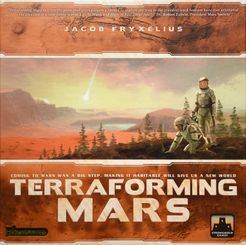
Lead a corporation developing Mars, building an economy and competing to make the planet habitable.
Terraforming Mars supports 1–5 players; community best: 3 players; playing time: 120 minutes. A WANGO browser trial has not been confirmed.
Background & introduction
Competing corporations work together to make Mars habitable. Raising the temperature, placing oceans and increasing oxygen advance global terraforming, while each corporation builds its own economy and seeks more efficient ways to score than its rivals.
Project cards must first be bought, then played by paying their costs. Some increase production, some provide immediate benefits, and others require particular conditions on Mars. Standard projects offer alternatives when your hand lacks a suitable opportunity, while cities and greeneries turn the shared map into a contest over position.
Each round represents a generation, with research, actions and production in sequence. Corporations manage money, building materials, plants, energy and heat while competing for milestones and awards. Once all three global parameters are complete, the game ends after that generation. Terraforming contributions, project effects and other points determine the winner.
Core rules & scoring
This guide uses the standard 2–5-player game: remove Corporate Era cards, start at 20 TR and one production in each of the six resources, then apply corporation adjustments. Each generation has Player Order, Research, Action and Production phases. Skip Player Order and Research in the first generation.
During the Action phase, take one or two actions on your turn, then pass play clockwise; you may act again on later turns. Taking no actions means passing for the generation, after which you cannot act again. Each red-arrow action on a corporation or blue card is available at most once per generation; ongoing effects without a red arrow follow their triggers.
During Research, draw four cards, pay 3 M€ for each you keep and discard the rest face down. There is no hand limit. Playing a card separately requires meeting its conditions and paying its printed cost. Steel pays only for building-tag projects, normally at 2 M€ each; titanium pays only for space-tag projects, at 3 M€ each. Overpayment gives no change.
Production occurs simultaneously only after everyone has passed. First convert all old energy into heat, then gain M€ equal to TR plus money production and gain the resources shown by your other production tracks. Newly produced energy stays in the energy box. Finally remove used-action markers. You cannot collect the generation's production early during the Action phase.
Raising oxygen or temperature while below its maximum, or placing an ocean, normally increases TR accordingly. Basic conversions spend eight plants for one greenery or eight heat for one temperature step. A greenery raises oxygen, but provides no TR from oxygen once that parameter is complete. Standard projects remain available and can be used repeatedly in a generation, subject to their costs and placement restrictions.
Oceans go only on reserved spaces and have no owner. Each adjacent ocean gives 2 M€ when a tile is later placed. Place greenery next to one of your own tiles whenever a legal adjacent space exists. Cities normally cannot be adjacent to other cities, with exceptions specified by cards. At game end, each of your greeneries scores one point; each city scores one point per adjacent greenery, regardless of its owner.
Claim a milestone by meeting its condition and paying 8 M€. Each can be claimed once, at most three in total, and each scores five points. Funding awards costs 8, then 14, then 20 M€, with at most three funded; funding one does not guarantee winning it. At game end, first place scores five and second two, except that second scores nothing in a two-player game. Tied first places each score five and eliminate second place; tied second places each score two.
Once temperature reaches +8°C, oxygen 14% and all nine oceans are placed, finish the current generation. Continue actions until everyone passes, perform normal production, then allow final plant-to-greenery conversions in player order. Add TR, awards, milestones, tile points and points on played cards. Highest total wins, with remaining M€ breaking ties.
Rules & gameplay questions
Do cards take effect as soon as I buy them during Research?
No. Draw four cards during Research, pay 3 M€ for each you keep and discard the others face down. Playing a card later requires meeting its conditions and paying its cost separately. There is no hand limit. Initial card selection occurs during setup, so the first generation skips Player Order and Research.
Does taking just one action mean passing for the generation?
No. Take one or two actions, then hand play to the next player; you can act again on later turns. Taking zero actions means passing, after which you cannot act again that generation. Red-arrow actions on corporations and blue cards are normally usable once per generation each; ongoing effects without red arrows follow their triggers.
When does energy become heat, and can I collect production at any time?
Production occurs simultaneously only after everyone has passed. First convert old energy into heat, then collect M€ equal to TR plus money production and the resources provided by your other production tracks. Finally clear used-action markers. Newly produced energy remains in the energy box.
Can steel and titanium pay any cost?
Steel pays only for project cards with a building tag, normally at 2 M€ per steel. Titanium pays only for space-tag projects, normally at 3 M€ each. You may combine payment types, but overpayment gives no change. They cannot pay for Research purchases, standard projects, milestones or award funding.
Does funding an award guarantee my points, and are milestones ranked at game end too?
No. Awards compare every player's relevant total at game end, regardless of who funded them. First scores five and second two, with no second-place points in two-player games; tied first places eliminate second place. Milestones instead lock in five points when you meet the condition, pay 8 M€ and claim them during an action. They are not ranked again at game end, and only three can be claimed in total.
Rules & introduction sources
- Edition
- Standard game in FryxGames' official 16-page base rulebook, for 2–5 players on the Tharsis map; remove Corporate Era cards and start each basic production at one. Excludes the Corporate Era variant, solo play, drafting, Prelude, Ares Expedition and other expansions or standalone versions.
- Rule references
- Introduction source
- BoardGameGeek
WANGO editorial
| Parameter | Recorded value |
|---|---|
| BGG overall rank (snapshot) | #9 |
| Complexity Weight | 3.27 / 5 |
| Best player count (community) | 3 |
| Player range | 1–5 |
| Playing time (minutes) | 120 |
| Core mechanisms | Closed Drafting · Contracts · End Game Bonuses · Hand Management · Hexagon Grid · Income · Solo / Solitaire Game · Tags · Take That · Tile Placement · Turn Order: Progressive · Variable Player Powers · Variable Set-up |
| Chinese publication | Unconfirmed |
| WANGO browser play | No confirmed WANGO trial |
| Year published | 2016 |
| Suggested age | 12+ |
BGG statistics are stored snapshots, not live rankings. Source checked:2026-09-26
Player questions
What is the best player count for Terraforming Mars, and can I play online?
Terraforming Mars supports 1–5 players; community best: 3 players; playing time: 120 minutes. A WANGO browser trial has not been confirmed. Recorded mechanism tags: Solo / Solitaire Game.
How complex is Terraforming Mars, and which mechanisms does it use?
Weight: 3.27 / 5. Mechanisms: Closed Drafting · Contracts · End Game Bonuses · Hand Management · Hexagon Grid · Income · Solo / Solitaire Game · Tags · Take That · Tile Placement · Turn Order: Progressive · Variable Player Powers · Variable Set-up. Chinese publication: Unconfirmed.
Where can I learn Terraforming Mars?
Available resources: Strategy https://wangogame.com/wiki/analysis/terraforming-mars