How to play Ticket to Ride
Draw, pay and claim routes on the original USA map, connect destinations and compare four real decisions.
Winning
Score the most points from routes, completed tickets and the longest path, subtracting uncompleted tickets.
Learn by playing
Fourteen lessons and four decisions reuse the WANGO rules engine with fixed, conserved inventories of 110 train cards and 30 tickets. Hidden faces are revealed only after confirmation. The final-scoring exercise also executes the opponent’s last draw.
Keep at least two opening tickets
Choose which of your three starting tickets to keep.
Keep at least two at setup. Rejected tickets return to the bottom of the ticket deck; your tickets remain private.
Normally draw two train cards
Take the face-up red card, then the face-up blue card.
A first ordinary card leaves a second draw. Your second card may be an ordinary face-up card or a blind draw.
A face-up locomotive uses both draws
Take the face-up locomotive from the market.
A locomotive is wild. Taking one face up as your first card ends the draw action immediately.
No face-up locomotive as the second card
You have already drawn an ordinary card. Choose the second.
A face-up locomotive cannot be your second card. Blind draws do not have this restriction.
A blind locomotive counts as one card
Draw your first card blind, then take blue.
A blind card stays unknown until confirmed. Even a locomotive drawn blind uses only one draw.
Match a colored route
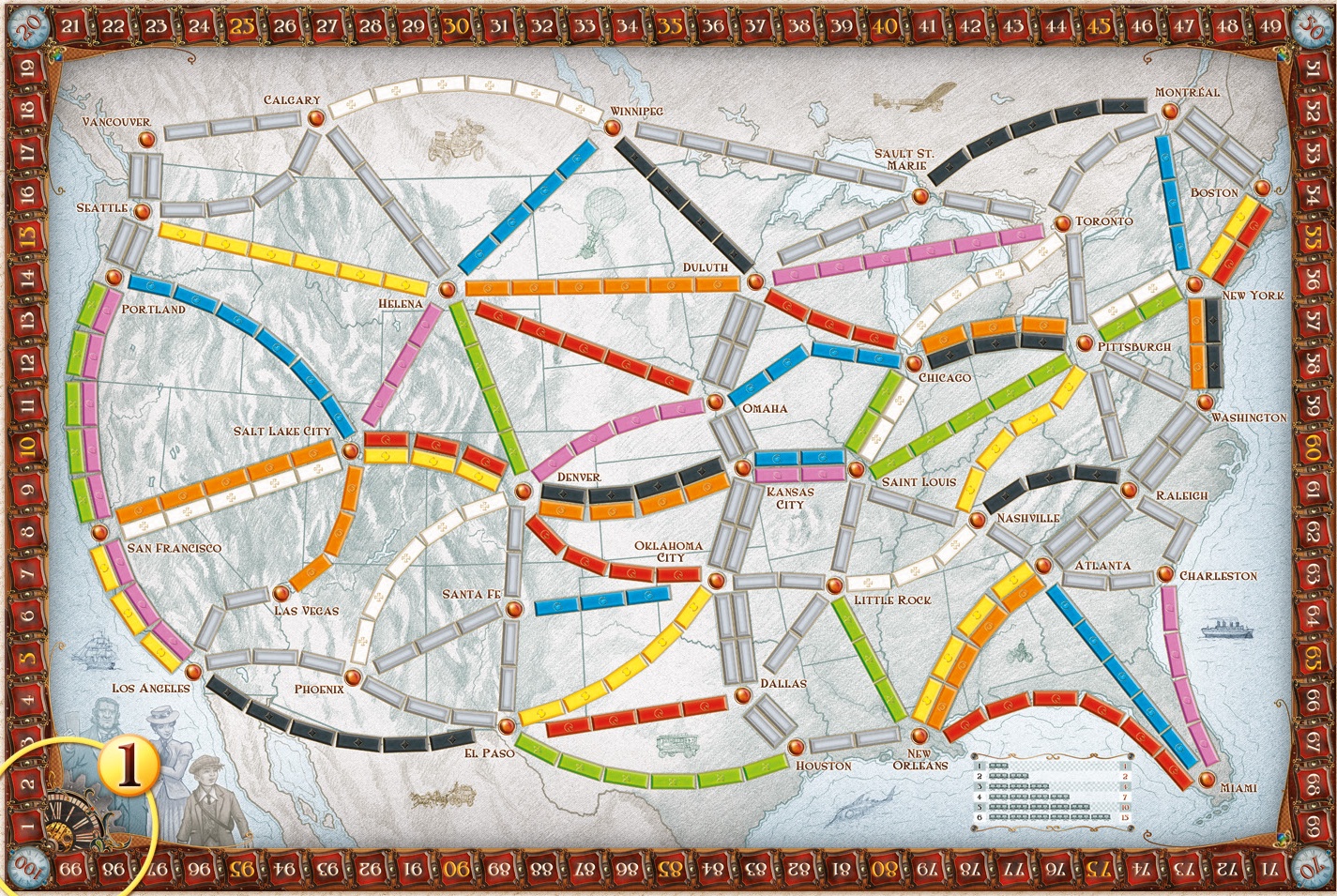
Claim San Francisco–Los Angeles with three yellow cards.
A yellow length-three route needs three yellow cards, with locomotives allowed as substitutes. Other ordinary colors do not match.
A gray route still needs one color
Pay one color for the two-space gray Los Angeles–Las Vegas route.
Gray lets you choose a color, not mix ordinary colors. Locomotives may still substitute.
Use locomotives as substitutes
Pay one red card and one locomotive for a two-space gray route.
A locomotive substitutes for any color, while ordinary cards in the payment must still be one color.
A length-six route scores fifteen
Pay six yellow cards to claim Seattle–Helena.
Lengths one through six score 1, 2, 4, 7, 10, 15 points and use that many trains.
Only one side of doubles with two or three
An opponent owns one Vancouver–Seattle side. Try the other, or claim Los Angeles–Las Vegas.
With two or three players, claiming one side closes the other to everyone.
Different players may use both sides with four or five
In a four-player game, claim the other Vancouver–Seattle side beside an opponent.
Both sides are available with four or five players, but one player can never own both sides.
Keep at least one additional ticket
You have just drawn three additional tickets; keep one or more.
Drawing additional tickets is a full action: normally draw three and keep at least one. This exercise starts at the retention step.
Connect both ends of a ticket
Add Dallas–Houston to connect Kansas City–Houston.
A connection may pass through several cities. A completed ticket adds its value at game end; an incomplete one subtracts it.
The final round and actual scoring
An opponent has two trains left and triggered the final round. Add Dallas–Houston; the exercise then executes that opponent’s final two-card draw and scores the game.
When someone ends a turn with 0–2 trains, everyone including that player gets one final turn. Final scoring combines routes, signed tickets, and the ten-point longest continuous route bonus; ties share the bonus.
With interaction enabled, select cards, tickets or routes on the original artwork, see what happens, then confirm. Preview never commits; try again restores the same position.
Component types and quantities
The classic USA box has one USA map, 240 plastic cars (45 in each of five colors for 225 in play, plus 15 spares), five scoring markers and 142 illustrated cards.
The 142 cards are 110 Train Car cards, 30 Destination Tickets, one longest-path bonus card and one summary card. Each player uses 45 cars; spares do not increase that supply.
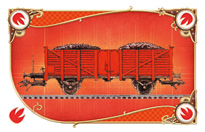
Red train card · 12
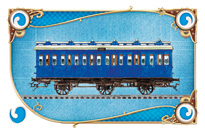
Blue train card · 12
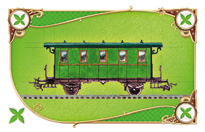
Green train card · 12
Yellow train card · 12
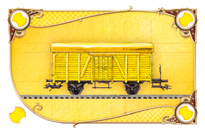
Orange train card · 12
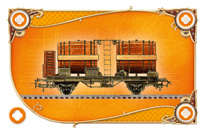
Purple train card · 12
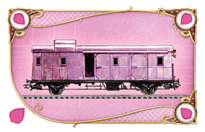
White train card · 12
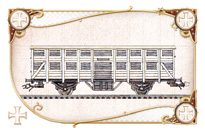
Black train card · 12
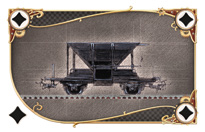
Locomotive · 14
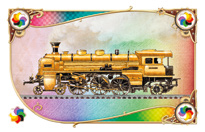
USA map · 1
Player cars · 240
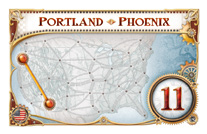
Destination Tickets · 30
Longest Continuous Path bonus card · 1
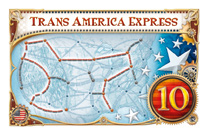
Summary card · 1
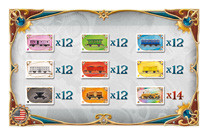
Scoring markers · 5

The thirty-ticket reference uses WANGO demo data for names, endpoints and values; it is not a gallery of all thirty original card faces. The original rules provide one classic ticket-front example.

Each player starts with 45 cars, a matching marker, four Train Car cards and three Destination Tickets; keep at least two tickets.
Returned tickets go under the ticket deck; kept tickets remain secret. Reveal five Train Car cards.
Turns and scoring
Choose exactly one action: draw Train Car cards, claim one route, or draw Destination Tickets.
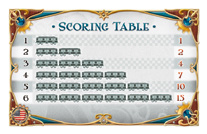
| Length | Points |
|---|---|
| 1 | 1 |
| 2 | 2 |
| 3 | 4 |
| 4 | 7 |
| 5 | 10 |
| 6 | 15 |
When a player ends a turn with zero, one or two cars, every player including that player gets one final turn.
The longest continuous path earns 10 points; all players tied for longest receive the bonus.
Decisions
A known color or a blind draw?
Compare two draws from the same market.
Face-up red guarantees red. A blind card is uncertain. The fixed teaching deck is repeatable; a live game cannot guarantee its color.
Save a locomotive or a red card?
Both payments can claim the same gray length-two route.
Two red cards preserve a flexible locomotive; red plus locomotive preserves a red card toward a red route. Both score the same immediately.
Complete a ticket or score a long route?
You can add Dallas–Houston or claim Seattle–Helena.
The short route scores only one now, but turns a five-point ticket from −5 to +5. The long route scores fifteen and uses six trains, leaving the ticket incomplete. A later connection depends on future turns.
Take more tickets or claim a route?
Compare taking additional tickets with claiming now; extra ticket contents are unknown before drawing.
Claiming gives certain immediate points. Extra tickets require keeping at least one and can later add or subtract points. This exercise keeps the first actual offered ticket to demonstrate the full draw-three, keep-one action.
Rule questions
How do you win?
Score the most points from routes, completed tickets and the longest path, subtracting uncompleted tickets.
Conditions: Destination Tickets stay secret until final scoring.
Example: 40 route points +11 −8 +10 =53.
What is in this edition?
The classic USA box has one USA map, 240 plastic cars (45 in each of five colors for 225 in play, plus 15 spares), five scoring markers and 142 illustrated cards.
Conditions: The 142 cards are 110 Train Car cards, 30 Destination Tickets, one longest-path bonus card and one summary card. Each player uses 45 cars; spares do not increase that supply.
Example: 110 cards = eight colors ×12 plus 14 locomotives.
What does each player start with?
Each player starts with 45 cars, a matching marker, four Train Car cards and three Destination Tickets; keep at least two tickets.
Conditions: Returned tickets go under the ticket deck; kept tickets remain secret. Reveal five Train Car cards.
Example: You may keep all three tickets or keep two.
How many actions are allowed per turn?
Choose exactly one action: draw Train Car cards, claim one route, or draw Destination Tickets.
Conditions: Drawing cards and claiming a route cannot share the same turn.
Example: Collect two red cards now, then claim a route on a later turn.
How do normal card draws work?
Normally draw two cards from the face-up display or blindly from the deck. Replace a face-up card immediately before the next choice.
Conditions: Face-up locomotives are the exception.
Example: Take a red card, refill its slot, then choose a green card or a blind draw.
Why does a face-up locomotive use the whole draw?
Taking a face-up locomotive uses the whole draw action. You cannot take one as your second card.
Conditions: A newly revealed locomotive is also unavailable as the second card.
Example: After taking blue and revealing a locomotive, choose another ordinary card or draw blindly.
Does a blind locomotive end the draw?
No. A blindly drawn locomotive counts as one normal card.
Conditions: The special one-card limit applies to taking a visible locomotive.
Example: A blind locomotive first still allows an ordinary visible card or another blind draw.
What if three visible cards are locomotives?
When at least three of the five face-up cards are locomotives, immediately discard all five and reveal five new cards.
Conditions: The old rules do not specify a digital guard for impossible repeated refills.
Example: Replace all five cards, not just the three locomotives.
How do you pay for a colored route?
Pay matching-color cards equal to the whole route length, using locomotives as substitutes, then place that many cars.
Conditions: Claim the whole route at once; partial construction is not allowed.
Example: A blue length-three route can use two blue cards and a locomotive.
Can different colors pay for a gray route?
Choose one regular color for the entire gray route; locomotives may substitute. Do not mix different ordinary colors.
Conditions: Locomotives are wild, so an all-locomotive payment is allowed.
Example: Gray length two accepts two red or red plus locomotive, but not red plus blue.
Must a new route connect to your network?
No. You may claim any available route you can fully pay for.
Conditions: Only one route between adjacent cities may be claimed per turn.
Example: A western network does not prevent you from claiming a separate eastern route.
How do double routes depend on player count?
With two or three players only one of a double route is usable. With four or five, different players may claim the two lines.
Conditions: At every player count, one player cannot claim both lines of the same double route.
Example: In a two-player game, claiming one Vancouver–Seattle line closes the other.
How many points does a route score?
Lengths one through six score 1, 2, 4, 7, 10 and 15 points respectively.
Conditions: Score immediately when claiming; car count and points differ.
Example: A six-car route costs six cars and earns 15 points.
How many new tickets must you keep?
Draw three and keep at least one, optionally two or three. If fewer than three remain, draw all available.
Conditions: Return rejected new tickets under the deck; previously kept tickets cannot be returned.
Example: With two tickets left, draw both and keep at least one.
How are tickets completed and scored?
Connect the two ticket cities with your own continuous network to add its value at game end; otherwise subtract its value.
Conditions: A multi-route connection works, but opponents’ routes do not count.
Example: Portland–Phoenix is worth +11 completed or −11 uncompleted.
When does the final round start?
When a player ends a turn with zero, one or two cars, every player including that player gets one final turn.
Conditions: The game does not end immediately, and triggering it does not determine the winner.
Example: A ends with two cars; B, C and A each take their final turn.
How is the longest-path bonus calculated?
The longest continuous path earns 10 points; all players tied for longest receive the bonus.
Conditions: Loops and repeated cities are allowed, but no train or route segment can be used twice in that path.
Example: A branched network does not automatically count every branch in one path.
How are tied final scores resolved?
Compare completed Destination Tickets first; if still tied, the holder of the Longest Continuous Path card wins.
Conditions: The old English rules do not explicitly resolve a tie that remains after these criteria.
Example: At equal points, five completed tickets beats four.
What if the train-card deck runs out?
Thoroughly shuffle discarded Train Car cards into a new deck.
Conditions: If neither deck nor discard has cards, drawing Train Car cards is unavailable; choose a route or ticket action.
Example: Cards held by players do not create replacement supply.
Is there a hand or ticket limit?
There is no limit to Train Car cards in hand or Destination Tickets held.
Conditions: Keeping a ticket is permanent and unfinished tickets still lose points.
Example: An extra ticket risks losing its printed value if unfinished.
Sources and scope
Classic USA edition with 30 Destination Tickets; excludes USA 1910, Europe and the refreshed 33-ticket edition
Checked: 2026-10-30
The primary source is the English PDF inside the publisher’s Old Rules archive: 7201-T2R-Rules-EN-20240423_LOWRES.pdf
Contents and setup p.2; drawing, payment and double routes p.3; extra tickets, scoring and game end p.4. Original illustrations come from the matching classic-edition publisher rules and remain the rights holders’ property.
WANGO retains the market when ordinary refills cannot resolve an excessive locomotive display, with a maximum of 64 refresh attempts. A tie surviving all printed criteria shares victory. These are digital conventions, not separate rulings in the old English rules.
Official classic rulebook PDF · Publisher and edition information