How to play Terraforming Mars: rules and strategy
Practise resources, production and project decisions, then connect the rules with a full generation and scoring example.
Learn by playing
Buy into your hand
Research with 12 M€: keep Electro Catapult for 3 M€, or discard it. The other three research cards are preset as discarded. Buying is not playing.
Research with 12 M€: keep Electro Catapult for 3 M€, or discard it. The other three research cards are preset as discarded. Buying is not playing.
Keep one: 3 M€
Discard; pay nothing
Pay by tag
Play Electro Catapult (17 M€) from hand using 20 M€ and three steel. Oxygen 5% and energy production 3 satisfy its maximum 8% requirement and mandatory production decrease.
Play Electro Catapult (17 M€) from hand using 20 M€ and three steel. Oxygen 5% and energy production 3 satisfy its maximum 8% requirement and mandatory production decrease.
2 steel + 13 M€
Pay 17 M€
Try titanium for a building card
Heat and threshold bonus
At −26°C with eight heat, raise temperature and check the −24°C bonus.
At −26°C with eight heat, raise temperature and check the −24°C bonus.
Spend 8 heat to warm
Energy converts before production
Old energy 5, heat 2. Energy production 3, heat production 2, M€ production −2, TR20. Preview production.
Old energy 5, heat 2. Energy production 3, heat production 2, M€ production −2, TR20. Preview production.
End actions and produce
Convert plants to greenery
Spend eight plants on a greenery. A legal empty area is preselected, without placement or ocean bonuses. Oxygen is 5%.
Spend eight plants on a greenery. A legal empty area is preselected, without placement or ocean bonuses. Oxygen is 5%.
8 plants → greenery
Claim a milestone
You have sixteen cards in hand and a milestone slot is open. Claim Planner, or try Gardener without three greeneries.
You have sixteen cards in hand and a milestone slot is open. Claim Planner, or try Gardener without three greeneries.
8 M€: claim Planner
Try Gardener (fewer than 3 greeneries)
Decisions
Warm now or build production
Same 20 M€, eight heat and −26°C. Compare heat conversion with the 11 M€ standard Power Plant: each is one legal action.
Same 20 M€, eight heat and −26°C. Compare heat conversion with the 11 M€ standard Power Plant: each is one legal action.
8 heat: warm now
11 M€: energy production +1
Cards versus available cash
Research with 12 M€: keep or discard Electro Catapult. Compare certain costs of 3 M€ versus zero; playing it and recovering the investment depend on later actions.
Research with 12 M€: keep or discard Electro Catapult. Compare certain costs of 3 M€ versus zero; playing it and recovering the investment depend on later actions.
Buy one; retain 9 M€
Discard; keep 12 M€
Save cash or keep steel
Play the same 17 M€ Electro Catapult with cash or 2 steel + 13 M€. Both lower energy production by one; remaining stock differs.
Play the same 17 M€ Electro Catapult with cash or 2 steel + 13 M€. Both lower energy production by one; remaining stock differs.
2 steel + 13 M€
17 M€; keep all steel
Components, resources and map
Base Tharsis board
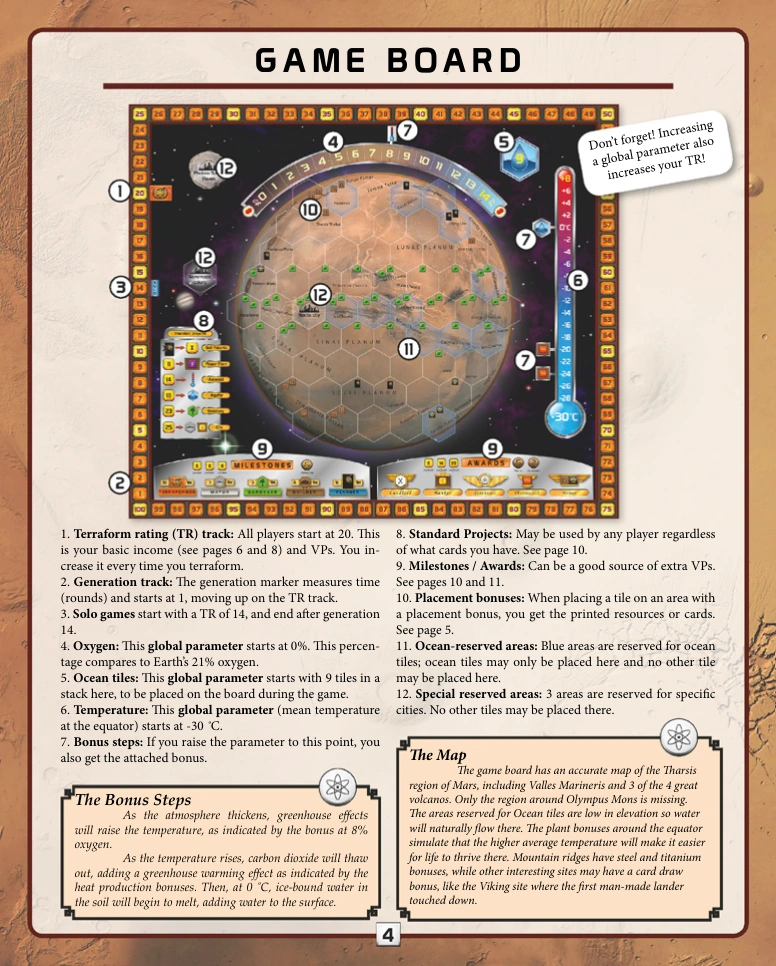
The board contains the map, parameter and TR/generation tracks, standard projects, milestones and awards.
Quantity: 1
Player board and six resources
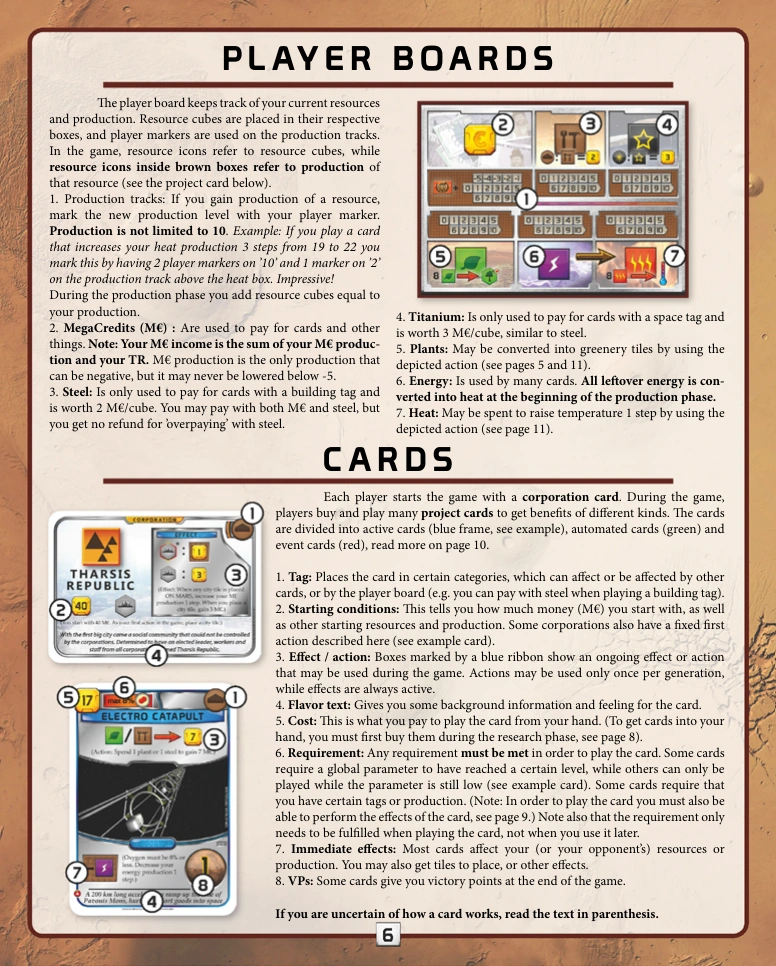
Separate stocks and production tracks for M€, steel, titanium, plants, energy and heat.
Quantity: 5
Corporations
Seventeen cards: five Beginner Corporations, ten standard corporations and two Corporate Era corporations. They set resources, abilities and any required first action.
Quantity: 17
Three project types
Green automated projects, blue active projects and red events show cost, prerequisites, tags, effects and VP.
Quantity: 208
Nine ocean tiles
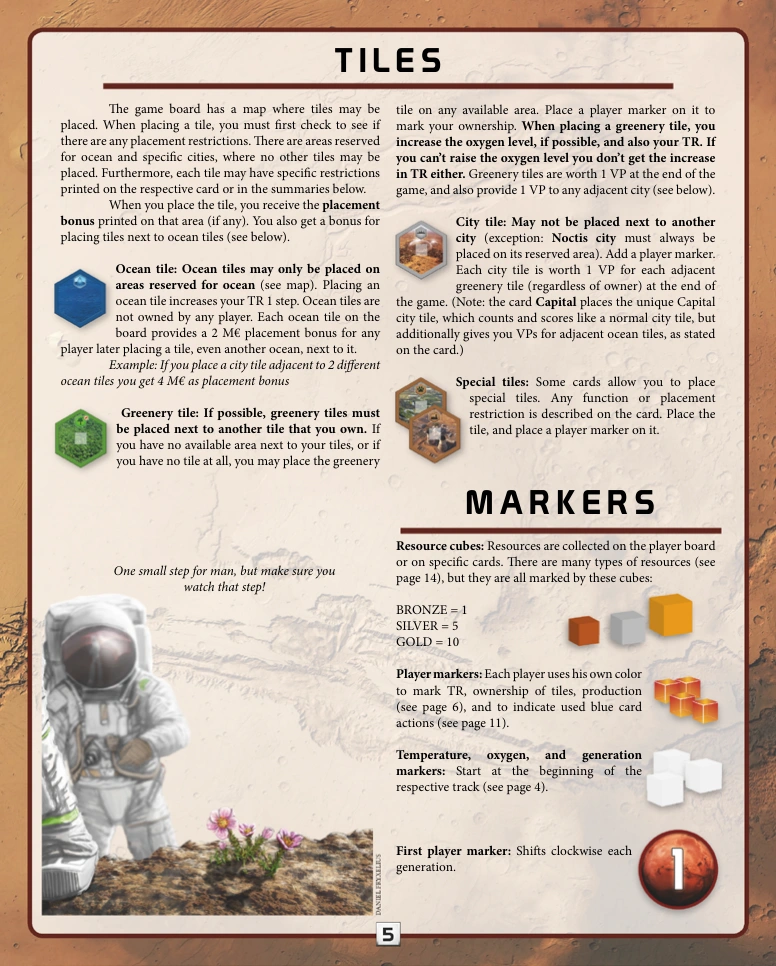
Placed only on reserved spaces and never owned; placement raises TR and later adjacent tiles gain 2 M€.
Quantity: 9
Greenery and city tiles
Sixty greenery/city tiles; mark ownership on the used face. Greenery raises oxygen and scores itself; cities score adjacent greenery.
Quantity: 60
Special tiles
Placed by specific projects under their own rules; do not treat every special tile as a city or greenery.
Quantity: 11
Resource cubes: 1 / 5 / 10
Bronze, silver and gold mean one, five and ten units; location determines resource type.
Quantity: 200
Colored player markers
Track TR, production, tile ownership, used blue actions and claims or funding.
Quantity: 200
Three game-board markers
Track temperature, oxygen and generation. Each player uses their own colored marker for TR.
Quantity: 3
Six standard projects
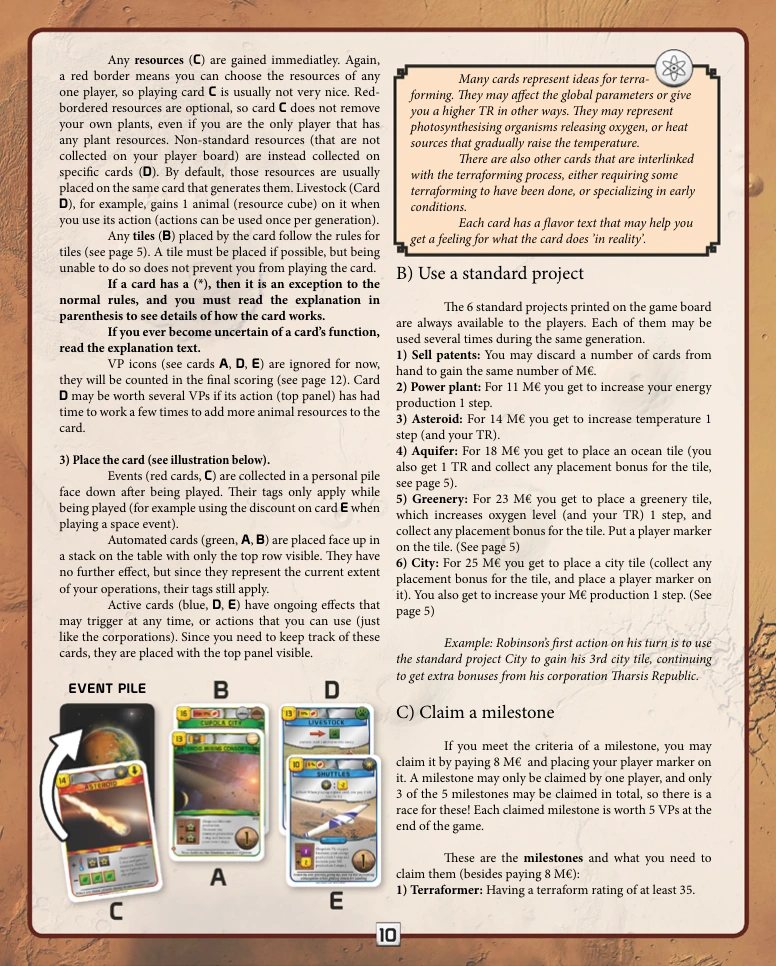
Available without hand cards: Sell Patents, Power Plant, Asteroid, Aquifer, Greenery and City.
Five milestones and five awards
Milestones are qualified for and claimed; awards are funded and ranked at game end. Only three of each may be taken.
Rulebook and symbol reference
One rulebook and eight reference cards explain setup, turns, exceptions and actions; symbol pages explain resources, tags and red borders.
Quantity: 1 + 8
First-player marker
One marker, initially given to the player who most recently won this game, then passed clockwise each generation.
Quantity: 1
Terraformer
At least 35 TR.
Mayor
Own at least three cities.
Gardener
Own at least three greeneries.
Builder
Have at least eight building tags in play.
Planner
Have at least sixteen cards in hand when claiming.
Landlord
Most owned tiles at game end; unowned oceans do not count.
Banker
Highest final M€ production, not cash stock.
Scientist
Most science tags in play at game end.
Thermalist
Most final heat stock, not heat production.
Miner
Most combined final units of steel and titanium stock.
What game and editions does this Terraforming Mars guide cover?
This guide covers Terraforming Mars and the Tharsis map in the base box. Players advance terraforming together but score individually.
Conditions: The main reference is the standard 2–5-player game; Corporate Era, base-game solo and drafting are identified separately. Corporate Era is an optional base-box variant, not Prelude or Colonies. This guide does not cover the standalone Ares Expedition game.
Example: Before checking starting production, identify standard play or Corporate Era: the former adds one of every production, the latter does not. Apply corporation effects separately.
Official rulebook pp. 3, 7, 13
p. 3 · p. 7 · p. 13How does a complete generation run from research to production?
In this generation-2 example, research comes first, actions rotate between players, then everyone produces after all have passed. Buying and playing Electro Catapult, then converting heat, leaves 36 M€ and TR 21 after production.
Conditions: This is a fixed public accounting position, not a corporation setup: cash 30, steel 3, titanium 0, plants 2, energy 2, heat 8; TR 20, oxygen 5%, temperature −26°C. Production in that order is 1/1/1/1/2/1, with no other effects. Generation 1 skips player order and research: do not draw another four research cards then.
| Step | Action and change | Result |
|---|---|---|
| Research | Buy only Electro Catapult from four cards for 3 M€; discard the others. | Cash 27; hand 1. |
| One of your turns | Play the 17-cost Electro Catapult with 2 steel + 13 M€; energy production −1. | Cash 14; steel 1; energy production 1; hand 0. |
| Your next turn | Spend 8 heat: −26→−24°C, TR +1, heat production +1. | Heat 0; TR 21; heat production 2. |
| All players pass | You later pass; the action phase ends when everyone has passed. | You cannot re-enter this generation when others continue. |
| Production | Convert 2 old energy to heat; cash income is 21 + 1 = 22; produce at current rates. | Cash 36, steel 2, titanium 1, plants 3, energy 1, heat 4. |
Example: You may take just one action on a turn and act again after the other players. Taking one action is not passing. Reaching −24°C increases heat production by one; the two old energy convert to heat before one new energy is produced.
Worked rules example; basis: Official rulebook pp. 4, 6, 8, 9, 11
p. 4 · p. 6 · p. 8 · p. 9 · p. 11How do you add every part of a final score?
Add final TR, earned awards and claimed milestones, map points and points from played cards. This example, based on the official rulebook, totals 64 VP.
Conditions: Finish the final generation, production and final plant conversions before scoring the resulting position. The award shown is already won; Planner was paid for and claimed. Three owned and two opposing greeneries all adjoin your only city.
| Source | Calculation | VP |
|---|---|---|
| TR | Final terraform rating: 38. | 38 |
| Award | First in Thermalist. | 5 |
| Milestone | Claimed Planner. | 5 |
| Greeneries | Three owned tiles, one each. | 3 |
| City | Adjacent to three own + two opposing greeneries. | 5 |
| Resource card | Three animals on Livestock, one VP each. | 3 |
| Other played cards | Other blue/green cards total six VP. | 6 |
| Events | Played events total −1 VP. | −1 |
| Total | 38 + 5 + 5 + 3 + 5 + 3 + 6 − 1 | 64 |
Example: The two opposing greeneries give you no greenery VP, but each gives your adjacent city one VP. Cash is normally not VP; it breaks a tied total. Unplayed hand cards do not score, while negative VP on played events still count.
Worked rules example; basis: Official rulebook pp. 11, 12
p. 11 · p. 12What should you prioritise early, midgame and near the end?
Early on, get cash and production working; midgame, connect cards, map position and contested objectives; near the end, compare remaining production with points you can actually secure. There is no universal generation at which to switch.
Conditions: This is WANGO strategy analysis for multiplayer base-game play. Parameter progress, opponents’ resources and their ability to accelerate terraforming affect the time left; Corporate Era can change the pace.
| Stage | Check first | Trade-off |
|---|---|---|
| Early | Can you afford the key project after research? When does production repay its cost? | Avoid exhausting cash on cards you cannot use soon. |
| Midgame | Milestone slots, map spaces, card requirements and synergies. | Grow the engine while reserving cash and actions for contested objectives. |
| Late | How many productions remain? Can scoring cards be played in time? Who benefits from ending sooner? | Compare realisable net gains; potential synergy is not secured VP. |
Example: With temperature and oceans complete and oxygen one step short, do not assume an engine has many generations to pay back. Whether someone raises that final step is unknown: compare an end-this-generation case with a two-more-generations case.
WANGO strategy analysis; rule basis: Official rulebook pp. 8, 10, 11, 12
p. 8 · p. 10 · p. 11 · p. 12How long does production take to repay its cost?
For a cash-only comparison, divide total cash cost by added cash per production to estimate payback. When too few productions remain, compare the investment with options that score directly.
Conditions: This hypothetical comparison is not a named real card: spend 10 M€ for +2 M€ production, with no tags, discounts, VP or other effects. If a separate 3 M€ research fee applies, cost is 13 and at least seven productions are needed to recover the cash.
| Productions left | Added cash | Net after cost |
|---|---|---|
| 2 | 4 M€ | −6 M€ |
| 5 | 10 M€ | 0 M€ |
| 7 | 14 M€ | +4 M€ |
Example: With 10 M€, A invests: over two remaining productions it returns four, a net cash change of −6. B holds: cash stays at 10 for possible later projects, but scores no automatic VP. Investing also uses an action; final VP depends on subsequent options, not payback alone.
WANGO strategy analysis; rule basis: Official rulebook pp. 6, 8, 9, 10, 12
p. 6 · p. 8 · p. 9 · p. 10 · p. 12Should you claim a milestone now or develop first?
If you qualify and a slot remains, claiming converts 8 M€ and one action into five secured end-game VP. Developing first allocates money to other projects but risks losing access to the milestone.
Conditions: Assume you hold 16 cards and 12 M€, Planner is unclaimed, and fewer than three milestones are claimed. A claims for eight and leaves four. B uses the 11 M€ standard Power Plant, leaving one and gaining one energy production. Both are legal, but current cash cannot cover both.
Example: A keeps the five VP even if the hand later shrinks. B has not scored merely by qualifying. Competition matters when another player qualifies or might fill the third slot; do not assume an opponent is guaranteed to claim next.
WANGO strategy analysis; rule basis: Official rulebook pp. 8, 10, 11
p. 8 · p. 10 · p. 11Does leading an award make funding it worthwhile?
A current lead does not guarantee the award. Funding fixes a category to score, not its winner; compare the cost with remaining production and opponents’ ability to change the totals.
Conditions: In a three-player game with no funded awards, you have 20 M€ and current M€ production is 8 for you, 7 and 3 for opponents. A funds Banker for eight and leaves 12. B uses standard Power Plant for 11, leaving nine and gaining one energy production; Banker remains unfunded. Assume no other triggers.
Example: If final production stays 8/7/3 and Banker is funded, you get five VP. At 8/9/3 you get two; in a two-player game second place gets zero. Opponents may raise production or fund other categories after B; none of those future actions is guaranteed.
WANGO strategy analysis; rule basis: Official rulebook pp. 8, 11, 12
p. 8 · p. 11 · p. 12Where should greenery go, and when is a city worth building first?
For greenery, compare placement bonuses, ownership of adjacent cities and room to expand. Cities score through adjacent greenery; building one does not automatically raise TR.
Conditions: Compare two legal greenery spaces with eight plants, oxygen 5% and no extra triggers. A adjoins your city and one ocean; B adjoins an opponent’s city and no ocean. Both satisfy the own-tile adjacency requirement and have equal printed bonuses.
| Result | A: by your city | B: by opponent’s city |
|---|---|---|
| TR and owned greenery | +1 TR; greenery worth 1 VP | +1 TR; greenery worth 1 VP |
| Ocean cash | +2 M€ | 0 |
| Added city VP | Your city +1 | Opponent’s city +1 |
Example: A and B both give you +1 TR and an owned greenery worth one end-game VP. A also gives 2 M€ and adds one VP to your own city; B adds one VP to the opponent’s city. Separately, a 25 M€ standard city next to only two existing greeneries currently secures two map VP and +1 M€ production. More future greenery is an assumption, not guaranteed high scoring.
WANGO strategy analysis; rule basis: Official rulebook pp. 5, 10, 11, 12
p. 5 · p. 10 · p. 11 · p. 12How many research cards should you buy without running out of cash?
There is no fixed number to buy. Reserve cash for valuable near-term actions whose requirements you can meet, then decide which cards justify the 3 M€ hand cost. Buying none is legal.
Conditions: Research and play are separate costs; a card already in hand does not incur research again. Steel and titanium pay for matching tagged projects, not research. Long-term synergy, timing windows and milestones can change the decision.
| Check | Decision |
|---|---|
| Usable? | Do you meet requirements and have suitable payment? When can it be played? |
| Cash pressure? | Does research spending prevent a key project or contested action this generation? |
| Return timing? | Separate remaining production, direct VP and synergy; do not count guesses as guaranteed gains. |
Example: With 20 M€ and two steel, buy Electro Catapult for three, then play it for two steel plus 13 M€: total cash spent is 16, leaving four. Buying one extra card for later leaves only one. Calculate that cash gap before deciding whether the extra card is worth three.
WANGO strategy analysis; rule basis: Official rulebook pp. 7, 8, 9, 10
p. 7 · p. 8 · p. 9 · p. 10What are the seven action types available on a turn?
On your turn take one or two legal actions in any combination, or pass. The table lists the seven base-rule types. Ending a turn after one action does not remove you from the generation.
Conditions: Each action has its own requirements. Arrow actions on blue cards and corporations are generally each usable once per generation; standard projects can repeat. Some corporations specify a first action; explicit card exceptions apply.
| Action | Requirement and cost |
|---|---|
| Play a project | Meet requirements, pay the card cost and resolve mandatory effects. |
| Standard project | Sell patents +1 each; Power Plant 11; Asteroid 14; Aquifer 18; Greenery 23; City 25 M€. |
| Claim a milestone | Qualify with a slot available; 8 M€, five end-game VP. |
| Fund an award | Unfunded category and a slot; first/second/third funding costs 8/14/20 M€ globally. |
| Blue-card or corporation action | Pay the left-of-arrow cost; that action must be unused this generation. |
| Convert plants | Normally eight plants; legal placement, oxygen rises if not full. |
| Convert heat | Eight heat; temperature must have room to rise. |
Example: Converting eight plants and then claiming the newly qualified Gardener can be your two actions, if you have eight M€, a milestone slot and a legal greenery space. You can instead stop after greenery and claim on a later turn, risking a changed slot situation.
Official rulebook pp. 8, 9, 10, 11
p. 8 · p. 9 · p. 10 · p. 11What do TR, M€, production, turn and generation mean?
TR means terraform rating and M€ is the cash unit. Stock is what you hold now; production determines resources gained in the production phase. A turn is one player’s opportunity to act; a generation includes repeated turns for all players and then production.
Conditions: TR normally contributes to final VP and cash income each production; it is not one of the six production tracks. Tags describe card categories or requirements and do not automatically generate matching resources. Card text may change general rules.
| Term | Meaning |
|---|---|
| Terraform rating / TR | Normally adds to cash income and forms the base final score. |
| M€ / MegaCredit | The currency resource unit. |
| Stock / 库存 | Resources currently held and available for legal payments. |
| Production / 产能 | Resources generated during production, not current stock. |
| Turn / 回合 | Take one or two actions, or pass, when it is your turn. |
| Generation / 世代 | Player order, research, action and production phases. |
| Tag / 标签 | Categories such as building, space and science, used by requirements and effects. |
| Action / 行动 | One legal operation; passive triggered effects do not consume another action. |
| Victory point / VP | The final total used to determine the winner, not just TR. |
Example: At TR 20 and M€ production −2, cash income is 18. With three steel in stock and one steel production, you can spend the three now; the next steel arrives during production.
Official rulebook pp. 3, 6, 8, 9, 11, 14, 15
p. 3 · p. 6 · p. 8 · p. 9 · p. 11 · p. 14 · p. 15Rule questions
How do you win Terraforming Mars?
In multiplayer, the highest final victory-point total wins. Add Terraform Rating (TR), claimed milestones, funded awards, map points and points on played cards.
If total VP is tied, the player with more M€ wins. TR supplies basic income and contributes to scoring; completing one parameter does not itself win.
30 TR, a 5-point milestone, 8 map points and 7 card points total 50 VP; unfunded awards score nothing.
What are the global parameter targets?
Temperature rises from −30°C to +8°C in 2°C steps; oxygen rises from 0% to 14% in 1% steps; nine ocean tiles must be placed. Each actual parameter step normally increases TR by one.
TR is not a fourth completion target.
Spending 8 heat to raise temperature from −16°C to −14°C gains 1 TR.
Does play stop as soon as all three parameters are complete?
No. Finish the action phase of that generation, perform production, then resolve final greenery conversion and scoring.
Completing only one or two parameters does not end multiplayer play. Solo play has a separate generation-14 deadline.
If the ninth ocean completes the last missing parameter, players who have not passed may still act.
How is the shared board set up?
Set temperature to −30°C, oxygen to 0% and generation to 1. Put nine ocean tiles in supply, and prepare resources, other tiles, the project deck and discard area.
This guide uses the base-game Tharsis board. Expansion-map milestones, awards and special rules are not substituted.
There are nine ocean tiles but twelve ocean-reserved spaces; filling all twelve is not required.
What are the starting TR and production in the standard game?
The standard game for two to five players starts at 20 TR and one production of each of the six resources, then applies the corporation’s starting resources, production and abilities.
This is the rulebook’s standard setup. Corporate Era removes the six starting production steps; do not mix the setups.
An extra energy production from a corporation is added to one in the standard game, or to zero in Corporate Era.
How are corporations and the ten starting projects chosen?
Experienced players receive two corporations and ten projects, choose one corporation, collect its starting resources, then pay 3 M€ for each project kept.
Return the unused corporation to the box and discard unbought projects face down. A corporation’s mandatory first action still applies.
With a 40-M€ corporation, keeping four projects costs 12 M€, leaving 28 M€ before paying to play any project.
Does a Beginner Corporation pay for its ten starting cards?
No. A Beginner Corporation receives 42 M€ and ten project cards as its starting hand without paying 3 M€ per card.
Playing those projects later still requires their printed costs and prerequisites; use the other setup rules of the chosen variant.
Receiving the starting hand for free does not make its projects free to play.
How does Corporate Era differ from the standard game?
Corporate Era adds the projects and corporations bearing its icon. All six production levels start at zero before corporation effects.
Corporate Era is a variant supplied with the base game, not Prelude, Colonies, Turmoil or another expansion.
Starting at zero plant production gives no automatic plant during production.
What happens in each generation?
Resolve player order, research, actions and production in that order. Pass first player clockwise and advance the generation at the start of a new generation.
Generation one skips player order and research because setup has already handled them.
Generation two changes first player before research; production follows actions, not the other way round.
How many cards may you buy during research?
Each player looks at four new projects and may buy zero to four at 3 M€ each. Discard the rest face down. There is no hand limit.
Buying only puts the card in your hand; it does not resolve the project.
Keeping two new cards costs 6 M€; existing hand cards are not purchased again.
Are you limited to two actions per generation?
No. On each turn you take one or two actions, then the next player acts. If you have not passed, you may take further turns in the same generation.
The seven action categories can be combined freely. Taking one action is not passing.
You may play one card now and raise temperature on your next turn in the same generation.
Can you rejoin the generation after passing?
No. Passing means taking no action and ends your participation in the current action phase. Production starts once everyone has passed.
You can act again next generation. Taking a single action does not count as passing.
You cannot pass, wait for someone to raise oxygen, then return to play a card.
How do resource cubes differ from production?
Resources are your current spendable stock. Production determines how much stock you gain during production. A resource icon in a brown box changes production.
Increasing production does not normally grant the resource immediately; gaining resources does not increase production.
With eight plants and one plant production, converting the eight plants leaves plant production at one.
Do bronze, silver and gold cubes represent different resources?
No. Bronze, silver and gold cubes represent one, five and ten units. Their location on a resource area or card determines the resource type.
Your colored player markers track production, ownership, TR and used actions; they are not resource denominations.
One gold cube and three bronze cubes in the heat box equal thirteen heat.
Why is income greater than M€ production?
Your M€ income is current TR plus M€ production. The other five resources are produced according to their production levels alone.
M€ production may be as low as −5; other production cannot be negative. Production is not capped at ten.
At TR 20 and M€ production −2, production earns 18 M€; it does not subtract twenty from your stock.
When does energy turn into heat?
At the start of production, convert all stored energy to heat, then produce new resources. Newly produced energy remains in the energy box.
Both converted old energy and heat production add to heat stock. Do not convert the newly produced energy a second time.
Starting with 3 energy and 2 heat, with energy production 2 and heat production 1, leaves 2 energy and 6 heat.
Can steel pay for any cost?
Steel pays only the play cost of a project bearing a building tag, at 2 M€ per unit, and may be combined with M€.
It does not pay research, standard-project or milestone costs. Overpayment gives no change. Explicit corporation or card effects may modify this.
A 7-cost building project can use three steel plus 1 M€, or four steel without receiving 1 M€ change.
How does titanium pay for space projects?
Titanium pays the play cost of a project bearing a space tag, normally at 3 M€ per unit, and may be combined with M€.
It cannot pay for a project without a space tag. Corporations or other cards may change its value; overpayment gives no change.
A 10-cost space project can use three titanium and 1 M€.
What must be checked before playing a project?
Check prerequisites and mandatory effects, pay the play cost, resolve immediate and triggered effects, then place the card according to its type.
The 3-M€ research fee does not reduce the play cost. Prerequisites are checked when played and do not normally have to remain true.
A card requiring at least 9% oxygen cannot be played at 8%, but can be played at 9%.
How are green, blue and red cards kept?
Keep automated green cards face up after their immediate effects; their tags remain active. Keep blue cards visible for effects or actions. Turn red events face down into your personal event pile after resolving them.
Event tags apply while the event is played, not to later tag requirements. Points on played events still count at final scoring.
A red building event may use steel when played, but its tag does not later count toward Builder.
How often may a blue-card action be used?
Each action on a blue card or corporation is normally usable once per generation. Pay the left-hand cost, resolve the right-hand result and mark it used.
Remove used-action markers during production. A continuing effect is not an action; it triggers when its stated condition occurs.
You cannot use the same animal card’s add-animal action twice in one generation, but may use it next generation.
Are tags resources or actions?
Tags categorize projects and interact with payments, prerequisites and effects; they do not automatically grant resources or actions. Base tags are building, space, power, science, Jovian, Earth, plant, microbe, animal, city and event.
Apply the specific card or corporation text. Tags on resolved face-down events do not remain active.
A plant tag does not give one plant; read the effect panel.
Does a missing effect target always prevent playing a card?
Not always. The rulebook makes exceptions for completed global parameters, resources you cannot collect and optional red-bordered resource removal. Other prerequisites, costs and mandatory effects still apply.
A card’s tile must be placed if possible; page 10 of this rulebook permits playing the card when placement is impossible. Do not generalize that card exception to other actions.
At 14% oxygen, an otherwise legal greenery card may still resolve its other effects, but gains no additional oxygen TR.
Is red-bordered resource removal the same as lowering production?
No. Red-bordered resource removal may be reduced or skipped and targets one player. Red-bordered production reduction must be performed.
If an opponent has no eligible production, check your own. If the mandatory reduction cannot legally be performed, you cannot play the card.
No opposing plant stock lets you skip optional plant removal; no opposing energy production does not let you skip a mandatory production loss.
Which standard projects are available without cards?
There are six standard projects: Sell Patents, Power Plant (11 M€), Asteroid (14 M€), Aquifer (18 M€), Greenery (23 M€) and City (25 M€). Each use is one action.
A project may be used more than once in a generation, with its cost and rules resolved each time.
A 14-M€ Asteroid raises temperature one step; an 18-M€ Aquifer places one ocean.
How many patents may be sold in one action?
In one Sell Patents action, discard any number of hand cards and gain 1 M€ per card.
Sell only hand cards, not projects already played. This is not a refund of their research cost.
Discarding three hand cards in one action earns 3 M€.
What does the 25-M€ City project provide?
Pay 25 M€, legally place an owned city, collect placement bonuses and increase M€ production by one.
A city does not itself raise a global parameter or grant TR. Resolve any corporation or card triggers separately.
A city next to two oceans immediately earns 4 M€ in ocean adjacency bonuses, plus the space’s printed bonus.
How do plants become greenery?
Normally spend eight plants as one action to place an owned greenery. If oxygen is not complete, raise it one step and gain 1 TR.
A corporation may change the plant requirement. Apply ownership adjacency and space restrictions, and collect placement bonuses.
Sixteen plants can fund two separate greenery actions, not two tiles in a single action.
How is heat converted into temperature?
Spend eight heat as one action to raise temperature one step, or 2°C. Gain 1 TR for the actual increase and resolve any bonus step reached.
Energy cannot simply be spent as heat during actions; it converts during production unless an explicit effect says otherwise.
From −2°C, spending eight heat reaches 0°C and triggers the ocean-placement bonus.
Can a completed parameter still give TR?
No. A completed temperature, oxygen or ocean parameter cannot be raised, so that part of an effect grants no more TR.
Direct TR effects and other corporation/card effects follow their own text; they are distinct from parameter increases.
A greenery placed at 14% oxygen still has its map point and placement bonuses, but grants no oxygen TR.
When are parameter-track bonuses gained?
Reaching −24°C and −20°C grants one heat production each; reaching 0°C grants an ocean placement. Reaching 8% oxygen raises temperature one step.
The player triggering the step receives it. Bonus parameter increases still respect caps and resolve their TR and chained bonuses normally.
Moving oxygen from 7% to 8% gains 1 TR and triggers a temperature step worth another TR; reaching 0°C can then trigger an ocean.
Can any tile go on any empty space?
No. Ocean-reserved spaces accept only oceans. Specific city spaces are reserved for their cards, and occupied spaces cannot receive another tile.
Apply the tile’s and card’s additional restrictions as well; an empty space is not automatically legal.
A greenery cannot occupy an empty blue ocean-reserved space.
Who owns oceans and where do they go?
Place oceans only in empty ocean-reserved spaces. The placer gains 1 TR and the space bonus, but nobody owns the ocean.
The base map has twelve ocean spaces but only nine tiles; placing the ninth completes that parameter.
Do not put an ownership marker on an ocean; it does not count as your tile for Landlord.
How are printed and ocean-adjacency bonuses collected?
When placing a tile, collect the space’s printed resources or cards, plus 2 M€ for each adjacent ocean.
The ocean bonus also applies when the newly placed tile is another ocean. It is a one-time placement bonus, not production.
A greenery on a legal space printed with two plants and adjacent to one ocean immediately gives two plants and 2 M€.
Must greenery touch one of your tiles?
If possible, greenery must be placed adjacent to a tile you own. If you own none, or have no legal adjacent space, you may choose another legal space.
Oceans are unowned, so touching only an ocean does not satisfy ownership adjacency. Owned cities, greenery and special tiles can do so.
If a legal space exists beside your city, you cannot ignore it merely to collect a better distant bonus.
Can cities be adjacent?
Normally no: a city may not be adjacent to another city, regardless of owner.
Noctis City occupies its designated space as an explicit exception; follow other specific card text where applicable.
Cities separated by an empty hex are not adjacent; hexes sharing an edge are adjacent.
How do greenery and cities score?
Each greenery you own scores 1 VP. Each city you own scores 1 VP per adjacent greenery, regardless of its owner.
Cities do not normally score adjacent oceans or cities; special cards such as Capital specify exceptions.
Your city beside two of your greeneries and one opposing greenery scores three points; your two greeneries separately score two.
Are milestones scored automatically when qualified?
No. You must qualify, spend an action and pay 8 M€ to claim it. Each milestone has one claimant, only three of the five may be claimed, and each scores 5 VP.
Merely meeting the condition scores nothing. Reaching the threshold and claiming can be separate actions.
After building your third city, claiming Mayor requires another action and 8 M€.
What are the five base-board milestone thresholds?
Terraformer: at least 35 TR; Mayor: at least three owned cities; Gardener: at least three owned greeneries; Builder: at least eight building tags in play; Planner: at least sixteen cards in hand.
Check when claiming. Resolved event tags do not count toward Builder; oceans are never owned.
You may claim Planner with sixteen hand cards; playing some later does not undo the claim.
Does funding an award guarantee you its points?
No. Funding opens a final-scoring competition; the funder need not currently lead, and someone else can win it. The first, second and third funded awards cost 8, 14 and 20 M€.
Each award may be funded once, and at most three awards are funded. Funding does not change ranking rules.
If you fund Thermalist for 8 M€ but another player finishes with most heat, that player receives the five points.
What do the five awards measure?
Landlord compares owned tiles; Banker compares M€ production; Scientist compares science tags in play; Thermalist compares heat stock; Miner compares combined steel and titanium stock.
Use final values: Banker is not cash, Thermalist is not heat production, and Miner does not convert metals to M€ values.
Four steel plus two titanium is a Miner value of six, not their 14-M€ payment value.
How are tied awards and two-player awards scored?
Normally first receives 5 VP and second 2 VP. Tied leaders each receive five and no second place is awarded. Tied runners-up each receive two. In two-player games there are no second-place points.
Only funded awards are ranked. These ties do not allow several players to claim the same milestone.
With heat totals 12, 12 and 8, the tied leaders get five each and the third player gets zero.
What may players do after the final production?
In player order, take the final opportunity to convert plants into greenery, applying normal plant costs, placement rules and bonuses, then score.
This is not a new action phase and does not reopen research, card plays or heat conversion. Solo final greenery after generation fourteen does not raise oxygen; multiplayer oxygen is already complete.
If final production brings you to eight plants, you can place greenery before scoring even though oxygen is already 14%.
Do events, animals and microbes count at final scoring?
Score the VP printed on played cards, including positive or negative VP on face-down events and VP based on animals, microbes or other card resources.
Hand cards do not score their printed VP. Evaluate Jovian and other conditional scoring as each card instructs; tags are not automatically points.
A card scoring one VP per two microbes scores two VP with five microbes, not three.
How is the base-game solo challenge set up and won?
Solo starts at 14 TR without the standard starting production. Place two neutral cities with adjacent greeneries as instructed, omit milestones and awards, and complete all three parameters by the end of generation fourteen.
This is the Corporate Era solo variant. Neutral setup greenery is unowned and does not raise oxygen. Final greenery after generation fourteen also does not raise oxygen and cannot rescue an incomplete terraforming attempt.
Even 80 VP does not win if an ocean is still missing after generation fourteen.
How are solo neutral tiles positioned?
Before choosing cards, reveal and discard four projects. Use their printed costs to locate the two cities and their neighboring greeneries: count the first city from top left and the second backward from bottom right, skipping illegal spaces; count greenery clockwise around its city as instructed.
Count greenery from the upper-left neighboring hex, skipping illegal placements. Tharsis Republic receives the neutral-city production triggers under the solo exception.
Neutral tiles constrain placement; do not simply put them wherever convenient.
Is drafting the default research rule?
No. Drafting is optional. During research, set aside one of four cards and pass the rest, repeating until you have four drafted cards; then choose which to buy for 3 M€ each.
Do not draft in generation one. Pass clockwise in even generations and counterclockwise in odd generations. Drafting does not waive purchase costs.
You may draft four cards but buy only one, paying 3 M€ and discarding the others.
What game and editions does this Terraforming Mars guide cover?
This guide covers Terraforming Mars and the Tharsis map in the base box. Players advance terraforming together but score individually.
Conditions: The main reference is the standard 2–5-player game; Corporate Era, base-game solo and drafting are identified separately. Corporate Era is an optional base-box variant, not Prelude or Colonies. This guide does not cover the standalone Ares Expedition game.
Example: Before checking starting production, identify standard play or Corporate Era: the former adds one of every production, the latter does not. Apply corporation effects separately.
How does a complete generation run from research to production?
In this generation-2 example, research comes first, actions rotate between players, then everyone produces after all have passed. Buying and playing Electro Catapult, then converting heat, leaves 36 M€ and TR 21 after production.
Conditions: This is a fixed public accounting position, not a corporation setup: cash 30, steel 3, titanium 0, plants 2, energy 2, heat 8; TR 20, oxygen 5%, temperature −26°C. Production in that order is 1/1/1/1/2/1, with no other effects. Generation 1 skips player order and research: do not draw another four research cards then.
Example: You may take just one action on a turn and act again after the other players. Taking one action is not passing. Reaching −24°C increases heat production by one; the two old energy convert to heat before one new energy is produced.
Generation-2 accounting
Step: Research · Action and change: Buy only Electro Catapult from four cards for 3 M€; discard the others. · Result: Cash 27; hand 1.
Step: One of your turns · Action and change: Play the 17-cost Electro Catapult with 2 steel + 13 M€; energy production −1. · Result: Cash 14; steel 1; energy production 1; hand 0.
Step: Your next turn · Action and change: Spend 8 heat: −26→−24°C, TR +1, heat production +1. · Result: Heat 0; TR 21; heat production 2.
Step: All players pass · Action and change: You later pass; the action phase ends when everyone has passed. · Result: You cannot re-enter this generation when others continue.
Step: Production · Action and change: Convert 2 old energy to heat; cash income is 21 + 1 = 22; produce at current rates. · Result: Cash 36, steel 2, titanium 1, plants 3, energy 1, heat 4.
Source: Worked rules example; basis: Official rulebook pp. 4, 6, 8, 9, 11
How do you add every part of a final score?
Add final TR, earned awards and claimed milestones, map points and points from played cards. This example, based on the official rulebook, totals 64 VP.
Conditions: Finish the final generation, production and final plant conversions before scoring the resulting position. The award shown is already won; Planner was paid for and claimed. Three owned and two opposing greeneries all adjoin your only city.
Example: The two opposing greeneries give you no greenery VP, but each gives your adjacent city one VP. Cash is normally not VP; it breaks a tied total. Unplayed hand cards do not score, while negative VP on played events still count.
Complete scoring example
Source: TR · Calculation: Final terraform rating: 38. · VP: 38
Source: Award · Calculation: First in Thermalist. · VP: 5
Source: Milestone · Calculation: Claimed Planner. · VP: 5
Source: Greeneries · Calculation: Three owned tiles, one each. · VP: 3
Source: City · Calculation: Adjacent to three own + two opposing greeneries. · VP: 5
Source: Resource card · Calculation: Three animals on Livestock, one VP each. · VP: 3
Source: Other played cards · Calculation: Other blue/green cards total six VP. · VP: 6
Source: Events · Calculation: Played events total −1 VP. · VP: −1
Source: Total · Calculation: 38 + 5 + 5 + 3 + 5 + 3 + 6 − 1 · VP: 64
Source: Worked rules example; basis: Official rulebook pp. 11, 12
What should you prioritise early, midgame and near the end?
Early on, get cash and production working; midgame, connect cards, map position and contested objectives; near the end, compare remaining production with points you can actually secure. There is no universal generation at which to switch.
Conditions: This is WANGO strategy analysis for multiplayer base-game play. Parameter progress, opponents’ resources and their ability to accelerate terraforming affect the time left; Corporate Era can change the pace.
Example: With temperature and oceans complete and oxygen one step short, do not assume an engine has many generations to pay back. Whether someone raises that final step is unknown: compare an end-this-generation case with a two-more-generations case.
Stage decision checklist
Stage: Early · Check first: Can you afford the key project after research? When does production repay its cost? · Trade-off: Avoid exhausting cash on cards you cannot use soon.
Stage: Midgame · Check first: Milestone slots, map spaces, card requirements and synergies. · Trade-off: Grow the engine while reserving cash and actions for contested objectives.
Stage: Late · Check first: How many productions remain? Can scoring cards be played in time? Who benefits from ending sooner? · Trade-off: Compare realisable net gains; potential synergy is not secured VP.
Source: WANGO strategy analysis; rule basis: Official rulebook pp. 8, 10, 11, 12
How long does production take to repay its cost?
For a cash-only comparison, divide total cash cost by added cash per production to estimate payback. When too few productions remain, compare the investment with options that score directly.
Conditions: This hypothetical comparison is not a named real card: spend 10 M€ for +2 M€ production, with no tags, discounts, VP or other effects. If a separate 3 M€ research fee applies, cost is 13 and at least seven productions are needed to recover the cash.
Example: With 10 M€, A invests: over two remaining productions it returns four, a net cash change of −6. B holds: cash stays at 10 for possible later projects, but scores no automatic VP. Investing also uses an action; final VP depends on subsequent options, not payback alone.
10 M€ for +2 M€ production: no other effects
Productions left: 2 · Added cash: 4 M€ · Net after cost: −6 M€
Productions left: 5 · Added cash: 10 M€ · Net after cost: 0 M€
Productions left: 7 · Added cash: 14 M€ · Net after cost: +4 M€
Source: WANGO strategy analysis; rule basis: Official rulebook pp. 6, 8, 9, 10, 12
Should you claim a milestone now or develop first?
If you qualify and a slot remains, claiming converts 8 M€ and one action into five secured end-game VP. Developing first allocates money to other projects but risks losing access to the milestone.
Conditions: Assume you hold 16 cards and 12 M€, Planner is unclaimed, and fewer than three milestones are claimed. A claims for eight and leaves four. B uses the 11 M€ standard Power Plant, leaving one and gaining one energy production. Both are legal, but current cash cannot cover both.
Example: A keeps the five VP even if the hand later shrinks. B has not scored merely by qualifying. Competition matters when another player qualifies or might fill the third slot; do not assume an opponent is guaranteed to claim next.
Source: WANGO strategy analysis; rule basis: Official rulebook pp. 8, 10, 11
Does leading an award make funding it worthwhile?
A current lead does not guarantee the award. Funding fixes a category to score, not its winner; compare the cost with remaining production and opponents’ ability to change the totals.
Conditions: In a three-player game with no funded awards, you have 20 M€ and current M€ production is 8 for you, 7 and 3 for opponents. A funds Banker for eight and leaves 12. B uses standard Power Plant for 11, leaving nine and gaining one energy production; Banker remains unfunded. Assume no other triggers.
Example: If final production stays 8/7/3 and Banker is funded, you get five VP. At 8/9/3 you get two; in a two-player game second place gets zero. Opponents may raise production or fund other categories after B; none of those future actions is guaranteed.
Source: WANGO strategy analysis; rule basis: Official rulebook pp. 8, 11, 12
Where should greenery go, and when is a city worth building first?
For greenery, compare placement bonuses, ownership of adjacent cities and room to expand. Cities score through adjacent greenery; building one does not automatically raise TR.
Conditions: Compare two legal greenery spaces with eight plants, oxygen 5% and no extra triggers. A adjoins your city and one ocean; B adjoins an opponent’s city and no ocean. Both satisfy the own-tile adjacency requirement and have equal printed bonuses.
Example: A and B both give you +1 TR and an owned greenery worth one end-game VP. A also gives 2 M€ and adds one VP to your own city; B adds one VP to the opponent’s city. Separately, a 25 M€ standard city next to only two existing greeneries currently secures two map VP and +1 M€ production. More future greenery is an assumption, not guaranteed high scoring.
Spend the same eight plants on two legal spaces
Result: TR and owned greenery · A: by your city: +1 TR; greenery worth 1 VP · B: by opponent’s city: +1 TR; greenery worth 1 VP
Result: Ocean cash · A: by your city: +2 M€ · B: by opponent’s city: 0
Result: Added city VP · A: by your city: Your city +1 · B: by opponent’s city: Opponent’s city +1
Source: WANGO strategy analysis; rule basis: Official rulebook pp. 5, 10, 11, 12
How many research cards should you buy without running out of cash?
There is no fixed number to buy. Reserve cash for valuable near-term actions whose requirements you can meet, then decide which cards justify the 3 M€ hand cost. Buying none is legal.
Conditions: Research and play are separate costs; a card already in hand does not incur research again. Steel and titanium pay for matching tagged projects, not research. Long-term synergy, timing windows and milestones can change the decision.
Example: With 20 M€ and two steel, buy Electro Catapult for three, then play it for two steel plus 13 M€: total cash spent is 16, leaving four. Buying one extra card for later leaves only one. Calculate that cash gap before deciding whether the extra card is worth three.
Three questions before buying
Check: Usable? · Decision: Do you meet requirements and have suitable payment? When can it be played?
Check: Cash pressure? · Decision: Does research spending prevent a key project or contested action this generation?
Check: Return timing? · Decision: Separate remaining production, direct VP and synergy; do not count guesses as guaranteed gains.
Source: WANGO strategy analysis; rule basis: Official rulebook pp. 7, 8, 9, 10
What are the seven action types available on a turn?
On your turn take one or two legal actions in any combination, or pass. The table lists the seven base-rule types. Ending a turn after one action does not remove you from the generation.
Conditions: Each action has its own requirements. Arrow actions on blue cards and corporations are generally each usable once per generation; standard projects can repeat. Some corporations specify a first action; explicit card exceptions apply.
Example: Converting eight plants and then claiming the newly qualified Gardener can be your two actions, if you have eight M€, a milestone slot and a legal greenery space. You can instead stop after greenery and claim on a later turn, risking a changed slot situation.
Seven base-rule action types
Action: Play a project · Requirement and cost: Meet requirements, pay the card cost and resolve mandatory effects.
Action: Standard project · Requirement and cost: Sell patents +1 each; Power Plant 11; Asteroid 14; Aquifer 18; Greenery 23; City 25 M€.
Action: Claim a milestone · Requirement and cost: Qualify with a slot available; 8 M€, five end-game VP.
Action: Fund an award · Requirement and cost: Unfunded category and a slot; first/second/third funding costs 8/14/20 M€ globally.
Action: Blue-card or corporation action · Requirement and cost: Pay the left-of-arrow cost; that action must be unused this generation.
Action: Convert plants · Requirement and cost: Normally eight plants; legal placement, oxygen rises if not full.
Action: Convert heat · Requirement and cost: Eight heat; temperature must have room to rise.
What do TR, M€, production, turn and generation mean?
TR means terraform rating and M€ is the cash unit. Stock is what you hold now; production determines resources gained in the production phase. A turn is one player’s opportunity to act; a generation includes repeated turns for all players and then production.
Conditions: TR normally contributes to final VP and cash income each production; it is not one of the six production tracks. Tags describe card categories or requirements and do not automatically generate matching resources. Card text may change general rules.
Example: At TR 20 and M€ production −2, cash income is 18. With three steel in stock and one steel production, you can spend the three now; the next steel arrives during production.
Chinese–English glossary
Term: Terraform rating / TR · Meaning: Normally adds to cash income and forms the base final score.
Term: M€ / MegaCredit · Meaning: The currency resource unit.
Term: Stock / 库存 · Meaning: Resources currently held and available for legal payments.
Term: Production / 产能 · Meaning: Resources generated during production, not current stock.
Term: Turn / 回合 · Meaning: Take one or two actions, or pass, when it is your turn.
Term: Generation / 世代 · Meaning: Player order, research, action and production phases.
Term: Tag / 标签 · Meaning: Categories such as building, space and science, used by requirements and effects.
Term: Action / 行动 · Meaning: One legal operation; passive triggered effects do not consume another action.
Term: Victory point / VP · Meaning: The final total used to determine the winner, not just TR.
Sources and edition
Checked 2026-11-05. Fixed lessons are not unrestricted play. Official rules and WANGO strategy analysis are distinguished; unknown draws and opponents’ actions are not guaranteed.
Written and checked as WANGO page maintenance with AI assistance. On 2026-11-05, relevant sections of FryxGames’ base rulebook pp. 3–15 were reread for generation accounting, scoring, action terminology and strategy examples. Numerical examples are checked automatically; strategy is WANGO analysis, not publisher rulings or guaranteed wins.
Official rulebook