How to play Sushi Go!
Pick, reveal and pass original cards to explore sets, wasabi and chopsticks.
Learn by playing
Eleven card-picking lessons and one cleanup exercise: choose original cards, preview, confirm the reveal and pass remaining cards. Preview does not commit state.
Pick one, pass the rest
Choose an original card, preview, then reveal and pass the rest.
Only the chosen card stays; the rest goes to the player on your left.
Complete a tempura pair
Choose the second tempura and score the pair.
One scores zero; the second completes a pair worth 5.
Finish a sashimi triple
Collect the third sashimi.
Two score zero, three score ten; incomplete sets never carry forward.
Dumpling marginal gain
Take a fourth dumpling; compare total and marginal gain.
Six becomes ten: this pick adds four, not ten.
Wasabi before nigiri
First play wasabi, then take squid from the next hand.
Unused wasabi is zero; the next nigiri automatically uses it.
No retroactive wasabi
Add wasabi after salmon and inspect the earlier card’s score.
Earlier salmon stays at 2; later wasabi does not retroactively make it 6.
Swap chopsticks for two
Choose tempura then sashimi using table chopsticks.
Both sets complete; chopsticks move from the table to the passing hand.
Chopsticks and wasabi order
Choose wasabi first, then squid; inspect order labels 1 and 2.
Under the lesson’s explicit placement order, wasabi is placed first and squid scores 9.
Count icons, not cards
Take three icons, raising your maki total from two to five.
Fixed opponents have four and three icons; five is sole first for 6 round-end points.
Maki tied first
Take two icons to tie an opponent on four.
Four, four and three icons score 3, 3 and 0; no second prize.
Take an endgame pudding
Final choice of round three: you previously have zero pudding; others have 3,1,1. Take pudding.
Zero alone loses 6; one ties two others for fewest, splitting the penalty to −2 each.
Cleanup exercise: a tempura pair scores 5 and salmon 2, total 7; retain pudding, discard the other three, deal next round from the unused deck.
All 12 original card types and quantities
The base deck has 108 cards and no board or map. Keep hands private, reveal collected cards in your tableau and pass the remainder left. Keep unused deck and discards separate; pudding stays across rounds.
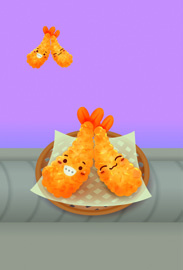
Tempura · 14
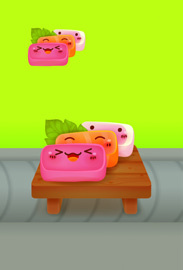
Sashimi · 14
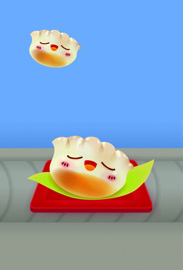
Dumpling · 14
Maki · 1 icon · 6
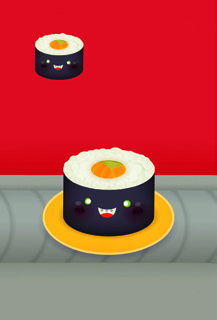
Maki · 2 icons · 12
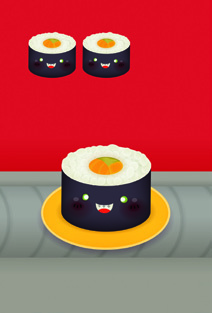
Maki · 3 icons · 8
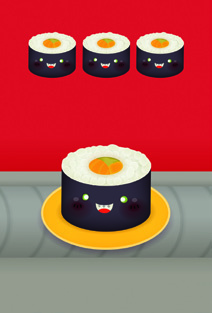
Egg nigiri · 5
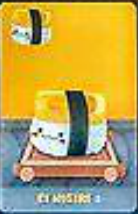
Salmon nigiri · 10
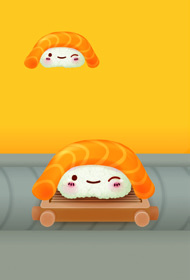
Squid nigiri · 5
Wasabi · 6

Chopsticks · 4

Pudding · 10

Decisions
Complete tempura or sashimi?
From the same hand, resolve each alternative once.
Tempura adds 5, sashimi adds 10. Sashimi gains more here, but passing tempura may help your neighbour; hidden hands prevent a guaranteed win.
Salmon or squid on wasabi?
Preview and resolve either nigiri with an unused wasabi.
Salmon scores 6, squid 9; both consume wasabi. Squid gains 3 more, but the other card passes to an opponent whose benefit is unknown.
One point now or avoid a penalty?
Final choice of round three: compare egg and pudding.
Egg adds 1 but zero pudding loses 6: net −5. Pudding adds no food points but reduces the penalty to −2: 3 better here, not a rule to always pick pudding.
Rule questions
How do you win Sushi Go!?
After three rounds, add pudding points; highest total wins.
Conditions: Break a points tie by pudding count; if still tied, the players remain joint highest.
Example: Rounds of 18, 20 and 17 plus 6 for pudding give 61.
How many cards are dealt?
For 2/3/4/5 players deal 10/9/8/7 cards each round.
Conditions: The base deck has 108 cards. Keep undealt cards face down for later rounds; do not shuffle in discards.
Example: Four players receive eight each: 32 cards in a round.
What is the pick–reveal–pass order?
Everyone secretly picks one, all reveal together, then pass remaining hands left.
Conditions: Revealed cards stay with their owner. Lessons use open fixed positions, not live opponents’ hidden choices.
Example: Pick one from three, reveal it, and pass the other two.
What do three tempura score?
Three tempura score 5: one pair, plus an unpaired zero.
Conditions: Multiple pairs count; sets do not carry between rounds.
Example: Four score 10; do not assign 2.5 to every card.
What do two or four sashimi score?
Two score 0; four score 10. Only complete triples count.
Conditions: Incomplete sashimi sets do not carry forward.
Example: With two already collected, a third adds 10 definite round points.
Are dumpling scores cumulative totals?
Totals for 1–5 cards are 1, 3, 6, 10 and 15; more than five still score 15.
Conditions: These are totals; do not add 1 + 3 + 6 together.
Example: Going from three to four changes 6 to 10, an increase of 4.
Can wasabi boost an earlier nigiri?
No. Wasabi applies only to the next nigiri acquired after it, and using it is mandatory.
Conditions: One nigiri per wasabi; multipliers do not stack. Unused wasabi scores zero.
Example: Salmon, then wasabi, then squid: 2 + 0 + 9 = 11.
How much is each nigiri worth?
Egg scores 1, salmon 2, squid 3; on wasabi they score 3, 6, 9.
Conditions: Wasabi multiplies only its paired nigiri, not your whole tableau.
Example: An egg after unused wasabi consumes it for 3; it cannot be saved for a later squid.
How do chopsticks let you pick two?
With chopsticks already on your table, a later turn may take two cards. Return the chopsticks before passing.
Conditions: Use at most one per turn. Newly picked chopsticks cannot be used that turn. Chopsticks score zero.
Example: From three cards pick two: pass the remaining card plus the returned chopsticks.
Does order matter for wasabi and nigiri picked together?
Lessons place cards in the explicit selection order: wasabi first, then nigiri, forms a triple.
Conditions: This is the fixed lesson’s explicit ordering convention; the manual does not separately detail placement for this same-turn combination.
Example: With chopsticks, choose wasabi then squid, labeled 1 and 2: preview 9 points.
How are maki ranked and ties split?
Count roll icons at the top of cards. First scores 6, second 3.
Conditions: Tied first splits 6 with no second prize. Tied second splits 3; discard remainders.
Example: Icons 5,3,3,2 score 6,1,1,0; icons 4,4,3 score 3,3,0.
What happens to the last card and at round end?
Reveal the final single card. Score this round’s food and maki; retain pudding.
Conditions: Discard everything else; deal fresh hands of the same size from the unused deck next round.
Example: Discard an unpaired tempura; keep pudding until the end of round three.
When is pudding scored?
Only after round three compare pudding accumulated across all rounds: most +6, fewest −6.
Conditions: Split tied awards and penalties, discarding remainders. Zero counts for fewest; if all equal, everyone gets zero.
Example: Pudding counts 4,3,0,0 give +6,0,−3,−3.
What changes with two players or the dummy variant?
Ordinary two-player hands have ten cards; pudding rewards most without penalizing fewest.
Conditions: The separate dummy variant deals three hands of nine, alternating control of the dummy. WANGO does not offer this dummy variant.
Example: In ordinary two-player play, pudding 2 versus 0 gives +6 and 0.
Do hands always pass left?
Base rules pass left each round. An optional variant passes right in round two, left in rounds one and three.
Conditions: Agree before play; WANGO offers the alternate-direction setting.
Example: Do not change direction halfway through a round.
Is this Sushi Go! or Sushi Go Party!?
This guide covers the 108-card 2014 Gamewright base game, without Party menus or expansion cards.
Conditions: There is no board or map: use hands, tableaus, retained pudding, draw pile and discards.
Example: Party menu and eel rules are outside this guide.
Sources and scope
Checked 2026-10-29; 108-card Gamewright 2014 base edition, seven-page official PDF. Design Phil Walker-Harding, art Nan Rangsima. Contents/setup p.2; chopsticks/maki p.3; food/cleanup p.4; pudding/winning/variants pp.5–6.
Ten original card illustrations come from the official PDF; egg and squid from Buffalo Public Library p.1 photographs of the base game. Images belong to their owners. Strategy is WANGO position analysis. Same-turn placement in selection order is an explicit lesson convention, not a separate manual ruling. Party rules do not apply.
Fixed lessons do not simulate a complete multiplayer draft. The full demo supports 2–5 players with bots and optional alternating passing direction, using WANGO SVG art. Dummy play, full-game ties and every ranking combination have reference text but no standalone lesson.
Official rules · Original photographs