CATAN guide
Learn base-game production, building, trading, the robber, development cards and scoring; fixed lesson maps are WANGO originals.
Scope: English 2020 base-game rulebook with 2015 original artwork, 3–4 players, 10 VP. The preset beginner island and variable setup use the same 19 land hexes. No 5–6-player, Seafarers or Cities & Knights rules. The WANGO demo has its own documented scope.
Twelve independent fixed exercises cover common first-game actions. Switching resets the selected exercise; this is not one continuous random game.
Learn by playing
Collect after an 8
On the WANGO original teaching island, blue selects forest 8, previews +1 lumber and confirms. Mountains 8 belongs to white’s production.
Settle at C
On the WANGO original position diagram, blue pays 1 each lumber/brick/wool/grain to settle C; B is rejected by the distance rule.
Upgrade A to a city
On the WANGO original position diagram, blue pays 3 ore and 2 grain to upgrade A, returns the settlement, and raises visible points from 1 to 2.
Extend your own road
Choose the empty edge between the two Bs in the WANGO original position diagram and pay 1 lumber + 1 brick. Red’s road is occupied; the remote edge is disconnected.
Fill a resource gap at 4:1
Choose 4 identical lumber for 1 bank ore. Mixed types cannot form the four-card payment; do not exchange for the same type.
Use a wool harbor at 2:1
Your blue settlement already controls the pictured wool harbor E: exchange 2 wool for 1 ore. Two lumber cannot pay the ordinary 4:1 rate.
Roll 7: discard 4 of 9 resources
Select exactly 4 resources to discard before previewing. Development cards neither count toward the resource total nor get discarded here.
Move the robber and choose one victim
Discards are complete. Choose another hex, then one adjacent opponent with resources. The stolen type is revealed only on confirmation. A hex without an eligible victim is also legal.
Play an older Knight before rolling
Select a Knight bought on an earlier turn, then move the robber. A newly bought Knight cannot be played. This lesson starts with 2 played Knights: the third awards Largest Army for 2 VP, without discarding half of 9 resources.
Year of Plenty: take 2 from the bank
Play an older Year of Plenty and select 2 available bank resources, including the same type twice. Confirmation transfers cards and uses your development-card play for the turn.
Monopoly: take one type from all opponents
All three opponents’ hands are public for this exercise. Name a resource and collect every card of that type from red, white and orange, not from the bank.
Reveal VP cards on your own turn
You have 8 public VP and 2 VP cards. Select both and compare the opponent’s turn with your turn: only your own turn permits the immediate 10-VP victory.
Public fixed positions, not a complete random game. Figure F has no numbers; future production cannot be inferred.
Original components and island
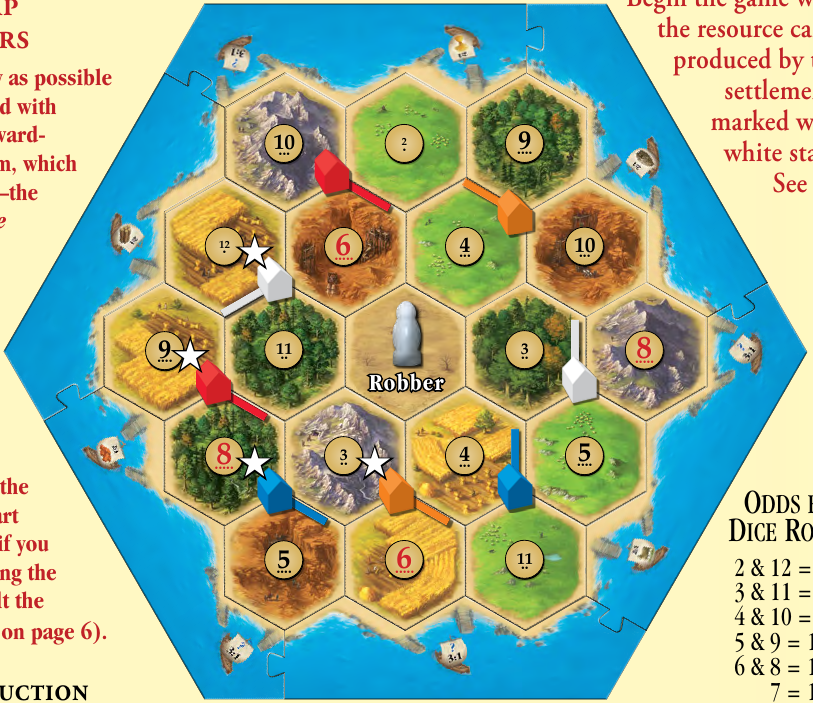
WANGO original fixed teaching island: 19 hexes and 18 tokens
Base-game terrain counts: 4 forests, 4 pastures, 4 fields, 3 hills, 3 mountains and 1 desert; all 18 number tokens go on non-desert hexes. The terrain, tokens and pieces are WANGO originals, not the original board. This number layout differs from the rulebook example and keeps 6 and 8 apart. Used for the production and robber lessons on this page.

Six terrains and five resources (original rules illustration)
WANGO original vector illustration, not original terrain tiles. Left to right: hills→brick, forest→lumber, mountains→ore, fields→grain, pasture→wool, desert→nothing. The base game has 95 resource cards, 19 of each type; use the text rules for production and buildings.
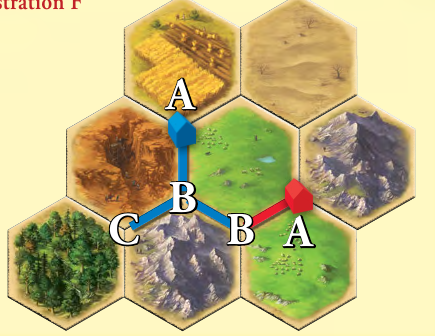
Roads, intersections and distance: WANGO position diagram
Drawn by WANGO to explain the official spacing and connectivity rules; this is not Illustration F. Blue roads use edges; blue A and red A use intersections. Each player has 15 roads, 5 settlements and 4 cities. B is too close to blue A; C is two edges away and connected, so it is legal.

City: replace your settlement to raise 1 VP to 2
WANGO original piece illustration, not an original component. Replace only your own settlement: pay 3 ore and 2 grain, return one settlement and place one city. Its score changes from 1 VP to 2, a net gain of 1.

18 number tokens: no 7 (original rules illustration)
WANGO original vector token illustration, not original pieces. One each of 2 and 12; two each of 3, 4, 5, 6, 8, 9, 10, 11. Add two six-sided dice: 6 and 8 each have 5/36 odds; 7 has 6/36 but triggers the robber instead of production. Pips show dice combinations, not resource yield.

Robber: block one hex’s production (original rules illustration)
WANGO original piece illustration, not the original robber component. It blocks production on one hex but not other hexes with the same number. On a 7, discard first, move to another land hex, then steal one random resource from one eligible opponent.
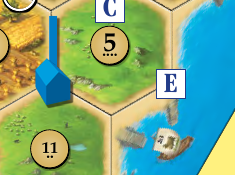
Wool harbor illustration: occupy a coastal intersection
WANGO original local illustration, not an original harbor component or complete coastline. The wool harbor trades wool at 2:1; your settlement or city must occupy its linked intersection. The base game also has four generic 3:1 harbors and one 2:1 harbor for each other resource.
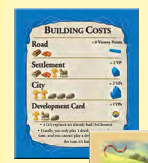
Base-game building costs (original rules illustration)
WANGO original vector reference, not original cost cards. Road: 1 lumber + 1 brick. Settlement: 1 each lumber, brick, wool and grain. City: 3 ore + 2 grain. Development card: 1 each ore, wool and grain. Pay the bank and meet supply, connectivity, spacing and turn limits.
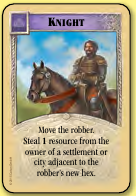
14 Knights: move the robber and attempt theft (original illustration)
WANGO original Knight-themed illustration, not the original card face. Keep played Knights face up for Largest Army; Knights do not cause half-hand discards. The first player to play 3 qualifies for the award; a challenger must play strictly more.
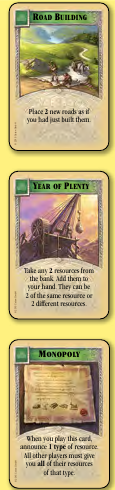
Three Progress cards: Road Building, Plenty, Monopoly (original illustration)
WANGO original card concepts, not original card faces. Road Building places up to 2 legal roads for free; Year of Plenty takes 2 available resources from the bank; Monopoly takes one named type from opponents. Remove a played card from the game.
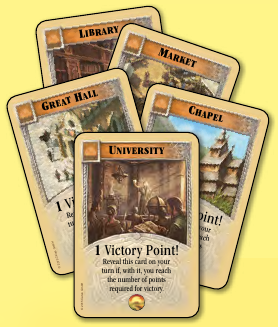
Five victory-point cards: 1 VP each (original illustration)
WANGO original card concepts, not original card faces. There is one each of Library, Market, Great Hall, Chapel and University; each is worth 1 VP with no additional effect. Keep them hidden; reveal on your turn to win if they bring you to 10 VP. The 25-card deck has 14 Knights, 6 Progress and 5 VP cards.
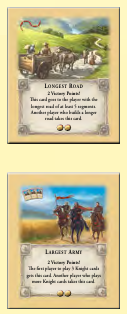
Longest Road and Largest Army (original rules illustration)
WANGO original award illustrations, not original award cards. Each award is worth 2 VP and can transfer. Longest Road requires at least 5 connected road segments; Largest Army starts at 3 played Knights, and a challenger must strictly exceed the holder.
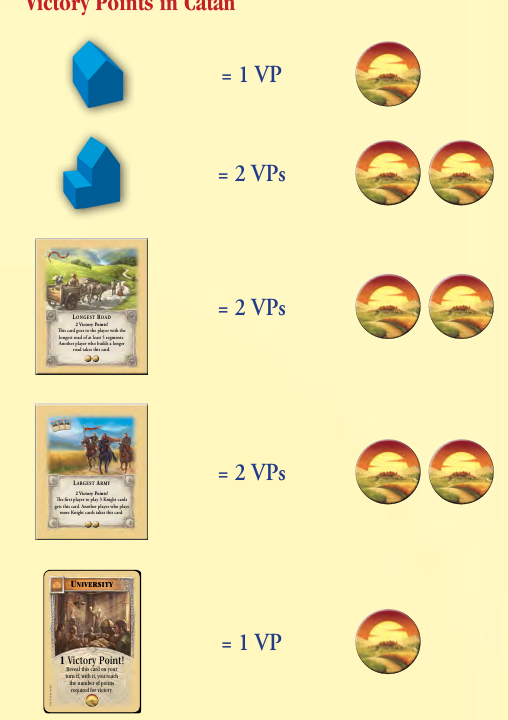
Victory points and game end
WANGO original vector scoring diagram: 1 VP per settlement; 2 total per city (+1 net when upgrading); 2 per award; 1 per VP card. Reach 10 on your own turn to end immediately. It is not an original component or scoring illustration.

Two six-sided dice: yellow and red
Third-party photograph of replacement dice identified as the 2015 base edition, rather than a rulebook illustration. Add the dice to determine production; colors do not indicate resources. The pictured 3 + 6 is 9; the separate lesson publicly fixes its roll at 8.
Bank resource piles are public; resource hands and unplayed development cards are hidden; played Knights and awards are public.
Same resources: expand or upgrade
Same WANGO original unnumbered position diagram with 1 lumber, 1 brick, 1 wool, 3 grain, 3 ore: settling C spends 4 and leaves 2 grain + 3 ore; upgrading A spends 5 and leaves 1 lumber + 1 brick + 1 wool + 1 grain. Both net 1 VP. C adds forest/hills/mountains coverage; A doubles existing grain/brick/wool yields. The diagram has no number tokens, so future production is not guaranteed; consider actual tokens, contested sites and resources.
Rule questions
How do you win CATAN?
Reach at least 10 victory points on your own turn to win immediately.
Conditions: Settlements are worth 1, cities 2, Longest Road and Largest Army 2 each, and each victory-point development card 1. Reaching 10 on someone else’s turn does not win yet.
Example: Two settlements + two cities + Longest Road + two VP cards = 10. A city’s 2 points include the settlement it replaced.
What do you place and collect at setup?
Each player starts with 2 settlements and 2 roads; starting resources come only from producing hexes beside the second settlement.
Conditions: In variable setup, place the first settlement/road clockwise and the second counterclockwise. Both obey the distance rule; each road touches the settlement just placed. Follow the preset beginner map; white stars identify starting-resource settlements.
Example: If the second settlement borders forest, mountains and desert, take 1 lumber and 1 ore, with no desert resource or extra cards from the first settlement.
Who receives production after a roll?
All players check matching numbered hexes: each adjacent settlement yields 1 card, each city 2.
Conditions: A robber-blocked hex and the desert produce nothing; 7 produces nothing. Production is not limited to the active player. Apply shortage rules if the bank lacks cards.
Example: On the beginner map, an 8 gives blue and red 1 lumber each beside forest 8 and white 1 ore beside mountains 8.
Where can you build roads and what do they cost?
Pay 1 lumber and 1 brick to place a road on an empty edge connected to your road, settlement or city.
Conditions: One road per edge. An opponent’s building blocks extension through that intersection. Roads do not directly score; setup roads are free.
Example: A blue road reaching B may extend along another empty edge from B; it cannot jump to a disconnected edge.
How does the settlement distance rule work?
Pay 1 each of lumber, brick, wool and grain at an empty intersection connected to your road, with no building at any adjacent intersection.
Conditions: The restriction includes your own buildings. Setup settlements need no existing road but still obey distance. Roads occupy edges; buildings occupy intersections.
Example: In official Illustration F, B separates blue A from C, so C is legal; B touches blue A and is illegal.
Can you build a city on an empty intersection?
No. Pay 3 ore and 2 grain to upgrade one of your own settlements in place.
Conditions: Return the settlement piece and use one city from supply. Its 1 point becomes 2, a net gain of 1; normal production there changes from 1 to 2.
Example: Upgrading blue A leaves the city at A. You cannot place it at empty C or red A, and you do not gain 2 additional points.
Who can trade resources?
After production resolves, resource trades must include the active player.
Conditions: Ratios are negotiated. No gifts, same-resource exchanges or development-card trades. Other players cannot trade with each other during your turn.
Example: On blue’s turn, red can trade grain with blue, but red cannot trade with white without blue.
When are bank and harbor trades 4:1, 3:1 or 2:1?
Without a harbor, exchange 4 identical resources for 1. Generic harbors offer 3:1; specialized harbors offer 2:1 only for their pictured resource.
Conditions: You need your settlement or city at one of the harbor’s two marked intersections. A road reaching the coast is insufficient. Use it on your turn and take an available resource.
Example: A wool harbor permits 2 wool for 1 ore, not 2 lumber for 1 ore; without a harbor, 4 lumber can buy 1 ore.
When does a 7 make you discard half?
Every player holding more than 7 resource cards discards half, rounded down; then move the robber and attempt a theft.
Conditions: Development cards are excluded; exactly 7 resources require no discard. Discard before moving the robber; 7 produces no resources.
Example: With 9 resources, discard 4 and keep 5; with 8 discard 4; with 7 keep all 7.
How do you move the robber and steal?
Move to a different land hex, including the desert, blocking its production; randomly steal 1 resource from one eligible adjacent opponent.
Conditions: Choose one adjacent opponent, not every opponent; do not choose the resource type. Move even if nobody can be robbed. A Knight does not trigger half-hand discards.
Example: If two opponents border the new hex, take one random resource from only one of them. The desert remains a legal destination even without buildings.
When can you buy and play development cards?
Pay 1 each of ore, wool and grain to draw the top development card secretly. Play at most 1 Knight or Progress card per turn, normally from an earlier turn.
Conditions: You may play before rolling. Purchases are limited by resources and deck supply. Reveal VP cards, including newly bought ones, when they let you win; they do not count toward that one-card limit.
Example: Keep a Knight bought this turn. An older Knight may be played before rolling, but then you cannot also play Year of Plenty this turn.
What do the three Progress cards do?
Road Building places up to 2 legal roads free; Year of Plenty takes 2 available resources from the bank; Monopoly collects one named resource type from every opponent’s hand.
Conditions: Roads still obey connectivity and supply. Year of Plenty may take the same or different types, subject to bank supply. Monopoly takes no bank resources or development cards.
Example: Naming ore with Monopoly takes 2 ore from one opponent and 1 from another, for 3; already spent ore is unavailable.
How is Longest Road counted, and do ties transfer it?
The first player with a continuous route of at least 5 segments receives 2 points; a challenger must exceed the current holder to take it.
Conditions: Count each segment once, not all branches together. Opponent buildings interrupt routes. Recompute after interruption; a tie without the prior holder among the leaders may leave the card unowned.
Example: If blue holds it at 5 and red reaches 5, blue keeps it; red needs 6. Losing it costs 2 points and gaining it adds 2.
Does Largest Army count held or played Knights?
Count played Knights only. The first player with 3 gets 2 points; another player must play more to take it.
Conditions: Unplayed Knights do not count. Ties do not transfer it, and the one-development-card-per-turn limit still applies.
Example: Blue with 3 retains it against red’s 3; red may take it by playing a fourth on a later turn.
What happens when the bank runs short?
If one resource cannot cover all entitled players, normally nobody receives that resource; distribute other types normally.
Conditions: If only one player is entitled to that resource, give them what is available. There is no deferred payment.
Example: If two players each need 1 ore and only 1 remains, neither gets ore. If only one player needs 2 and 1 remains, that player gets 1.
Can you build only once per turn?
No. After rolling and resolving production, you can trade and build repeatedly while resources and pieces allow.
Conditions: The beginner sequence separates trade then build; the almanac recommends combining them for experienced play, allowing immediate use of a new harbor. Development-card limits still apply.
Example: Under combined trade/build, build a road, settle a harbor, then use it for ore. This page’s building exercises resolve one action at a time.
Coverage and gaps
Component reference and rule questions
Covered: core types, setup, turns, costs, scoring and 16 questions
Real interactions
Covered: 12 exercises, including the first Largest Army award
Strategy comparison
Covered: settle C or upgrade A from the same resources, with different remaining cards and production coverage
Snake setup and number-token placement
Rules and original map are present; free two-round placement and variable-layout exercises remain absent
Production exceptions and generic harbors
Double city production, robber blocking, bank shortages and generic 3:1 harbors are documented; dedicated interactive exercises are still absent
Road Building and Longest Road
Costs, connectivity and award rules are documented; two free roads, loops, branches, interruption and transfer remain text only
Buying development cards and a hidden deck
Buying costs and timing are documented; random purchases, deck exhaustion and a complete deck flow are not simulated
Negotiation and multiplayer resolution
Trade limits, shortages and ties are referenced; live negotiation, whole-table discards and contested awards are not simulated
Expansions and other editions
Outside this guide: 5–6 players, Seafarers, Cities & Knights and sixth-edition artwork
Scope and sources
Scope: English 2020 base-game rulebook with 2015 original artwork, 3–4 players, 10 VP. The preset beginner island and variable setup use the same 19 land hexes. No 5–6-player, Seafarers or Cities & Knights rules. The WANGO demo has its own documented scope.
Checked 2026-10-28. Rules: p.2 components; p.3 island A; pp.4–7 production/building/robber/scoring/figure F; pp.8–11 harbors/development/awards/shortages; pp.12–13 setup; p.14 scoring. Strategy is editorial analysis. Original images ©CATAN GmbH / CATAN Studio; crop and source records are available.
CATAN Rules & Almanac · Official FAQ · Image sources