Brass: Pittsburgh
Practise building, railways, oil transport and selling on the original board, then compare real choices from the same position.
Learn by playing
Practise building, railways, oil transport and selling on the original board, then compare real choices from the same position.
Select game objects, preview the result, then confirm; all rules remain readable without completing exercises.
Iron needs a railway too
Take one iron from connected Cleveland to develop the accessible kerosene II tile. New York has no railway connection.
Pittsburgh transports iron, steel, coal and coke by railway. Connected industries take priority. Development removes a player-mat tile; it does not build on the map.
Use Cleveland iron and develop
Use Cleveland iron and develop
Try New York iron
Verify that a disconnected source is rejected.
Build coal and fill a local market
Use a Clarksburg card to build coal I in its empty coal space. Another player’s works there supplies one iron; its coal market has two vacancies.
Coal I costs $5 and one iron and produces three coal. On construction, fill connected markets where possible. Two coal sell for $3 each; one remains, so the mine stays unflipped. Proceeds do not reduce recorded spending.
Build coal I and sell two coal
Build coal I and sell two coal
Light trains and coal transport
Pay one coal from your Pittsburgh mine to build the Pittsburgh–Columbus light train.
A light train costs one coal, with no fixed cash fee. The newly placed railway may help transport its construction coal. It scores and is removed at era end.
Build a light train for one coal
Build a light train for one coal
Pipeline and first prospecting
The money pipeline is already unlocked. Use one iron at Pittsburgh to connect it to Venango, covering one oil icon.
A pipeline costs one iron. Its route icon adds one oil now, and first prospecting grants the tile’s left reward. This fixed oilfield grants three income spaces and zero next-era oil. Its money pipeline later earns its owner $10 per barrel transported.
Build pipeline and prospect
Build pipeline and prospect
Sell with oil and a merchant reward
Sell Pittsburgh manufacturing I: railways connect it through Columbus to the Cincinnati merchant; source one oil from Venango through the orange pipeline.
Manufacturing I needs one oil. The orange money pipeline earns $10; you gain the merchant’s $15 and four income spaces from flipping the industry. Its five industry VP wait until era end.
Source one oil and sell manufacturing I
Source one oil and sell manufacturing I
Whiskey makes a card wild
Your only card names Cleveland. Spend one whiskey to treat it as New York, then pay $12 to build manufacturing I in its legal space. This tile consumes no resource.
Manufacturing I costs only $12, with no cube resource cost. A location card may build outside your network. This action spends one whiskey and one card, reducing cash from $30 to $18. The new industry stays unflipped and grants no industry VP or income yet.
Spend one whiskey and build in New York
Spend one whiskey and build in New York
Loans lower levels, not spaces
You have $5 and income space 20 (level five). Discard one card to borrow $30.
Lose three income levels, reaching the highest space of level two: space 14, not space 17. Borrowing does not count as spending, and the principal is never repaid.
Borrow $30 and lose three income levels
Borrow $30 and lose three income levels
Era scoring and retained pieces
Era one’s deck and every hand are empty. The pictured state has flipped coal I and kerosene II, one light train, one heavy train, one pipeline and three pending oil.
The light train scores three link VP, the heavy train five, and industries 1+4, totalling 13 VP. Remove the light train and level-I industry; retain the heavy train, pipeline and level-II industry, add three oil, shuffle discards and draw eight cards for you. Other players’ draws and the remaining shared deck size are outside this lesson. Pipelines score no link VP.
Score and enter era two
Score and enter era two
Components, industries and map
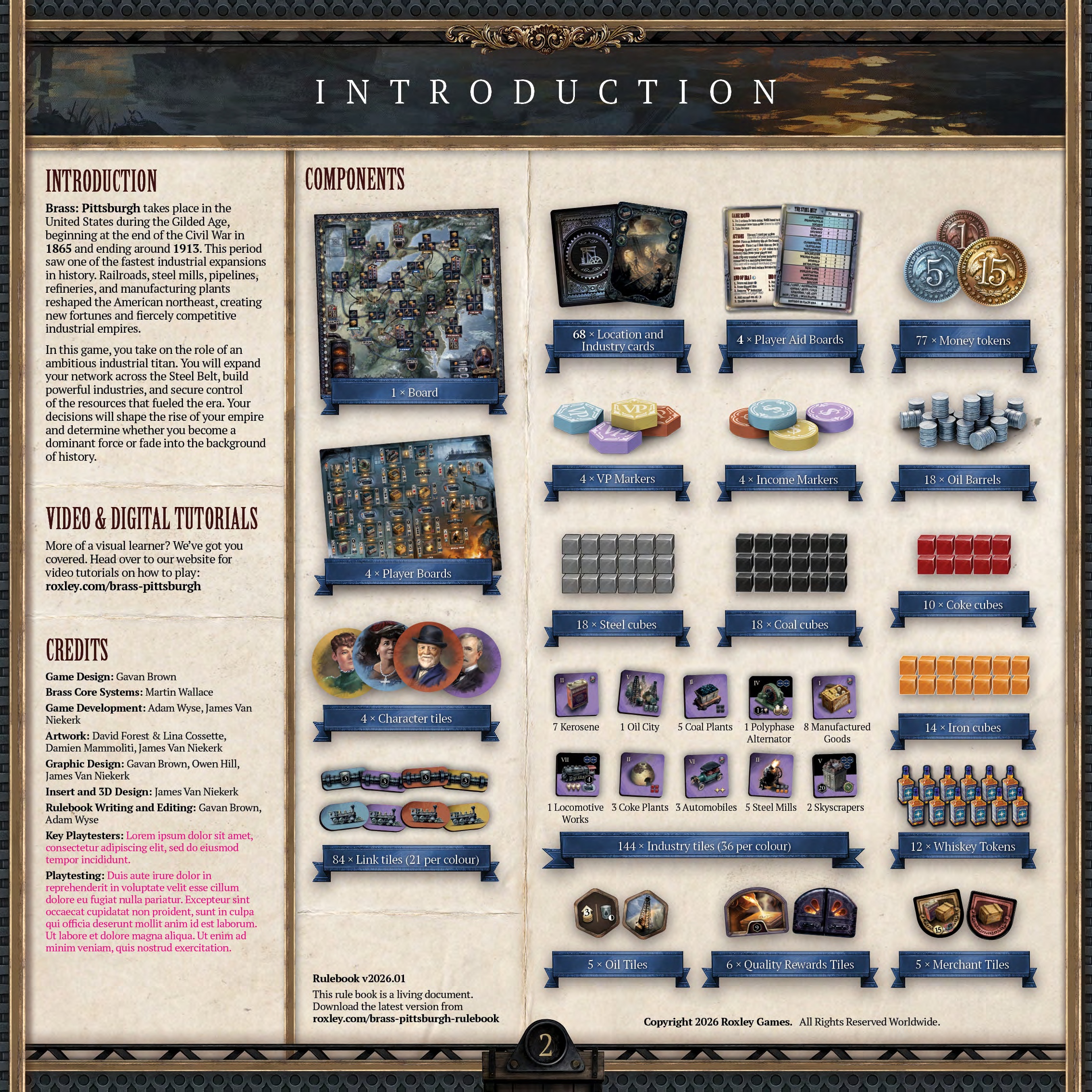
Double-sided board · 1
Dedicated two-player and three/four-player sides.
Location and industry cards · 68
Filter by player-count icons; discard one for each normal action.
Player boards · 4
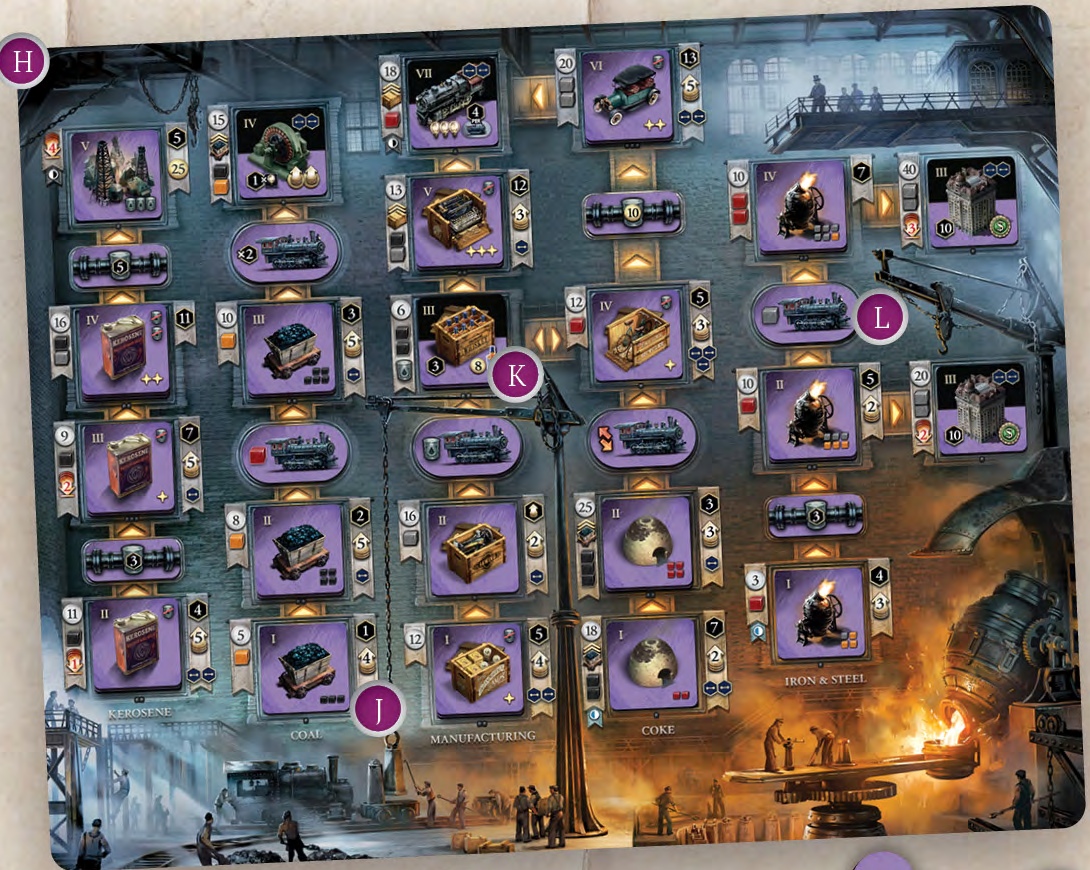
Five industry paths, branches and locked link tiles.
Player aid boards · 4
Setup, turn and rule reminders.
Money tokens · 77
Unlimited general supply; track round spending.
VP markers · 4
Track total VP, which can fall below zero.
Income markers · 4
Start at space 10; increase by spaces, decrease by levels.
Character tiles · 4
Double-sided; randomise initial turn order.
Industry tiles · 144
36 per colour across 10 actual industry types.
Link tiles · 84
21 per colour: light trains, heavy trains and pipelines, some unlocked along industry paths.
Oil barrels · 18
Leave oilfields via a transport pipeline, then trains; physical count does not cap general supply.
Coal cubes · 18
Black; train transport required, used to build light trains.
Iron cubes · 14
Orange; train transport required, used for pipelines and development.
Steel cubes · 18
Grey; train transport required, used for heavy trains.
Coke cubes · 10
Red; initial market sales can earn additional VP.
Whiskey tokens · 12
Maximum 3 per player; make build cards wild or add quality stars.
Oilfield tiles · 5
Reveal on first pipeline connection; distinguish immediate reward from next-era oil.
Quality reward tiles · 6
Use 3 at random; at most 1 claimed per sale.
Merchant tiles · 5
Match sale icons; flip after paying a merchant reward.
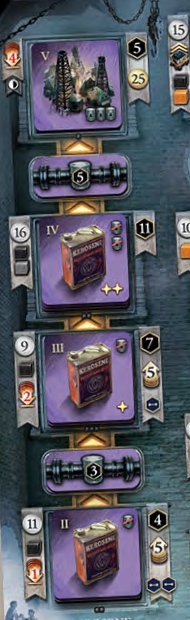
Kerosene Refinery · 7
Sell to a kerosene merchant using printed oil. Resolve printed flip rewards and score VP at era end; higher tiles need not have income or link icons.
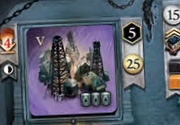
Oil City · 1
Era two: build on a pipeline-connected oilfield, take existing oil plus 3 barrels; depletion flips it for $25.
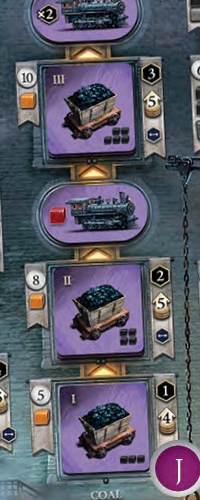
Coal Mine · 5
Produces coal; initially fill connected market vacancies. Any connected player may use remaining coal for free; depletion flips it.
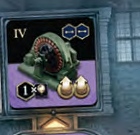
Polyphase Alternator · 1
Upgrades your flipped coal industry; gain twice current income in cash, then score empty industry spaces at era end.
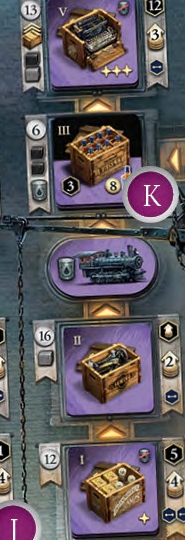
Manufactured Goods · 8
Sellable tiles require matching merchants and oil. Some higher tiles are already flipped; follow printed cash, income, stars and link icons.
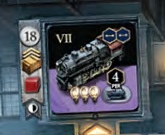
Locomotive Works · 1
Era two only; upgrades flipped manufacturing. Gain 3 free develops; score 4 VP per built heavy train at era end.
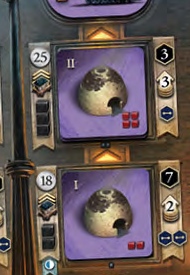
Coke Plant · 3
Produces coke; initial sales into connected coke-market spaces also earn their printed 4 VP per cube.
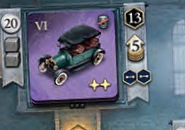
Automobile Manufacturer · 3
A branch of manufacturing; sell using an automobile merchant and printed oil, contributing quality stars.
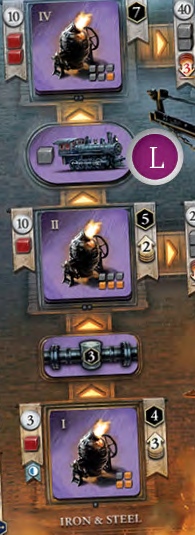
Iron & Steel Works · 5
Produces iron and steel; both require train transport and initially fill their connected matching markets.
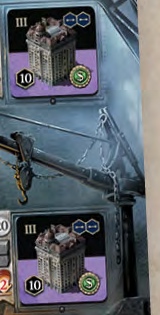
Skyscraper · 2
A branch of iron and steel. Built flipped; offers an immediate sale without a discard, with printed VP scored at era end.
| Industry and level | Build cost | Production | Flip reward | Era VP | Link icons | Quality stars | Oil to sell | Verification notes |
|---|---|---|---|---|---|---|---|---|
| Kerosene II · II | $11 + 1 coal + lose 1 income level | None | Sell: +5 income spaces | 4 | 2 | 0 | 1 | Reviewed against native crops of the current public PDF. Physical counts per level and final version-51 values are not verified. |
| Kerosene III · III | $9 + 1 coal + lose 2 income levels | None | Sell: +5 income spaces | 7 | 1 | 1 | 1 | Reviewed against native crops of the current public PDF. Physical counts per level and final version-51 values are not verified. |
| Kerosene IV · IV | $16 + 1 coal + 1 steel | None | Sell to flip; no immediate reward icon. Score 11 VP at era end. | 11 | 0 | 2 | 2 | Reviewed against native crops of the current public PDF. Physical counts per level and final version-51 values are not verified. |
| Oil City V · V | Lose 4 income levels; era two, pipeline-connected oilfield | Existing field oil + 3 oil | Depletion: $25 | 5 | 0 | 0 | — | Reviewed against native crops of the current public PDF. Physical counts per level and final version-51 values are not verified. |
| Coal I · I | $5 + 1 iron | 3 coal | Depletion: +4 income spaces | 1 | 1 | 0 | — | Reviewed against native crops of the current public PDF. Physical counts per level and final version-51 values are not verified. |
| Coal II · II | $8 + 1 iron | 4 coal | Depletion: +5 income spaces | 2 | 1 | 0 | — | Reviewed against native crops of the current public PDF. Physical counts per level and final version-51 values are not verified. |
| Coal III · III | $10 + 1 iron | 5 coal | Depletion: +5 income spaces | 3 | 1 | 0 | — | Reviewed against native crops of the current public PDF. Physical counts per level and final version-51 values are not verified. |
| Polyphase Alternator IV · IV | $15 + 1 coal + 1 iron; upgrade your flipped coal industry | None | On build: cash equal to twice current income | Empty industry spaces on your player board | 2 | 0 | — | Reviewed against native crops of the current public PDF. Physical counts per level and final version-51 values are not verified. |
| Manufactured Goods I · I | $12 | None | Sell: +4 income spaces | 5 | 2 | 1 | 1 | Reviewed against native crops of the current public PDF. Physical counts per level and final version-51 values are not verified. |
| Manufactured Goods II · II | $16 + 1 steel | None | Sell: +2 income spaces | Income symbol; see verification note | 1 | 0 | 0 | Some fields remain unverified. The VP position shows an income symbol. A 2025 publisher diary describes income-level scoring, but the current draft does not explain it separately; this dynamic scoring is not implemented in lessons. |
| Manufactured Goods III · III | $6 + 2 coal + 1 oil | None | Built flipped; gain $8 immediately | 3 | 0 | 0 | — | Reviewed against native crops of the current public PDF. Physical counts per level and final version-51 values are not verified. |
| Manufactured Goods IV · IV | $12 + 1 coke | None | Sell: +3 income spaces; whiskey reward not independently verified on the current image | 5 | 3 | 1 | 1 | Some fields remain unverified. Current image clearly shows +3 income. An earlier publisher diary described 1 whiskey, but that reward was not independently legible here and is not asserted from the older draft. |
| Manufactured Goods V · V | $13 + 1 coal + 1 steel; upgrade your flipped manufacturing | None | Sell: +3 income spaces | 12 | 1 | 3 | 1 | Reviewed against native crops of the current public PDF. Physical counts per level and final version-51 values are not verified. |
| Automobile VI · VI | $20 + 2 steel | None | Sell: +5 income spaces | 13 | 2 | 2 | 1 | Reviewed against native crops of the current public PDF. Physical counts per level and final version-51 values are not verified. |
| Locomotive Works VII · VII | $18 + 1 coke; upgrade your flipped manufacturing; era two only | None | Built flipped; 3 free develops | 4 VP per built heavy train | 2 | 0 | — | Reviewed against native crops of the current public PDF. Physical counts per level and final version-51 values are not verified. |
| Coke I · I | $18 + 2 coal; upgrade your flipped coal industry; era one only | 2 coke | Depletion: +2 income spaces | 7 | 2 | 0 | — | Reviewed against native crops of the current public PDF. Physical counts per level and final version-51 values are not verified. |
| Coke II · II | $25 + 3 coal; upgrade your flipped coal industry | 4 coke | Depletion: +3 income spaces | 3 | 1 | 0 | — | Reviewed against native crops of the current public PDF. Physical counts per level and final version-51 values are not verified. |
| Iron & Steel I · I | $3 + 1 coke; era one only | 3 iron + 1 steel | Depletion: +3 income spaces | 4 | 0 | 0 | — | Reviewed against native crops of the current public PDF. Physical counts per level and final version-51 values are not verified. |
| Iron & Steel II · II | $10 + 1 coke | 3 iron + 3 steel | Depletion: +2 income spaces | 5 | 0 | 0 | — | Reviewed against native crops of the current public PDF. Physical counts per level and final version-51 values are not verified. |
| Iron & Steel IV · IV | $10 + 2 coke | 1 iron + 5 steel | Flips on depletion; no income reward icon | 7 | 0 | 0 | — | Reviewed against native crops of the current public PDF. Physical counts per level and final version-51 values are not verified. |
| Skyscraper III (lower) · III | $20 + 2 steel + lose 2 income levels | None | Built flipped; optional immediate extra Sell action | 10 | 2 | 0 | — | Some fields remain unverified. This row transcribes printed page 5: both skyscrapers are III, 10 VP and 2 links. Page 10 instead depicts V, 20 VP and 3 links, an unresolved internal draft conflict. |
| Skyscraper III (upper) · III | $40 + 2 steel + lose 3 income levels | None | Built flipped; optional immediate extra Sell action | 10 | 2 | 0 | — | Some fields remain unverified. This row transcribes printed page 5: both skyscrapers are III, 10 VP and 2 links. Page 10 instead depicts V, 20 VP and 3 links, an unresolved internal draft conflict. |
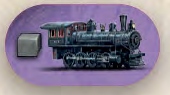
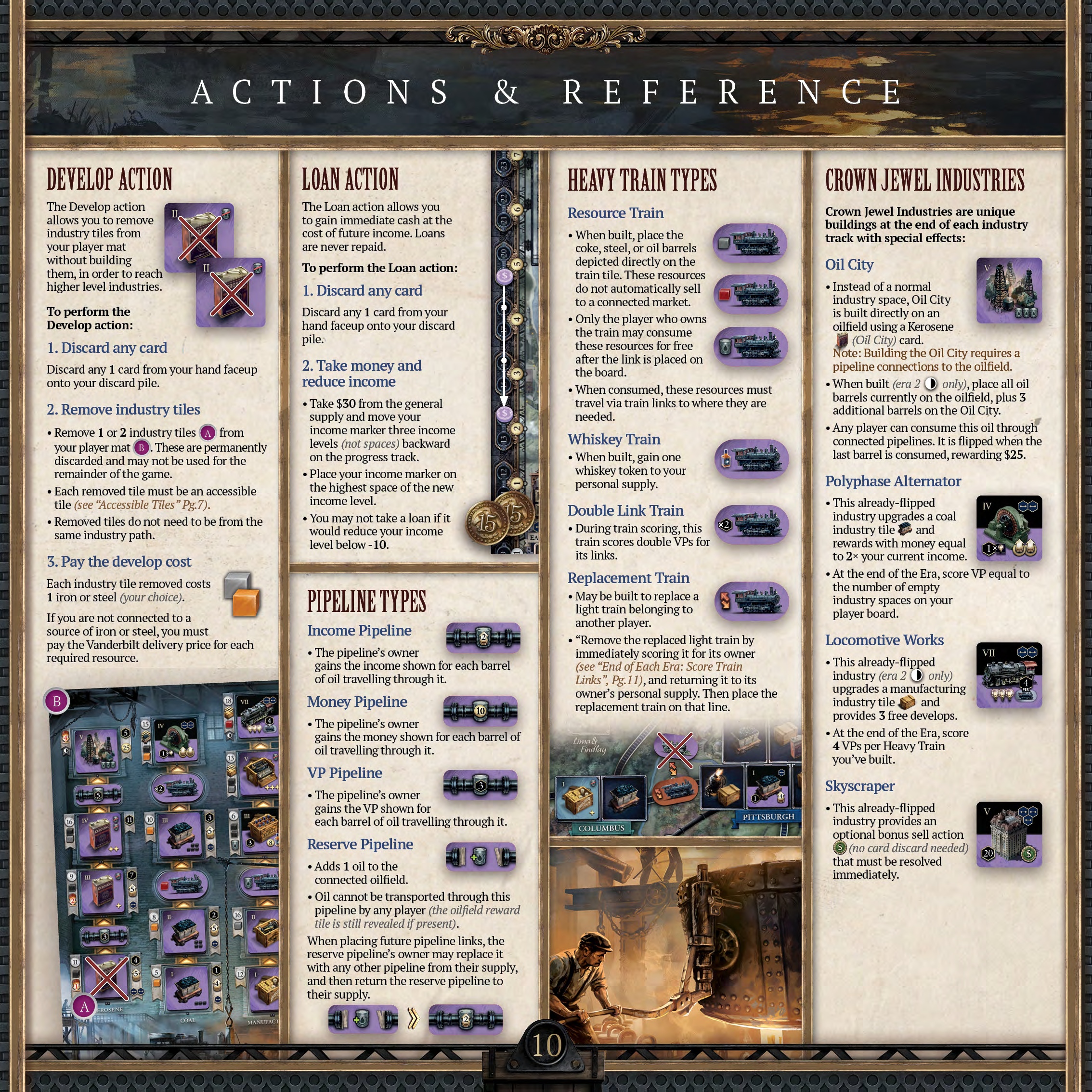
Resource heavy train
Produces printed owner-only resources; transport required, no automatic market sales, and cannot pay for itself.
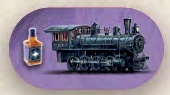
Whiskey heavy train
Gain 1 whiskey on construction.
Double-link heavy train
Double this train’s link points at era scoring.
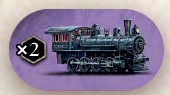
Replacement heavy train
Replace an opponent’s light train; first score and return that light train for its owner.
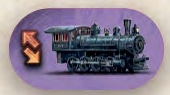
Income pipeline
Owner gains the printed income spaces for each barrel transported.
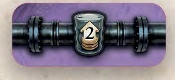
Money pipeline
Owner gains printed cash per barrel transported.
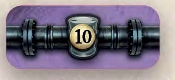
VP pipeline
Owner gains printed VP per barrel transported.
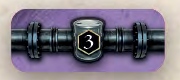
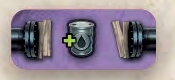
Reserve pipeline
Add 1 oil to its field; cannot transport oil. May reveal an oilfield; its owner can later replace and recover it.
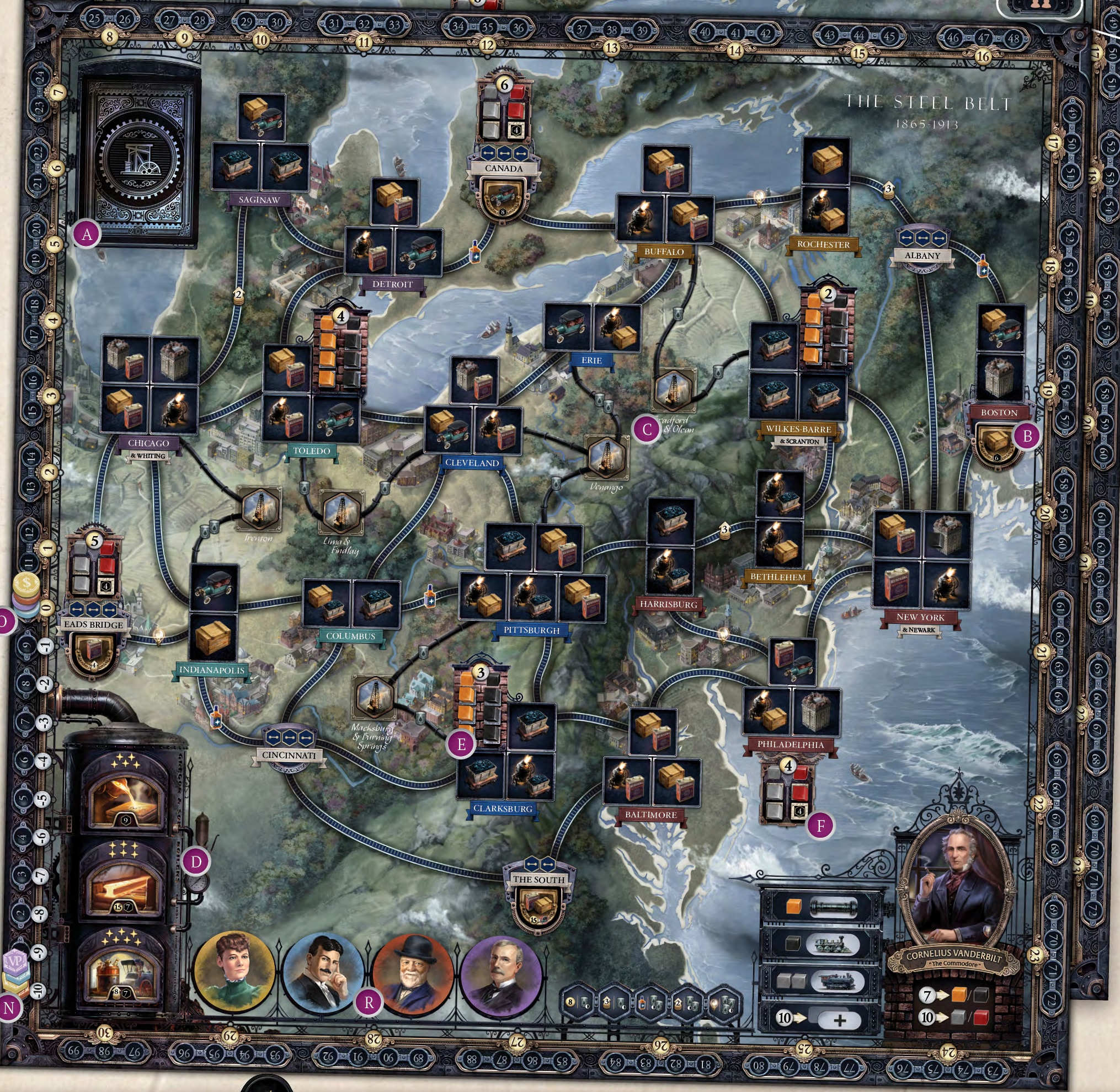
Three/four-player board
The original board used in the lessons, cropped from printed rulebook pages 4–5.
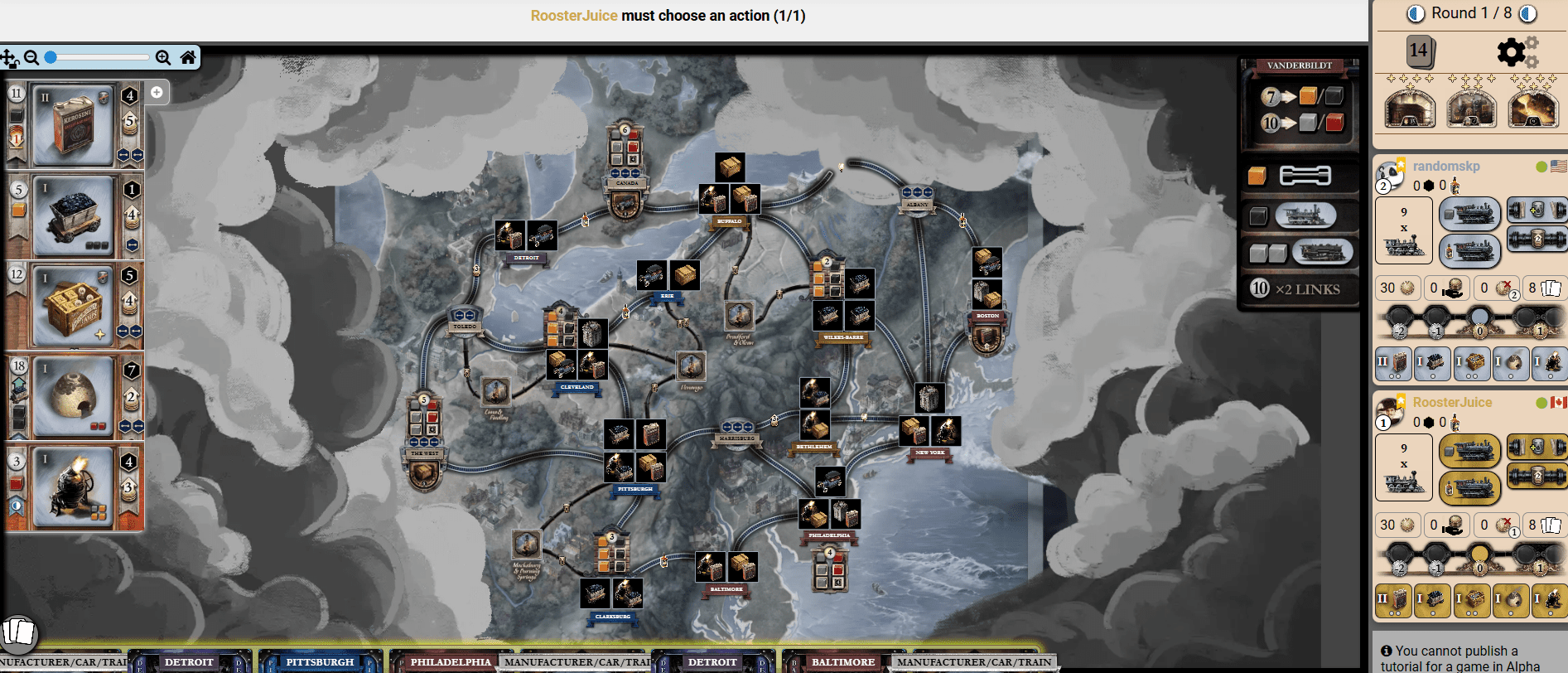
Two-player public test interface (2026-04)
Ed Chen’s game with Gavan, endorsed in publisher update 28: a BGA public test screenshot dated 2026-04-09. Compared with the three/four-player side, Saginaw, Chicago and Columbus are absent, the west uses The West, and routes and industry spaces differ. Reference only; does not switch the lesson and is not represented as the final version-51 board.

Rule questions
How do you win and break ties?
Most VP after both eras wins. Break ties by the higher income-track space, then cash.
The tiebreaker uses the marker’s space, not just its income level. Unflipped industries do not score in era scoring.
At 80 VP each and the same income level, the player on the higher income-track space wins the first tiebreak.
What does each player start with?
Start with $30 and 8 cards, VP at 0 and income on space 10 (level 0). Draw one extra card facedown beneath your discard pile.
The extra facedown discard is only part of era-one setup. Match industries to the player board; the starting personal supply also has 2 heavy trains, 2 pipelines and 9 light trains.
The extra facedown card is not a ninth card in hand and cannot pay for your first action.
How does setup change with player count?
Use the dedicated two-player side for two, and the other side for three or four. At two or three, filter cards by their player-count icons.
At two, remove the oilfield tile producing 3 oil and the merchant tile rewarding $15. The lesson image is the 3–4-player side, not the two-player side.
For two players, remove those two tiles before randomising the remaining merchants and oilfields.
How are markets and quality rewards set up?
Fill coal, iron and steel markets. Put only 1 cube in the top space of each coke market. Randomly reveal 3 quality reward tiles.
Return the unused quality rewards to the box. The general supply is unlimited; running out of physical pieces does not prevent production.
Empty coke-market spaces are intentional at setup, not missing cubes.
How many actions and discards do you take?
Normally take 2 actions sequentially, discarding 1 card for each. You may repeat an action.
In the first round of era one, each player takes only 1 action. Actions are Build, Network, Develop, Sell, Loan and Pass the whiskey.
Your second action cannot spend a reward from an unconfirmed preview of the first.
When do you refill your hand?
After your actions, refill to 8 cards if possible. When the deck runs out, continue with the cards left in hand until everyone is empty.
Refill at the end of your turn, not after each action. The rules describe 8 rounds per era; the ending trigger remains all players exhausting their hands.
From 8 cards, take two actions to reach 6 and draw 2. With only 1 card left in the deck, refill only to 7.
How is next round’s turn order decided?
Lower spending acts earlier next round. Tied spending preserves the players’ relative order.
Place money spent during your turn on your character tile. Return it after sorting at round end. Loan and sale receipts are not spending.
If A precedes B and both spend $10, A stays ahead. A’s $30 loan receipt does not count as spending.
Do you use income spaces or levels, and when?
At round end, receive or pay cash equal to the income level beside your marker. Increases use spaces; decreases use levels.
Determine turn order before income. Do not collect income after the final round of the game. After a decrease, use the highest space of the new level.
A marker on space 10 means income $0, not $10.
Which locations are in your network?
Your network includes locations containing your industries or adjacent to one of your links.
Locations are cities or merchant spaces with railway lines. Oilfields are not locations. Network ownership differs from transport connectivity.
An opponent’s railway can transport resources, but does not by itself make its far city part of your network.
Can resources use opponents’ trains or pipelines?
Resources may use continuous light- or heavy-train links of any colour. Pipelines do not connect locations as railways do.
Coal, iron, steel and coke all require train transport. Pipelines cannot carry these cubes.
Iron in the consuming city or reachable over an opponent’s train links can be used. A pipeline-only route cannot carry it.
What is the resource sourcing priority?
If a connected unflipped industry belonging to any player can supply a required cube for free, use industry cubes first.
The public draft’s resource-train paragraph also allows using trains instead of industries, creating ambiguity with the industry-priority wording on the same and final pages. Resource-train priority is unresolved here; exercises avoid that conflict.
With coal remaining in a connected mine, you cannot preserve it by buying market coal instead.
What if no resource source is connected?
Vanderbilt can deliver without a market connection: $7 per coal or iron, $10 per steel or coke, as printed on the board.
Connected industry cubes still take priority. Vanderbilt is not a general oil substitute. Oil on your resource trains follows train-resource rules.
Without connected iron, developing one tile can use $7 iron delivery; Birmingham’s unrestricted iron transport does not apply.
When does production sell to markets?
Only when an industry is built, sell as many produced cubes as possible into connected matching market vacancies, taking their cash and VP.
Choose the order among connected markets. Unsold resources remain on the industry. Later vacancies do not trigger another automatic sale.
Selling 2 coke cubes into spaces worth 4 VP each earns 8 VP immediately; any remaining coke stays on the plant.
How does oil reach an industry?
Oil must first leave its oilfield through a transport-capable pipeline, then follow continuous train links.
The pipeline owner receives its reward for each barrel passing through. Reserve pipelines cannot transport oil; pipelines cannot carry cubes.
Oil can leave Venango through the Pittsburgh pipeline and continue by train to a connected selling industry. Oilfield oil cannot bypass the pipeline.
How do cards and whiskey permit building?
A location card permits a matching industry space in that city. An industry card permits its industry in your network. Any card plus 1 whiskey can act as any location or industry card.
With no industries or links on the board, an industry card may start in any permitted location. Cards do not waive costs, spaces or era restrictions.
Without a Pittsburgh card, spend 1 whiskey to treat any card as Pittsburgh, then pay the normal building costs.
Can you build any higher-level industry?
Only accessible tiles may be chosen: the bottom of a path, or the next tile reached along its arrows after preceding tiles are removed.
Follow branch arrows. This is not simply choosing the highest number, nor does every earlier tile have to be built. Newly unlocked heavy trains or pipelines move immediately to your supply.
Developing a blocking tile can unlock its successors and a link tile positioned along that path.
Which industry space must you use?
Use an empty dedicated space for that industry in the city first. Only otherwise may you use a compatible mixed-icon space.
The space must permit that industry. Normal building cannot cover another player’s tile or ignore upgrade requirements.
With an empty coal-only space, you cannot take the coal/manufacturing space instead.
Can you build twice in one city in era one?
In era one, each player may build only 1 industry tile in each location. This restriction is removed in era two.
Individual tiles may be restricted to era one or era two. Removing the city limit does not remove a tile’s own era restriction.
In era one, already having an industry in Pittsburgh prevents another normal build there even if space remains.
Does Pittsburgh allow overbuilding?
Pittsburgh has no Birmingham-style overbuilding. A tile with an upgrade-cost icon replaces your own flipped industry of the indicated type and immediately scores the old tile.
The old tile may be any level, but must be yours and flipped. An upgrade-only industry cannot be put in an empty space.
A Polyphase Alternator replaces your flipped coal industry, scoring and removing the old coal tile immediately.
What do light trains, heavy trains and pipelines cost?
A light train costs 1 coal, a heavy train 2 steel, and a pipeline 1 iron, with no universal additional cash fee for placement.
Discard any 1 card per Network action. Purchased resources cost extra. Extend your network, unless you have no tiles on the board and may start on any appropriate empty line.
A light train using free connected coal does not pay Birmingham’s £5 railway fee.
How do you place a second link in one action?
Fully resolve the first link, then pay an extra $10 and the second link’s resources to place another legal link of any type.
Rewards, resources and connectivity gained from the first link can help the second, which must still be legal.
First connect to an iron market with a light train, then pay $10 and 1 iron for a pipeline. A not-yet-built second link cannot supply the first.
What are the four pipeline types?
Income, money and VP pipelines reward their owner per barrel transported. A reserve pipeline adds 1 oil to its oilfield but cannot transport it.
Use each tile’s printed value. A reserve pipeline can reveal an oilfield. Its owner may later replace it with another supplied pipeline and recover the reserve tile.
If both barrels for a sale pass through a money pipeline, its printed per-barrel reward triggers twice.
What happens when an oilfield is first connected?
When placing a pipeline, add oil for its route’s barrel icons. If it first connects that oilfield, reveal its tile and take the left-side reward.
For a tile revealed in era one, add its right-side oil at the era transition. If first revealed in era two, add it immediately and move the tile to its matching bottom-board space.
An era-one reveal showing 3 oil for the next era does not immediately add those 3 barrels.
What special abilities do heavy trains have?
Resource trains carry owner-only resources; a whiskey train gives 1 whiskey on construction; a double-link train doubles link VP; a replacement train can replace an opponent’s light train.
Train resources still require transport and do not automatically sell to markets. A train cannot use its own steel to build itself. A replaced light train scores immediately for its owner and is returned.
A heavy train scores in era one and stays to carry resources in era two; a light train is removed.
How does Develop work?
Discard 1 card and remove 1 or 2 accessible industry tiles sequentially, paying 1 iron or steel per tile. Removed industries leave the game permanently.
You may use different paths, rechecking accessibility after each removal. The public draft does not define the map origin for a Develop connection test. Exercises use explicit connected teaching sources and do not resolve every network case.
Developing two tiles may use 1 iron and 1 steel; it does not allow a free jump to the top of a path.
How many industries can one Sell action sell?
Discard 1 card to sell one or more of your unflipped kerosene, manufactured-goods or automobile industries. Each needs a matching connected merchant and its required oil.
Industries that flip by depletion are not sold with this action. Resolve pipeline rewards before returning consumed oil to the supply.
Two industries requiring 1 oil each need 2 reachable barrels, not one barrel for the whole action.
When can you claim a merchant reward?
When selling to a connected faceup matching merchant, take its reward and flip it facedown.
After flipping, recheck the currently visible sale icons rather than assuming they are unchanged. A reward cannot be claimed twice. Era transition does not reset merchants.
The first sale to the $15 merchant takes $15 and flips it. Later sales must match the new visible icons and do not take another $15.
How do quality stars and whiskey earn rewards?
Total the quality stars on industries in this Sell action. Each spent whiskey adds 1 star. Meeting a faceup reward’s threshold lets you claim and flip 1 reward tile.
Claim at most 1 quality reward per Sell action. Stars from previous sales do not carry over, and meeting several thresholds does not claim all of them.
Two sold industries total 2 stars; spend 1 whiskey to meet an available 3-star reward.
How much whiskey can you hold and use?
Hold at most 3 whiskey. Spend 1 to make a build card wild, or spend whiskey for 1 extra quality star each during selling.
Ignore additional whiskey while at the cap of 3. Pass the whiskey is still an action and requires a discard.
At 3 whiskey, a further reward leaves you at 3. Spend one first to make room.
Must loans be repaid and how does income fall?
Discard 1 card, take $30 and reduce income by 3 levels to the highest space of the new level. Loans are never repaid.
You cannot take a loan or other action reducing income below −10. Reduce levels, not three spaces.
Borrowing at income 0 leaves income −3. The $30 received is not round spending.
What happens if you cannot pay negative income?
Return all whiskey, lose 40 VP and reset income to level 0 on space 10, then continue playing.
VP may become negative. This bankruptcy procedure applies to unpaid negative income, not an optional reset whenever cash is low.
Bankruptcy at 10 VP leaves −30 VP and income 0.
What is the era scoring order?
Score train links first, then flipped industries. Each ordinary train scores 1 VP per link-point icon at its two endpoint locations.
Double-link trains double their link points. Both light and heavy trains score. Pipelines do not score and remain; unflipped industries do not score.
With 5 endpoint link icons, an ordinary train earns 5 VP and a double-link train earns 10 VP.
What remains after era one?
Remove light trains while scoring; retain heavy trains and pipelines. After industry scoring, remove every level-I industry on the board, then add next-era oil from revealed oilfields.
Remove both flipped and unflipped level-I industries. Keep level II and above. Shuffle all discards, including the initial facedown bottom cards, and deal 8 each.
An unflipped level-II kerosene industry remains. A level-I coal mine is removed even with coal left.
What is special about Oil City?
Build Oil City on an oilfield in era two using a Kerosene (Oil City) card and a pipeline connection. Move existing field oil plus 3 extra barrels onto it.
Future oil added to that field also goes on Oil City. Depleting all oil flips it for $25. Other players may use its oil through connected pipelines.
With 2 barrels already in the field, Oil City holds 5. Adding the 3 barrels does not immediately earn $25.
How do the other Crown Jewel industries work?
The Polyphase Alternator pays cash equal to twice current income and scores empty industry spaces at era end. Locomotive Works gives 3 free develops and scores 4 VP per built heavy train. A Skyscraper offers an immediate sale without a discard.
Locomotive Works is era-two-only and upgrades manufacturing; the Alternator upgrades coal. Already-flipped buildings give immediate rewards on construction, with VP reserved for era scoring or replacement.
With 3 built heavy trains and Locomotive Works in era two, its scoring gives 12 VP. Ordinary railways do not count for this 4-VP reward.
Decisions
Develop with iron or steel?
Connected iron and steel are both available. Developing accessible kerosene II needs one of either. Try both payments.
Both payments legally develop the same tile without cash. They consume different stock: steel can build heavy trains, while iron can build pipelines. Future value depends on your plan and supply; no future VP is guaranteed.
Develop with one iron
Develop with one iron
Develop with one steel
Develop with one steel
Light or heavy train?
For the same empty Pittsburgh–Columbus railway, use one coal for a light train or two steel for an unlocked whiskey heavy train.
Both connect the same places. The light train costs one coal and is removed after era one. The heavy train costs two steel, immediately grants one whiskey and survives era one. Neither scores link VP now; survival does not guarantee future VP.
Build light for one coal
Build light for one coal
Build whiskey heavy for two steel
Build whiskey heavy for two steel
Take whiskey or borrow?
You have $5, income level five, no whiskey and one card. Compare discarding it for one whiskey with borrowing $30.
Both use one action and one card. Passing grants whiskey and retains income; borrowing provides cash and loses three income levels. This comparison ends after the action, without including next-round income or unknown draws.
Pass and take one whiskey
Pass and take one whiskey
Borrow $30
Borrow $30
Sources and lesson scope
Checked 2026-11-01. Based on Roxley public rulebook v2026.01 (download dated 2026.06.01), a public draft for 2–4 players. The developing solo mode is excluded. Lessons cover named fixed public positions, not a full multiplayer game. Strategy conclusions are WANGO analysis of the current position, not guarantees about unknown draws or opponents.
Current publisher rulebook draft: download page dated 2026-06-01; footer Rulebook v2026.01. Page references are printed pages. Lessons use the 3–4-player board and do not cover solo rules.
Based on the public publisher draft, without claiming equivalence to final balance version 51. The April 2026 two-player BGA image is historical test reference; interactions use the three/four-player board. Complete solo rules are excluded. Resource-train priority, Develop connection origin, Manufactured Goods II scoring, Manufactured Goods IV whiskey, and cross-page skyscraper level/VP conflicts remain unresolved; physical tile counts per level are unverified.
Official rulebook · RoxleyReferences use printed pages. PDF pages 1–5 each contain two printed pages; PDF page 6 is printed page 12. Artwork, rules and interaction state are checked separately.