How to play Brass: Birmingham
Practice coal, iron and sales on the original map; compare beer sources, iron ownership and development choices.
Learn by playing
Practice coal, iron and sales on the original map; compare beer sources, iron ownership and development choices.
Select game objects, preview, then confirm resolution. Enable JavaScript to operate lessons; all rules remain readable without completing exercises.
Coal: nearest first
A Birmingham cotton-II build has paid its card and £14; pay the remaining one coal. Choose a mine.
Use any player’s links. While the nearest connected mine has coal, you cannot bypass it for a farther mine or the market.
Iron: no connection
Development is at its one-iron payment step. Select the iron works without a transport connection.
Take free iron from a works on the board before the market, regardless of distance.
Beer: yours and theirs
A Birmingham sale needs one beer. Try both disconnected breweries.
Your own beer needs no connection; an opponent’s brewery must be connected to the place using it.
Sell: merchant and flip
Choose the Oxford cotton merchant to sell the Birmingham mill; Coventry has no matching merchant.
Selling does not directly give cash. Flip the industry and gain income spaces; Oxford merchant beer adds two more spaces.
Loan: levels, not spaces
Discard one ordinary card to borrow £30 and inspect income levels.
Drop three income levels to the highest space of the new level, never below −10. Loans are not repaid.
Develop: lowest tile
Spend one iron to remove the lowest available cotton I; pottery I has the no-development symbol.
Develop one or two tiles, spending one iron each and checking the lowest level separately. This exercise removes one tile without building it.
Rail: place, then supply coal
Build one rail from your Birmingham industry to Dudley.
One rail costs £5 and one coal. Place it before resolving connected coal supply; the new rail reaches the last cube at Dudley’s level-II mine.
Scout: three for two
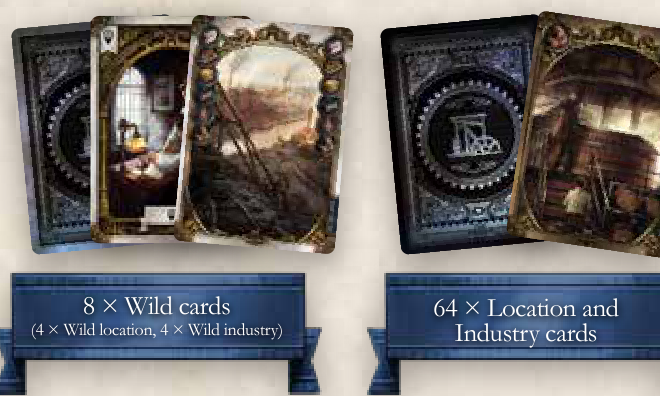
Discard three ordinary hand cards to scout for one wild card of each kind.
You cannot scout while holding either wild card. Used wild cards return to their supply.
Build: cards, space and payment
Start with the card and build your lowest available iron II in Birmingham; confirm each step.
Location cards bypass your network; industry cards require it. Canal cities allow one own industry. Pay £7 and one coal, produce four iron and immediately fill market vacancies.
Round end: track and order
Already spent £4 this round; seven hand cards remain after your first action and the known deck holds 12 cards. For your second action, develop your last cotton I using the final cube from your iron works; gain three income spaces, then resolve round end.
Income spaces differ from income levels. Refill to eight cards after your actions (or take what remains), then at round end sort by spending, preserving tied order, and collect income. Drawn card faces are not predicted.
Era scoring and rail transition
The deck and all hands are empty: score canal links and flipped industries, then remove level I and begin the rail era.
Links count adjacent flipped industry link icons and merchant icons; only flipped industries score industry VP. Retain level II and remove every level I.
Double rail: coal per link
Place Birmingham–Walsall and Walsall–Cannock separately; pay two coal and brewery beer.
Two rails cost £15, one coal each and one brewery beer. Check coal after each placement; check opponent beer after placing the second link.
Sell several industries
Use one card to sell two industries to matching Oxford merchants, paying beer separately.
Check merchant, connection and beer separately for each tile. The first uses merchant beer for two extra income spaces; the second uses your brewery. Sales give no direct cash.
Market buying and replenishment
Practice three separate actions without simulating turns, round ends or opponents: buy market coal when no board coal is available and build iron works; replenish iron immediately. Then replenish coal with a new mine and buy market iron for development when no board iron remains.
Coal buying needs a connection to any merchant space; iron needs none. New connected coal mines and all new iron works fill their markets, highest vacancy first; empty tiles flip.
Overbuild: yours and opponents’
Try an equal level or opponent’s mill, then choose a legal higher-level same-type replacement.
You may replace your own industry; opponents only coal or iron, with none of that resource on the entire board or market. Use your lowest available higher-level tile and pay all build costs.
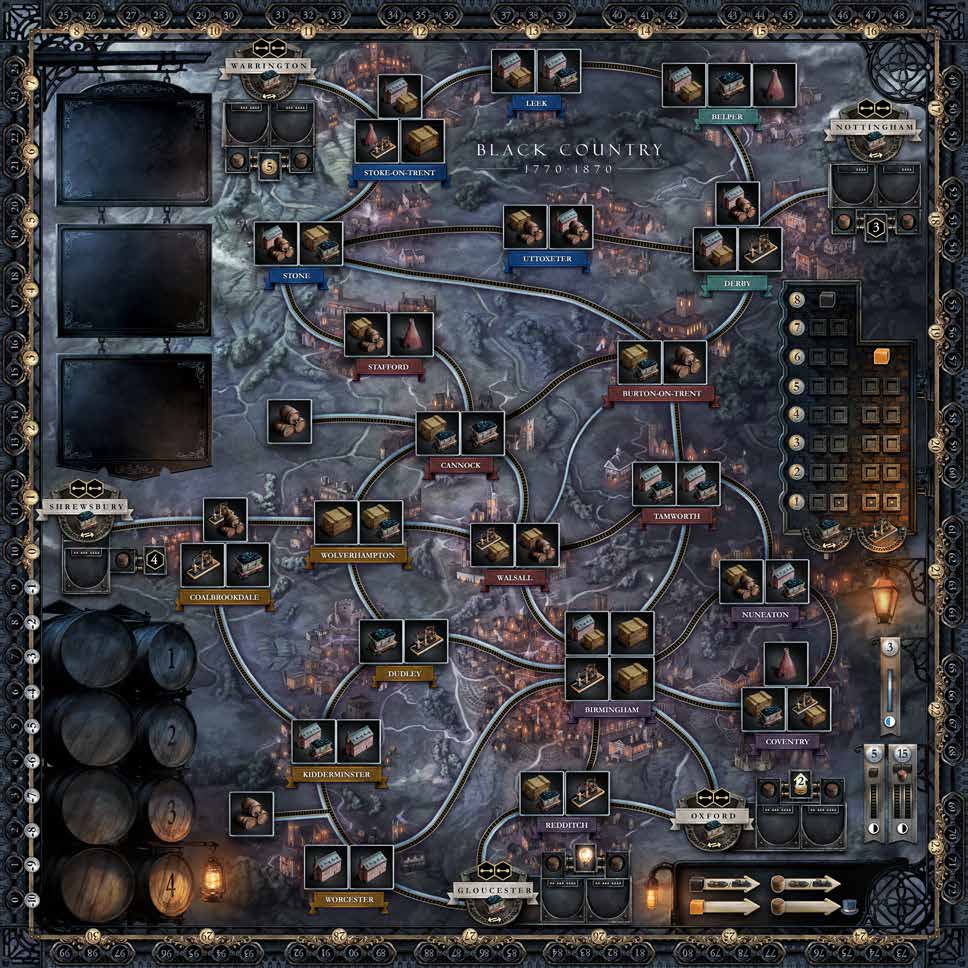
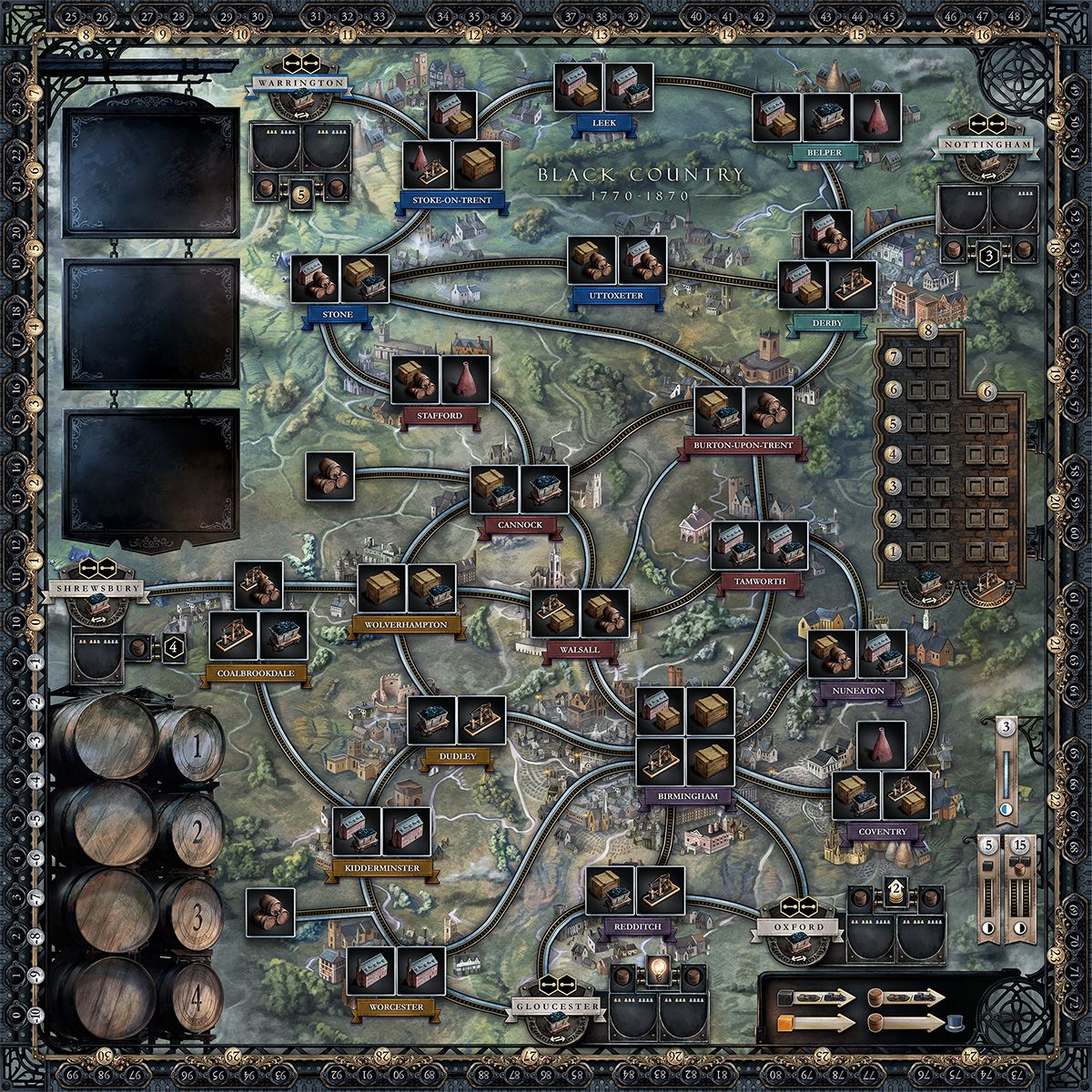
Original components, industries and map
Income spaces, income levels and VP
The outer numbers identify track spaces; the adjacent coin number is the income level paid each round. Flipping advances spaces through income bands of different widths. A separate marker records VP and loops after 100. A loan drops three income levels to the highest space of the new level.
Official rulesCoal and iron markets
Coal is black and iron orange. Buy from the cheapest occupied spaces; new works fill the most expensive vacancies first. Board resources take priority. Market coal also requires connection to a merchant location; iron does not. There is no beer market.
Official rulesWarrington: £5 bonus
Take £5 only when a matching sale consumes beer beside the actual merchant here. Two-player games place no merchant here. An empty merchant space does not accept goods, but the location still gives access to market coal.
Official rulesNottingham: 3 VP bonus
Gain three VP immediately when the sale consumes beer beside this merchant. Merchants here are set up only in four-player games. The merchant tile must accept the industry being sold.
Official rulesShrewsbury: 4 VP bonus
A matching sale that consumes merchant beer grants four VP immediately. A connection and the appropriate demand icon on the merchant tile are both required.
Official rulesOxford: advance income two spaces
Consuming merchant beer during a matching sale advances income two spaces, not two income levels. Using only your own brewery beer does not claim this bonus.
Official rulesGloucester: one free development
A matching sale using merchant beer lets you remove one lowest available tile from your mat without iron. Pottery carrying the no-development symbol is still prohibited.
Official rulesCannock farm brewery access
This unnamed location requires a brewery industry card or wild industry card and uses the dedicated link shown. Neither a location card nor a wild location card can name a farm brewery.
Official rulesWorcester farm’s shared link
The Kidderminster–Worcester link also connects this adjacent farm; no extra link is required. Building still needs a brewery or wild industry card and the network condition or no-board-presence exception.
Official rulesCanal, rail and resource key
Use the bottom-right key to distinguish canal and rail lines. Build only on an empty line of the current era, one link tile per line. Place each rail before checking its coal supply. A double rail also costs £15 and brewery beer.
Official rulesCity industry spaces and cards
Build only in a vacant space showing the matching industry icon, preferring single-icon spaces. Location cards name a city; industry cards require your network. Birmingham’s upper-left space accepts cotton or manufactured goods; its lower-left space accepts only iron. Read the printed icons rather than guessing from the city name or similar artwork.
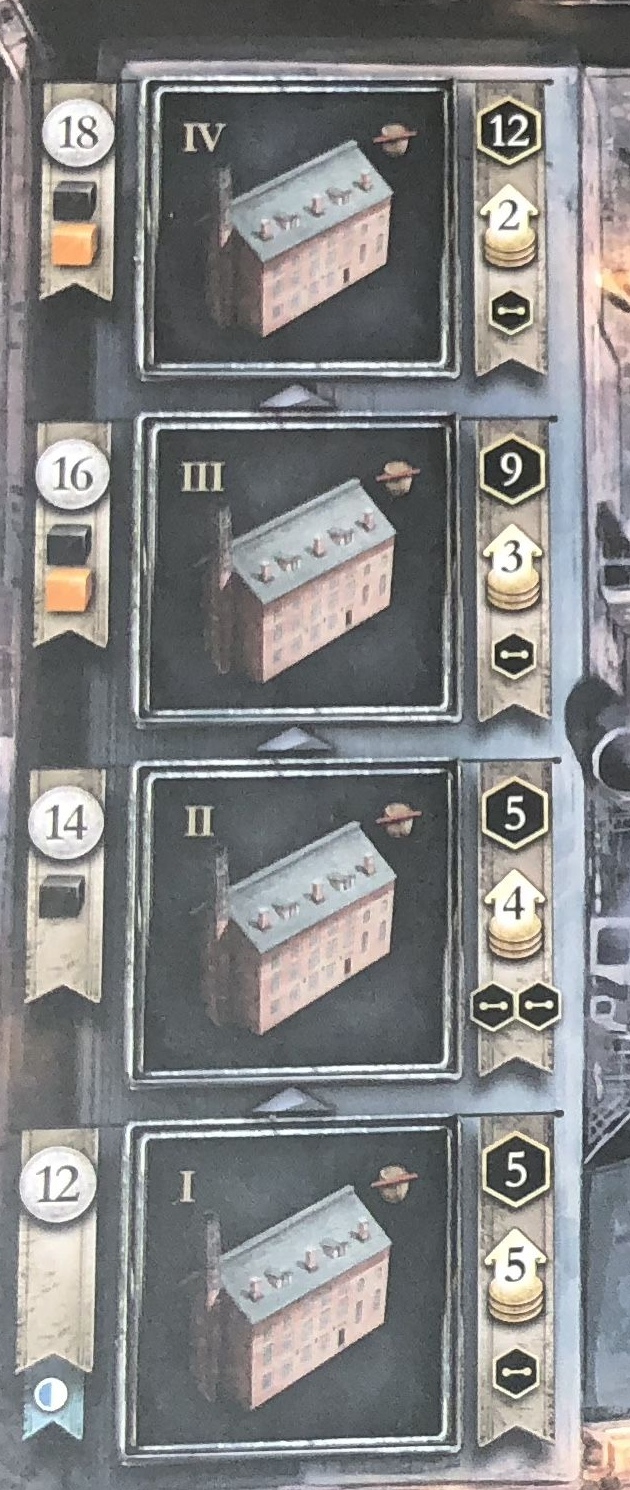
Official rulesCotton mills
Flip by selling to a cotton merchant, paying the printed beer requirement. Gain income immediately and industry VP at era end.
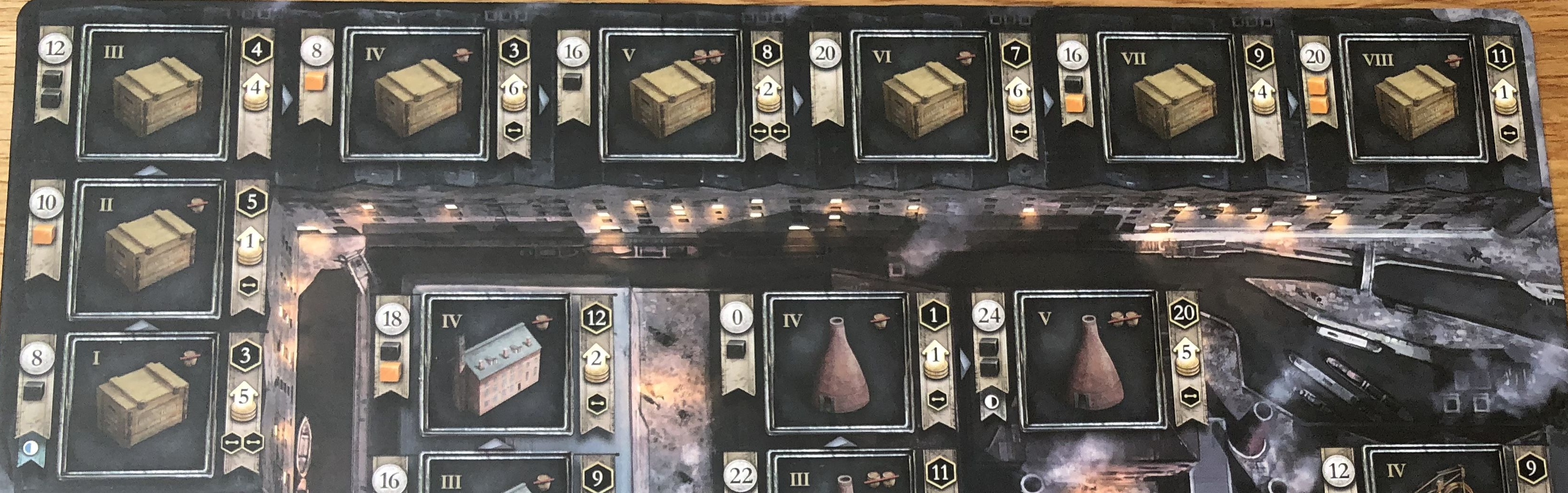
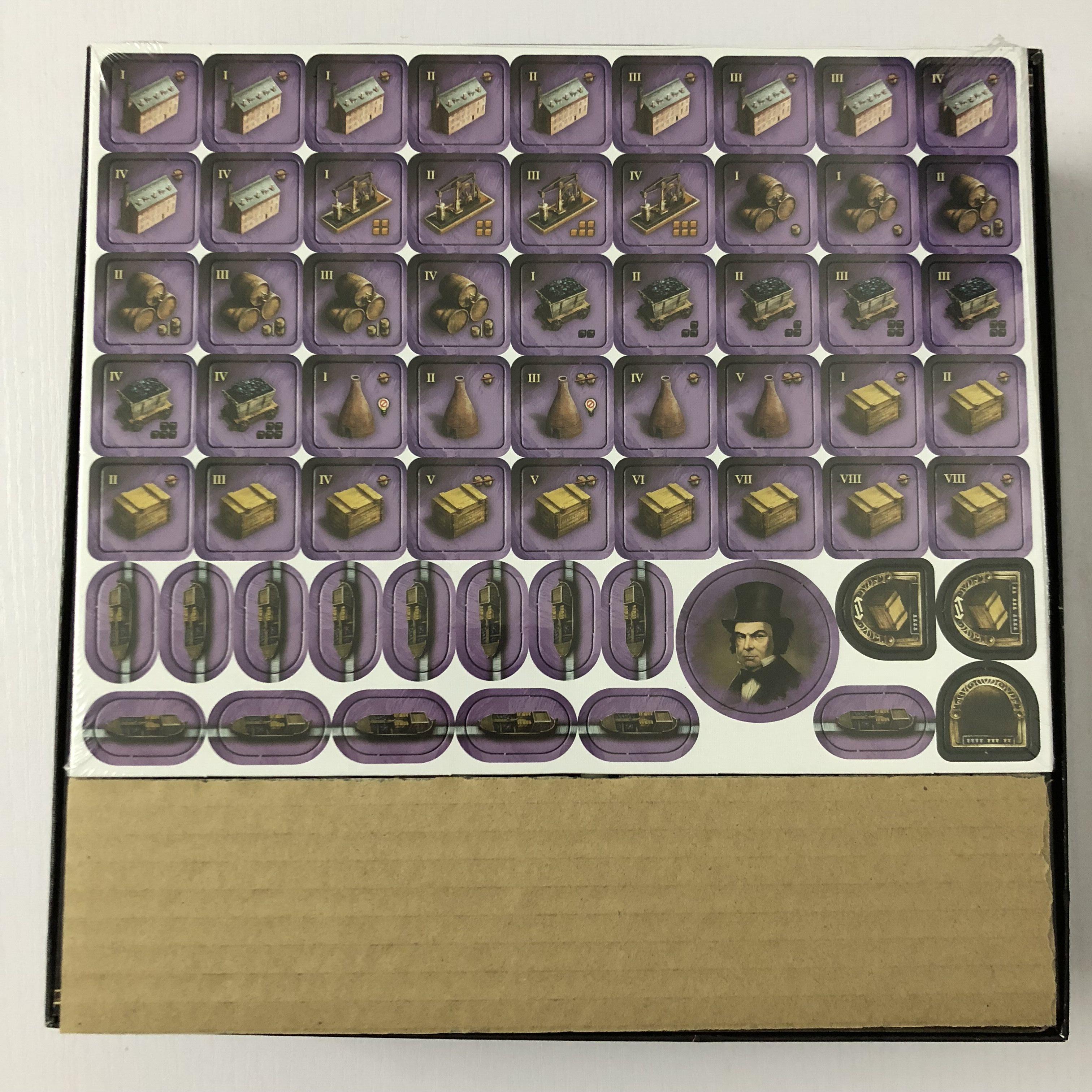
All 29 level rows were checked against the original 2018 retail player mat. Per-level counts were separately counted from an original photograph of the intact 2018 punchboard: 45 tiles across six types, with no unknown quantities. Brewery production is assigned when built and is not replenished at era change.
| Level | Per player | Build £ | Build coal | Build iron | Sale beer | Income spaces | VP | Link icons | Supply | Developable | Build era |
|---|---|---|---|---|---|---|---|---|---|---|---|
| 1 | 3 | £12 | 0 | 0 | 1 | 5 | 5 | 1 | — | Yes | Canal only |
| 2 | 2 | £14 | 1 | 0 | 1 | 4 | 5 | 2 | — | Yes | Both eras |
| 3 | 3 | £16 | 1 | 1 | 1 | 3 | 9 | 1 | — | Yes | Both eras |
| 4 | 3 | £18 | 1 | 1 | 1 | 2 | 12 | 1 | — | Yes | Both eras |
Manufacturers
Sell to manufactured-goods merchants to flip. Beer, costs and rewards vary by level; do not assume a uniform value.
All 29 level rows were checked against the original 2018 retail player mat. Per-level counts were separately counted from an original photograph of the intact 2018 punchboard: 45 tiles across six types, with no unknown quantities. Brewery production is assigned when built and is not replenished at era change.
| Level | Per player | Build £ | Build coal | Build iron | Sale beer | Income spaces | VP | Link icons | Supply | Developable | Build era |
|---|---|---|---|---|---|---|---|---|---|---|---|
| 1 | 1 | £8 | 1 | 0 | 1 | 5 | 3 | 2 | — | Yes | Canal only |
| 2 | 2 | £10 | 0 | 1 | 1 | 1 | 5 | 1 | — | Yes | Both eras |
| 3 | 1 | £12 | 2 | 0 | 0 | 4 | 4 | 0 | — | Yes | Both eras |
| 4 | 1 | £8 | 0 | 1 | 1 | 6 | 3 | 1 | — | Yes | Both eras |
| 5 | 2 | £16 | 1 | 0 | 2 | 2 | 8 | 2 | — | Yes | Both eras |
| 6 | 1 | £20 | 0 | 0 | 1 | 6 | 7 | 1 | — | Yes | Both eras |
| 7 | 1 | £16 | 1 | 1 | 0 | 4 | 9 | 0 | — | Yes | Both eras |
| 8 | 2 | £20 | 0 | 2 | 1 | 1 | 11 | 1 | — | Yes | Both eras |
Coal mines
Supply coal, consumed free from the closest connected mine. Flip and increase the owner’s income when the last cube is removed.
All 29 level rows were checked against the original 2018 retail player mat. Per-level counts were separately counted from an original photograph of the intact 2018 punchboard: 45 tiles across six types, with no unknown quantities. Brewery production is assigned when built and is not replenished at era change.
| Level | Per player | Build £ | Build coal | Build iron | Sale beer | Income spaces | VP | Link icons | Supply | Developable | Build era |
|---|---|---|---|---|---|---|---|---|---|---|---|
| 1 | 1 | £5 | 0 | 0 | 0 | 4 | 1 | 2 | 2 | Yes | Canal only |
| 2 | 2 | £7 | 0 | 0 | 0 | 7 | 2 | 1 | 3 | Yes | Both eras |
| 3 | 2 | £8 | 0 | 1 | 0 | 6 | 3 | 1 | 4 | Yes | Both eras |
| 4 | 2 | £10 | 0 | 1 | 0 | 5 | 4 | 1 | 5 | Yes | Both eras |
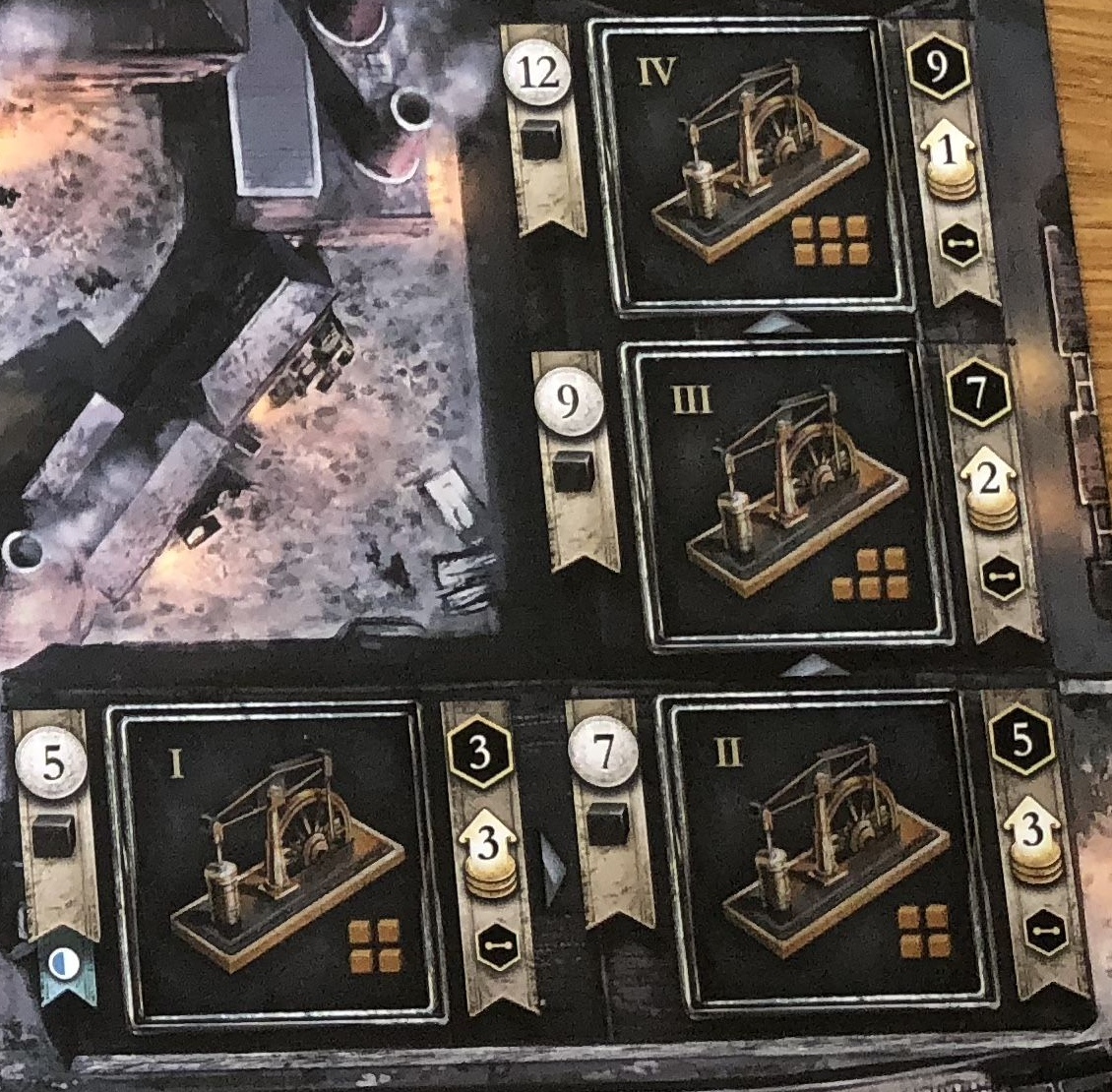
Iron works
Supply iron without requiring connections. Board iron has priority over the market. Flip when the last cube is removed.
All 29 level rows were checked against the original 2018 retail player mat. Per-level counts were separately counted from an original photograph of the intact 2018 punchboard: 45 tiles across six types, with no unknown quantities. Brewery production is assigned when built and is not replenished at era change.
| Level | Per player | Build £ | Build coal | Build iron | Sale beer | Income spaces | VP | Link icons | Supply | Developable | Build era |
|---|---|---|---|---|---|---|---|---|---|---|---|
| 1 | 1 | £5 | 1 | 0 | 0 | 3 | 3 | 1 | 4 | Yes | Canal only |
| 2 | 1 | £7 | 1 | 0 | 0 | 3 | 5 | 1 | 4 | Yes | Both eras |
| 3 | 1 | £9 | 1 | 0 | 0 | 2 | 7 | 1 | 5 | Yes | Both eras |
| 4 | 1 | £12 | 1 | 0 | 0 | 1 | 9 | 1 | 6 | Yes | Both eras |
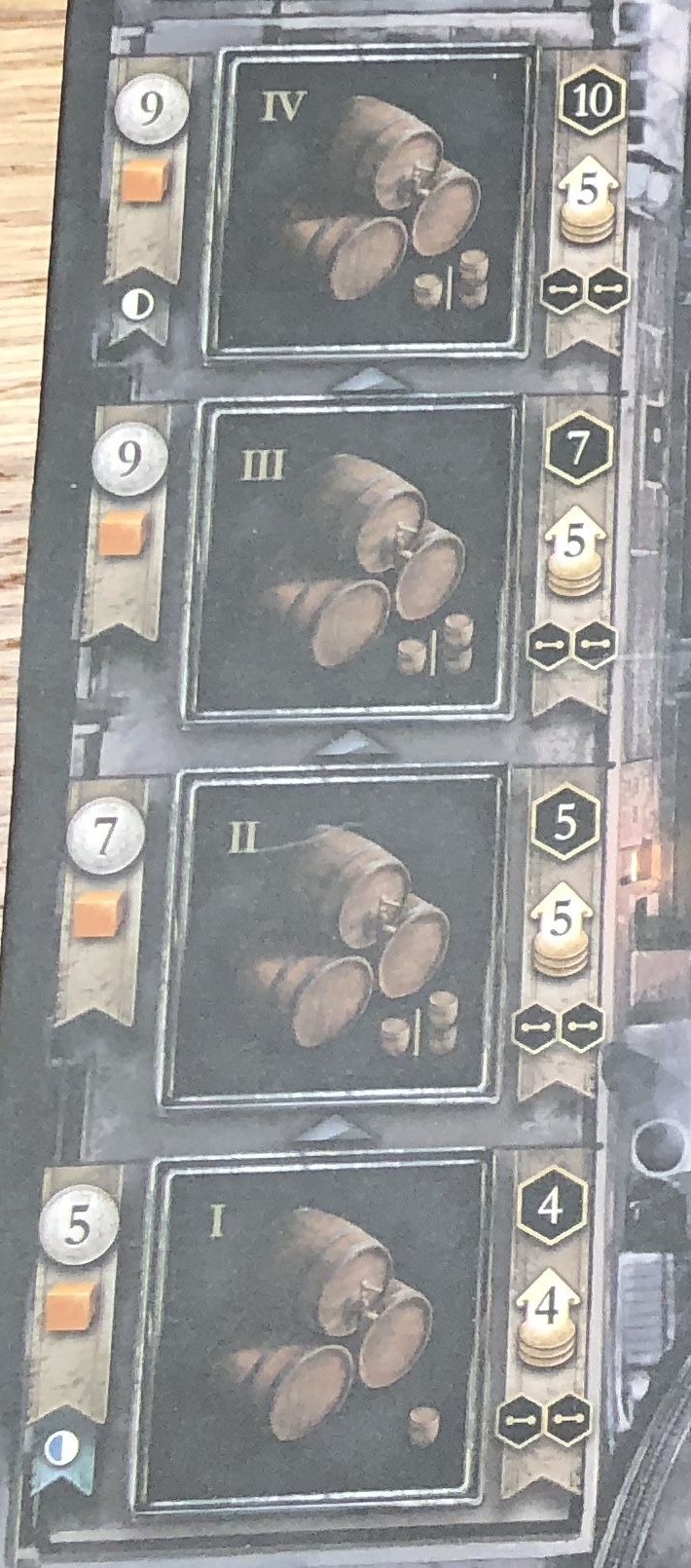
Breweries
Receive one beer when built in canal or two in rail. Own beer needs no connection; opponents need one. Flip after the last barrel is consumed.
All 29 level rows were checked against the original 2018 retail player mat. Per-level counts were separately counted from an original photograph of the intact 2018 punchboard: 45 tiles across six types, with no unknown quantities. Brewery production is assigned when built and is not replenished at era change.
| Level | Per player | Build £ | Build coal | Build iron | Sale beer | Income spaces | VP | Link icons | Supply | Developable | Build era |
|---|---|---|---|---|---|---|---|---|---|---|---|
| 1 | 2 | £5 | 0 | 1 | 0 | 4 | 4 | 2 | 1 canal / 2 rail | Yes | Canal only |
| 2 | 2 | £7 | 0 | 1 | 0 | 5 | 5 | 2 | 1 canal / 2 rail | Yes | Both eras |
| 3 | 2 | £9 | 0 | 1 | 0 | 5 | 7 | 2 | 1 canal / 2 rail | Yes | Both eras |
| 4 | 1 | £9 | 0 | 1 | 0 | 5 | 10 | 2 | 2 rail | Yes | Rail only |
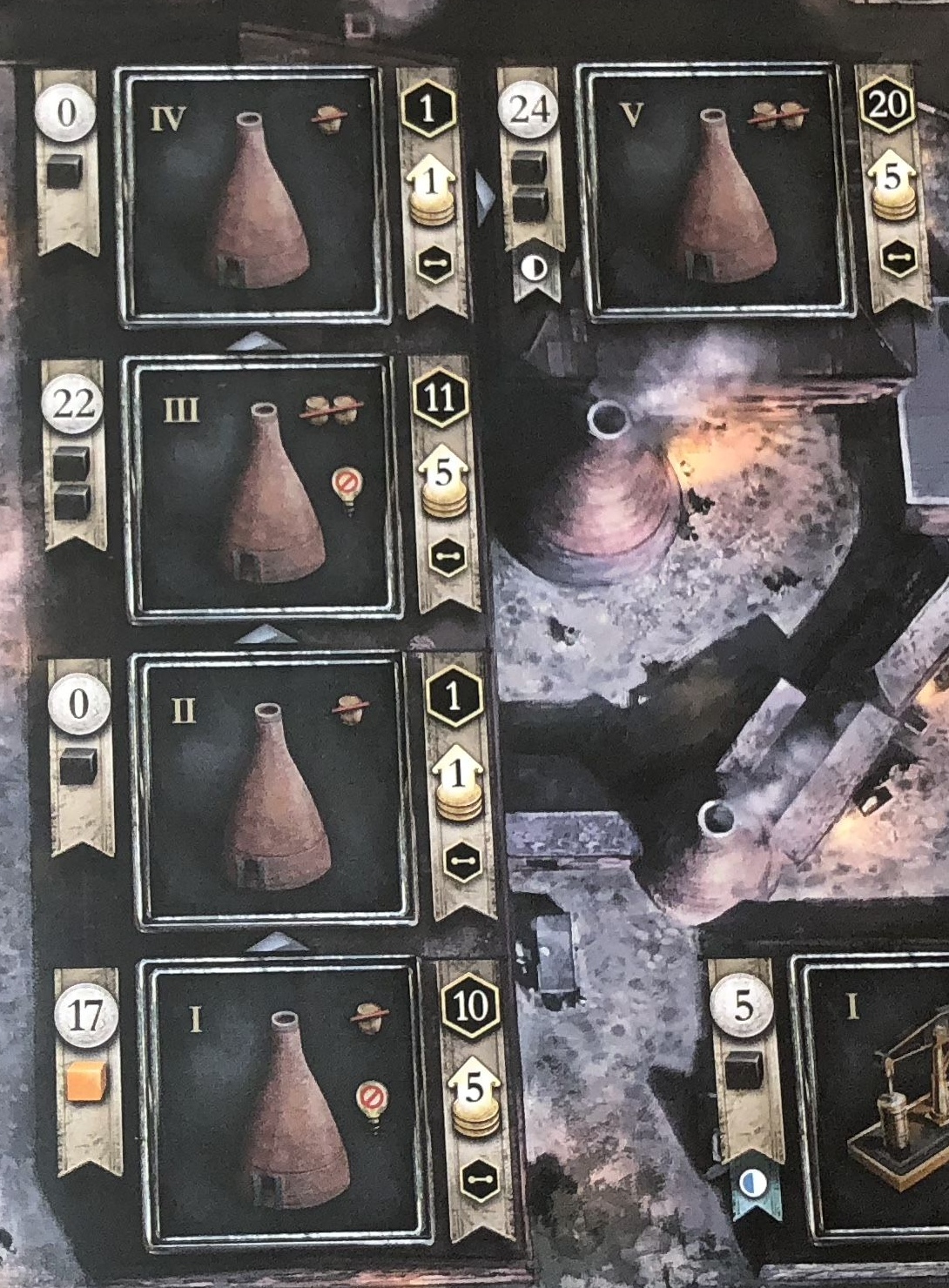
Potteries
Flip by selling to a pottery merchant. Tiles with the prohibited-development icon must be built. Level I pottery may be built in rail.
All 29 level rows were checked against the original 2018 retail player mat. Per-level counts were separately counted from an original photograph of the intact 2018 punchboard: 45 tiles across six types, with no unknown quantities. Brewery production is assigned when built and is not replenished at era change.
| Level | Per player | Build £ | Build coal | Build iron | Sale beer | Income spaces | VP | Link icons | Supply | Developable | Build era |
|---|---|---|---|---|---|---|---|---|---|---|---|
| 1 | 1 | £17 | 0 | 1 | 1 | 5 | 10 | 1 | — | No | Both eras |
| 2 | 1 | £0 | 1 | 0 | 1 | 1 | 1 | 1 | — | Yes | Both eras |
| 3 | 1 | £22 | 2 | 0 | 2 | 5 | 11 | 1 | — | No | Both eras |
| 4 | 1 | £0 | 1 | 0 | 1 | 1 | 1 | 1 | — | Yes | Both eras |
| 5 | 1 | £24 | 2 | 0 | 2 | 5 | 20 | 1 | — | Yes | Rail only |




Rule questions
How do you win?
Have the most victory points after the Canal and Rail Eras.
Conditions: Score links and flipped industries at each era end. Break ties by income level, then cash, then share the victory. Cash and income do not directly score in the full game.
Example: A flipped level II or higher industry surviving from the Canal Era can score again after the Rail Era.
What is in the box?
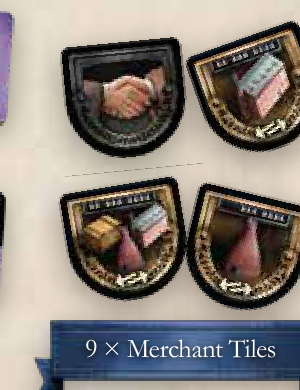
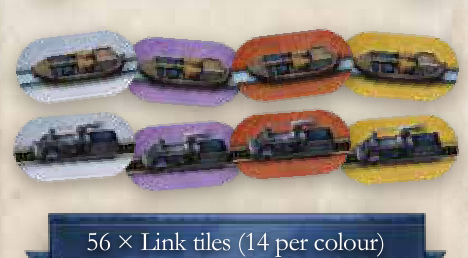
The retail edition has one double-sided board, four player mats, 180 industry tiles, 56 links, nine merchant tiles, plus cards, resources and markers.
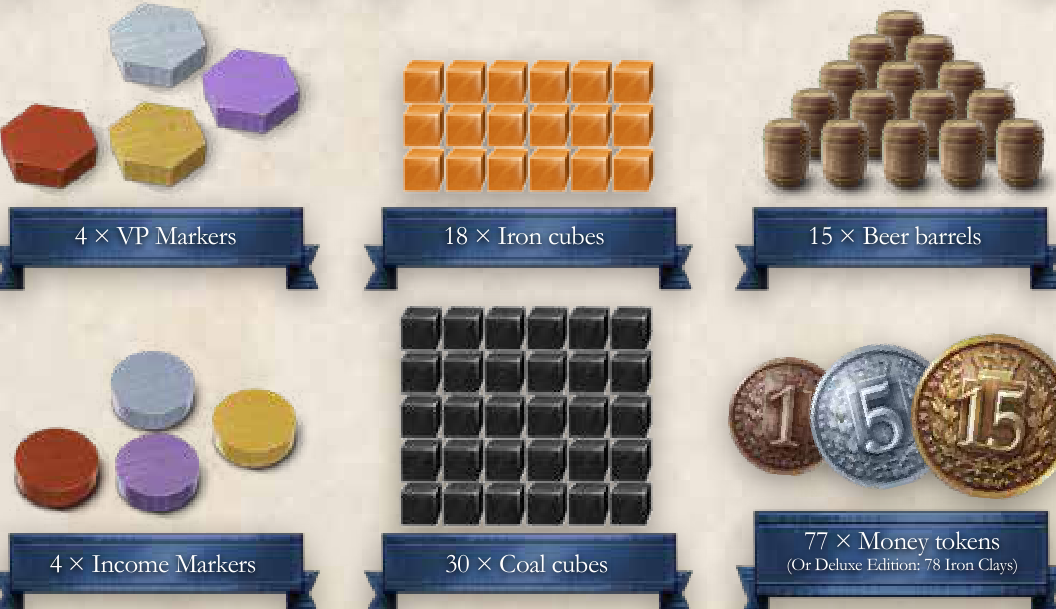
Conditions: Each player has 45 industries and 14 links. The box has 64 location/industry cards, eight wild cards, four aids, four character tiles, four VP and four income markers, 30 coal, 18 iron, 15 beer barrels and 77 money tokens. Three blank tiles are unused. The general resource supply is unlimited.
Example: Per colour: 11 cotton mills, 11 manufacturers, seven coal mines, four iron works, seven breweries and five potteries: 45 total.
Are day/night boards different eras?
Day and night are alternative artwork on the same board; both eras use that map.
Conditions: The board contains city industry spaces, link lines, five edge merchant locations, coal/iron markets, the progress track and turn-order track. Era restrictions determine available links and industries; the board is not flipped to start the Rail Era.
Example: Canal and rail routes can differ. Canal links cannot be built in the Rail Era.
How do you set up?
Start with £17 and eight cards. Set VP to zero and the income marker on progress space 10 (income level zero), then deal one extra face-down card to start the discard pile.
Conditions: Remove regular cards and merchants marked for higher counts: two players omit blue and teal location cards; three omit teal; four use all location cards. Set wild cards aside, stack industries by level with their black top halves face down, and randomize initial order.
Example: Two-player games omit merchants in Warrington and Nottingham; three-player games omit Nottingham merchants. Locations whose cards were removed are still buildable.
How are markets and merchant beer set up?
Fill the coal market except one £1 space, and the iron market except both £1 spaces. Place one beer beside each non-blank merchant.
Conditions: Shuffle eligible merchants onto spaces marked for the current player count. Place remaining resources in the general supply.
Example: Blank merchants receive no beer, but the merchant location can still provide access to the coal market.
What happens on your turn?
Normally perform two actions, discarding a card for each, then refill to eight after both actions.
Conditions: Only the first Canal round has one action each. Except for Build, any card can pay for an action; Scout discards three cards total and is forbidden while holding a wild card. Used wild cards return to supply. Actions may repeat; passing discards a card. Hands shrink after the deck empties.
Example: Taking a loan and then building is legal. You do not draw new cards between the two actions.
How do turn order and income work?
The lowest spender acts first next round, with ties retaining relative order; then collect or pay your income level.
Conditions: Track action spending on your character tile, then return it to the bank. Money earned from selling resources does not offset spending. Income is skipped only after the final round of the entire game.
Example: A spends £10 and earns £6 from the market; B spends £8, so B acts first next round and A still records £10 spending. A at space 15 (level three) collects £3; B at space eight (level −2) pays £2. Skip both payments after the final Rail round.
How do you build an industry?
Discard a matching location or industry card, place the lowest available tile of that industry into a legal space, and pay cash and required coal/iron.
Conditions: A location card allows building in its named location without personal-network access. An industry card requires a matching industry in your network. Use a single-industry space before a shared-icon space when possible.
Example: A Birmingham card permits a legal industry there, but any required coal still needs a transport connection.
Is your network the same as connected locations?
Your network consists of locations with your industries or adjacent to your links. Connected locations can be joined through built links belonging to anyone.
Conditions: Industry-card building and network expansion use your personal network. Coal, sales and opponents’ beer can travel over any player’s links. An opponent’s link alone does not add a city to your personal network.
Example: An opponent’s railway can carry a sale to a merchant without allowing you to build by industry card along that route.
Where must coal come from?
Take free coal from the nearest connected unflipped coal mine, regardless of owner.
Conditions: Measure distance in link tiles, choose among ties and recalculate after depletion. Only when no connected mine is available may you buy cheapest market coal, requiring connection to a merchant-location icon. Empty-market coal costs £8. Check a new railway’s connection after placing it.
Example: You cannot choose market coal while a nearer connected opponent’s mine still has coal.
Does iron need a connection?
No. First take free iron from any unflipped iron works on the board, regardless of owner or distance.
Conditions: Buy cheapest market iron only when board iron is unavailable. Empty-market iron costs £6. No merchant connection is required.
Example: Developing from Coventry may use iron from a distant, completely unconnected iron works.
How do own and opponent beer differ?
Your own brewery beer needs no connection; opponents’ beer must be connected to the location where it is used.
Conditions: There is no beer market. A sale may also use beer beside the merchant you are selling to. Merchant beer cannot fund a double-rail action. Multiple barrels may come from different legal sources.
Example: Your distant brewery may supply a double-rail action; an opponent’s brewery must be connected after the second railway is placed.
When do industries flip and gain income?
Cotton mills, manufacturers and potteries flip on sale; coal mines, iron works and breweries flip when their last resource is consumed.
Conditions: Flipping immediately advances income by spaces, not income levels. Tile VP is scored at era end. Income level is capped at 30.
Example: From progress space 10 (level zero), a five-space flip reaches space 15, income level three: collect £3 at round end, not £5. Spaces 25–26 share level eight; spaces 31–33 share level eleven.
What resources appear when you build?
Coal mines and iron works receive the printed number of cubes; breweries receive one beer in the Canal Era or two in the Rail Era.
Conditions: A new coal mine connected to any merchant location, or any new iron works, must immediately fill as many market vacancies as possible, highest price first. This happens only during its build action, never automatically on later turns.
Example: A new level-I iron works produces four iron. If empty market spaces pay £2, £1 and £1, immediately sell three cubes for £4 and retain one. If all four can be sold, flip immediately for three income spaces. Later vacancies never allow another sale to the market. Coal works similarly but requires a merchant-location connection.
What build limits change between eras?
In the Canal Era, each player may have only one industry per location; in the Rail Era, multiple own industries may share a location.
Conditions: Follow era icons on the player mat. Canal-only level I tiles cannot be built in the Rail Era; level I pottery is an exception. Always take the lowest available tile of a type, developing blockers first if needed.
Example: In the Canal Era, you cannot add your brewery to a city already containing your cotton mill, even using its location card.
What if you have no tiles on the board?
You may use an industry card to build in any location with a matching free space, or discard any card to start a link on any legal empty line.
Conditions: This applies only when you have neither industries nor links on the board. Costs, era limits, space restrictions and coal access still apply.
Example: At the Rail Era start, if you have no board presence, you may start a new route but must still supply coal.
How do farm breweries work?
The two unnamed farm breweries require a brewery industry card or wild industry card; location and wild location cards cannot build there.
Conditions: Personal-network rules and the no-board-presence exception still apply. The Cannock farm needs its own link. The Kidderminster–Worcester link also connects their adjacent farm, without an additional link.
Example: A wild location card does not treat an unnamed farm as a named city.
How do you build canals and railways?
A Canal Era network action builds one link for £3. A Rail Era action builds one railway for £5, or two for £15 plus one beer.
Conditions: Pay one coal for each railway, placing and supplying the first before placing the second. Each link adjoins your network unless you have no tiles on the board. The double-rail beer must come from a brewery; an opponent’s brewery must connect to the second rail after it is placed. Merchant beer is forbidden.
Example: Two single rails cost £10, two coal and two actions; a double costs £15, two coal, one beer and one action.
How does development work?
Discard one card and remove one or two industry tiles from your mat, consuming one iron per tile.
Conditions: Remove the current lowest tile of a type each time; the two may be different types. Development does not remove board tiles. Pottery with the prohibited-development icon must be built, including when using the merchant’s free development bonus.
Example: When developing two tiles of one type, the second is the lowest exposed after removing the first.
How many industries can one sale action flip?
One sale action may flip multiple own unflipped cotton mills, manufacturers and potteries, including mixed types.
Conditions: Each must connect to a merchant accepting that type and consume its own printed beer requirement. You cannot sell opponents’ industries. Resolve each sale, beer cost, flip and income advance in sequence.
Example: One Sell action can sell cotton II (one beer, four income spaces), then manufacturer III (zero beer, four spaces). Each must connect to a merchant accepting its type; discard only one action card. Manufacturer III cannot take unnecessary merchant beer to claim a bonus.
What are merchant beer bonuses?
Receive a merchant bonus only when a sale actually consumes beer beside that merchant.
Conditions: Gloucester develops one tile for free; Oxford advances income two spaces; Shrewsbury grants four VP, Nottingham three VP, and Warrington £5. A zero-beer sale cannot consume an unnecessary barrel just to claim a bonus.
Example: Connection to a merchant does not grant its bonus if you consume only your own brewery beer.
Must loans be repaid, and how far does income fall?
A loan gives £30 and is never repaid, but drops income by three levels, not three spaces.
Conditions: Place the marker on the highest space within the new level. A loan is illegal if it would take income below −10. It still costs an action and a card.
Example: Income level five falls to level two, on the highest space within level two.
How does scouting get wild cards?
Discard three cards in total: the action card plus two more. Take one wild location and one wild industry card.
Conditions: You cannot scout while holding either wild card. When used, wild cards return to their public areas instead of your discard pile.
Example: You may scout, use one of the gained wild cards to build as your second action, then refill normally at turn end.
Can you overbuild your own or an opponent’s industry?
Overbuilding your own industry or an eligible opponent’s industry always requires the same industry type at a higher level.
Conditions: Only an opponent’s coal mine or iron works may be overbuilt, and only when that resource is absent from the whole board and its market. Pay normal costs and meet card requirements. Remove the old tile and return its resources; previous income and VP remain, but it cannot score again.
Example: An opponent’s brewery cannot be overbuilt, nor can you ignore coal elsewhere just because one mine is empty.
How do you score an era?
Score each own link for the link icons in its two adjacent locations and remove it, then score the printed VP of your flipped industries.
Conditions: Link scoring counts relevant icons from any player’s flipped industries and merchant locations, not the number of tiles or their printed VP. Unflipped industries score no industry VP.
Example: A link with five total endpoint link icons scores five VP; do not add the industries’ printed five and nine VP as link points.
What survives the transition to rail?
After Canal scoring remove every level-I industry from the board, keep level II and higher, refill empty merchant beer spaces, shuffle all discards and deal eight cards each for Rail.
Conditions: Include the initial face-down card at the bottom of every discard pile: turn it over before shuffling. Do not deal a new face-down discard for Rail. Keep level-I tiles on mats, cash, income and VP. Retained industries do not refill resources or gain a second beer. Rail starts with two actions each.
Example: An unsold level II mill remains available to sell in rail; even an unflipped level I tile is removed.
Does an empty deck end the era?
No. An era ends after the round in which all players have exhausted their hands as well as the deck.
Conditions: The full game ends after Rail scoring, and its final round gives no income. The Canal-only introductory variant has extra money, income and level II+ scoring; do not import those rules into the full game.
Example: With four cards left at the end of rail, you normally still have two turns of actions.
What if you cannot pay negative income?
Remove your own board industries for half their cash build cost, rounded down, until the debt is covered.
Conditions: You cannot liquidate links. Stop as soon as sufficient money is raised and keep the excess. If payment is impossible, lose one VP per unpaid £1 where possible. This liquidation is only for negative-income shortfalls.
Example: You cannot voluntarily liquidate an old industry to fund a railway.
Decisions
Merchant beer or your own?
Use the same mill and Oxford merchant; confirm each beer source.
Merchant beer yields 5+2 income spaces and preserves your beer. Your last barrel yields 5+4 spaces and preserves merchant beer. These are income spaces, not cash-income levels.
Which iron works to empty?
Pay the same one iron from your last cube or an opponent’s works.
Your last iron flips your works for three income spaces. The opponent’s nonfinal cube flips nothing. Ownership still matters for free resources.
Develop one tile or two?
From the same mat and two iron, develop one or two cotton tiles.
One preserves one iron; two consume both to bypass two lowest cotton tiles and, in this position, empty your iron works for three income spaces. Building still needs another action and its costs.
Level I income or level II retention?
The deck and opponents’ hands are empty; you hold one card. Both mills are already built, with one barrel of your beer. Sell either I or II, then score the canal era.
Build costs are sunk: I £12, II £14 plus coal. Both choices now cost one action, card and beer. I gives one extra income space but is removed. II remains whether sold or not; unsold tiles score nothing.
Rail link points or iron works?
The deck and opponents’ hands are empty; you hold one card. Your final action: rail to Cannock or build iron II in Birmingham. Resolve the known era-end position only.
The rail scores current adjacent flipped icons. Iron only scores once exhausted; this market has exactly four vacancies, so construction flips it immediately. No unknown opponent moves are assumed.
Loan and next-round tempo
Your first action is complete (prior spending £0); seven hand cards remain and the known deck holds 12. Last action: borrow or spend £7 on coal II. Compare cash, income and next-round order.
A loan drops three levels; received cash is not spending. It preserves the earlier position here. Building adds spending and an industry. Refill to eight after your actions, then resolve round-end order and income without predicting card faces. Order conclusions use only the declared spending.
Cotton, manufactured goods or pottery?
The deck and opponents’ hands are empty; you hold two cards. With the same cash and resources, choose an industry route for your final two actions, build and sell, then score this known canal end.
Cotton I costs £12, manufacturer I £8 + coal, pottery I £17 + iron; each needs one beer. Emptying your brewery also gains five income spaces and five VP. Each factory gives five income spaces; its own VP are 5, 3, 10. This does not rank entire-game strategies.
Sources and lesson scope
Checked 2026-10-30 against the Roxley base-game rules. Lessons use fixed public positions and do not provide a full multiplayer match. Artwork, rules and interaction state are checked separately.
Official rulebook · Roxley