How to play A Feast for Odin
Place Vikings, upgrade goods and arrange your home, then hunt, whale, raid, explore, emigrate, serve the feast and settle the round in ten hands-on lessons with original components.
Learn by playing
Place Vikings
Select a building space on the original board, pay its Viking and material costs and resolve it immediately. Occupied spaces and insufficient workers or materials are rejected.
Rule sourceUpgrade goods
Use the first-column upgrade-two-goods space for one Viking. Select peas and wool separately, upgrading each once at the same shape and size.
Rule sourcePlace the robe
Select the robe’s origin on the home grid and check income prerequisites and covered bonus symbols.
Rule sourceHunt game
Choose an unoccupied hunt, roll the orange d8 at most three times, replacing the previous roll each time. Pay the exact total in wood and bows to gain hide and game meat, or resolve failure consolation.
Rule sourceWhale
Choose a whaling action and 1–3 boats or one boat. Reduce the blue d12 by printed and added ore; zero forces an immediate success. Failure costs no equipment and grants wood, spear and up to two returned Vikings. Column three first draws one unplayed dark-brown occupation.
Rule sourceRaid and pillage
Compare orange-d8 raiding with blue-d12 pillaging: raiding ignores ore; pillaging requires your highest-ore longship and adds its ore. Add stone and long swords, then choose exactly one eligible blue good, or resolve failure consolation.
Rule sourceExplore a region
In long-game round four, choose a region using a qualifying ship and enough Vikings. Claim the board and accumulated silver, keep the ship, and draw an occupation when using the third column.
Rule sourceEmigrate
In long-game round four, pay two Vikings and four silver to flip a knarr or longship onto the next two places after existing emigrants. Feast demand falls from seven to five, the ship is no longer usable, longship ore is lost and total Vikings do not decrease.
Rule sourceFill the last two feast spaces
Fill the final two places with food or silver, checking colour adjacency, orientation and empty-seat penalties.
Rule sourceSettle the round
Resolve multiplayer income, breeding, feast, bonuses, mountains and retrieval in order. Round six has eight idle Vikings; retrieving three makes eleven. In the final round nine are idle and play ends after the feast. Collect three silver, flip a sheep pregnant and gain one wood from the enclosed bonus.
Rule sourceDecisions
Compare income with the mead bonus, then compare paying food or silver at the feast.
Components
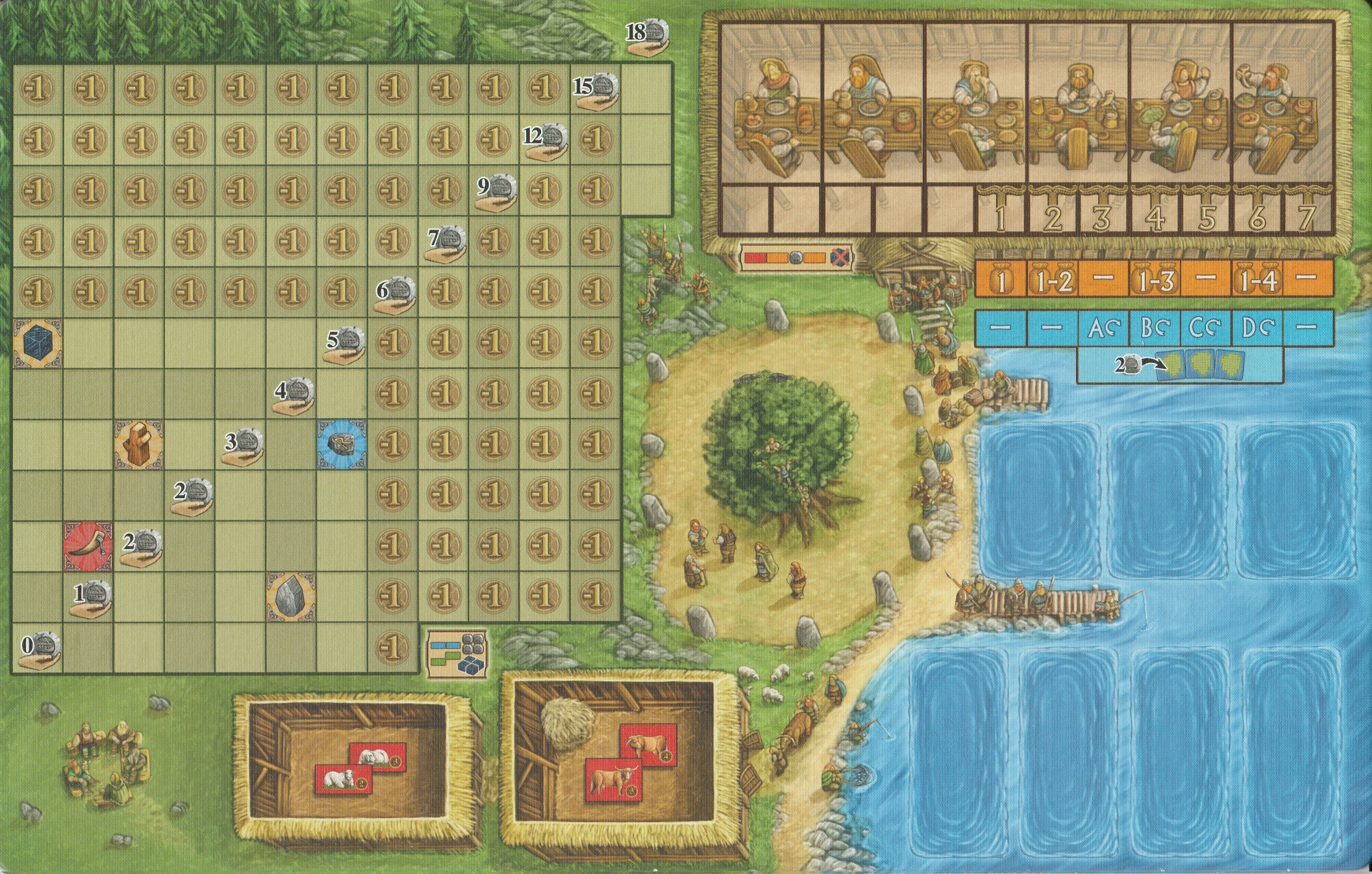
Home board · seven-round side
Goods and income are on the left; the banquet track, bay and stables sit on the right around the Thing Square. Flip the board for the long or short game.
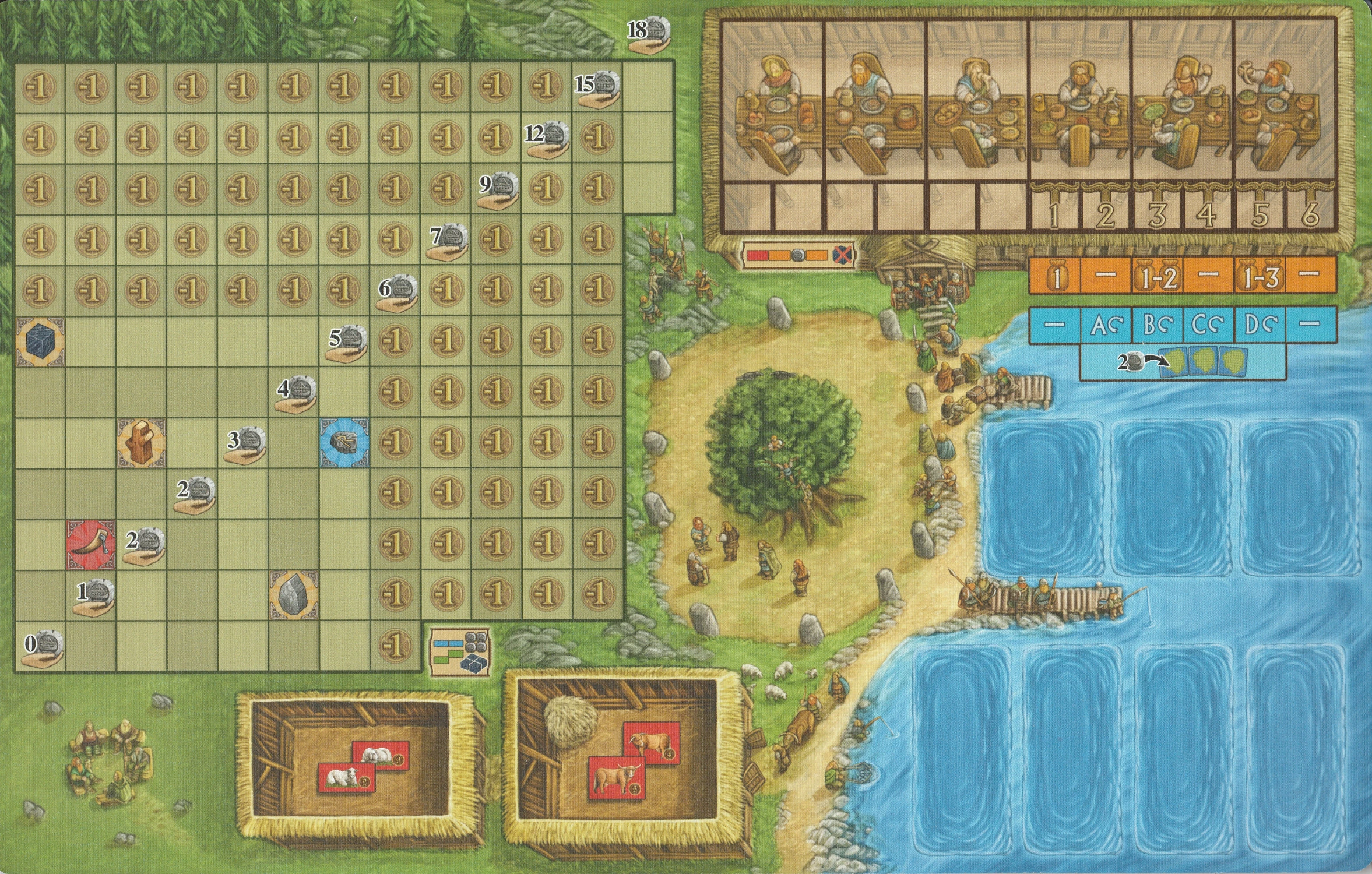
Home board · six-round side
The short game starts with one extra Viking on the Thing Square and uses different harvest and exploration schedules.
Base-game four-column action board
Columns cost one through four Vikings. Use the extensions for your player count. The round reference lists 12 phases.

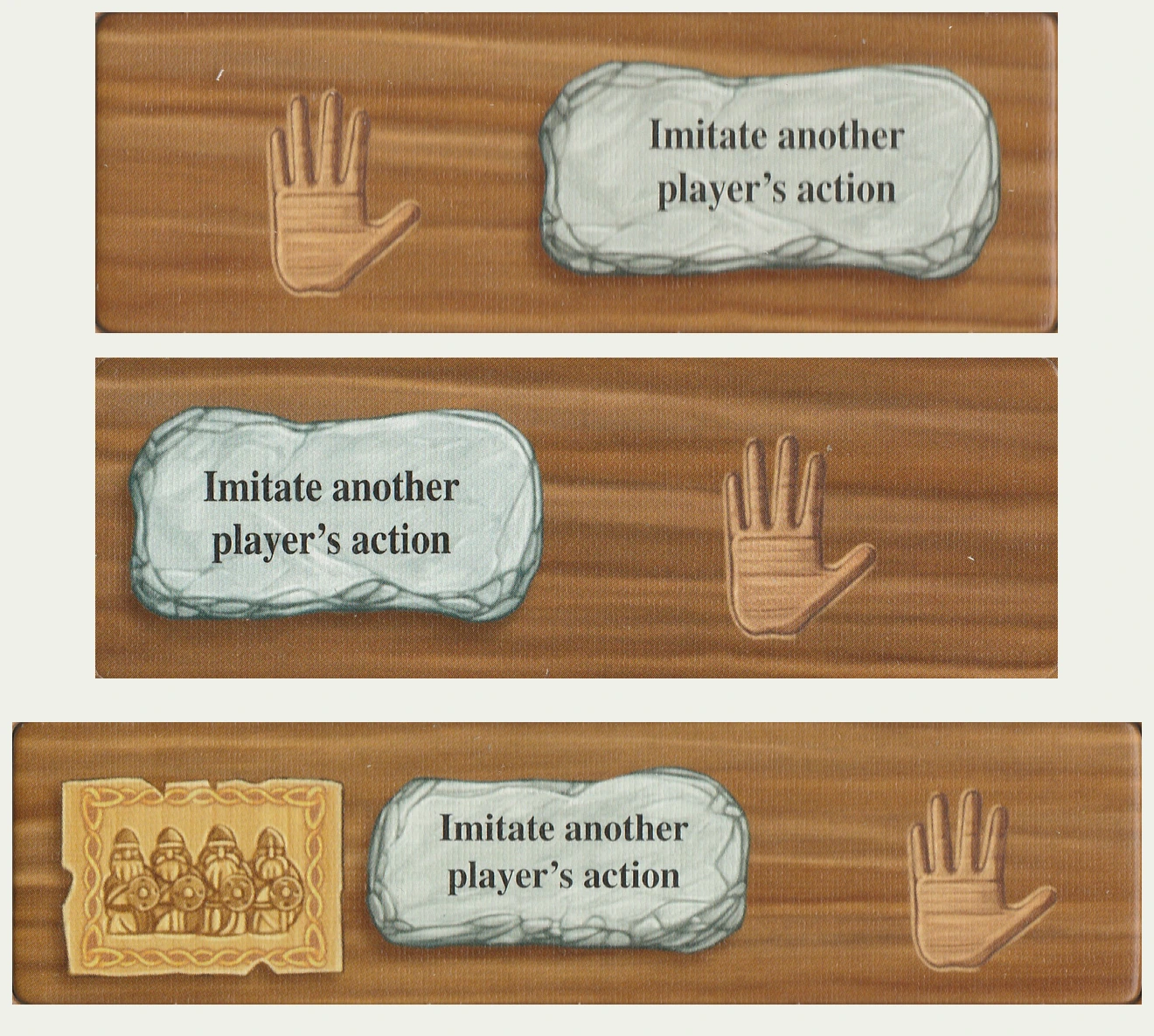
Four-player action extensions
Use only with four players. Grey spaces let you imitate another player’s action subject to their rules.
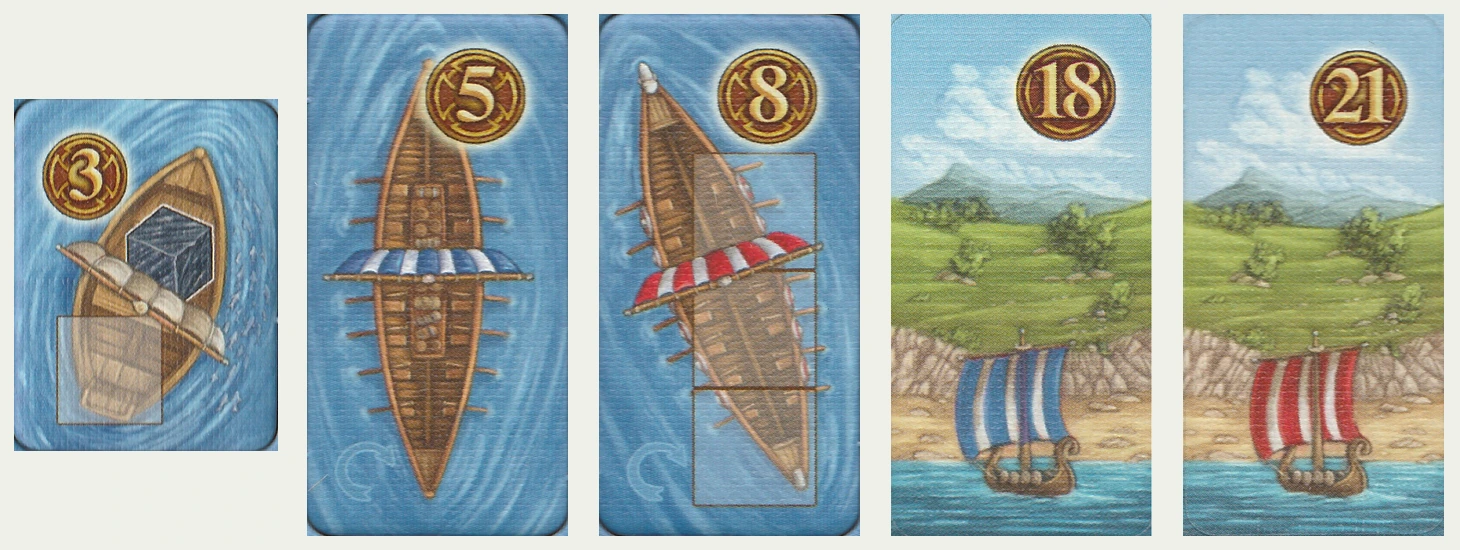
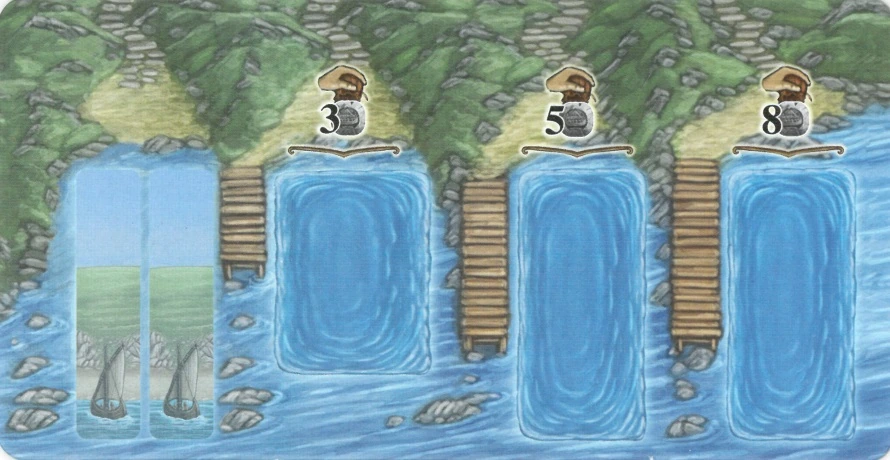
Ship supply and 32 ships
Ten whaling boats, twelve knarrs and ten longships. They enable whaling, overseas trade, raiding and pillaging. Large ships also enable exploration and emigration.
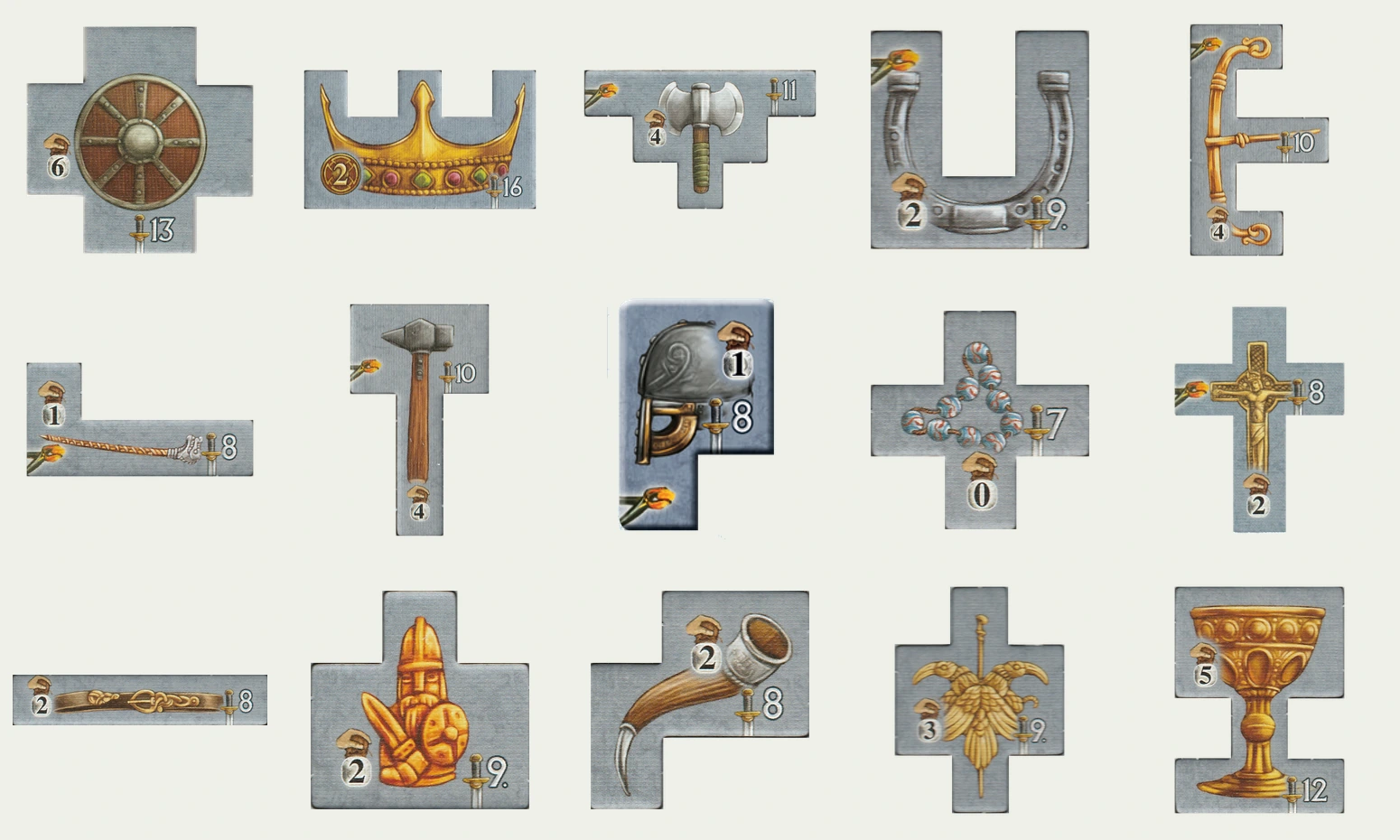
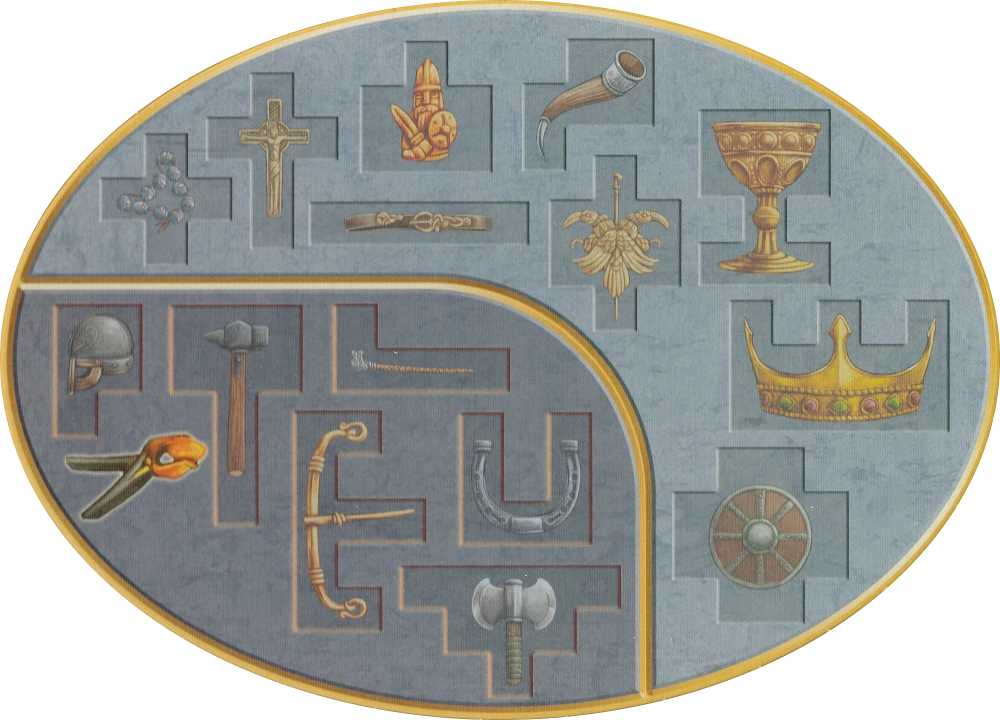
15 special tiles and their oval supply
Treat special shapes as blue luxuries. Actions including pillaging can provide them. The English Crown cannot be purchased.
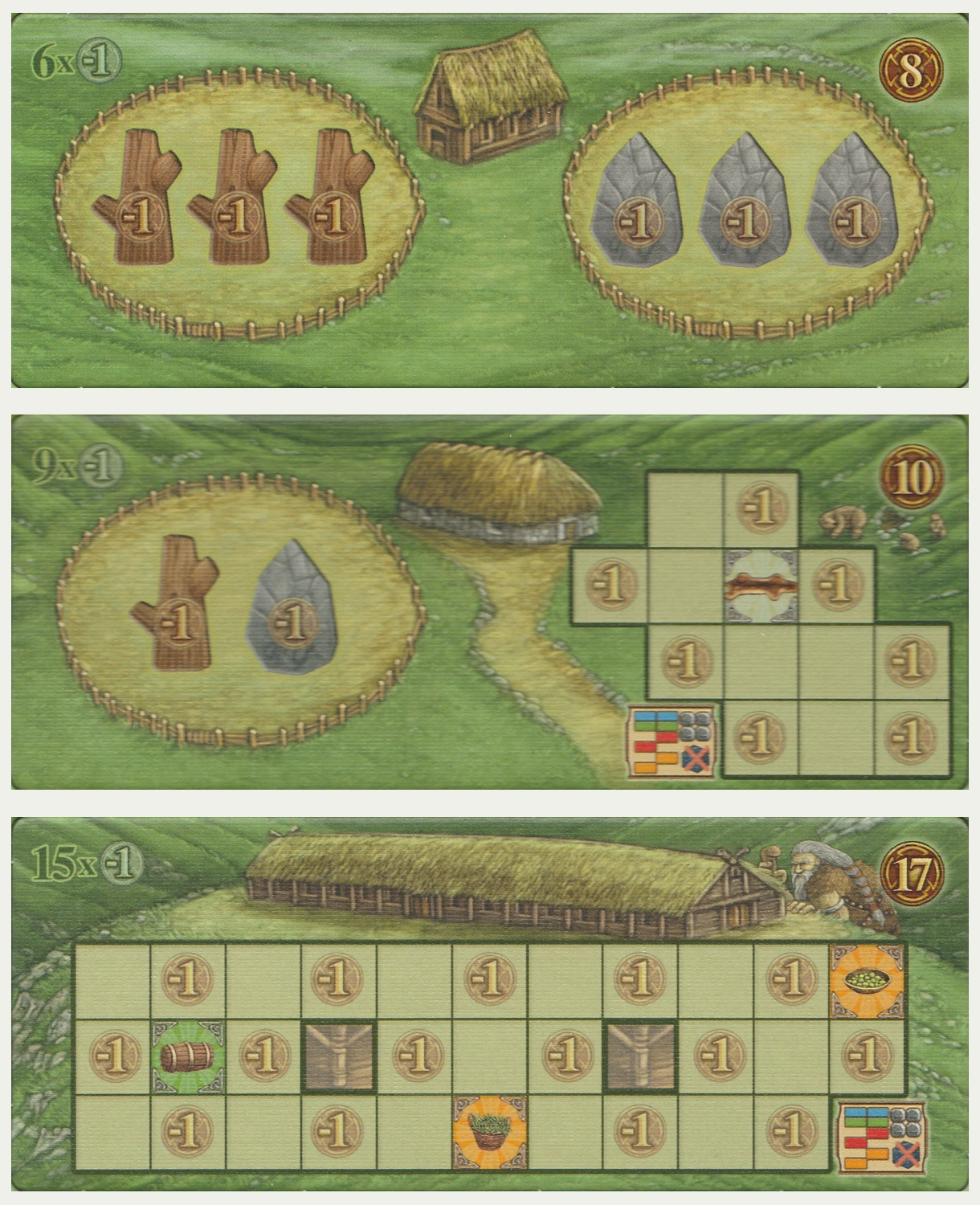
11 buildings
Three sheds, three stone houses and five long houses. Follow each tile’s materials and penalty spaces. They score 8, 10 and 17 base points respectively.
346 goods tiles and two storage trays
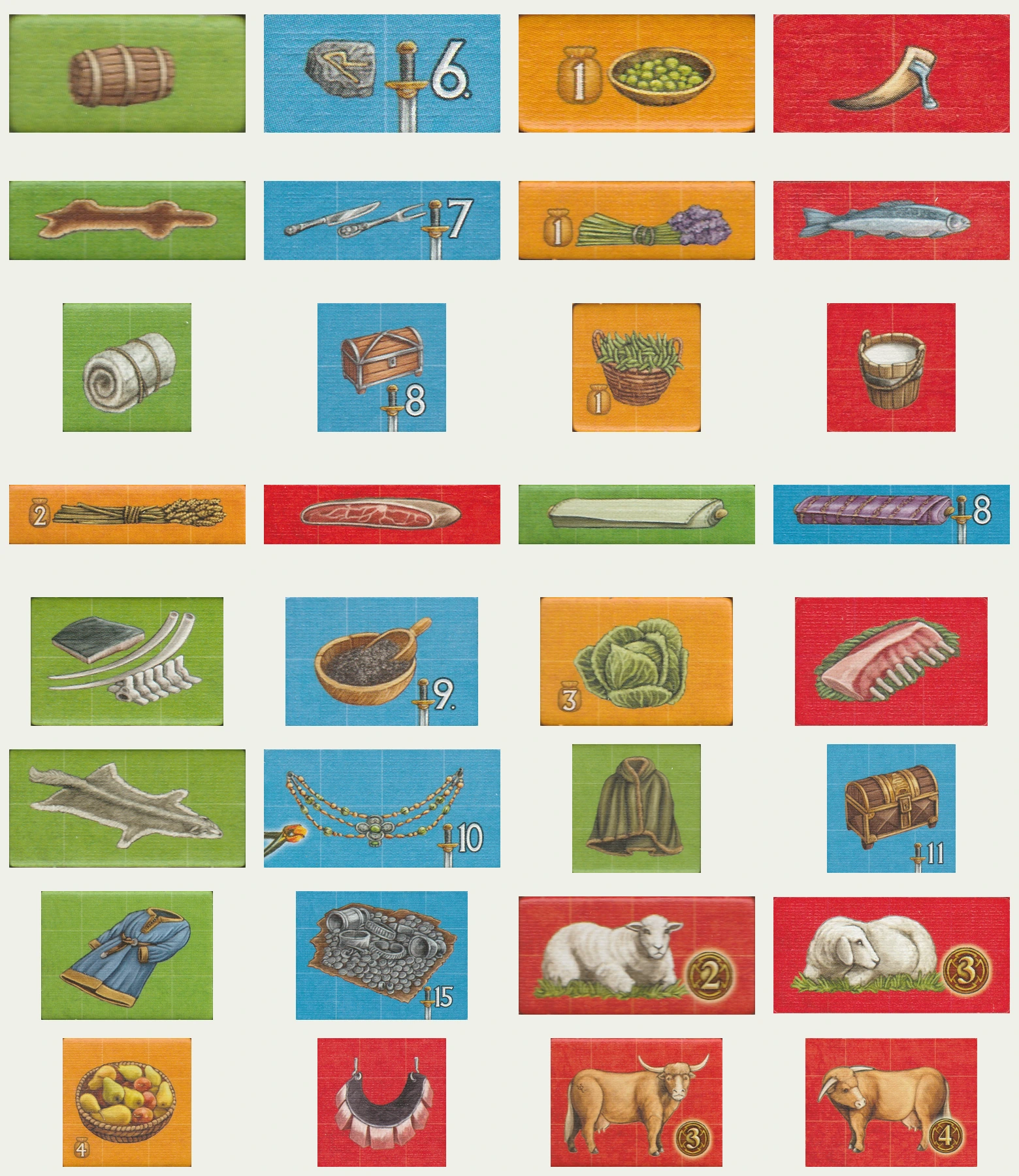
Orange/red faces represent farm and animal products; green/blue represent crafts and luxuries. Sheep and cattle flip to their pregnant side. Colour determines placement.
Four occupation examples
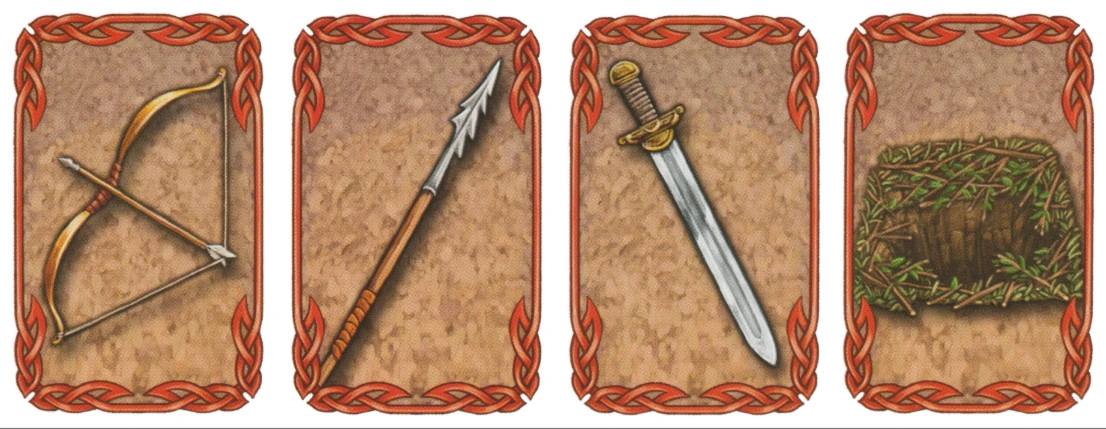
Left to right: Peddler 1A, Craft Leader 8a, Archer and Patron. Lower-case indices denote starting occupations, upper-case indices regular occupations. The box has 45 starting and 145 regular occupations, 190 total. Play a card before using it; see the appendix for full text.
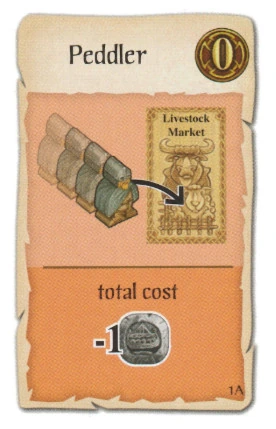
Deck A occupation · Peddler
A regular dark-brown occupation (1A). Once played, reduce the total cost of a Livestock Market action by one silver.
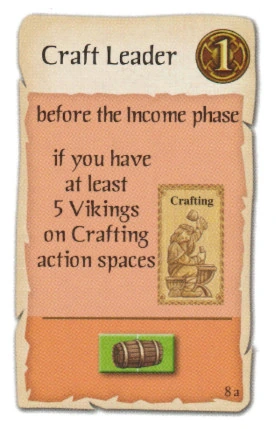
Starting occupation a · Craft Leader
A light-brown starting occupation (8a). Before income, gain one oil if you have at least five Vikings on crafting spaces.
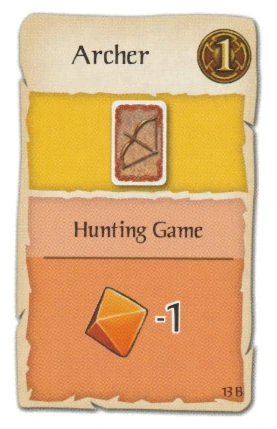
Deck B occupation · Archer
Gain a bow and arrow immediately on playing this card. Subtract one from hunting rolls.
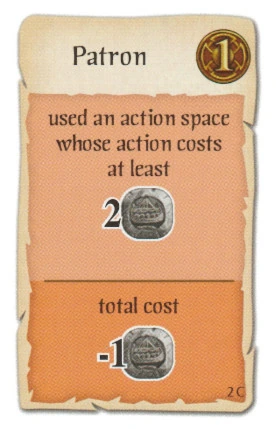
Deck C occupation · Patron
Reduce the total cost by one silver when using a space that costs at least two silver.
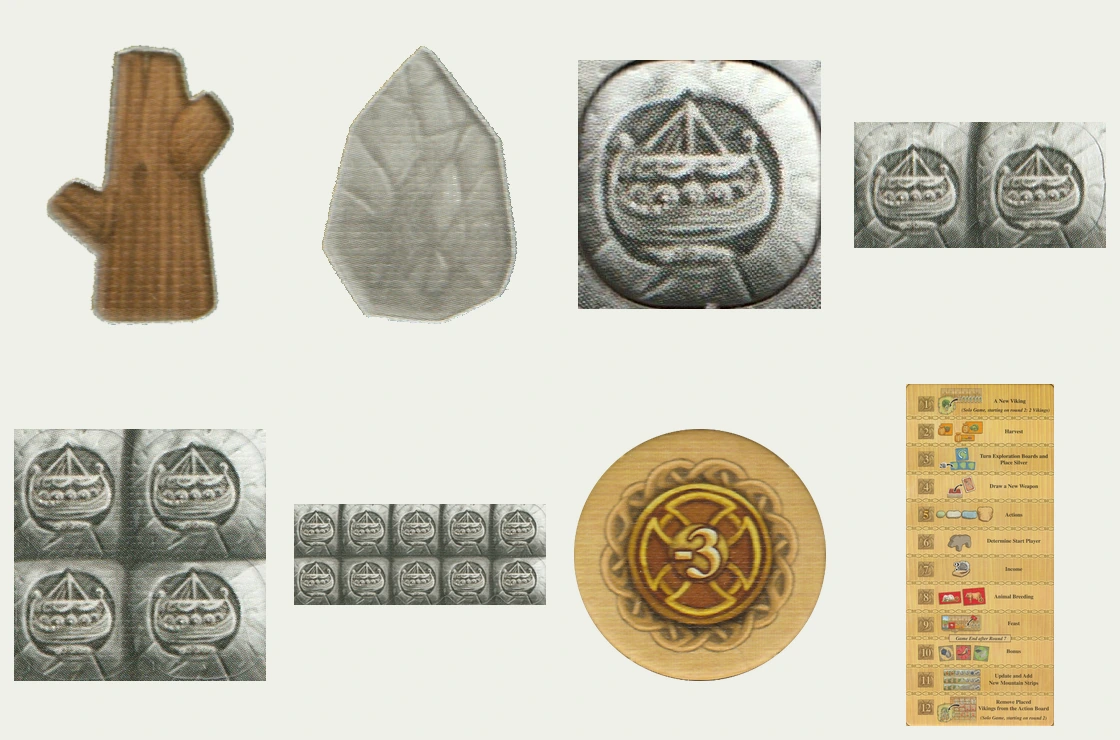
Wood, stone, silver, penalties and round reference
Eight mountain strips; 32 wood, 24 stone and 40 ore; 125 silver coins; 48 Vikings, the moose, round cube and seven Thing Penalty tiles.
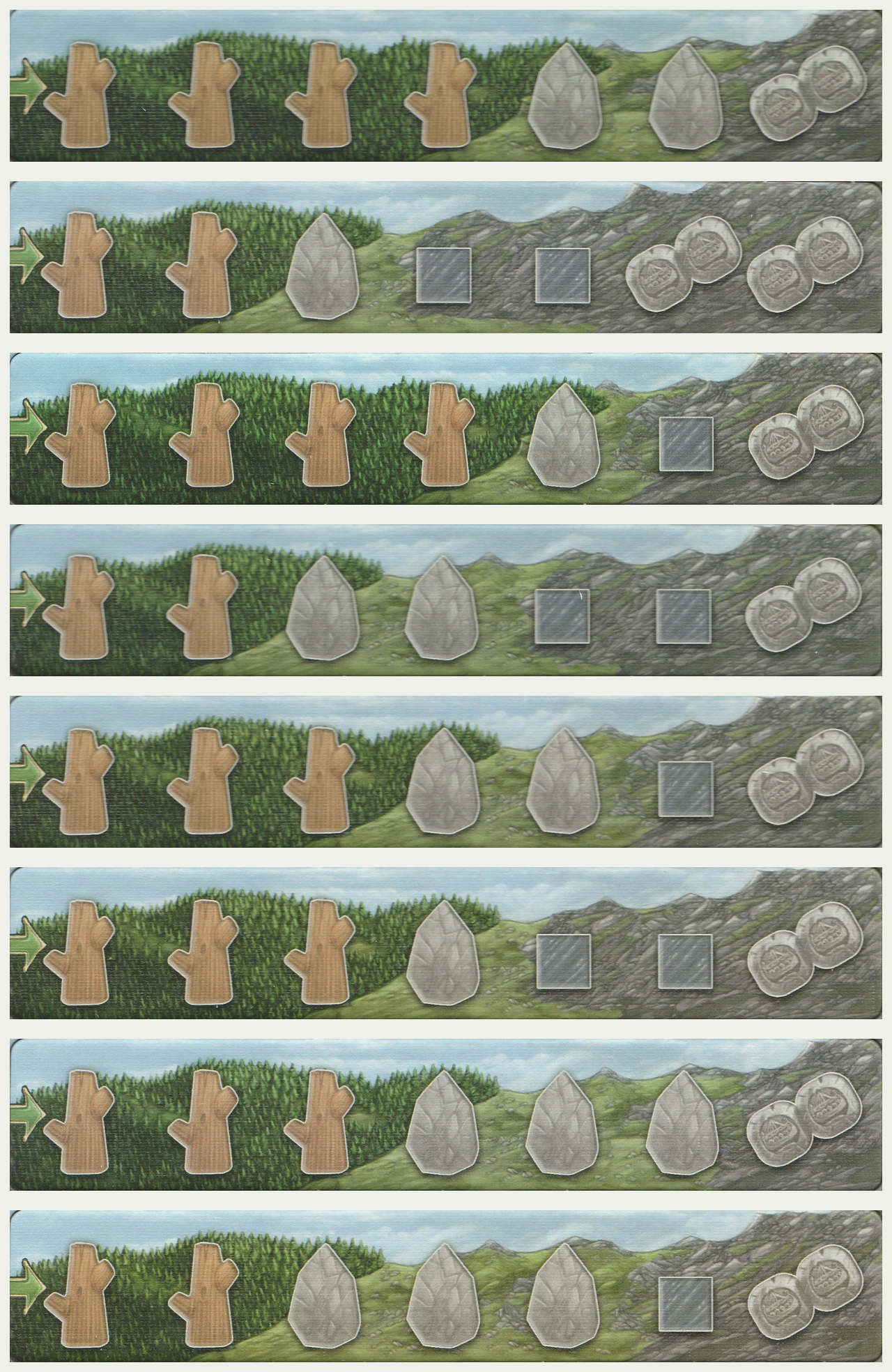
All eight base-game mountain strips
Stock the printed spaces when revealed and collect resources from the left.
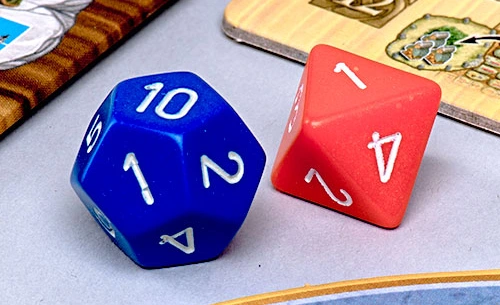
Orange d8 and blue d12
Use the die shown on the action space. Hunt with low rolls and raid with high rolls.
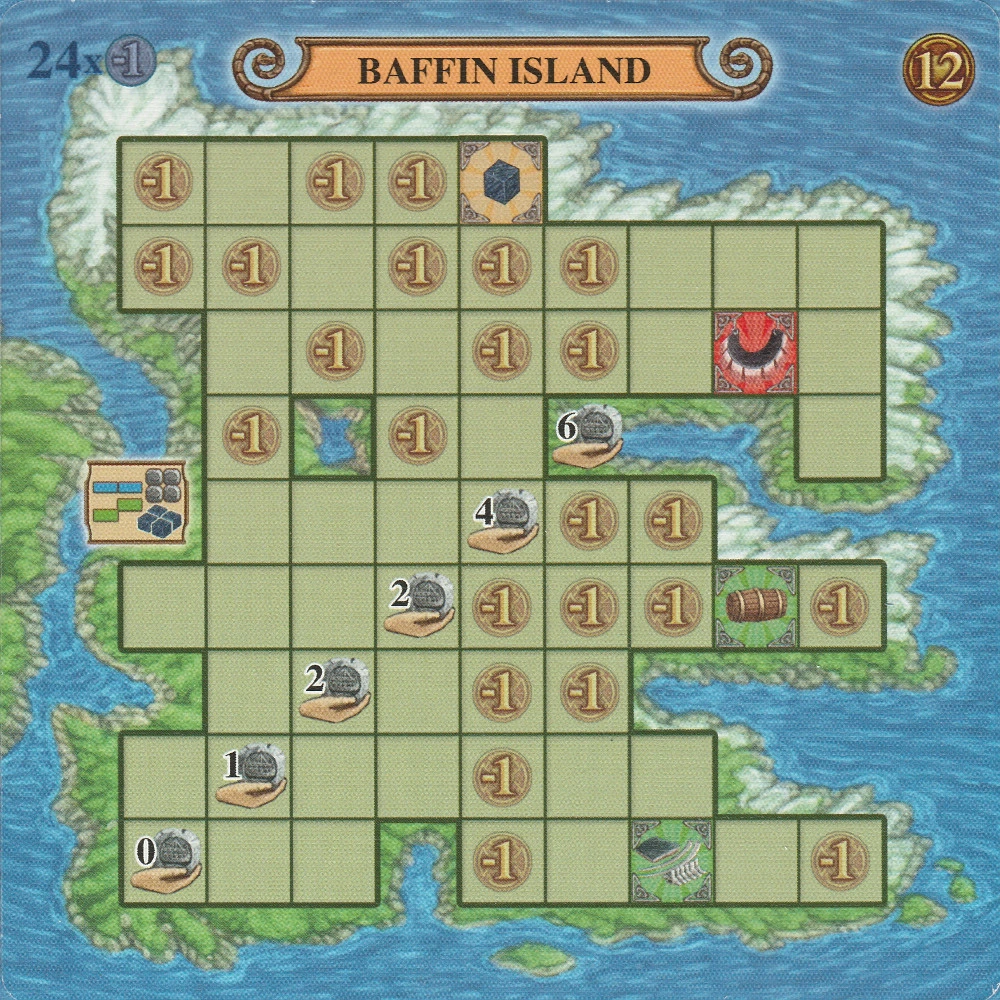
Baffin Island
Available from long-game round 4 or short-game round 3, provided the front was not claimed. The board scores 12 points and has 24 points in uncovered penalties.
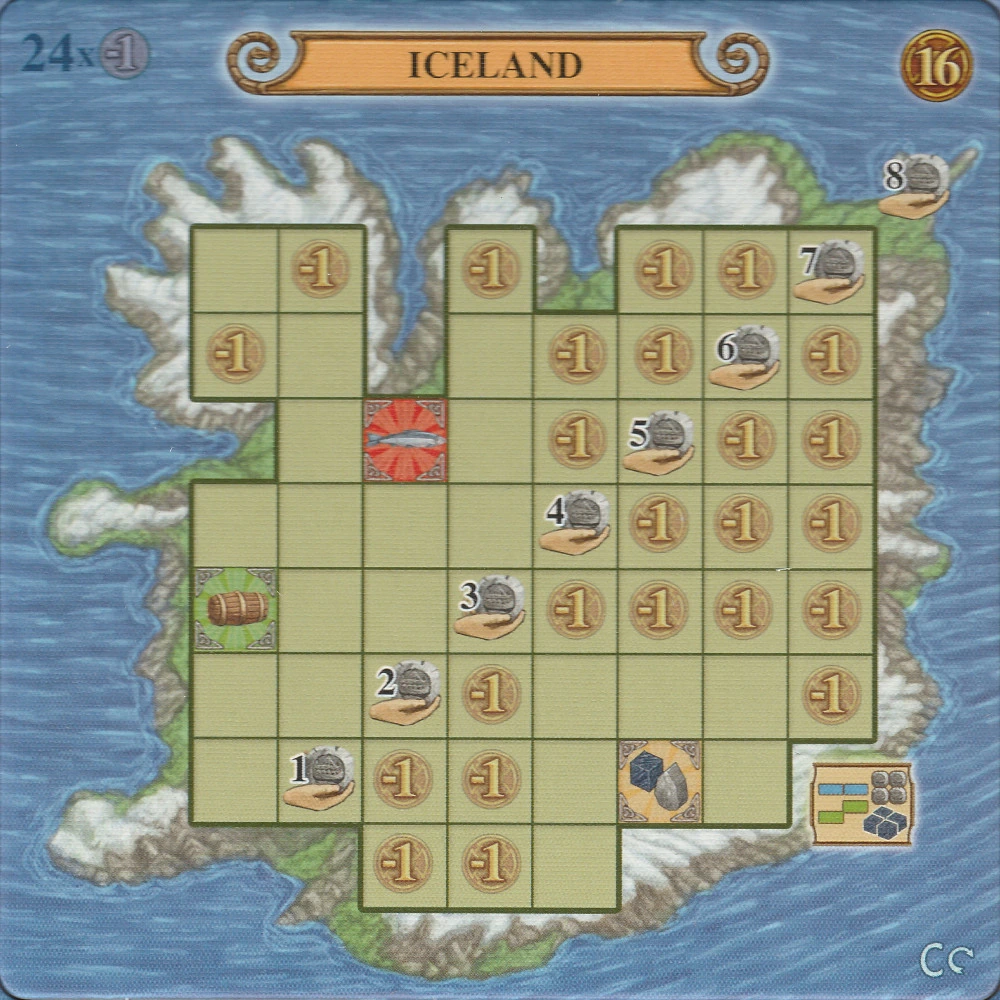
Iceland
Available in long-game rounds 1–4 and short-game rounds 1–3. The board scores 16 points and has 24 points in uncovered penalties.
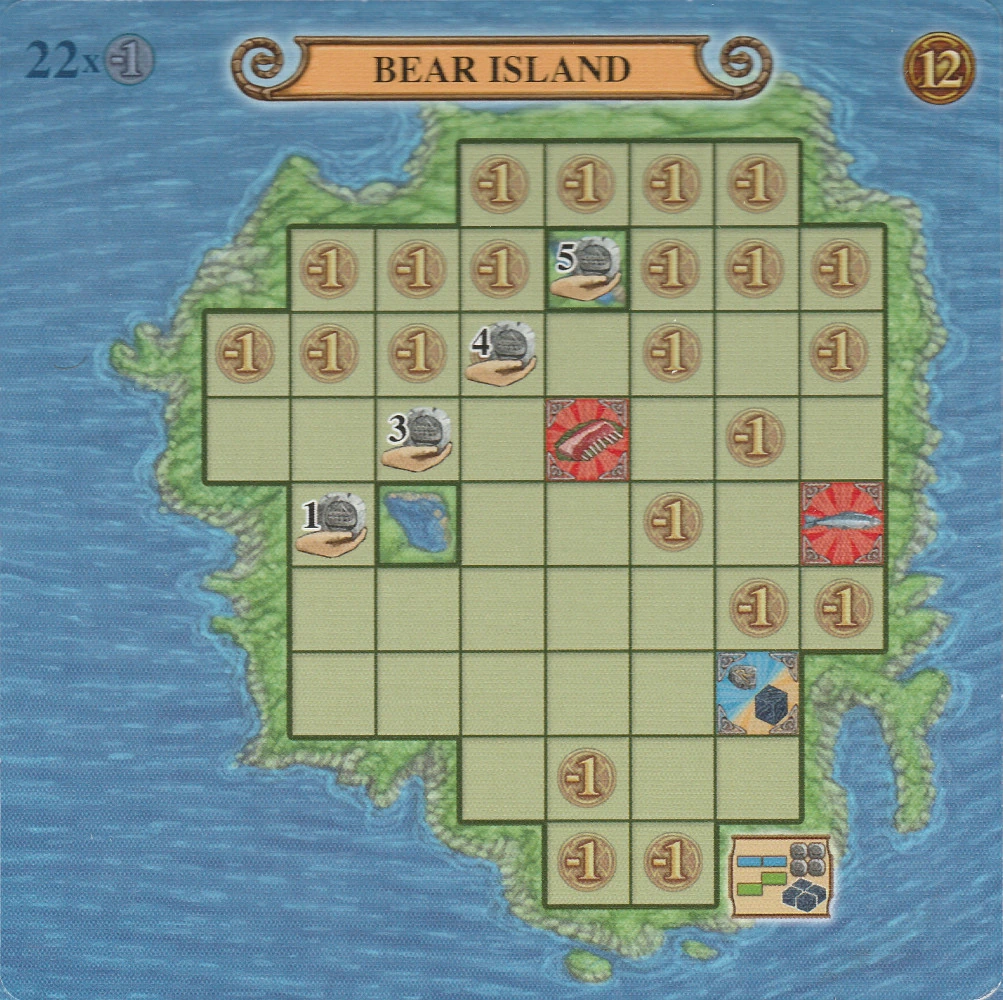
Bear Island
Available from long-game round 3 or short-game round 2, provided the front was not claimed. The board scores 12 points and has 22 points in uncovered penalties.
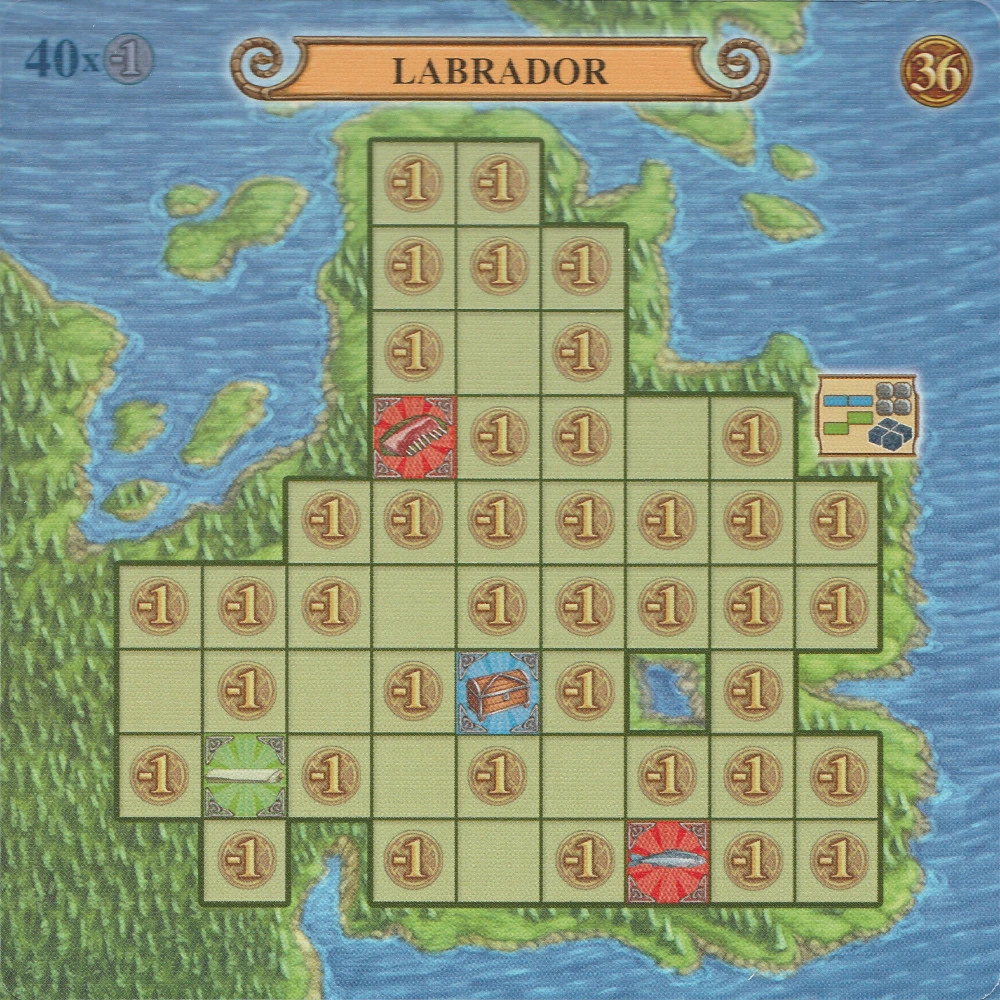
Labrador
Available from long-game round 5 or short-game round 4, provided the front was not claimed. The board scores 36 points and has 40 points in uncovered penalties.
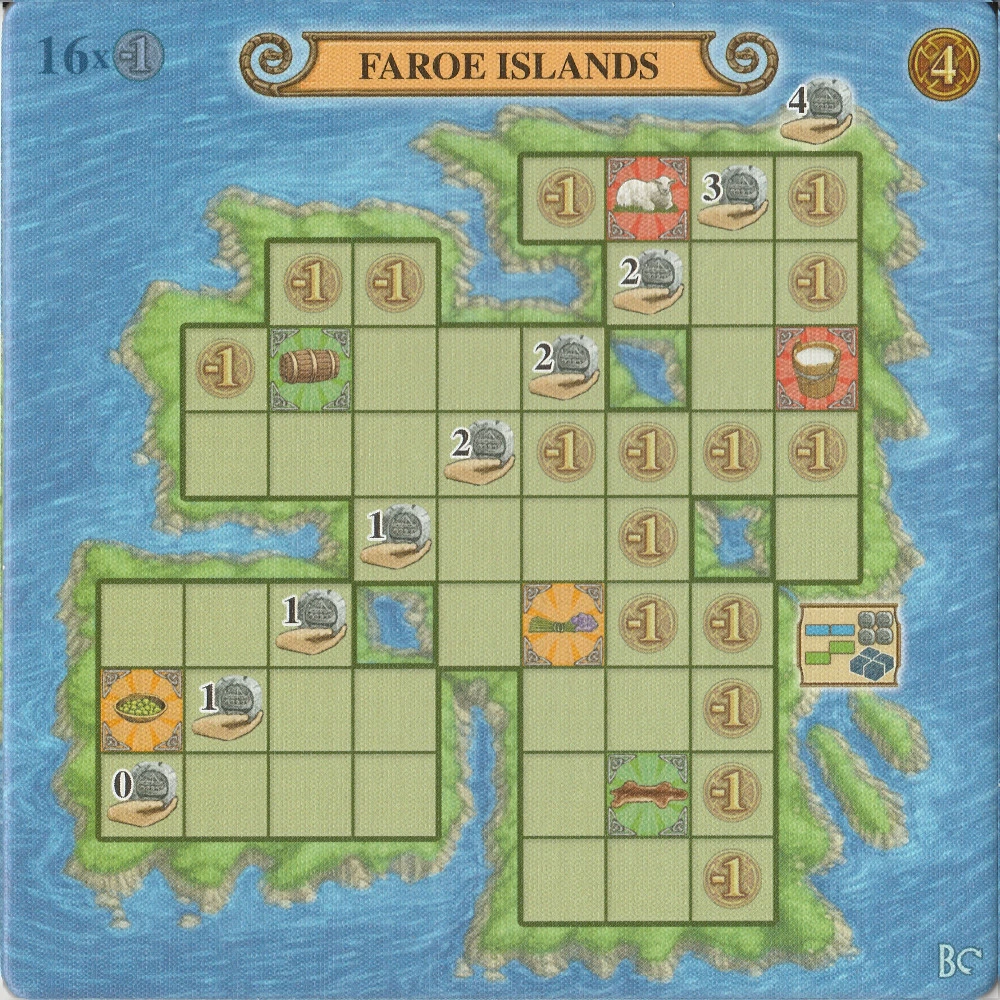
Faroe Islands
Available in long-game rounds 1–3 and short-game rounds 1–2. The board scores 4 points and has 16 points in uncovered penalties.
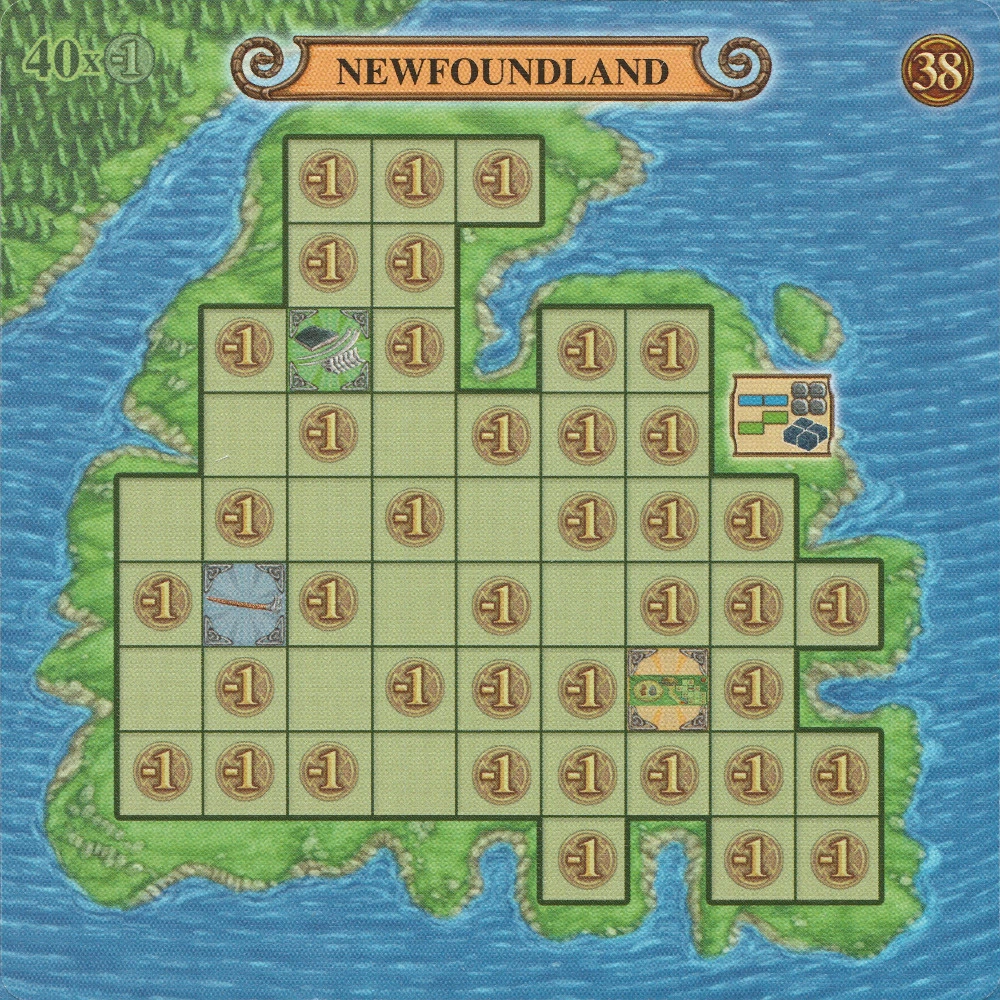
Newfoundland
Available from long-game round 6 or short-game round 5, provided the front was not claimed. The board scores 38 points and has 40 points in uncovered penalties.
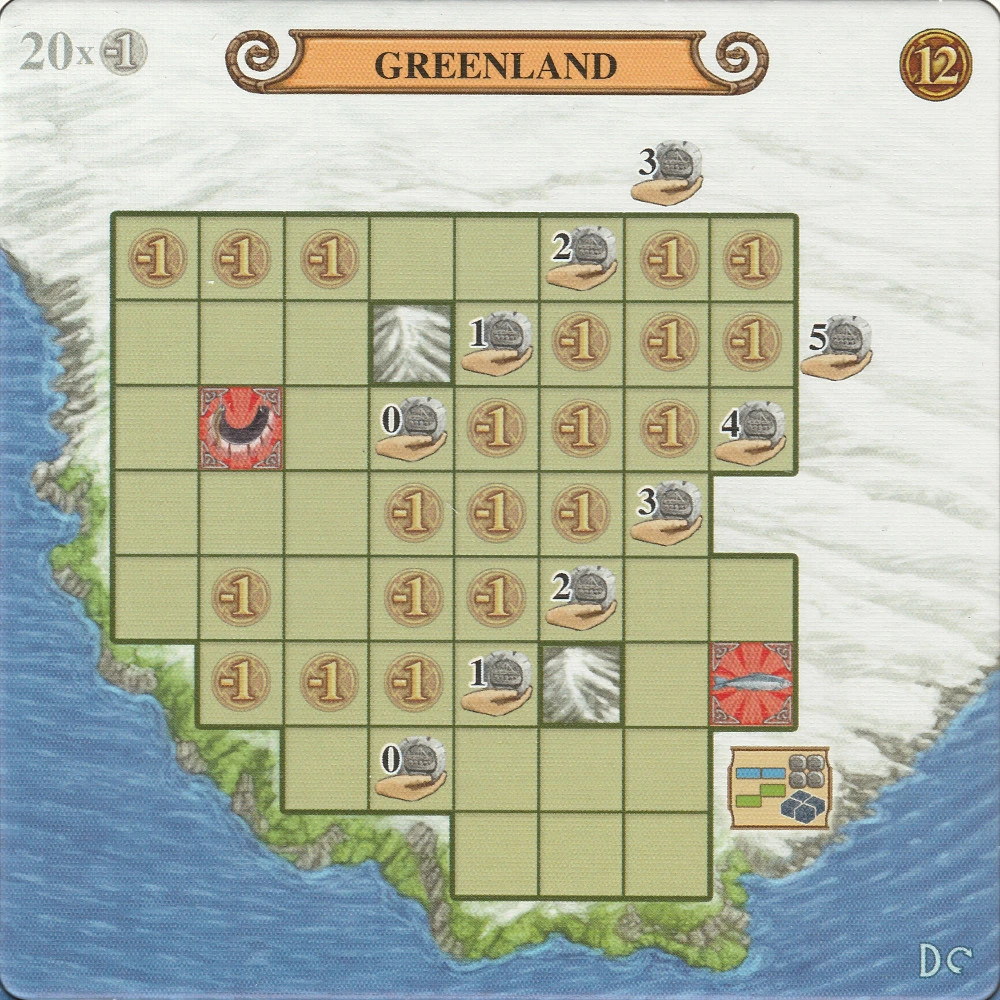
Greenland
Available in long-game rounds 1–5 and short-game rounds 1–4. The board scores 12 points and has 20 points in uncovered penalties.
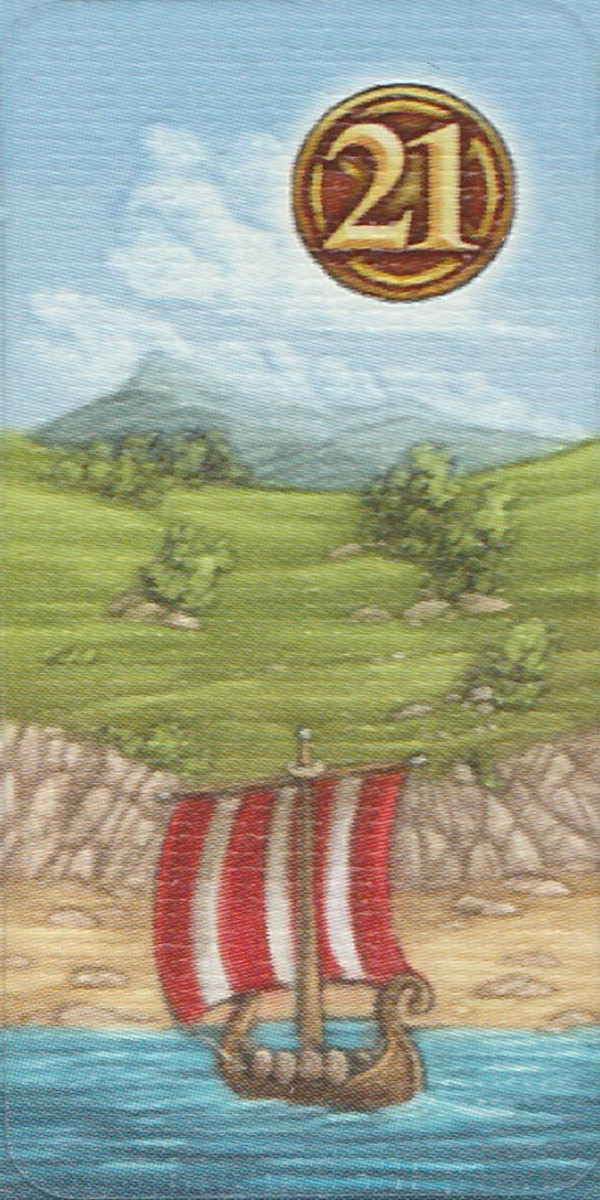
Shetland
Available in long-game rounds 1–2 and short-game rounds 1–1. The board scores 6 points and has 24 points in uncovered penalties.
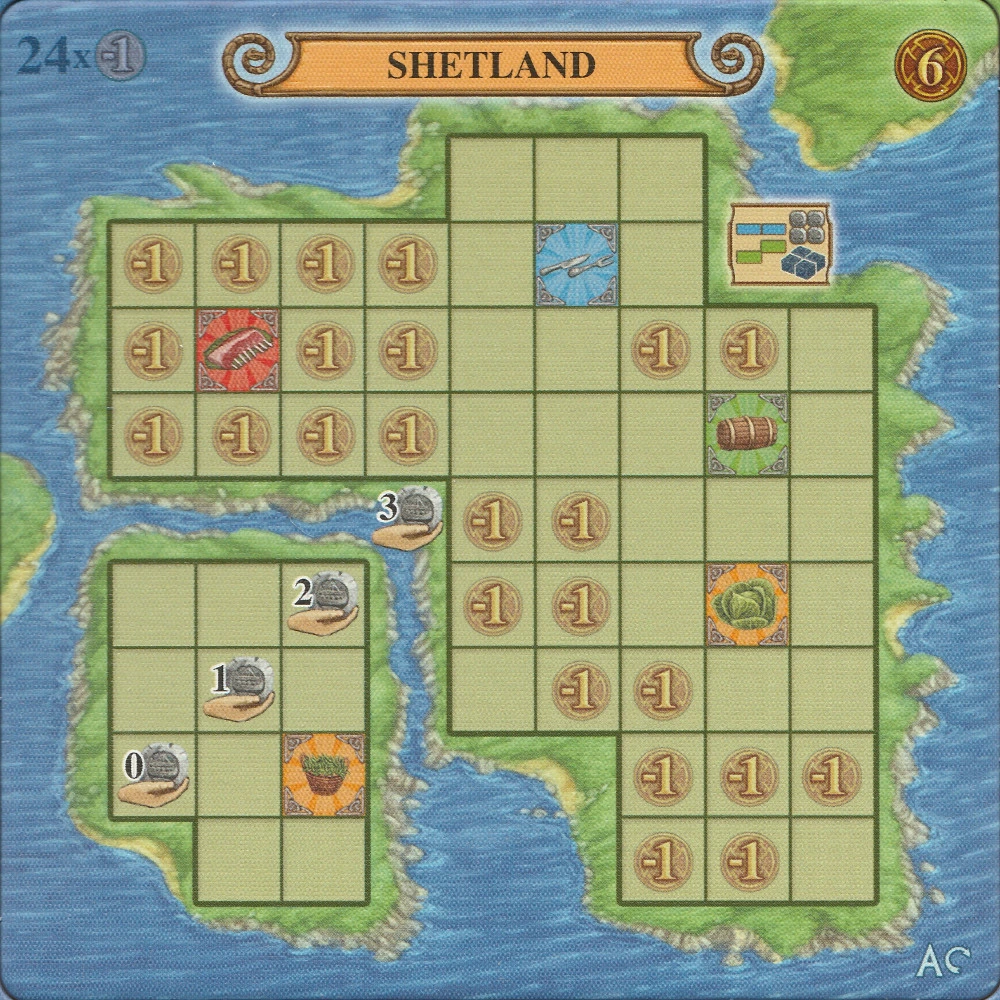
Four weapon types
The base box has 47: twelve bows, snares and spears, and eleven long swords. Use bows for hunting, snares for snaring, spears for whaling, and swords for raiding/pillaging.
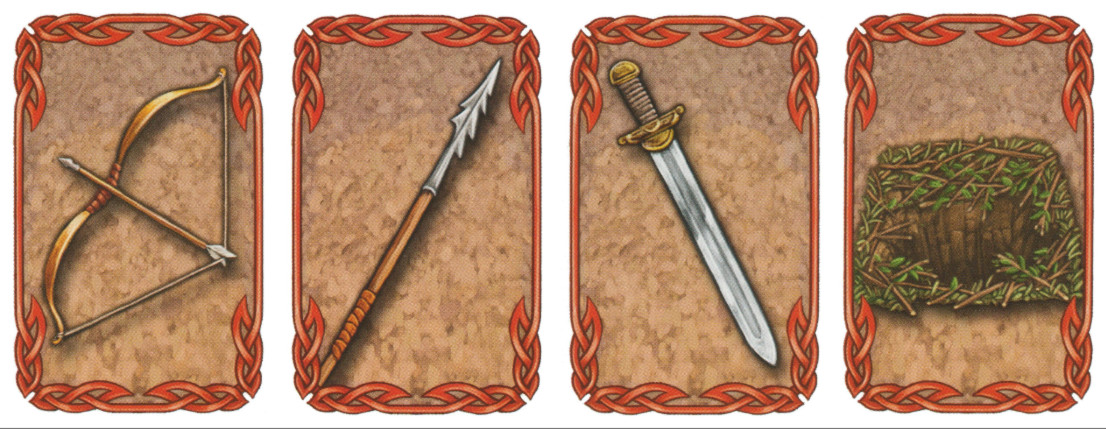
Knarr emigrant reverse
A knarr is worth five as a ship or eighteen as an emigrant covering two places. Pay the current round in silver; it can no longer trade or explore.
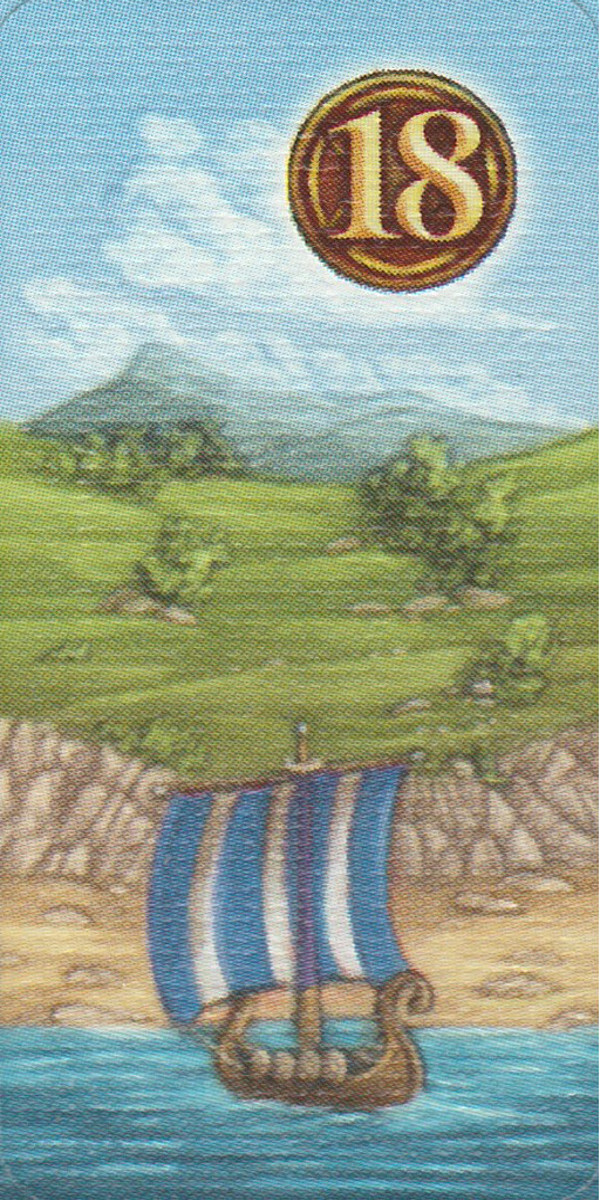
Longship emigrant reverse
A longship is worth eight as a ship or twenty-one as an emigrant covering two places. Its ore is lost, not returned; it can no longer raid or explore.
Rule questions
How do you win?
Play seven rounds in the long game or six in the short game. Make final legal placements after the last feast, then score. Highest total wins; tied players share the win.
What counts at final scoring?
Add ships, emigrations, exploration boards, buildings, livestock, played occupations, supply silver, final income and the English Crown. Deduct uncovered penalty spaces and Thing Penalties. Silver on boards is not supply silver.
A longship is worth 8 points, or 21 on its emigration side.
What does each player start with?
Take a home board and 12 Vikings of one colour. Use the same long or short side. Set seven Vikings on the long-game banquet track or six on the short-game track and place the rest in the Thing Square. Take one starting occupation, one bow and arrow, one snare, one spear and one mead.
How do you set up the shared table?
Set out the action board, goods trays and ship and special-tile supplies. Start the four exploration boards on sides A–D and sort buildings by type. Shuffle the mountain strips and reveal two, or three with four players, then stock their spaces. In a four-player game only, add both action-board extensions and randomly choose each face.
How many Vikings does an action cost?
Columns one through four require one, two, three and four Vikings respectively. Use one vacant space on your turn and carry out at least one of its effects. Paying a cost counts as an effect.
Who starts the next round?
The last player to place Vikings on the action board takes the moose marker.
What do you receive at harvest?
Read this round’s harvest mark on the home board. Harvest gives orange farm products only. Take the crops up to the stated threshold, or take none when there is no harvest.
Can you cover an income number directly?
To cover a number, fill every space to its left, below it and in the square to its lower left. Printed goods spaces count as covered for this test. Income is the smallest visible value.
May green goods touch?
On home and exploration boards, green goods cannot share an edge, but may touch diagonally. Blue goods, silver and ore follow their own placement rules and can touch their own kind. Goods may never overlap.
How do printed home-board bonuses pay out?
Keep the printed goods space uncovered and fill its required surrounding spaces. The bonus then pays in the bonus phase. Covering the symbol frees placement space but forfeits that recurring bonus.
Covering the mead symbol does not award mead.
How do you feed the banquet?
Fill banquet-track spaces without Vikings using orange farm goods, red animal goods or one-silver coins. Separate food tiles of the same colour. Only one non-square tile of a given type may be laid horizontally; others of that type are upright. Silver can touch silver.
What if one feast space is empty?
Take one Thing Penalty per empty space, worth minus three at the end. Return spent food and silver to the general supply after the feast.
When do sheep and cattle breed?
Resolve each species separately. If you already have pregnant animals, flip them back and take offspring of that species. Otherwise, with at least two regular animals of the species, flip one to its pregnant side.
How do upgrades differ from overseas trade?
A normal upgrade exchanges goods for the next tier, orange to red to green to blue, at the same size and shape. Overseas trade requires a knarr and one silver and flips any number of different green goods in your supply to blue.
Do hunting and raiding want high or low rolls?
Hunting, snaring and whaling want low rolls; raiding and pillaging want high rolls. Roll at most three times, replacing the previous result each time, and stop early if you wish. Whaling reduced to zero must stop and succeed.
What do the three ship types do?
Whaling boats enable whaling. Knarrs enable overseas trade, and longships enable raiding and pillaging. Exploration spaces specify their ship requirements. Knarrs and longships may also emigrate.
What does emigration do to ships and feasts?
Pay silver equal to the current round and flip a knarr or longship onto the next two places from the left end, after existing emigrants. It becomes an 18- or 21-point emigration and is no longer a ship. Longship ore is lost; total Vikings do not decrease.
In round four, pay four silver. With one emigration already in place, a second reduces current feast demand from seven to five.
When can you claim an exploration board?
Take an exploration action and meet the ship requirement to claim an available board on its current face. Unclaimed boards flip at the scheduled round; claimed boards do not.
Why do mountain strips change each round?
Remove the leftmost resource from each current strip, discard exhausted strips, and reveal a new strip. Follow the four-player long-game replenishment rule if the stack runs out.
How are action spaces blocked in solo play?
Alternate two colours of Vikings. The previous round’s Vikings stay and block their action spaces. Retrieve the older colour according to the solo round procedure.
Does the final round award bonuses?
The last round ends immediately after the feast, with no bonus phase. Make final legal placements and score. Final income may be recorded directly on the scoring sheet.
How do starting and regular occupations take effect?
Play the card through an occupation action. Only played occupations apply at their stated time and count for scoring. A, B and C identify decks. Start with A for a first game; B and C add triggered effects.
Do buildings follow the home-board placement rules?
Sheds take wood and stone on designated spaces. Stone and long houses can take food, crafts, luxuries and silver. Leave pillars uncovered and follow the restrictions shown on the building.
What does a successful or failed hunt give?
Roll the orange d8 and pay the stopped roll in wood and/or bows to receive one hide and one game meat. You may fail without payment to gain one wood and one bow. Hunting returns no Vikings on failure.
For a roll of three, pay one wood and two bows. After re-rolling seven, the earlier three is unavailable.
How do ore and zero work in whaling?
Column-three whaling costs three Vikings and uses 1–3 boats; column four costs four and uses only one. Reduce the blue d12 by all printed and added ore on the boats used, treating negatives as zero. Pay the remainder in wood or spears. Zero must immediately succeed, with no re-roll or voluntary failure. Keep boats and ore; gain one oil, skin and bones, and whale meat.
With five total ore, an eight needs three payment. Re-rolling four becomes zero and costs nothing.
How do raiding and pillaging differ?
Both require a longship and add one per stone or long sword spent. Orange-d8 raiding ignores ship ore. Blue-d12 pillaging must use the highest-ore longship, adds one per ore and keeps it. Success takes exactly one blue tile with sword value at most the battle result; five or less cannot succeed.
Pillaging six with three ship ore and one sword yields ten, enough for value-ten jewelry.
Does a failed die action spend equipment or return Vikings?
Failure spends no selected materials or weapons. Hunting/whaling grants one wood plus the matching bow/spear; raiding/pillaging grants one stone and one sword. Whaling may retrieve two Vikings and pillaging one for reuse this round. Hunting and orange-die raiding retrieve none. Zero whaling cannot fail.
After a failed three-Viking whale, two may return to the Thing Square and one stays on the action. The occupation drawn for column three stays in hand.