Dungeon Petz
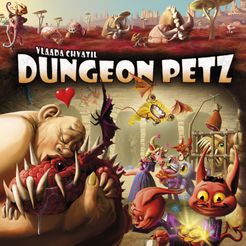
Dungeon Petz is a worker-placement game about running a fantasy pet shop. Players lead imp families who buy, raise, and care for magical monsters, enter exhibitions, match Dungeon Lords’ preferences, and compete for the most reputation.
Dungeon Petz supports 2–4 players; community best: 4 players; playing time: 90 minutes. A WANGO browser trial has not been confirmed.
Background & introduction
Dungeon Petz begins with a family of imps out of work. The old dungeon has fallen, so the imps look around town for a new business and settle on opening a pet shop for Dungeon Lords. The idea sounds simple: buy young monsters, feed them, clean their cages, watch them grow, and sell the right creature to a customer. But these pets have their own moods and needs. They may want to play, get angry, cast magic, or make a mess, forcing their keepers to respond to problems as they arise.
Each player runs an imp family, sending some members to buy food, pets, cages, and supplies while keeping others at home to care for the animals. The game combines worker placement with simultaneous planning: players secretly form imp groups of different sizes, then compete for town actions according to group size and order. A large group can improve the chance of claiming a scarce action, but leaves fewer imps at home. A smaller group conserves labor yet may have to accept whatever choices remain after other players act.
Pet and Need cards make each round’s care puzzle different. Players assign every pet its own cage, draw and allocate cards representing needs, and then deal with feeding, play, magic, anger, disease, and cleaning. If cared for well, pets can grow healthy and perform in exhibitions. If ignored, they may suffer, mutate, soil their cages, or even escape and be lost. These complications are not only penalties: a monster that matches an exhibition can earn reputation, and a mature pet that fits a customer’s tastes can bring profit.
Exhibitions and customers are revealed ahead of time, allowing players to plan purchases and care over several rounds. Exhibitions ask players to show off their pets and their condition; customers select animals that meet their preferences. Selling early can bring gold, but it also gives up the chance to exhibit or keep developing that pet. At the end, players evaluate both the business and the remaining shop. The imp merchant who balances expansion, staffing, and animal care to achieve the most reputation wins.
Core rules & scoring
Objective and scope: Players run imp pet shops and gain reputation by entering exhibitions, satisfying customers, raising pets, and managing their business. The CGE base game supports 2–4 players and lasts about 90 minutes. A 2- or 3-player game uses six rounds; a 4-player game uses five. This summary excludes the Dark Alleys expansion and bonus or promotional pets.
Setup and rounds: Each player takes imps, minions, a Burrow Board, and a Pet Display Board. The Central Board provides town actions, while the Progress Board lays out exhibitions, customers, and rounds. Select the sides appropriate for the player count and prepare starting gold and cages and set out pets available to purchase. Each round has six phases: Setup, Shopping, Need Cards, Showing Off and Care, Business, and Aging. Round 1 has no regular exhibition, and customers begin arriving in round 3; future exhibitions and customers are revealed in advance.
Setup phase: Collect income, reveal new information, and refill the market with pets, food, cages, addons, and other items. In a 2- or 3-player game, neutral imps block some town actions; use the arrows and neutral-imp rules on the correct board side to determine which locations are unavailable. Since exhibitions and customers are revealed early, players can plan purchases before the customer arrives instead of reacting only at the moment of sale.
Shopping and group order: Each player secretly forms groups of imps and assigns gold to them. After everyone reveals, group size is the total number of imps and gold; in the specified order, each group chooses an open town action or stays home. Larger groups generally choose first. Each group uses one action space to buy a pet, food, cage, addon, or artifact, or to take another listed action. If a space is occupied or blocked by a neutral imp, the group must choose a different legal location.
Assigning Need cards: First give each pet its own cage, then draw and assign Need cards during the Need Cards phase. The four colored decks provide different combinations of needs. Card icons may involve food, play, magic, or containing anger, and can also lead to disease or cage-cleaning problems. Consider each pet’s size, cage strength, stored food, and available imps when assigning cards. Once assigned, the cards are evaluated in order during Showing Off and Care; players cannot simply ignore an inconvenient need.
Showing Off and Care: Beginning in round 2, pets enter public exhibitions. On a player’s turn, evaluate the pets’ needs and conditions in the order given by the rules, using food and imps still at home to care for them. Hunger, anger, magic, disease, manure, and play needs have different consequences. Poor care can add suffering, soil a cage, cause mutation, or make a pet escape or be lost. The exhibition theme determines how display points are counted, and players receive reputation based on their final ranking.
Business and selling: Beginning in round 3, Dungeon Lord customers buy pets according to their preferences. Only a pet that has reached the required saleable size may be sold; a young pet is not eligible. In starting-player order, each player may offer a pet that matches the customer or decide to keep their animals. The degree of preference matching affects the reward in gold and reputation. Selling returns an investment and frees a cage, but removes that pet from future exhibitions and further growth.
Aging and pet loss: At the end of a round, eligible pets grow, imps return or remain assigned as directed, and the market is prepared for the next round. A pet’s size determines when it becomes saleable. If a player does not have enough cages, an unplaced pet may have to be released. Severe conditions can also remove a pet: too much suffering, anger beyond a cage’s strength, or excessive mutation can cause it to leave and may reduce reputation. Plan each animal together with its cage, addons, and available care staff.
End game and scoring: After the final round, players complete two final assessments: Business Acumen and Pet Display. The business assessment considers pets, cages, addons, food, artifacts, potions, and remaining gold according to the rules. The display assessment checks pet condition and manure, suffering, and mutation tokens in cages. Each imp still in the hospital, on the platform, or away from home can cost reputation. The player with the most reputation after both assessments wins; a tie is shared.
Rules & gameplay questions
How many people can play Dungeon Petz?
Czech Games Edition lists the base game for two to four players and about 90 minutes. A four-player game follows a five-round progress board, while two- and three-player games use the six-round board and the corresponding neutral-imp rules that block some town actions. Player count changes the length of the game and the available action spaces, so the four-player setup should not be used unchanged with fewer players.
What phases happen in each round?
Each round follows six phases: Setup, Shopping, Need Cards, Showing Off and Care, Business, and Aging. Setup refills the town and reveals upcoming exhibitions or customers. Players send imp groups to shop, assign cages and Need cards, then resolve care and exhibitions. Beginning in round three, players may sell mature pets to customers. Aging grows pets and resets parts of the shop for the next round.
Why do players form imp groups of different sizes?
Players secretly choose the imps and gold in each group. Once revealed, group size is the number of imps plus gold, and the listed order determines who chooses a location or stays home, so a larger group can claim a popular action. However, every imp sent away is unavailable for caring for pets at home. Group size is therefore both a way to compete for actions and a decision about how much labor the family can spare.
How can I stop a pet from getting hurt or leaving?
Assign Need cards with the pet’s cage and condition in mind, then resolve their icons in the rulebook’s order. Prepare the right food, care imps, and any useful addons. Different needs have different procedures, and anger or magic must be compared with a cage’s strength while disease can be affected by how dirty it is. Reaching a suffering, mutation, or escape limit can remove a pet, so choose its cage and staffing when you acquire it.
Can I sell a young pet as soon as I buy it?
No. Customers appear beginning in round three, but only a pet that has reached the required size can be sold. Pets grow over rounds, so the player must first care for them and may enter them in exhibitions. When a customer arrives, compare the mature pet with the customer’s preferences and decide whether to sell or keep it. Selling provides a reward and frees a cage, but ends that pet’s future exhibition and growth opportunities.
How do exhibitions award reputation?
Starting in round two, each exhibition has a public theme. Players calculate display points from the relevant Need cards and the condition of their pets. Different exhibitions reward different traits and may penalize suffering, manure, or mutations. After all players show their pets, rank the exhibition scores and award more reputation to the higher placements. Entering a pet can be lucrative, but the player must first keep it healthy enough to perform.
Do exhibitions and customers appear randomly at the last minute?
No. The rules reveal upcoming exhibitions and customers before they take effect, giving players time to plan purchases, care, and pet growth. Players can see the current and future exhibition themes and customers’ buying preferences in advance. This information does not guarantee a perfect match because Need cards and animal conditions may change, but it gives the player a planning target instead of a surprise decision at sale time.
How is final reputation calculated?
Final scoring includes two assessments, one for Business Acumen and one for the Pet Display. The business score uses the pets, cages, addons, food, artifacts, potions, and remaining gold specified by the rules. The display score considers animal conditions and manure, suffering, and mutation tokens. Imps still in the hospital, on the platform, or away from home can cost reputation. After both assessments, the player with the most reputation wins; tied players share victory.
Rules & introduction sources
- Edition
- This entry follows the 2011 base game by Czech Games Edition. The publisher lists 2–4 players, about 90 minutes, and age 10+. Games with 2–3 players use the six-round setup, while four-player games use five rounds. Dark Alleys, bonus pets, and promotional pieces are excluded.
- Introduction source
- BoardGameGeek
WANGO editorial
| Parameter | Recorded value |
|---|---|
| BGG overall rank (snapshot) | #386 |
| Complexity Weight | 3.63 / 5 |
| Best player count (community) | 4 |
| Player range | 2–4 |
| Playing time (minutes) | 90 |
| Core mechanisms | Auction / Bidding · Contracts · End Game Bonuses · Hand Management · Income · Investment · Ownership · Selection Order Bid · Simultaneous Action Selection · Worker Placement |
| Chinese publication | Unconfirmed |
| WANGO browser play | No confirmed WANGO trial |
| Year published | 2011 |
| Suggested age | 13+ |
BGG statistics are stored snapshots, not live rankings. Source checked:2026-09-27
Player questions
What is the best player count for Dungeon Petz, and can I play online?
Dungeon Petz supports 2–4 players; community best: 4 players; playing time: 90 minutes. A WANGO browser trial has not been confirmed.
How complex is Dungeon Petz, and which mechanisms does it use?
Weight: 3.63 / 5. Mechanisms: Auction / Bidding · Contracts · End Game Bonuses · Hand Management · Income · Investment · Ownership · Selection Order Bid · Simultaneous Action Selection · Worker Placement. Chinese publication: Unconfirmed.
Where can I learn Dungeon Petz?
No rule guide, strategy article or WANGO trial has been confirmed for this record.