Mage Knight Board Game
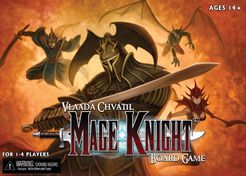
Mage Knight Board Game uses action cards, mana, skills and recruited units to explore an empire. Day and night change travel and spellcasting; the chosen scenario sets the objectives, time limit and outcome.
Mage Knight Board Game supports 1–4 players; community best: 1–2 players; playing time: 60–240 minutes. A WANGO browser trial has not been confirmed.
Background & introduction
As a Mage Knight serving the Council of the Void, you uncover the map, interact with settlements, recruit units, acquire spells and artifacts, and confront roaming enemies or city defenders. Fame develops your hero, while Reputation affects dealings with local people.
Your deck supplies movement, influence, attacks and blocks. Action cards offer a basic effect or a stronger effect powered by matching mana; non-Wound cards can also be played sideways for one basic point. Units and skills widen your options, subject to their own activation limits.
The game has several scenario structures. First Reconnaissance asks you to locate a city; Full Conquest compares Fame and achievements within a limited sequence of days and nights; Solo Conquest requires conquering both cities. Choose the scenario before setting up.
Core rules & scoring
Days, nights and turns: each round is Day or Night, with Tactics setting turn order. A regular turn allows movement followed by one action; resting replaces both. An empty draw deck does not immediately reshuffle: at the start of your turn you may forfeit it to announce round end, giving everyone else one final turn.
Cards and mana: an action card offers its basic effect or a stronger effect for matching mana. Any non-Wound card can give one Move, Influence, physical Attack or Block sideways. Normally use at most one Source die per turn. Pure mana expires at turn end; store at most three crystals per basic color. Gold substitutes for a basic color by day and cannot be used at night.
Exploration and interaction: pay terrain movement costs and another two Move to reveal a tile, normally in a fixed orientation. Spend Influence at settlements for permitted recruits and services. Units require available Command tokens.
Enemy combat proceeds through Ranged/Siege, Block, Assign Damage and Attack. An ordinary enemy attack must be fully blocked; partial blocking does not reduce its damage. Unblocked damage may go to unwounded units, with the remainder wounding the hero. Defeat an enemy with enough attack to meet its Armor in a single attack; damage is not accumulated across phases.
Growth and Wounds: defeated enemies grant Fame. Crossing a level line leads to end-of-turn advancement, alternating skills plus advanced actions with improved Armor, hand limit and Command capacity. Wounds clog your hand. Resting only discards them; healing removes them, and cannot be used during combat.
Full Conquest lasts up to six rounds. Once every city is conquered, everyone including the triggering player gets one final turn, unless the round ends first. Add standard achievements and city scoring, including seven Fame per city led or four for participation without leadership. Highest final Fame wins even if some cities remain unconquered.
Solo Conquest also allows six rounds and uses a dummy player to pace time. The two cities are level five and eight in reveal order. You win only by conquering both; otherwise you fail, but may record Fame, achievements and scenario bonuses to compare performance.
Rules & gameplay questions
Can I reshuffle as soon as my draw deck runs out?
Normally no. Stop drawing when the deck empties and reshuffle all Deed cards when preparing the next Day or Night. Explicit effects such as Long Night are exceptions. You may keep taking turns with cards still in hand rather than immediately announcing round end.
Does resting permanently heal discarded Wounds?
No. Resting puts them in the discard pile, so they can return next round. Healing returns Wounds from your hand to the Wound pile. You cannot heal during combat, but may heal later in the same turn after combat ends.
Must I conquer the city in the introductory scenario?
No. In multiplayer First Reconnaissance, revealing a city gives everyone one final turn, within a three-round limit. The city cannot be entered or conquered. Add standard achievements and compare Fame; ties share victory. Solo Conquest uses a different victory condition.
Are spells powered like action cards?
No. An action card normally has a free basic effect and a stronger effect costing matching mana. A spell already costs matching mana for its basic effect; its strong effect is available only at night and also costs black mana. Gold can replace a basic color during the day and cannot be used at night.
Rules & introduction sources
- Edition
- Uses the original base system as presented in the official WizKids 2018 Ultimate Edition base rulebook/scenario book and walkthrough. Covers 2–4-player First Reconnaissance and Full Conquest, plus one-player Solo Conquest. Ultimate includes separately governed expansions; this page excludes Volkare, Krang, Shades of Tezla, The Apocalypse Dragon and expansion scenarios, and does not detail player-versus-player combat or cooperative city assaults.
- Rule references
- Introduction source
- BoardGameGeek
WANGO editorial
| Parameter | Recorded value |
|---|---|
| BGG overall rank (snapshot) | #39 |
| Complexity Weight | 4.38 / 5 |
| Best player count (community) | 1–2 |
| Player range | 1–4 |
| Playing time (minutes) | 60–240 |
| Core mechanisms | Card Play Conflict Resolution · Cooperative Game · Deck, Bag, and Pool Building · Dice Rolling · Grid Movement · Hand Management · Hexagon Grid · Map Addition · Modular Board · Multi-Use Cards · Open Drafting · Role Playing · Scenario / Mission / Campaign Game · Solo / Solitaire Game · Tags · Turn Order: Claim Action · Variable Player Powers |
| Chinese publication | Unconfirmed |
| WANGO browser play | No confirmed WANGO trial |
| Year published | 2011 |
| Suggested age | 14+ |
BGG statistics are stored snapshots, not live rankings. Source checked:2026-09-27
Player questions
What is the best player count for Mage Knight Board Game, and can I play online?
Mage Knight Board Game supports 1–4 players; community best: 1–2 players; playing time: 60–240 minutes. A WANGO browser trial has not been confirmed. Recorded mechanism tags: Solo / Solitaire Game.
How complex is Mage Knight Board Game, and which mechanisms does it use?
Weight: 4.38 / 5. Mechanisms: Card Play Conflict Resolution · Cooperative Game · Deck, Bag, and Pool Building · Dice Rolling · Grid Movement · Hand Management · Hexagon Grid · Map Addition · Modular Board · Multi-Use Cards · Open Drafting · Role Playing · Scenario / Mission / Campaign Game · Solo / Solitaire Game · Tags · Turn Order: Claim Action · Variable Player Powers. Chinese publication: Unconfirmed.
Where can I learn Mage Knight Board Game?
No rule guide, strategy article or WANGO trial has been confirmed for this record.