War of the Ring
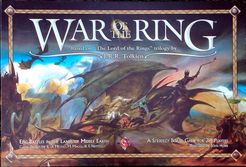
A two-sided strategy game linking the armies of Middle-earth with the Fellowship’s hidden journey, where conquest and the fate of the Ring offer competing routes to victory.
War of the Ring supports 2–4 players; community best: 2 players; playing time: 120 minutes. A WANGO browser trial has not been confirmed.
Background & introduction
The Free Peoples defend scattered nations while guiding the Ring-bearers toward Mordor. The Shadow has more starting action dice and can replace military casualties, but must divide its attention between conquest and hunting the Fellowship.
Rolled symbols determine the actions available each turn. A Character result can help the quest or a led army, while Muster results support political readiness and recruitment. Spending a useful die now may leave a different front waiting until the next roll.
The Fellowship is tracked through hidden progress rather than moving openly after every step. Moving repeatedly increases Hunt danger, and Companions can absorb losses or leave to aid the war. The decision to separate them therefore connects the military and quest sides of the game.
Core rules & scoring
The 2004 base game has two opposing sides, normally one player each, with optional three/four-player team rules. Begin the Fellowship in Rivendell, hidden at progress0 and corruption0; the Free Peoples start with four action dice and the Shadow with seven.
Each game turn proceeds through drawing Events, Fellowship, Hunt allocation, action roll, alternating action resolution and victory check. In the standard game each side draws one card from each of its two decks, has a six-card hand limit and does not reshuffle exhausted Event decks.
The Shadow may allocate Hunt dice up to the number of Companions remaining, with at least one permitted when Gollum is Guide; rolled Eyes also enter the Hunt Box. Roll remaining action dice, then the Free Peoples act first. A side with fewer unused dice may pass without spending one.
Spend a die for an action allowed by its symbol. Character, Army, Muster and Event results serve different tasks; Will of the West is the Free Peoples’ flexible result. Elven Rings can change results with restrictions, at most one ring per side per game turn, and cannot create Will of the West.
Ordinary Muster recruitment requires the nation to be At War and a qualifying settlement it originally controlled and still controls. One die normally recruits two Regulars/Leaders in separate settlements or one Elite. Recruitment Events may provide exceptions. Shadow military casualties return to reinforcements; Free Peoples casualties normally do not.
An Army die can move two different armies one adjacent region each; a Character die can move one army with a Leader or Character. Units cannot move twice in the same action. Normal stacking is ten army units, reduced to five inside a besieged stronghold; leaders do not count as army units.
In normal battle, roll up to five combat dice based on army strength, normally hitting on5–6. Leadership rerolls failed dice up to its rating. A siege normally gives attackers hits only on6 and lasts one round; reducing an attacking Elite to a Regular can extend it by another round.
Move a hidden Fellowship with a Character action or an applicable Event. Progress advances on its track and triggers a Hunt. Outside Mordor, Shadow rolls up to five Hunt dice, normally succeeding on6, with bonuses from earlier Fellowship movement dice and eligible rerolls. Apply tile damage as corruption or a Companion casualty, with excess damage becoming corruption.
When the hidden Fellowship is declared in Minas Morgul or Morannon during the Fellowship phase, enter the Mordor track and prepare its Hunt pool. Movement there draws a Hunt tile automatically instead of rolling; Stop symbols prevent progress, and revealed Fellowship must hide before advancing. Failing to attempt movement or hiding that turn adds one corruption before victory check.
Corruption12 gives Shadow an immediate Ring victory; reaching the Crack of Doom below12 gives the Free Peoples an immediate victory. Military victory is checked at turn end: Shadow needs10 points of enemy settlements and Free Peoples4. Captured strongholds count2 and cities1 for either side. If both military thresholds occur together, Shadow’s condition has priority.
Rules & gameplay questions
Do captured Shadow cities count toward a Free Peoples military victory?
Yes. The first-edition FAQ corrects the misleading stronghold-only wording: any four settlement points qualify, with cities worth one and strongholds two.
Does a newly added character action die become available immediately?
No. The July2006 FAQ says the extra die from Gandalf the White, Aragorn or a Minion enters the pool on the following game turn. Its removal after that character dies also takes effect the following turn.
When revealed by a Hunt, may the Fellowship end in any Free Peoples settlement?
The FAQ permits towns and Shadow-controlled settlements but forbids ending this reveal movement in a Free Peoples-controlled City or Stronghold. This differs from voluntarily declaring a hidden Fellowship to heal.
Does the current Fellowship movement die increase Eye-tile damage in Mordor?
No. Resolve that movement and its Hunt result before adding the used Free Peoples die to the Hunt Box. Earlier movement dice count; the current one does not count yet.
Can reaching four military points save the Free Peoples from the inactivity corruption in Mordor?
No. Apply the one corruption for a turn with no attempt to move or hide before victory check. If that reaches12, Shadow wins before the Free Peoples’ military threshold is checked.
Rules & introduction sources
- Edition
- Original 2004 War of the Ring first edition, full base rules with the first-edition FAQ dated2006-07-27. Summary centers on standard two-player sides; official three/four-player team play is identified but its nation assignments, card exchange and individual team scoring require the multiplayer chapter. Excludes Second Edition, Collector’s Edition revisions, Battles of the Third Age and later expansions or fan solo systems. Historical FFG download links failed; actual publisher-authored PDFs were read through labeled mirrors.
- Rule references
- Introduction source
- BoardGameGeek
WANGO editorial
| Parameter | Recorded value |
|---|---|
| BGG overall rank (snapshot) | #227 |
| Complexity Weight | 3.85 / 5 |
| Best player count (community) | 2 |
| Player range | 2–4 |
| Playing time (minutes) | 120 |
| Core mechanisms | Action Points · Area Majority / Influence · Area Movement · Campaign / Battle Card Driven · Dice Rolling · Events · Hand Management |
| Chinese publication | Unconfirmed |
| WANGO browser play | No confirmed WANGO trial |
| Year published | 2004 |
| Suggested age | 12+ |
BGG statistics are stored snapshots, not live rankings. Source checked:2026-09-27
Player questions
What is the best player count for War of the Ring, and can I play online?
War of the Ring supports 2–4 players; community best: 2 players; playing time: 120 minutes. A WANGO browser trial has not been confirmed.
How complex is War of the Ring, and which mechanisms does it use?
Weight: 3.85 / 5. Mechanisms: Action Points · Area Majority / Influence · Area Movement · Campaign / Battle Card Driven · Dice Rolling · Events · Hand Management. Chinese publication: Unconfirmed.
Where can I learn War of the Ring?
No rule guide, strategy article or WANGO trial has been confirmed for this record.