Paths of Glory
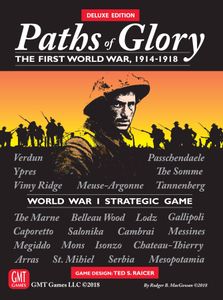
Paths of Glory is Ted Raicer’s two-player, card-driven World War I campaign game. The Central Powers and Allies use limited actions, supply, and historical events to contest victory points.
Paths of Glory supports 2 players; community best: 2 players; playing time: 480 minutes. A WANGO browser trial has not been confirmed.
Background & introduction
Paths of Glory is a two-player strategic wargame by Ted Raicer, using a point-to-point map and a hand of cards to represent the decisions of World War I. The Central Powers player relies on German quality and interior lines to defeat the enemy; the Allied player tries to bring a larger force to bear, hold the fronts, and survive Russian upheaval until American strength can arrive. Players do not simply activate every unit in sequence. They choose how to spend a limited number of card-driven actions on movement, attacks, replacements, or events.
The campaign begins in the summer of 1914 and brings the Western, Eastern, Balkan, Turkish, and Near East fronts into one strategic map. Corps and armies move between connected spaces, while rail redeployment and supply determine whether forces can keep operating. Victory depends on more than territory: Victory Points, War Status, and event cards shape the course of the conflict. American entry, Russia’s revolution, and an Armistice are triggered by card and track conditions rather than occurring automatically on their historical dates.
The game offers three standard scenarios—Introductory, Limited War, and Campaign—so players can choose a shorter contest or a longer war. Turns generally represent three months, with exceptions for the first two turns of 1914; the Campaign can reach a final check in Winter 1919. Different card draws, battle lines, and political turning points make each game a contest between military pressure, supply risk, and the future value of a hand.
Core rules & scoring
Scenarios and setup: Choose Introductory, Limited War, or Campaign. All three begin in August 1914 and use their scenario deployment. The Central Powers (CP) and Allied Powers (AP) have separate Strategy Card decks; place units, Victory Point, and War Status markers as directed. Each player draws seven cards at setup. At the end of each turn, the Draw Strategy Card Phase replenishes the hand to seven; if the draw and discard piles together cannot supply that many, the player begins the next turn with fewer. The map is point-to-point, not hex-based: two spaces are adjacent only when a printed line connects them.
Turn sequence: Begin with the Mandated Offensive Phase. Each player rolls on the relevant table to see whether a nation must make a qualifying attack. Then play six Action Rounds; CP takes the first action in each round, followed by AP, so each player normally acts six times. Resolve the remaining phases in order: Attrition, Siege, War Status, Replacement, Draw Strategy Card, and End of Turn. The order matters; reinforcements or card draws cannot be moved forward into the Action Phase.
Strategy Cards and actions: In an Action Round, a player usually plays one Strategy Card as Operations (OPS), Strategic Redeployment (SR), Replacement Points (RP), or an Event. A few card or rule exceptions explicitly allow a combined event and OPS play. A player may also take an automatic 1-OPS action without playing a card, or offer Peace Terms when the scenario’s Victory Point range allows it. Each played card normally has one use; an Event is not automatically mandatory unless its text or the rules say so.
Operations and unit actions: OPS provide Activation Points, not movement spaces for each unit. Pay the activation cost for a space based on its nationalities, mark it activated, and choose either movement or attack for that activation; the same activation cannot do both. Movement follows connected spaces and each Corps or Army uses its own Movement Factor. An attack may come from one or more adjacent spaces against a target space. Units, forts, terrain, and card effects determine which combat table and modifiers apply.
Combat and trenches: Attacker and defender use the appropriate combat table based on their participating units, then apply terrain, trench, and Combat Card modifiers to a die roll to determine losses. The side inflicting the higher Loss Number wins. A winning attacker may force the defender to retreat; if a space is cleared and the advance conditions are met, full-strength attacking units can advance. A flank attack has extra requirements: attackers must come from at least two spaces and include an Army, while the target cannot be entrenched, in swamp or mountain terrain, or an undefended fort. Entrench events allow armies to build and later improve trenches.
Supply and attrition: A unit normally traces supply through friendly-controlled, nationality-legal connections to a valid supply source. An Out of Supply unit cannot move, attack, redeploy, or build a new trench. If it remains Out of Supply in the Attrition Phase, it is eliminated. A Corps returns to the replaceable area; an Army is permanently removed and cannot be rebuilt. Supply sources are nationality-specific, with special rules for ports and the Near East; control of a space and the supply status of a unit are related but distinct checks.
War Status and historical events: Strategy Cards increase each side’s War Commitment. At War Status 4, Limited War cards enter; at 11, Total War cards enter. At Combined War Status 30, the Zimmermann Telegram can become playable; American reinforcements still require the later Over There event. Russia’s withdrawal also depends on an event sequence and track conditions. When Combined War Status reaches 40 in the War Status Phase, an Armistice is declared. These events are driven by the game, not the calendar alone.
Victory and scenario endings: All scenarios share an automatic victory check in the War Status Phase: CP wins at 20 or more Victory Points, while AP wins at 0 or less. If neither threshold is reached, each scenario has its own end date and final VP bands. Introductory ends after Turn 3: CP wins at 14+, 11–13 is a draw, and AP wins at 10 or less. Limited War ends when either player reaches Total War, at the end of Turn 10, or when Peace Terms are accepted; CP wins at 17+, 13–16 is a draw, and AP wins at 12 or less. Campaign can end at Turn 20, with an Armistice, or with accepted Peace Terms. Its final bands depend on whether CP played Brest-Litovsk: CP wins at 11+ with a draw at 10 if played, or CP wins at 13+ with a draw at 10–12 if not; AP wins at 9 or less in either case. Accepting Peace Terms ends in a draw.
Rules & gameplay questions
Can OPS points be converted directly into movement spaces for every unit?
No. OPS provide Activation Points that pay to activate spaces; the player then chooses movement or attack for the activation. How far each Corps or Army moves is controlled by that unit’s Movement Factor and the connected map spaces, not by giving every unit the OPS number as a movement allowance. A space activated for movement cannot also attack in that same activation.
Can a Strategy Card be used as both an Event and OPS?
Usually not. Each time a card is played, the player chooses one use: OPS, Strategic Redeployment, Replacement Points, or Event. Only a rule or a specific card explicitly permits combining an event with OPS. When permitted, follow the printed timing, which may require resolving the event before the OPS. Some events are permanently removed if played as events, but that does not mean every use of the card removes it.
Does a Mandated Offensive allow an attack against any nearby enemy?
No. At the start of the turn, each side rolls on the Mandated Offensive table. The result may require a particular nation to attack a specified enemy in a specified region; for example, British or French units usually must attack German units in France, Belgium, or Germany. Failing to meet the requirement may shift Victory Points, and card events can modify or cancel it. Check the table result, nationality, target, and location before declaring the attack qualifying.
Does being Out of Supply only prevent movement for one turn?
No. Out of Supply units cannot move, attack, strategically redeploy, or build a new trench. If a unit is still Out of Supply in the Attrition Phase, it is eliminated. A Corps returns to the replaceable area, while an Army is permanently removed. Moving another unit later to open a route does not retroactively make an earlier illegal activation valid; supply is checked using nationality, control, and the proper supply source.
Do the United States and Russia enter or leave the war on fixed historical dates?
No. These changes depend on event cards and War Status tracks. At Combined War Status 30, the Zimmermann Telegram can be played; after that, Over There must still be played to make American reinforcement cards available. Russia’s withdrawal follows its own event sequence and track conditions. A particular game can delay, accelerate, or avoid these turning points, so units do not enter or leave solely because the calendar reaches a historical date.
Which player acts first, and how many actions are there per turn?
Each turn has six Action Rounds. In every round both sides take one action, with the Central Powers acting first and the Allies second; each player normally receives six actions. The turn then continues through Attrition, Siege, War Status, Replacements, and card draw. Completing the six rounds does not end the game by itself; the selected scenario and Victory Point conditions determine what happens next.
Do all scenarios use the same final Victory Point threshold?
No. All scenarios share the automatic victory check—CP at 20 or more wins, AP at 0 or less wins—but the end turn and final score bands differ between Introductory, Limited War, and Campaign. Campaign also changes its final CP threshold depending on whether Brest-Litovsk was played. Identify the scenario before checking the end condition; a Campaign score line should not be applied to a shorter introductory game.
Does a connected route on the map always provide supply?
Not necessarily. The map’s printed connection defines adjacency, but supply also depends on friendly control, nationality restrictions, a valid supply source, and special port or regional rules. Supply sources are not interchangeable across nations, and Paris is not a universal Allied source. A space’s control and the supply status of its garrison must be checked separately; a visible chain of connected spaces alone is not enough.
Do an Armistice or Peace Terms automatically end every scenario?
No. In Campaign, Combined War Status reaching 40 in the War Status Phase declares an Armistice. Peace Terms require a player to offer them within the scenario’s allowed Victory Point range and the opponent to accept. Introductory does not use Peace Terms, while Limited War and Campaign have different end conditions and final score bands. Check the selected scenario and current War Status before ending the game.
Rules & introduction sources
- Edition
- Core scenario rules based on GMT’s Deluxe Living Rules (PDF footer August 2022; product page link marked June 2023). Covers Introductory, Limited War, and Campaign; excludes the separate optional Historical Scenario changes.
- Rule references
- Introduction source
- BoardGameGeek
WANGO editorial
| Parameter | Recorded value |
|---|---|
| BGG overall rank (snapshot) | #265 |
| Complexity Weight | 3.86 / 5 |
| Best player count (community) | 2 |
| Player range | 2 |
| Playing time (minutes) | 480 |
| Core mechanisms | Campaign / Battle Card Driven · Dice Rolling · Point to Point Movement |
| Chinese publication | Unconfirmed |
| WANGO browser play | No confirmed WANGO trial |
| Year published | 1999 |
| Suggested age | 14+ |
BGG statistics are stored snapshots, not live rankings. Source checked:2026-09-27
Player questions
What is the best player count for Paths of Glory, and can I play online?
Paths of Glory supports 2 players; community best: 2 players; playing time: 480 minutes. A WANGO browser trial has not been confirmed.
How complex is Paths of Glory, and which mechanisms does it use?
Weight: 3.86 / 5. Mechanisms: Campaign / Battle Card Driven · Dice Rolling · Point to Point Movement. Chinese publication: Unconfirmed.
Where can I learn Paths of Glory?
No rule guide, strategy article or WANGO trial has been confirmed for this record.