The Castles of Burgundy
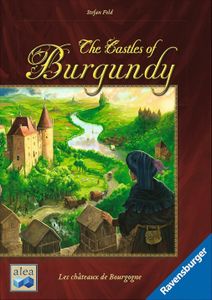
Use dice to organize building and trade, develop a fifteenth-century Loire Valley estate, and race for completion bonuses.
The Castles of Burgundy supports 2–4 players; community best: 2 players; playing time: 30–90 minutes. A WANGO browser trial has not been confirmed.
Background & introduction
Designed by Stefan Feld, The Castles of Burgundy casts players as lords developing estates in the fifteenth-century Loire Valley through trade and construction. Pastures, castles, mines, ships, buildings, and knowledge tiles offer different benefits, while the layout of your land shapes your opportunities.
The game has five phases of five rounds each. Each round, two dice provide actions to take tiles, place tiles, sell goods, or recruit workers. Workers adjust die results, giving players ways to plan around the roll. Taking and placing a tile are separate steps, and limited storage needs careful management.
Completing a connected color region scores for its size and the current phase, with larger phase bonuses awarded earlier. Castles provide extra actions, mines supply phase income, ships affect turn order and collect goods, and animals can score repeatedly within the same pasture. These benefits need to fit your estate’s developing layout.
Core rules & scoring
There are five phases, A–E, each with five rounds, for 25 rounds total. At phase start, replace leftover public hex tiles and refill them; goods stay in their depots. Each round, everyone rolls their two dice. The first player also rolls the white die to assign that round’s goods tile to a depot. The white die is not a third action die and cannot be adjusted with workers. Players then take their two-die turns in turn order.
Use each die to take one hex tile from its numbered depot, place a stored tile on an estate space with that die value, sell every good of the corresponding type, or take two workers regardless of the result. Repeat actions or choose their order freely. Each worker adjusts one of your dice by one up or down, wrapping between one and six; multiple workers may be spent.
New tiles must first enter one of your three storage spaces, never your estate directly. If storage is full, discard an older tile first. Placement is a separate action: match the die value on the space and the tile’s color, adjoining a tile already placed. Placed tiles cannot move or be removed. Normally, a connected beige city cannot repeat a building type, although knowledge tiles can provide exceptions.
A placed ship takes goods you can store from any one depot, independently of the die used to place it, and advances your turn-order piece one space, on top of pieces already there. Animals score their printed count plus existing animals of the same type in that pasture, without requiring direct tile adjacency. A castle immediately grants an extra action with any die value; each mine gives one Silverling at phase end. Buildings resolve their one-time benefit when placed.
Goods storage holds at most three types, stacking tiles of the same type. Leave behind goods you cannot store. A sale must include every stored good of the chosen type. Each tile scores points equal to the player count, but the whole sale normally gives only one Silverling, not one per tile. A Warehouse permits the same sale without a die.
Once during your own turn, you may additionally pay two Silverlings for one tile from the central black depot. Buy before, between, or after your die actions, without using a die. The purchased tile still enters storage and later needs a legal placement action or effect; buying does not place it directly into your estate for free.
Completing a connected color region immediately scores 1, 3, 6, 10, 15, 21, 28, or 36 points for sizes one through eight, plus 10, 8, 6, 4, or 2 for phases A through E. Separately, filling every space of one color across the entire estate awards the first player 5/6/7 points with 2/3/4 players, and the second 2/3/4. Later players receive no color-completion bonus.
After completing phase five, add one point per unsold goods tile and remaining Silverling, one per two workers, and endgame points from placed knowledge tiles. Stored hex tiles score nothing. Highest total wins; ties favor more empty estate spaces, then the player later in final turn order. This uses the original 2011 German rule, correcting the old English translation’s “fewer empty spaces.”
Rules & gameplay questions
Can workers turn a one into a six, and can they adjust the white die?
They can adjust your own dice: each worker changes a result by one, with one and six adjacent, and multiple workers may be spent. The white die cannot be adjusted or used for an action; it only determines which public depot receives the round’s goods tile.
Must animal tiles touch directly to score again?
No, but they must be the same animal type within the same connected pasture. When placing a new tile, score its animals and all existing animals of that type in that pasture. The same animals in other pastures do not count. Three cows followed by four score seven; adding two more later scores nine.
Can a tile bought from the black depot enter my estate immediately for free?
No. Once per turn, pay two Silverlings to buy a tile without a die, but put it in storage. Placing it still needs a legal placement action or an effect such as a Castle or City Hall. Color, adjacency, and other placement restrictions still apply.
Which die determines ship goods and sales?
The die used to place a ship selects its estate space only. Take goods from any one public depot, limited by your storage of three types. A Sell Goods action instead uses its die to select a goods type and sells every tile of that type. Each tile scores according to player count; the whole sale normally gives one Silverling.
Does finishing one connected region earn the whole-color bonus?
No. Every completed connected region scores for size and phase. The whole-color bonus requires filling every space of that color across your estate, potentially in several separate regions, and goes only to the first and second players to do so. Both bonuses can trigger on the same placement.
Rules & introduction sources
- Edition
- Original The Castles of Burgundy (2011) base game for 2–4 players, using the 12-page ©2011 alea/Ravensburger English rules and 12-page German original; German takes precedence for the mistranslated tiebreaker. Covers original tiles and basic estate play only. Excludes expansions collected in 2019, Special Edition, Vineyards, Shields, cooperative play, and solo rules.
- Rule references
- Introduction source
- BoardGameGeek
WANGO editorial
| Parameter | Recorded value |
|---|---|
| BGG overall rank (snapshot) | #17 |
| Complexity Weight | 2.97 / 5 |
| Best player count (community) | 2 |
| Player range | 2–4 |
| Playing time (minutes) | 30–90 |
| Core mechanisms | Delayed Purchase · Dice Rolling · End Game Bonuses · Grid Coverage · Hexagon Grid · Open Drafting · Pattern Building · Tile Placement · Track Movement · Turn Order: Stat-Based · Variable Set-up · Worker Placement with Dice Workers |
| Chinese publication | Unconfirmed |
| WANGO browser play | No confirmed WANGO trial |
| Year published | 2011 |
| Suggested age | 12+ |
BGG statistics are stored snapshots, not live rankings. Source checked:2026-09-27
Player questions
What is the best player count for The Castles of Burgundy, and can I play online?
The Castles of Burgundy supports 2–4 players; community best: 2 players; playing time: 30–90 minutes. A WANGO browser trial has not been confirmed.
How complex is The Castles of Burgundy, and which mechanisms does it use?
Weight: 2.97 / 5. Mechanisms: Delayed Purchase · Dice Rolling · End Game Bonuses · Grid Coverage · Hexagon Grid · Open Drafting · Pattern Building · Tile Placement · Track Movement · Turn Order: Stat-Based · Variable Set-up · Worker Placement with Dice Workers. Chinese publication: Unconfirmed.
Where can I learn The Castles of Burgundy?
No rule guide, strategy article or WANGO trial has been confirmed for this record.