YINSH
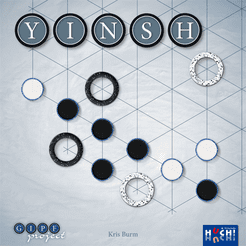
YINSH is a two-player abstract game of moving rings and flipping markers. Remove five-marker rows and one of your rings for each; first to remove three rings wins the standard game.
YINSH supports 2 players; community best: 2 players; playing time: 30–60 minutes. A WANGO browser trial has not been confirmed.
Background & introduction
YINSH uses rings and two-sided markers on a board of intersections. Players begin by alternately placing five rings each. A normal move puts a marker of your color inside one of your rings, then moves that ring away in a straight line, leaving the marker behind. Jumping over markers flips every jumped marker, regardless of its current color.
The standard objective is not to finish with the most markers of your color. Form and remove three rows of five, removing one of your own rings for each row. Progress toward victory therefore reduces your available moving pieces. Qualifying rows must be resolved; you cannot simply leave a scoring row intact to preserve all your rings.
The puzzle centers on paths, flips and the board left after removals. One move can create rows for both players, while intersecting rows differ from separate rows. Resolution order matters when both players are near their third ring. This guide distinguishes standard three-ring victory from the official one-row Blitz game.
Core rules & scoring
Setup: use five white rings, five black rings and a shared pool of 51 two-sided markers. Draw lots for first player, who plays white. Starting from an empty board, alternate placing one ring on a vacant intersection, including edge intersections, until each has five. Play on intersections rather than inside cells. The three scoring spaces on each side hold removed rings.
Normal move: take a pool marker, put it your color face up inside one of your rings, then move that ring. Leave the marker behind. The ring must travel in a straight line to a vacant intersection; it cannot stay put or turn. Only one new marker is placed at the starting point.
Empty spaces and blockers: a ring may cross any number of vacant intersections before stopping or reaching markers. It cannot jump over a ring of either color. Do not move markers along with the ring or leave new markers at every empty space crossed.
Jump: a ring may cross an uninterrupted group of one or more markers of any colors, but must stop on the first vacant intersection directly after them. It may first cross empty spaces and then jump, but cannot continue across more empty spaces after a jump or jump a second separated group. There must be a legal landing intersection.
Flip: after moving the ring, flip every marker it jumped over, including friendly markers. White becomes black and black becomes white. Do not flip the starting marker, which was not jumped. Markers change faces rather than moving between intersections. Check rows after the movement and flips are complete.
Row and ring: five adjacent markers showing your color in a straight line form a row; rings cannot substitute for markers. Remove the five markers to the pool, then remove any one of your own rings to your scoring area. It need not be the ring just moved. Both removals are mandatory, and you never take an opponent’s ring as the reward.
Longer or multiple rows: from a line longer than five, choose five consecutive markers, leaving the remainder. Separate nonintersecting rows formed together must each be removed with a ring. For intersecting rows choose one, remove it and reassess the board; a row broken by that removal cannot also score using the removed markers.
Opponent rows: your move can create the opponent’s row. They remove their row and one ring before their next normal move. If the same move creates rows for both colors, the active player resolves their own first, then the opponent resolves theirs. Resolving a row does not replace that opponent’s normal move.
Ending: removing a third ring wins immediately. If one move creates both players’ third rows, the active player wins by removing their third ring first. If all markers have been placed before anyone wins, compare rings already removed; the higher number wins and equal numbers draw. Do not count faceup marker majorities instead.
Variant boundary: official Blitz uses the same play rules but ends when a player forms their first five-marker row. Agree on that version before play rather than switching objectives midgame. Standard play retains the three-ring target and the normal placement, movement, flipping and required row-removal sequence.
Rules & gameplay questions
Can a ring keep sliding after jumping markers?
No. It must land on the first vacant intersection after the uninterrupted marker group. Moving through empty intersections before the jump is allowed, but sliding further afterwards or jumping a second separated group is not. Rings of either color block the route, and the landing must be on the board.
Do I flip only enemy markers, including the starting one?
No. Flip every jumped marker, even friendly ones, after completing the ring move. The new starting marker stays its original color because it was not jumped. Resolve rows after all those flips rather than scoring a temporary line partway through the operation.
Can I remove a row without giving up a ring?
No. A qualifying row requires returning its five markers to the pool and removing one of your own rings. Choose any ring still on the board, not necessarily the one just moved. Losing options as you approach victory is part of the game, not a reason to postpone the required removal.
Must I remove an entire six- or seven-marker line?
No. Choose five consecutive markers and leave the others. Do not select disconnected markers. Recheck intersecting rows after removing one: a line broken by the removal cannot score again using those missing markers. Separate intact rows must each be resolved with their own ring removal.
Can my move give the opponent a scoring row?
Yes. They must remove that row and one ring before their next normal move, without losing that move. If both colors form rows, the active player resolves their own first. That order means a move creating both players’ third rows gives the active player the immediate win.
If markers run out, does the larger color majority win?
No. If all markers are on the board before a standard win, compare rings already removed. More removed rings wins; equal numbers draw. Marker colors are not that tiebreak. Normal row removals return markers to the pool. The one-row Blitz target is a separately agreed variant, not a midgame substitute.
Rules & introduction sources
- Edition
- YINSH standard two-player rules, Rio Grande Games English rulebook bearing 2016 credits. The one-row Blitz version is labelled separately; excludes other GIPF games and potential-piece rules.
- Rule references
- Introduction source
- BoardGameGeek
WANGO editorial
| Parameter | Recorded value |
|---|---|
| BGG overall rank (snapshot) | #262 |
| Complexity Weight | 2.62 / 5 |
| Best player count (community) | 2 |
| Player range | 2 |
| Playing time (minutes) | 30–60 |
| Core mechanisms | Catch the Leader · Grid Movement · Pattern Building |
| Chinese publication | Unconfirmed |
| WANGO browser play | No confirmed WANGO trial |
| Year published | 2003 |
| Suggested age | 9+ |
BGG statistics are stored snapshots, not live rankings. Source checked:2026-09-27
Player questions
What is the best player count for YINSH, and can I play online?
YINSH supports 2 players; community best: 2 players; playing time: 30–60 minutes. A WANGO browser trial has not been confirmed.
How complex is YINSH, and which mechanisms does it use?
Weight: 2.62 / 5. Mechanisms: Catch the Leader · Grid Movement · Pattern Building. Chinese publication: Unconfirmed.
Where can I learn YINSH?
No rule guide, strategy article or WANGO trial has been confirmed for this record.