Battle Line
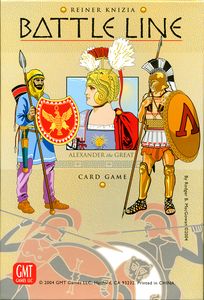
Battle Line is a two-player card game about claiming nine flags. Players build three-card formations and win by claiming five flags or three adjacent flags.
Battle Line supports 2 players; community best: 2 players; playing time: 30 minutes. A WANGO browser trial has not been confirmed.
Background & introduction
Battle Line turns an ancient battlefield into a row of nine contests between two commanders. Rather than moving units across a map, each player commits Troop cards beside flags and tries to build the stronger three-card formation. The design balances local strength with the whole line: a powerful formation may win one flag, while three neighboring flags can end the game immediately.
The Troop deck contains six colors numbered one through ten. A separate set of Tactics cards changes what can be played or how a flag is judged. Cards become public once committed, allowing players to reason about what formations remain possible. Claiming a flag is therefore more than announcing that you are ahead; the claimant must prove, from public information, that the opponent cannot eventually beat the formation.
The game combines hand management, set comparison, and spatial objectives in a short two-player duel. Players decide where to spend scarce cards, when to use limited Tactics, and whether to claim a completed contest or wait. Every flag matters, but not equally: five flags wins, and three adjacent flags win even when the opponent has claimed more flags elsewhere.
Core rules & scoring
Objective and victory: The players contest nine flags arranged in a line. A player immediately wins by claiming any five flags or three adjacent flags. There is no general final victory-point total: formations decide individual flags, while their positions create a second direct victory route. Place the nine flags between the players with room on each side for that player’s Troop cards.
Setup and hand: Shuffle the sixty Troop cards—six colors numbered one through ten—and deal seven to each player. Shuffle the ten Tactics cards into a separate pile. Both players cut Troop cards; the higher number shuffles and deals, and the non-dealer takes the first turn. Alternate thereafter. Players normally replace a played card by drawing from either pile that still has cards, keeping seven cards in hand. If both piles run out, no replacement draws occur, but legal play continues until someone wins.
Playing a Troop card: On a turn, place one Troop card from hand beside an unclaimed flag on your side of the line. Normally each side may have at most three Troop cards at a flag; Mud changes this to four, and the player chooses how to build the formation. Played cards are public and normally stay there; players cannot freely move a card after seeing a later draw. Some Tactics cards can move or remove cards, but only as their specific text allows.
Formation ranking: Compare formations from strongest to weakest: Wedge (same color and consecutive values), Phalanx (three equal values), Battalion (same color), Skirmish (three consecutive values), and Host (any other set). Category outranks total value. When both formations share a category, compare the sum of their three values; the higher sum wins. Equal categories and totals tie, so a high-valued Host can still lose to a lower-valued Wedge.
Claiming a flag: A player may claim one or more flags during their turn before drawing. Normally, the player must have three Troop cards at the flag and prove that no remaining possible Troop card could let the opponent complete a stronger formation. The proof uses visible cards and public information, never the claimant’s hidden hand. If the opponent has fewer than three cards there, the claimant must consider every legal completion; simply being ahead at the moment is not enough. Unplayed Tactics do not block a claim. Once a flag is claimed, neither player may add cards there or use Tactics to affect those cards.
Incomplete formations and ties: A player can claim against an incomplete opposing formation only by publicly showing that it cannot later beat theirs or can at best tie. If both complete formations tie, or public information shows the opponent can do no better than tie, the rules award the flag against the player who completed the relevant formation last; the opponent may claim it on a later turn. A claim must still be made at the proper time. Once claimed, a flag leaves the contest and both victory conditions are checked.
Tactics limits: The ten Tactics cards can stand in for a Troop card, change a flag’s conditions, or affect cards beside an unclaimed flag, depending on the card. Its timing and restrictions override the general turn procedure. A player may never have played more Tactics cards than their opponent by more than one. Each player may play at most one Leader; a second Leader must stay in hand and cannot be played.
Turns and public reasoning: The core turn is to play one Troop or Tactics card, resolve its placement or effect, and draw a replacement when possible. Because both formations and flag ownership are public, players can calculate remaining formation possibilities and paths to three adjacent flags. Only when unable to play any Troop card may a player pass or play a legal Tactics card; a pass does not stop the opponent. When both draw piles are empty, players stop drawing but continue making legal plays with their remaining cards.
End of game and series scoring: The game ends immediately when someone has five flags or three adjacent flags; no other flags are claimed. The original rules also suggest a simple series score: the winner records five points, the loser records the number of flags they claimed, and the winner starts the next game. This is an optional score for a match across games, not a victory-point system for one game.
Optional advanced claim timing: The basic rules permit a qualifying flag claim during a player’s turn before drawing. An advanced variant restricts claims to the beginning of that player’s turn, giving the opponent an opportunity to alter the position with Tactics. Agree before setup whether to use this variant; it is not mandatory in every base game.
Specific Tactics exceptions: Fog removes formation categories and compares only each side’s total value. Mud requires four cards on each side. A Leader’s color and value are defined when the flag is resolved. Companion Cavalry is an eight with a chosen color; Shield Bearers have a chosen color and a value no greater than three. Redeploy moves or discards one of your cards beside an unclaimed flag; Deserter discards an opposing Troop or Tactics card there; Traitor takes only an opposing Troop card into an available slot on your side. The Tactics-count restriction still applies.
Public-proof example: With no Environment card changing the comparison, your red three, four, and five make a Wedge against an opposing blue eight. If blue seven and blue ten are already publicly played elsewhere, every same-color consecutive triple containing blue eight lacks an essential card. The opponent therefore cannot make a stronger Wedge or win with a weaker category. A blue seven hidden in your own hand is not public evidence and cannot be used to establish that same claim.
Rules & gameplay questions
How many players does Battle Line support, and how do you win?
GMT lists Battle Line for two players and about thirty minutes. The players build three-card Troop formations beside nine flags. The first to claim any five flags or three adjacent flags wins immediately. This is not a game where all card values are added into a final total: formations determine each flag, while the flags’ positions create a second direct victory condition.
How are formations at a flag compared?
Compare formation category first, then compare total value only when both categories match. Wedge—same color and consecutive values—is strongest, followed by Phalanx (three equal values), Battalion (same color), Skirmish (consecutive values), and Host (any other set). Within one category, the higher sum wins; matching categories and sums tie. A high-valued Host can therefore lose to a lower-valued Wedge. A Skirmish does not require three different colors; an all-one-color sequence instead qualifies as the stronger Wedge. Fog cancels category comparison.
Can I claim a flag before my opponent has three cards there?
Yes, but on your turn you must prove from public information that the opponent cannot later form something stronger. Your hidden hand cannot be used as evidence. If the opponent has played only two cards, a complete formation on your side is not enough by itself; consider every legal remaining card that could complete their formation and show that none can beat yours. With Mud, judge four-card formations. Unplayed Tactics cannot prevent an otherwise valid flag claim.
What do I do on a turn, and how do I refill my hand?
A player normally plays one Troop or Tactics card, resolves its placement or effect, then draws one card from either pile that still has cards, maintaining a seven-card hand. Troop cards go beside an unclaimed flag on that player’s side. Tactics cards follow their own timing and target restrictions. If both piles are empty, players stop drawing but continue making legal plays until a victory condition is met.
Can one player keep playing Tactics cards in a row?
The Tactics limit prevents a player from getting far ahead: they may have played at most one more Tactics card than their opponent. Leaders have an additional limit, with only one playable Leader per player; a second must remain in hand. Each Tactics card has its own timing, target, and effect, so it cannot be placed as an ordinary Troop card unless its text allows it.
What happens if the formations tie?
A tie occurs when both formations have the same category and total value. The original rules also address completed formations, or public positions where the opponent can do no better than tie: the player who completed the relevant formation last loses that flag, and the opponent may claim it on a later turn. The claim still follows the formal timing; a tie does not automatically remove every unclaimed flag.
Does the base game have solo or cooperative play?
The GMT base rules and current 12th Printing listing describe a two-player contest, and the sources checked do not provide an official solo, cooperative, or team mode. The ten Tactics cards are part of the base game. Battle Line: Medieval-Themed Edition is a different catalog entry, so check the box and rulebook before applying its components or rules to BGG 760.
Is there scoring after an individual game?
An individual game ends immediately when a player claims five flags or three adjacent flags. The original rules separately suggest a series score: the winner records five, the loser records the number of flags they claimed, and the winner starts the next game. That optional match score does not replace the flag-based victory conditions for one game.
Rules & introduction sources
- Edition
- This entry covers Reiner Knizia’s original 2000 Battle Line (BGG 760), published by GMT Games, using the base game represented by GMT’s current 12th Printing page: two players, about 30 minutes, 60 Troop cards, 10 Tactics cards, and nine flags. Detailed procedures come from a four-page 2000 rules copy whose footer credits GMT Games; the PDF is hosted by a third party. Battle Line: Medieval-Themed Edition and Schotten Totten differences are outside scope.
- Rule references
- Introduction source
- BoardGameGeek
WANGO editorial
| Parameter | Recorded value |
|---|---|
| BGG overall rank (snapshot) | #334 |
| Complexity Weight | 1.89 / 5 |
| Best player count (community) | 2 |
| Player range | 2 |
| Playing time (minutes) | 30 |
| Core mechanisms | Card Play Conflict Resolution · Hand Management · Lane Battler · Melding and Splaying |
| Chinese publication | Unconfirmed |
| WANGO browser play | No confirmed WANGO trial |
| Year published | 2000 |
| Suggested age | 12+ |
BGG statistics are stored snapshots, not live rankings. Source checked:2026-09-27
Player questions
What is the best player count for Battle Line, and can I play online?
Battle Line supports 2 players; community best: 2 players; playing time: 30 minutes. A WANGO browser trial has not been confirmed.
How complex is Battle Line, and which mechanisms does it use?
Weight: 1.89 / 5. Mechanisms: Card Play Conflict Resolution · Hand Management · Lane Battler · Melding and Splaying. Chinese publication: Unconfirmed.
Where can I learn Battle Line?
No rule guide, strategy article or WANGO trial has been confirmed for this record.