Troyes
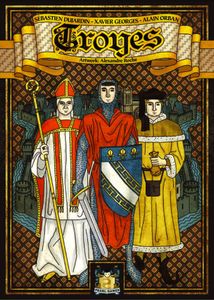
Lead a family in medieval Troyes, directing nobles, clergy and civilians to develop trades, build the cathedral and face the city’s crises for prestige.
Troyes supports 1–4 players; community best: 3 players; playing time: 90 minutes. A WANGO browser trial has not been confirmed.
Background & introduction
Three estates are represented by red, white and yellow dice. Citizens stationed in the principal buildings generate labor, which is grouped for activities, construction and dealing with events. Dice values determine efficiency without restricting you to the results you rolled yourself.
Other families’ dice can be purchased compulsorily, while neutral dice are bought from the bank. The total number of dice used in an action determines the purchase price. Profit must be weighed against salaries, opponents’ opportunities and the dice left behind.
Each player has a secret character objective, but every objective scores all families at game end. Developing the city and deducing other players’ goals both matter. Passing produces income while surrendering your remaining actions for the round.
Core rules & scoring
Setup: prepare the red event deck for 6, 5 or 4 rounds with four, three or two players. Start with 5 deniers, 4 influence and the prescribed citizens. Deal one secret character each, or two each with two players. Place initial citizens in alternating snake order; with two players, place neutrals first as diagrammed.
Round sequence: reveal that round’s three activity cards in the first three rounds, receive 10 deniers and pay salaries of 1 per citizen in the Bishopric and 2 in the Palace; City Hall is free. If unable to pay all salaries, pay what you can and lose 2 VP, or nothing if you have no VP. Roll dice for citizens in the principal buildings, resolve new and existing events, take actions in turn, then recover expelled citizens and pass the start player left.
Event phase: add a red event and the event color it requests, then resolve the queue. Starting with the first player, counter the highest remaining black die using dice from your own district, optionally mixing colors; red values double, and you may counter additional black dice at the same time. You cannot buy dice here. Gain 1 influence per black die defeated; inability to counter loses 2 VP and discards that black die.
Action dice: normally group 1–3 dice of one color, buying across districts if desired. Your own dice are free. For a total group of 1, 2 or 3 dice, each external die costs 2, 4 or 6 deniers respectively, paid to its owner or the bank for neutral dice. Owners cannot refuse. Used dice return to the supply.
Activities and agriculture: an activity requires your tradesman; initially pay its hiring cost and place a citizen. Divide the dice total by the card’s divisor, rounding down, for the number of activations; a new hire must activate at least once. Delayed effects place cubes, with at most one modifying a later action. Agriculture pays half your yellow dice total, rounded down, without a tradesman.
Cathedral and event actions: each white die places a cathedral cube at its own value, with lower levels of that value occupied first. Each cube gives 1 VP and the indicated influence. An event action uses its required color/divisor to cover banners, gaining 1 influence per cube; filling the card distributes rewards and ownership by contribution. Marauding stays in play and can be countered again.
Citizens and influence: placing a citizen in a principal building uses exactly one die of that building’s color; its value selects the location, shifting or expelling as required. A color with an expelled citizen already lying there cannot be expelled again that round. Before an action or black die, spend 1 influence to reroll your die, 2 to recruit a citizen or 4 to invert 1–3 of your dice; influence is capped at 20.
Passing and round end: while dice remain, pass and place 2 deniers in your district, adding 1 on each later turn. You cannot resume actions that round. When everyone passes or all city dice are gone, collect district money, return unused dice and recover lying expelled citizens to personal supplies.
Final scoring: finish the round in which the last red event enters play. Add earned VP, participation on unresolved events, tradesman-space VP and every secret character’s scoring for all players. Lose 2 VP for each cathedral level containing none of your cubes. Most VP wins; money and influence score only when a character or other explicit rule rewards them.
Rules & gameplay questions
Does buying two opponents’ dice always cost 4 deniers each?
The total group size matters, not how many dice you buy. Adding your own die makes a three-die group, so each of the two purchased dice costs 6. A group consisting only of those two costs 4 each. Neutral dice are paid to the bank, and opponents cannot refuse purchases.
Can I spend influence to reroll or invert a purchased die?
No. The 1-influence reroll and 4-influence inversion affect only dice in your own district, excluding neutral dice even after purchase. You may spend influence repeatedly before an action or a black die, but an action can still use at most one delayed-effect cube.
Are countering black dice and combating an event card the same action?
No. During the event phase you use your own district’s dice, may mix colors, double red values and gain influence per black die defeated. An event-card action instead uses the printed color and divisor to place banner cubes, followed by contribution-based rewards when completed.
May I take another action after passing?
No. Passing lasts for the rest of the round. Put 2 deniers in your district the first time, add 1 on each later turn and collect them at round end. Other players may still buy dice remaining in your district under the normal rules.
Does a secret character score only its owner, and what if I ignore the cathedral?
Every character in play scores every player individually; two-player games give each player two characters. Check all three cathedral levels separately, losing 2 VP for each without your own cube, so having none anywhere loses 6 VP.
Rules & introduction sources
- Edition
- Troyes (2010), 2–4-player base game using the current Pearl Games-linked 2017 English rules and base-card appendix (PDF pages 1–10). Excludes pages 11–12 bonus cards/Le Roy solo mode, The Ladies of Troyes and Troyes Dice.
- Introduction source
- BoardGameGeek
WANGO editorial
| Parameter | Recorded value |
|---|---|
| BGG overall rank (snapshot) | #143 |
| Complexity Weight | 3.37 / 5 |
| Best player count (community) | 3 |
| Player range | 1–4 |
| Playing time (minutes) | 90 |
| Core mechanisms | Area Majority / Influence · Dice Rolling · End Game Bonuses · Events · Hidden Roles · Hidden Victory Points · Income · Ownership · Set Collection · Slide / Push · Solo / Solitaire Game · Turn Order: Progressive · Variable Set-up · Worker Placement with Dice Workers · Worker Placement, Different Worker Types |
| Chinese publication | Unconfirmed |
| WANGO browser play | No confirmed WANGO trial |
| Year published | 2010 |
| Suggested age | 12+ |
BGG statistics are stored snapshots, not live rankings. Source checked:2026-09-27
Player questions
What is the best player count for Troyes, and can I play online?
Troyes supports 1–4 players; community best: 3 players; playing time: 90 minutes. A WANGO browser trial has not been confirmed. Recorded mechanism tags: Solo / Solitaire Game.
How complex is Troyes, and which mechanisms does it use?
Weight: 3.37 / 5. Mechanisms: Area Majority / Influence · Dice Rolling · End Game Bonuses · Events · Hidden Roles · Hidden Victory Points · Income · Ownership · Set Collection · Slide / Push · Solo / Solitaire Game · Turn Order: Progressive · Variable Set-up · Worker Placement with Dice Workers · Worker Placement, Different Worker Types. Chinese publication: Unconfirmed.
Where can I learn Troyes?
No rule guide, strategy article or WANGO trial has been confirmed for this record.