Ora et Labora
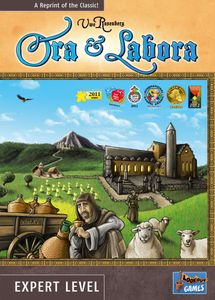
Develop a medieval monastery by acquiring land and assigning clergy to buildings, turning supplies from the production wheel into an economic network.
Ora et Labora supports 1–4 players; community best: 3 players; playing time: 60–180 minutes. A WANGO browser trial has not been confirmed.
Background & introduction
Ora et Labora links monastery development to resources, buildings and settlements. Players clear space in a small heartland, then buy landscapes to connect productive facilities and residential areas into a layout that scores at the end.
The production wheel lets a resource accumulate over time, while harvesting resets its indicator. Buildings upgrade raw materials into more valuable goods. Using an opponent's facilities requires a work contract and one of that opponent's available clergymen.
France and Ireland share a core framework but offer different building sides and goods chains. Player count also changes the wheel side, action rhythm and ending. The solo neutral player has its own clergy and occupancy restrictions, rather than offering unlimited transactions at any time.
Core rules & scoring
Choose France or Ireland together, turn buildings to that side and remove buildings marked 4 or 3+ as required by player count. In the normal multiplayer setup, each player receives a prior, two lay brothers, a heartland with forests and moors, and one of each of six basic goods. Solo instead starts without goods.
In a normal three- or four-player round, first retrieve all three clergy if all have been placed, then rotate the wheel one space counterclockwise and resolve any settlement phase triggered. Each player takes one action clockwise, then the starting player takes another action before passing the start marker. One or two placed clergy cannot be retrieved.
An action can use a building with clergy, fell trees, cut peat or build a building. To use your own building, place an available clergyman in an unoccupied building; placement triggers its function. Clergy remaining on a building do not produce again each round.
To use an opponent's unoccupied building, pay a work contract first; the owner must have available clergy and chooses which one to place. The usual cost is one coin, rising to two for everyone when the Winery or Whiskey Distillery is built. Returning one wine or whiskey to the supply replaces the coin payment. Contracts cannot be refused.
Wheel production equals the value at the resource indicator; reset that indicator to zero afterward. You may instead use the joker, resetting only the joker. Felling trees or cutting peat removes one corresponding card from your own landscape and yields the wheel quantity without using clergy.
To build, pay for one available building and immediately place it on a legal empty landscape space. Cloister buildings must be orthogonally adjacent to another cloister building. If your prior is available, you may immediately place it in the new building and use its function.
Buying a landscape is an additional action, normally limited to one per personal turn and one per settlement phase. Buy a top tile from either pile and place it immediately. Districts extend above or below the heartland without horizontal offset; coastal plots extend left and mountain plots right, following their connection rules.
The wheel and building marker trigger settlement phases: each player may pay food and energy for at most one personal settlement, then the next lettered buildings and settlements enter play. An ordinary building action cannot directly build a settlement. Normal three- and four-player games have a special prior bonus round as round 25, then a fifth settlement phase and game end.
Final scoring adds goods points, the economic values of buildings and settlements, and each settlement's own dwelling value plus those of orthogonally adjacent cards. Adjacent water also contributes dwelling value, and negative values count. Highest score wins, with shared victories on a tie.
Normal two-player play uses the wheel side beginning 0, 1, 2, 2; each turn rotates the wheel before two consecutive actions. With D buildings in play and at most one building in the display, finish that turn, rotate the wheel and give the opponent one final action, without a bonus round or final settlement phase. Solo uses the 0, 2, 3, 4 side, two actions per rotation, paid contracts and neutral clergy for neutral buildings; it ends after the last settlement phase, targeting 500 points.
Rules & gameplay questions
Are France and Ireland only different artwork?
No. Everyone chooses one country variant and uses its building sides and goods. France uses grapes, wine, flour and bread; Ireland uses malt, beer and whiskey. Choosing coastal or mountain sides of landscape plots is a separate decision.
Does production always move the joker too?
No. Choose either the ordinary resource indicator or the joker for that production and reset only the chosen indicator. The joker can even produce a resource whose ordinary indicator has not entered play yet.
Can solo players repeatedly pay to use the same neutral building?
Not while ignoring occupancy. Place an available neutral clergyman in the building and pay the contract. Normal clergy and occupancy limits apply, with all three returned at the start of a turn if all have been used. The extra prior use of a new building in a settlement phase also requires payment. If that uses the last neutral clergyman, the settlement-phase procedure immediately returns all three before continuing the settlement phase and normal turn.
Do the short multiplayer and long two-player games use the same rhythm?
Not exactly. The short three- or four-player game has 12 rounds plus a bonus round, only a prior and one lay brother per player, and shared production bonuses. The long two-player game gives the starting player two actions and the other one per round, triggering its ending when at most three buildings remain during stage D.
Are economic value and dwelling value the same score?
No. Economic value scores directly; dwelling value is used for settlements and their orthogonal neighbors. A building can contribute separately to multiple adjacent settlements, while negative dwelling values reduce the relevant settlement scores.
Rules & introduction sources
- Edition
- 2011 Lookout base game with France and Ireland sides. Read official English Game Setup PDF pages 1-6 (two setup pages followed by four introductory pages), Detailed Game Rules pages 1-8 and Appendix pages 1-2, 8 and 12. Rule claims follow the detailed rules, with rendered inspection of wheel and country symbols. Covers normal 1-4 player play and key short-game and long two-player differences, without cataloging all 41 building effects.
- Rule references
- Introduction source
- BoardGameGeek
WANGO editorial
| Parameter | Recorded value |
|---|---|
| BGG overall rank (snapshot) | #248 |
| Complexity Weight | 3.89 / 5 |
| Best player count (community) | 3 |
| Player range | 1–4 |
| Playing time (minutes) | 60–180 |
| Core mechanisms | Increase Value of Unchosen Resources · Modular Board · Network and Route Building · Worker Placement · Worker Placement, Different Worker Types |
| Chinese publication | Unconfirmed |
| WANGO browser play | No confirmed WANGO trial |
| Year published | 2011 |
| Suggested age | 13+ |
BGG statistics are stored snapshots, not live rankings. Source checked:2026-09-27
Player questions
What is the best player count for Ora et Labora, and can I play online?
Ora et Labora supports 1–4 players; community best: 3 players; playing time: 60–180 minutes. A WANGO browser trial has not been confirmed.
How complex is Ora et Labora, and which mechanisms does it use?
Weight: 3.89 / 5. Mechanisms: Increase Value of Unchosen Resources · Modular Board · Network and Route Building · Worker Placement · Worker Placement, Different Worker Types. Chinese publication: Unconfirmed.
Where can I learn Ora et Labora?
No rule guide, strategy article or WANGO trial has been confirmed for this record.