7 Wonders
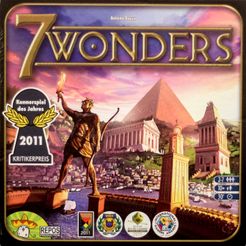
Lead an ancient city through three Ages of simultaneous card drafting, developing resources, commerce, science and military strength to earn the highest combined score.
7 Wonders supports 2–7 players; community best: 4–5 players; playing time: 30 minutes. A WANGO browser trial has not been confirmed.
Background & introduction
Antoine Bauza’s award-winning 7 Wonders puts each player in charge of an ancient city such as Alexandria, Babylon, Ephesus or Rhodes. Across three Ages, develop raw-material production, trade, civic buildings, military power and science while constructing stages of a famous wonder.
Play uses simultaneous drafting. Everyone receives seven cards at the beginning of an Age, secretly selects one and reveals it together. Build its structure, bury it to construct a Wonder stage, or sell it for three coins. Pass the remaining cards clockwise in Ages I and III and counterclockwise in Age II, keeping the whole table involved in each selection.
At each Age’s end, compare military strength separately against your left and right neighbors, earning victory tokens or a minus-one defeat. Several scoring routes coexist: scientific collections, civic points, commercial rewards, military strength and the Wonder itself, producing different combinations in a compact game.
Core rules & scoring
Keep Age cards whose minimum-player requirement does not exceed the player count; add a random selection of player count plus two Guilds to Age III. Choose a Wonder board and its Day or Night side, and start each player with three coins. Shuffle each Age deck and deal seven cards per player when that Age begins. These are the 2020 second-edition base rules for 3–7 players.
Each turn, secretly choose one card and simultaneously use it in exactly one way: pay to construct that Building; pay only the next Wonder-stage cost and place the card face down beneath it; or sell the card for three coins from the reserve. Never build duplicate named structures. Wonder stages are built left to right; the buried card does not provide its printed Building effect, and completing the Wonder is optional.
After all actions, pass remaining cards left in Ages I and III and right in Age II. Normally an Age has six turns. From the final two-card hand, use one and discard the other without a reward; that final discard is not a three-coin sale. Specific Wonder effects can change the last-card procedure.
Pay the cost on the Building or Wonder stage using your own production and any resources bought from neighbors. Production is reusable capacity rather than stock discarded after use, with each symbol supplying one resource that turn. Coin costs go to the reserve. Construction uses coins held at turn start; coins gained during the turn must wait until later turns.
Buy only from immediate left and right neighbors, using their starting resource and Brown or Grey production, normally paying that neighbor two coins per resource before discounts. Yellow and Wonder-stage production is unavailable for sale, as is a structure built that same turn. Neighbors cannot refuse; their own use and the other buyer’s use are not depleted. Each buyer independently selects a flexible resource, and purchases cannot be stored for later turns.
From Age II onward, a matching chain symbol on an existing Building lets you construct the new chained Building without its normal cost. You may still pay normally without the matching symbol. The duplicate-name restriction remains. A chain does not give two uses to one card or waive a Wonder-stage cost.
At each Age’s end, compare total military symbols separately with each neighbor. Ties give neither side a token. A loss gives minus one; a victory gives one, three or five in Ages I, II or III respectively. The game ends after Age III’s military resolution rather than after a sequence of separate player turns.
Add seven scoring categories: Wonder, one point per complete three coins, military tokens, Blue cards, Yellow cards, science and Guilds. Each type of matching science symbol scores its count squared, with seven more per complete set of three different symbols. Apply special effects and chosen science symbols as described. Highest total wins; tied players compare remaining coins, then share victory if still tied.
Rules & gameplay questions
Can one card build both its structure and a Wonder stage?
No. Each chosen card has one use: pay its structure cost, bury it face down after paying the next Wonder-stage cost, or sell it for three coins. Buried cards do not provide their own Building effect, and Wonder stages proceed left to right.
Do resource costs discard production cards or use up my neighbor’s production?
No. Production symbols supply resources each turn without discarding the cards. A symbol provides one resource for your current construction. Buying a neighbor’s production does not prevent their own use or the other neighbor’s purchase. Normally pay that owner two coins per resource, adjusted by discounts.
Whose resources can I buy, and can I spend coins received in the same turn?
Only your two immediate neighbors’ starting resource and Brown or Grey production can be bought; Yellow and Wonder-stage production cannot. Buyers choose flexible production independently. Use coins held when the turn began, not newly received trade income, and do not buy production built that same turn.
Does a free chain still require the normal cost?
No. A matching symbol on an existing Building waives the new Building’s normal cost, while duplicate named structures remain forbidden. Without a matching symbol, pay normally. Chains are not purchasable resources and do not let one card also build a Wonder stage.
Which last card can Babylon’s Night side use, and when does it activate?
After the relevant first stage is constructed, starting that Age you may use the seventh card normally discarded at each Age’s end. Resolve it as an extra turn after other players have used their final cards, following normal construction or sale rules.
Rules & introduction sources
- Edition
- 7 Wonders 2020 second-edition base game for 3–7 players, using the current official eight-page English rules, effects reference and base-game FAQ entries. Excludes the older two-player variant, Duel, Architects and expansions.
- Rule references
- Introduction source
- BoardGameGeek
WANGO editorial
| Parameter | Recorded value |
|---|---|
| BGG overall rank (snapshot) | #118 |
| Complexity Weight | 2.32 / 5 |
| Best player count (community) | 4–5 |
| Player range | 2–7 |
| Playing time (minutes) | 30 |
| Core mechanisms | Closed Drafting · End Game Bonuses · Hand Management · Melding and Splaying · Multi-Use Cards · Neighbor Scope · Once-Per-Game Abilities · Score-and-Reset Game · Set Collection · Simultaneous Action Selection · Tags · Tech Trees / Tech Tracks · Variable Player Powers · Variable Set-up |
| Chinese publication | Unconfirmed |
| WANGO browser play | No confirmed WANGO trial |
| Year published | 2010 |
| Suggested age | 10+ |
BGG statistics are stored snapshots, not live rankings. Source checked:2026-09-26
Player questions
What is the best player count for 7 Wonders, and can I play online?
7 Wonders supports 2–7 players; community best: 4–5 players; playing time: 30 minutes. A WANGO browser trial has not been confirmed.
How complex is 7 Wonders, and which mechanisms does it use?
Weight: 2.32 / 5. Mechanisms: Closed Drafting · End Game Bonuses · Hand Management · Melding and Splaying · Multi-Use Cards · Neighbor Scope · Once-Per-Game Abilities · Score-and-Reset Game · Set Collection · Simultaneous Action Selection · Tags · Tech Trees / Tech Tracks · Variable Player Powers · Variable Set-up. Chinese publication: Unconfirmed.
Where can I learn 7 Wonders?
Available resources: Strategy https://wangogame.com/wiki/analysis/7-wonders