Navegador
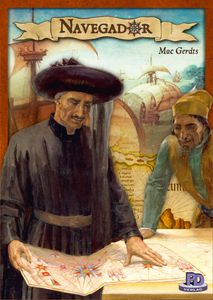
Navegador is an economic strategy game set during Portugal’s Age of Discovery. Move around a rondel to sail, colonize, trade, build, and acquire privileges as your trading dynasty competes for victory points.
Navegador supports 2–5 players; community best: 4 players; playing time: 60–90 minutes. A WANGO browser trial has not been confirmed.
Background & introduction
Navegador takes players to Portugal’s age of maritime expansion in the fifteenth and sixteenth centuries. Each player represents a trading dynasty that begins with only a few ships and workers, then explores sea regions, discovers new colonies, and earns money from sugar, gold, and spice. Extending a route also opens opportunities to build factories, shipyards, and churches, creating different economic and scoring paths.
The game’s main decisions happen on a circular action rondel. Each turn, a player chooses one of its actions, but ships and workers are both tools for expansion and costs for moving around the rondel. Reaching a distant action can require sacrificing ships, while moving to a nearby space is free. Planning the action sequence is therefore part of the puzzle: players must leave room for the next voyage or colony.
Sailing into an unknown region reveals its colonies and rewards the first explorer with an Explorer marker and money, but one of the ships used in the discovery is lost. Players can then found colonies, sell goods at the market, or use workers and money to build. Factories earn income by processing market goods, shipyards build ships, churches recruit workers, and privileges strengthen the endgame value of different achievements.
Sailing gradually advances the game through three phases. Crossing designated regions expands the distance ships can travel, while raising the cost of buying additional ships and workers. The end is triggered when the final sea region is explored or the last building is removed; each player then receives one last turn. Final scoring rewards players who combine colonies, factories, Explorers, buildings, workers, ships, and privileges effectively.
Core rules & scoring
Objective and setup: Players represent trading dynasties during Portugal’s maritime expansion and seek victory points through exploration, colonies, markets, buildings, and privileges. PD-Verlag lists the base game for 2–5 players, about 60–90 minutes, ages 12+. Each player begins with two ships, three workers, starting money, and a privilege, then places a marker on the rondel. Set out the sea regions, market, buildings, and privilege supply.
Rondel movement: Players take turns clockwise, moving their marker forward on the rondel to select and perform an action. The first turn may choose any position; afterward, moving forward up to three spaces is free. For each additional space, return one of your ships from the board to your supply. You may not stay on the same action twice in a row unless you move around the rondel and pay the ship cost. Different players may share a rondel space.
Actions: The rondel offers Workers, Ships, Sailing, Colony, Market, Buildings, and Privilege actions; Market appears twice. Workers recruits workers, Ships builds vessels, Sailing moves a fleet, Colony establishes settlements, Market buys and sells goods, Buildings constructs factories, shipyards, or churches, and Privilege acquires an endgame bonus. Each action follows its current phase, board position, and the player’s buildings, workers, and money.
Sailing and exploration: During Sailing, move your fleet into sea regions according to the current phase. In phases I, II, and III, ships may cross up to one, two, or three borders per turn. To enter an ordinary undiscovered region, send at least two ships; one is lost and at least one remains. A double-loss region requires at least three ships and loses two. Take the Explorer marker, reveal the colonies in that region, and gain money. Discovering Cabo da Boa Esperança and Malacca advances the game to later phases, normally effective from the next turn; if the Navegador card triggers the phase, it applies to the regular turn immediately afterward.
Colonies, trade, and buildings: Found a colony by paying its price and having a ship in that sea region plus enough workers in Lisboa; neither ships nor workers are consumed for founding. Colonies provide sugar, gold, or spice that can be sold at the Market. Prices change as goods are bought, sold, or processed by factories. Factories earn income from market goods; shipyards support fleet expansion; churches help recruit workers. Workers are needed for actions and also determine a player’s capacity to found colonies or construct buildings.
Privileges and the Navegador card: A Privilege action makes the player lose one worker in Lisboa, take one privilege in one of five categories, and receive a cash bonus based on matching achievements: colonies, factories, Explorers, shipyards, or churches. The Navegador card provides one extra Sailing action immediately before its holder’s regular rondel turn. After use it passes to the player on the right; it cannot be used in the first round and expires if left unused for the prescribed rotation. Its sailing follows the ordinary movement and exploration rules.
Three phases and the end trigger: The game begins in phase I; the first exploration of Cabo da Boa Esperança begins phase II, and the first exploration of Malacca begins phase III. Later phases allow ships to sail farther but increase the costs of additional workers and ships. Exploring the end region Nagasaki or taking the last building from the supply triggers the end. All players then take one final turn, including the player who triggered the end.
Final scoring: Multiply achievements in the five categories by the privilege values shown on each player sheet. Also score workers in Lisboa, ships on the board, and each full 200 Cruzados of cash. Apply the King’s Privilege according to Rules 2.0 before adding the final total. The player with the most victory points wins; ties are resolved using the holder of the Navegador card and its passing order as the rules specify.
Rules & gameplay questions
How many players can play Navegador?
PD-Verlag lists the base game for two to five players, about 60–90 minutes, and ages 12+. Each player represents a trading family that competes through colonies, market income, buildings, and privileges. This summary follows the publisher’s English Rules 2.0; it does not automatically add small expansions or unofficial rules from other editions.
How does movement on the rondel work?
On the first turn, a player may choose any rondel space. On later turns, move clockwise; moving forward up to three spaces is free, while each additional space costs one of your ships returned to your supply. Players can share the same action space, but normally cannot take the same action on consecutive turns without paying to travel around the rondel.
What happens when a player explores an unknown sea region?
The first player to enter a marked unknown region normally sends at least two ships; one is lost and at least one remains. A double-loss region requires at least three ships and loses two. The player takes the Explorer marker, reveals the corresponding colonies, and gains a money bonus tied to the cheapest revealed colony. Exploration opens new goods and building opportunities, but costs ships and a turn.
How do colonies and markets generate income?
Colonies provide sugar, gold, or spice that can be sold in a Market action for the current price. Factories can also take goods from the market and process them for income, so a player can operate factories without owning colonies. Prices respond to supply and demand, making the timing of sales, expansion costs, and future privilege bonuses part of the economic plan.
What does the Navegador card do?
The player holding the Navegador card may take an extra Sailing action immediately before their regular rondel turn. After using it, pass the card to the player on the right; if it remains unused through the prescribed rotation, it expires. It cannot be used in the first round. The extra sailing still follows the usual rules for movement, exploration, and losing a ship.
How does the game move into later phases?
Navegador has three phases. Discovering Cabo da Boa Esperança begins phase II, and discovering Malacca begins phase III; the new phase normally starts on the next turn; if triggered by the extra Navegador sailing, it applies to the following regular turn. Each phase lets ships cross more regions per sailing action but increases the price of additional ships and workers. Players weigh the benefit of early exploration against higher future expansion costs.
When does the game end?
The end is triggered when the final sea region Nagasaki is explored or when the last building is taken from the shared supply. The triggering player does not score immediately: everyone, including that player, takes one final turn. Then players calculate points from the five privileged achievement categories, workers, ships, and money. The highest total wins.
How do Privileges affect final scoring?
Privileges increase the scoring multiplier for one of five achievement categories: colonies, factories, Explorers, shipyards, or churches. At the end of the game, count the player’s achievements in each category and multiply them by the value on the player sheet, then add points for workers, ships, and full amounts of cash. Acquiring a privilege costs one worker but immediately pays cash based on matching achievements, as well as improving later scoring.
Rules & introduction sources
- Edition
- This entry follows PD-Verlag’s English Rules 2.0 and current base-game product page. It covers the three phases, rondel actions, the Navegador card, and final scoring. Pirates & Diplomats and other separately released mini-expansions or house rules are excluded.
- Introduction source
- BoardGameGeek
WANGO editorial
| Parameter | Recorded value |
|---|---|
| BGG overall rank (snapshot) | #379 |
| Complexity Weight | 3.08 / 5 |
| Best player count (community) | 4 |
| Player range | 2–5 |
| Playing time (minutes) | 60–90 |
| Core mechanisms | Advantage Token · Area Movement · Market · Rondel |
| Chinese publication | Unconfirmed |
| WANGO browser play | No confirmed WANGO trial |
| Year published | 2010 |
| Suggested age | 12+ |
BGG statistics are stored snapshots, not live rankings. Source checked:2026-09-27
Player questions
What is the best player count for Navegador, and can I play online?
Navegador supports 2–5 players; community best: 4 players; playing time: 60–90 minutes. A WANGO browser trial has not been confirmed.
How complex is Navegador, and which mechanisms does it use?
Weight: 3.08 / 5. Mechanisms: Advantage Token · Area Movement · Market · Rondel. Chinese publication: Unconfirmed.
Where can I learn Navegador?
No rule guide, strategy article or WANGO trial has been confirmed for this record.