Dominant Species
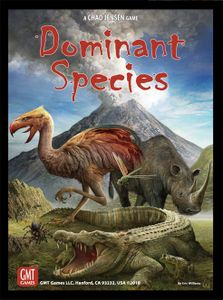
Program actions, reshape habitats and spread species across an Earth facing an ice age, balancing population with elemental adaptation to earn victory points.
Dominant Species supports 2–6 players; community best: 4 players; playing time: 120–240 minutes. A WANGO browser trial has not been confirmed.
Background & introduction
Designed by Chad Jensen, Dominant Species depicts an approaching ice age in 90,000 B.C. Each player controls one animal class: mammals, reptiles, birds, amphibians, arachnids or insects. Species spread across an expanding Earth while tundra steadily transforms its habitats.
Players first place action pawns in initiative order, then resolve the action display in a fixed sequence. Adaptation changes an animal’s needs, abundance and depletion change the environment, and speciation, migration and competition change the populations on the map. Earlier actions can transform the conditions facing a later pawn.
Population leadership and ecological dominance serve different purposes: cubes determine terrain scoring ranks, while matching elements determine access to powerful Dominance Cards. Glaciation reduces populations and extinction removes species unable to match their habitat. Playing Ice Age starts the final scoring procedure; accumulated victory points decide the winner.
Core rules & scoring
Setup: The basic game supports 2–6 players, each controlling one animal. At 2/3/4/5/6 players, take 7/6/5/4/3 action pawns and 55/50/45/40/35 cubes respectively, using one cube as a score marker. Follow the fixed starting Earth, element and species layout; put Ice Age at the bottom of the card deck.
Planning and execution: In initiative order, place one pawn at a time into a vacant eyeball space. Resolve the display from top to bottom and left to right. Only the leftmost Glaciation pawn acts this turn; the others queue for later turns. Regression, Wasteland and certain animal abilities can operate without placed pawns.
Environment and adaptation: Elements on animal displays represent needs; elements at tile corners represent supply and can affect several tiles. Adaptation adds an element up to a total of six. Regression can remove added elements, but printed default elements cannot be removed. Abundance, Wasteland and Depletion alter elements on Earth.
Dominance: With a species present, sum the products of each element’s count on your display and its count on the tile. A strictly highest positive total allows a dominance cone. A tie for the highest matching total leaves no dominant animal; neither cube count nor the food chain breaks it. Claim and update dominance when circumstances change.
Expansion and competition: Speciation adds cubes from your gene pool around a selected element, with capacity depending on terrain. Wanderlust adds an adjacent tile and lets all animals move adjacent species onto it. Migration moves a limited number of species, with birds able to travel two tiles. Competition removes opposing species only on permitted terrain where both animals are present.
Glaciation and extinction: Glaciation converts a non-tundra tile next to tundra, retains one species of each animal and returns the excess to their gene pools. Remove elements surrounded by three tundra tiles. During Reset, zero-match species go extinct, though mammals may save one each turn. Species removed for reasons other than Glaciation normally leave play rather than returning to the gene pool.
Terrain and Survival scoring: A Domination action scores a tile not already chosen this turn. Rank animals by cube count and award the terrain’s points, breaking population ties in food-chain order: mammals, reptiles, birds, amphibians, arachnids, insects. Its dominant animal then chooses and resolves an available Dominance Card. The sole leader in total tundra cubes holds Survival and scores bonus points during Reset for tundra tiles occupied; a tie leaves the card unclaimed.
Endgame: After Ice Age is resolved, finish the remaining Domination actions, Extinction and Survival, but skip reseeding. Remove dominance cones and score every tile once more by population, without awarding cards. Highest total wins; the animal higher on the food chain wins a score tie.
Rules & gameplay questions
Does having the most cubes give me a Dominance Card?
No. Cubes determine terrain points, while matching elements determine dominance. The player selecting the tile, the animal scoring most points and the animal receiving a card can all be different.
Can my animal dominate a tile it occupies alone?
Only with a positive matching-element total. A zero-match animal is endangered and cannot dominate even alone. If present animals tie for the greatest match, nobody dominates.
Can removed cubes always breed again?
Usually not. Cubes lost to competition, extinction and similar effects go into the box, out of play. Excess cubes displaced by Glaciation return to gene pools; follow any specific card exception.
Does Survival score the number of cubes on tundra?
Cube totals across all tundra determine who holds the card outright. The holder then scores from the bonus table for the number of tundra tiles occupied. A tie for the card means nobody scores it.
Must two players each control three animals?
No. The basic game gives each player one animal. Controlling three each is an optional two-player rule; the equivalent three-player variant gives two each. Those variants use each player’s lowest-scoring animal as their final score and are outside this summary.
Rules & introduction sources
- Edition
- The original 2010 terrestrial Dominant Species, using the official English third-printing rules (2012, 20 pages) currently linked by GMT. Covers the basic 2–6-player fixed setup, excluding the multiple-animal and random-Earth variants on page 17, Marine and the card game.
- Introduction source
- BoardGameGeek
WANGO editorial
| Parameter | Recorded value |
|---|---|
| BGG overall rank (snapshot) | #115 |
| Complexity Weight | 4.04 / 5 |
| Best player count (community) | 4 |
| Player range | 2–6 |
| Playing time (minutes) | 120–240 |
| Core mechanisms | Action Drafting · Action Queue · Area Majority / Influence · End Game Bonuses · Grid Movement · Hexagon Grid · Map Addition · Take That · Tile Placement · Turn Order: Claim Action · Variable Player Powers · Worker Placement |
| Chinese publication | Unconfirmed |
| WANGO browser play | No confirmed WANGO trial |
| Year published | 2010 |
| Suggested age | 14+ |
BGG statistics are stored snapshots, not live rankings. Source checked:2026-09-27
Player questions
What is the best player count for Dominant Species, and can I play online?
Dominant Species supports 2–6 players; community best: 4 players; playing time: 120–240 minutes. A WANGO browser trial has not been confirmed.
How complex is Dominant Species, and which mechanisms does it use?
Weight: 4.04 / 5. Mechanisms: Action Drafting · Action Queue · Area Majority / Influence · End Game Bonuses · Grid Movement · Hexagon Grid · Map Addition · Take That · Tile Placement · Turn Order: Claim Action · Variable Player Powers · Worker Placement. Chinese publication: Unconfirmed.
Where can I learn Dominant Species?
No rule guide, strategy article or WANGO trial has been confirmed for this record.