Cyclades
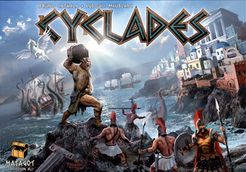
Cyclades is a mythic Greek auction and area-control game: bid for the gods, build your city-state, and claim enough Metropolises by the end of a cycle.
Cyclades supports 2–5 players; community best: 4–5 players; playing time: 60–90 minutes. A WANGO browser trial has not been confirmed.
Background & introduction
Cyclades is set in an archipelago off the coast of a Greece that has not yet been unified. Sparta, Athens, Corinth, Thebes, and Argos struggle for supremacy under the gaze of the gods. Each player represents a city-state, gathering resources, extending sea routes, and building the Metropolises that signal a claim to power. Mythological creatures can briefly disrupt those plans, turning a carefully prepared position into a new opportunity or threat.
The main actions are secured through offerings to the gods. Ares governs troops, Poseidon rules fleets, Zeus and Athena support religious and intellectual development, and Apollo helps a city-state earn income. Gold is both the price of influence and the currency for recruitment, buildings, and creatures. Spending heavily to control the action you want can therefore leave too little money to develop the city once that action arrives.
Victory comes from controlling enough Metropolises at the end of a complete cycle, not from occupying every island. Players can build one from a set of different structures, collect philosophers, or conquer an opponent’s existing city. Troops and fleets create routes to territory and revenue, while auctions and income management decide when that force can matter. The changing god order, bids, and creature market make each expansion plan compete with the race to build or capture a metropolis.
Core rules & scoring
Version and setup: This entry follows Matagot’s original base rules for 2–5 players; each player hides 5 GP behind a screen and sets up units, cards, and the modular map as shown for the player count. Each player takes one offering marker, randomly ordered on the turn track; the second marker is used in the two-player game. The objective is to control enough Metropolises when a cycle ends.
Cycle and player count: Update creatures, arrange Gods, collect income, resolve offerings, then act from the first God down to Apollo; check victory only after the complete cycle. Five players use all four major Gods. Four players hide the last God and put it first next cycle before shuffling the others. Three players use the first two Gods, then the other pair next cycle, and reshuffle all four on the following cycle. Apollo stays last.
Income and creatures: Gain 1 GP per controlled prosperity icon or marker, including sea-commerce spaces occupied by your Fleets, and hide the money. Only the 4-GP creature appears in cycle one; cycle two offers up to two, then the usual track has three. At cycle start discard the unused 2-GP card, slide others right and refill. During any God action except Apollo, buy and immediately use one or more creatures at current prices, without refilling after purchase. Each Temple discount can be used once per cycle; pay at least 1 GP per creature.
Offerings and auctions: Players choose Gods in turn-track order. Each ordinary God grants this cycle’s action to only one player. To take an occupied God, a later player must bid more; the displaced player immediately chooses another God, resolving any resulting chain of bids before play continues. Priests reduce offering costs, but the final payment for an ordinary God cannot be less than 1 GP. Apollo is free and may be chosen by multiple players.
God actions: Poseidon recruits one Fleet for free, can recruit more for increasing costs, build Ports, or pay for special Fleet movement. Ares recruits one Troop for free, can raise more, build Fortresses, or move Troops along the player’s own Fleet links. Zeus grants a Priest, lowers future offerings, and allows Temples or creature replacement; Athena grants a Philosopher, and four Philosophers make a Metropolis, while Universities support the building route. Apollo gives 1 GP if you control several islands, or 4 GP if you control only one, and lets you place a Prosperity marker for +1 GP on that island in future cycles. If several players choose Apollo, only the first to choose him places the marker. He does not recruit, build, or move. Each building normally costs 2 GP.
Movement and battle: Poseidon spends 1 GP to move a group of Fleets up to three sea spaces, joining or leaving Fleets en route; an enemy space stops movement for battle. Ares spends 1 GP to move Troops from one isle to another along friendly Fleet links. Do not attack another player’s final isle unless you can demonstrate that taking it would win the game. Each assault rolls a die plus participating units, with +1 per relevant defensive Fortress or Port. The lower side loses one unit; ties remove one each. If both still have units, defender may retreat first, then attacker; otherwise fight again. If both land forces disappear, the defender retains the isle and its buildings with a territory marker.
Metropolises and victory: Owning all four building types, even across islands, forces an immediate exchange of one of each for a Metropolis. Four Philosophers must likewise be discarded immediately for one. Use a Metropolis space on your isle, destroying ordinary buildings there if needed. If your only isle already has a Metropolis, the Philosophers are still discarded and the new city replaces the old without increasing your count. Conquering an existing Metropolis is another route; a Metropolis has all four building powers. At cycle end, at least two wins in 3–5 players, or three in two players. Multiple qualifiers compare remaining GP; no further equal-GP rule is given.
Two-player exception: Each player uses two offering markers and bids for two Gods; the later marker can displace the player’s own earlier choice, but both offerings must still be resolved and paid. The remaining rules follow the method the rulebook specifies for four players, with the two-player victory threshold of three Metropolises. Do not apply the usual two-city goal from a larger game to a two-player match.
Retreat and control: Land retreat needs a friendly isle connected to the battlefield by your Fleet chain. Naval retreat needs an adjacent empty or friendly sea space; without one, retreat is unavailable. Leave a territory marker when your Troops vacate an isle. It remains yours, but an opponent landing there claims it without a battle, even with a Fortress present. Within a God action, recruiting, building and special actions can be interleaved rather than choosing only one category.
Recruitment costs and limits: Poseidon grants one free Fleet and up to three extra at 1, 2 and 3 GP. Ares grants one free Troop and up to three extra at 2, 3 and 4 GP; each player has at most eight of either unit. Place new Fleets in empty or friendly sea spaces adjacent to your isles, and Troops on your isles. Zeus and Athena grant one free Priest or Philosopher respectively, and allow exactly one extra for 4 GP. Each corresponding ordinary building costs 2 GP and may be built repeatedly if space and money allow.
Rules & gameplay questions
Does the highest bidder always act first?
No. Players place offerings in turn-track order, and a player who bids higher for an occupied God forces the previous bidder to choose a different God immediately. After all bids are settled, actions follow the God-tile order for that cycle, not the size of the bids. Completing an action also changes a player’s place on the turn track for the next cycle, so the order of bidding and acting both matter.
Can a displaced bidder wait before choosing another God?
No. Move immediately to a different God when outbid, resolving any resulting displacement chain before the next scheduled player places a marker. You cannot simply raise your offer on the same God at that moment. If later displaced from a different God, you may return with a higher bid. All offers must be affordable, despite gold being hidden; Apollo is the free shared option.
Is Apollo auctioned, and can several players choose him?
Apollo requires no offering and may be chosen by several players. Every chooser receives 1 GP if they own more than one isle, or 4 GP if they own exactly one. Only the first chooser also receives a prosperity marker, placed on one of their isles for an extra 1 GP in future cycles; several markers can share an isle. Apollo grants no recruiting, construction, movement or creature actions.
Can I keep a Mythological Creature for a later turn?
No. A creature bought during your non-Apollo God action must be used immediately and then discarded. You may use several, but normal purchases do not refill the track until the next cycle, so later players may find none left. Each Temple discount works once per cycle and the price stays at least 1 GP. Zeus separately allows a paid 1-GP action to discard and replace an available creature.
When do we check for a Metropolis victory?
Check at the end of a complete cycle, not the moment someone builds a second Metropolis. The normal threshold is two in a three-to-five-player game and three in a two-player game, and the remaining God actions in that cycle still resolve. If several players meet the threshold at cycle end, the player with more hidden GP wins. The base rulebook does not specify a further tiebreak if their gold is also tied.
How can I obtain a Metropolis?
Metropolises and victory: Owning all four building types, even across islands, forces an immediate exchange of one of each for a Metropolis. Four Philosophers must likewise be discarded immediately for one. Use a Metropolis space on your isle, destroying ordinary buildings there if needed. If your only isle already has a Metropolis, the Philosophers are still discarded and the new city replaces the old without increasing your count. Conquering an existing Metropolis is another route; a Metropolis has all four building powers. At cycle end, at least two wins in 3–5 players, or three in two players. Multiple qualifiers compare remaining GP; no further equal-GP rule is given.
Who owns an isle when both land forces are eliminated?
The defender keeps it. Place the defender’s territory marker there; the isle, its buildings and revenue remain theirs rather than becoming neutral. Without Troops it cannot defend a later landing, even with a Fortress. If both sides still have units after an assault, the defender has the first retreat choice, then the attacker; land retreat requires a friendly isle linked by friendly Fleets.
Do two players still win with two Metropolises?
No. Each player uses two offering markers and the victory threshold is three Metropolises at cycle end. You must afford both final offerings together. Each Priest discounts each offering by 1 GP, but each ordinary God still costs at least 1 GP. You may outbid your own earlier marker and resolve the displacement normally. Use the specified two-player setup and otherwise the four-player God procedure.
Rules & introduction sources
- Edition
- Matagot’s original base game, BGG 54998, using the ©2009 base-game rulebook. The current product page identifies the product; the rules PDF is a third-party-hosted copy of the original rulebook. Excludes Cyclades: Legendary Edition and all expansions.
- Rule references
- Introduction source
- BoardGameGeek
WANGO editorial
| Parameter | Recorded value |
|---|---|
| BGG overall rank (snapshot) | #272 |
| Complexity Weight | 2.82 / 5 |
| Best player count (community) | 4–5 |
| Player range | 2–5 |
| Playing time (minutes) | 60–90 |
| Core mechanisms | Area Majority / Influence · Area Movement · Auction / Bidding · Auction: Fixed Placement · Dice Rolling · Open Drafting · Set Collection · Variable Phase Order |
| Chinese publication | Unconfirmed |
| WANGO browser play | No confirmed WANGO trial |
| Year published | 2009 |
| Suggested age | 13+ |
BGG statistics are stored snapshots, not live rankings. Source checked:2026-09-27
Player questions
What is the best player count for Cyclades, and can I play online?
Cyclades supports 2–5 players; community best: 4–5 players; playing time: 60–90 minutes. A WANGO browser trial has not been confirmed.
How complex is Cyclades, and which mechanisms does it use?
Weight: 2.82 / 5. Mechanisms: Area Majority / Influence · Area Movement · Auction / Bidding · Auction: Fixed Placement · Dice Rolling · Open Drafting · Set Collection · Variable Phase Order. Chinese publication: Unconfirmed.
Where can I learn Cyclades?
No rule guide, strategy article or WANGO trial has been confirmed for this record.