Jaipur
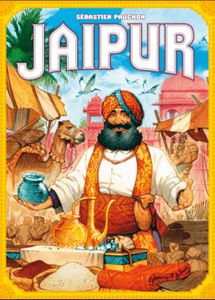
Collect, exchange and sell goods in a two-player market, using camels to keep stock moving as you race to win two Seals of Excellence.
Jaipur supports 2 players; community best: 2 players; playing time: 30 minutes. A WANGO browser trial has not been confirmed.
Background & introduction
Jaipur casts two traders as rivals for the Maharaja’s patronage. The shared market holds goods and camels; selling collected goods earns rupees, and the richer trader takes a Seal of Excellence at each round’s end.
A turn offers taking cards or selling goods. Take one good, exchange goods and camels for several goods, or collect every camel in the market. Camels stay in a separate herd and do not count toward the goods hand limit.
Early sales usually secure more valuable goods tokens, while larger sets earn bonus tokens. Sales timing, the seven-card limit and the market left behind after an exchange shape each round’s trading decisions.
Core rules & scoring
The base game is for exactly two. Start a round with three camels in the market, shuffle the remaining cards, deal five each and add two market cards to make five. Move hand camels to personal herds. Stack goods tokens highest first and shuffle each of the three bonus types separately.
Alternate turns, taking cards or selling goods, never both. Taking cards means choosing one good, exchanging several goods or taking all camels.
Take one good from the market into your hand and replace it with one deck card. Your goods hand cannot exceed seven at turn end, so a single pickup cannot take it above that limit.
Exchange at least two market goods for the same number of hand goods, herd camels or a mixture. Do not take and return the same goods type, and never exchange one for one. This action does not refill from the deck.
Taking camels means taking every market camel into your herd, then refilling the market. Do not also take goods. Herd camels do not count toward the seven-card hand limit, and you need not disclose their number.
Sell any number of one goods type from hand and take its top tokens. Diamonds, gold and silver require at least two cards per sale, even with only one matching token left. Other goods may be sold singly.
Selling three, four or at least five cards earns one matching bonus token, worth 1–3,4–6 or 8–10 rupees respectively. If goods tokens run short, take only those available, but determine the bonus from the number of cards actually sold.
The round ends immediately when three goods-token types are exhausted or the deck cannot refill the market to five. An empty deck alone does not end it without a required refill, and bonus stacks do not count as goods-token types.
The larger herd earns the five-rupee camel token; equal herds earn neither. Add goods, bonus and camel token values. Richest wins the round’s seal; ties compare bonus-token count, then goods-token count. No further unpublished tiebreak is supplied.
If neither trader has two seals, reset for another round with the previous round’s loser starting. First to two Seals of Excellence wins the match, normally within three rounds.
Rules & gameplay questions
Can I exchange one for one, or return the same goods type I take?
No. An exchange takes at least two goods from the market, and the same goods type cannot move in both directions within that exchange.
Can I take only one camel when several are available?
No. Take all market camels, without also taking goods. Camels stay outside the seven-card hand limit.
Does a shortage of goods tokens reduce my sales bonus?
No. Take only the remaining goods tokens, but the bonus still depends on the number of cards sold. Precious goods still require at least two cards.
Does a full seven-card hand prevent every taking action?
No. You can still collect camels or make a legal exchange, provided your goods hand ends at seven or fewer. You cannot take one more good to make eight.
Does the previous round’s winner always start next?
No. The loser starts the new round. Keep earned seals and otherwise reset as instructed.
Rules & introduction sources
- Edition
- Original Jaipur base game in the 2019 SPACE Cowboys English printing, using the current official linked PDF. Exactly two players, physical play; excludes digital campaigns and fan variants. Round ties use only the listed bonus-token and goods-token counts, without inventing a further tiebreak.
- Rule references
- Introduction source
- BoardGameGeek
WANGO editorial
| Parameter | Recorded value |
|---|---|
| BGG overall rank (snapshot) | #202 |
| Complexity Weight | 1.46 / 5 |
| Best player count (community) | 2 |
| Player range | 2 |
| Playing time (minutes) | 30 |
| Core mechanisms | End Game Bonuses · Hand Management · Hidden Victory Points · Market · Open Drafting · Push Your Luck · Race · Score-and-Reset Game · Set Collection · Sudden Death Ending · Turn Order: Progressive · Variable Set-up |
| Chinese publication | Unconfirmed |
| WANGO browser play | No confirmed WANGO trial |
| Year published | 2009 |
| Suggested age | 10+ |
BGG statistics are stored snapshots, not live rankings. Source checked:2026-09-27
Player questions
What is the best player count for Jaipur, and can I play online?
Jaipur supports 2 players; community best: 2 players; playing time: 30 minutes. A WANGO browser trial has not been confirmed.
How complex is Jaipur, and which mechanisms does it use?
Weight: 1.46 / 5. Mechanisms: End Game Bonuses · Hand Management · Hidden Victory Points · Market · Open Drafting · Push Your Luck · Race · Score-and-Reset Game · Set Collection · Sudden Death Ending · Turn Order: Progressive · Variable Set-up. Chinese publication: Unconfirmed.
Where can I learn Jaipur?
No rule guide, strategy article or WANGO trial has been confirmed for this record.