Tikal
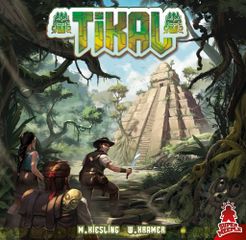
Tikal is a jungle archaeology and area-control strategy game. Players expand a map of ancient ruins, send expeditions to uncover temples and recover treasure, then compete for control during recurring scoring rounds.
Tikal supports 2–4 players; community best: 4 players; playing time: 90 minutes. A WANGO browser trial has not been confirmed.
Background & introduction
Tikal is an ancient Maya city deep in the forests of northern Guatemala. In the game’s setting, the ruins remain partly hidden beneath the jungle and large areas have yet to be investigated. Each player leads an expedition into the site, following old stone paths to uncover temples and recover precious artifacts. Exploration is not simply a matter of revealing the next location: the way terrain tiles connect determines which routes are open and whether an expedition can reach an opportunity in time.
The map grows from hexagonal terrain tiles that represent jungle, temples, treasure sites, and volcanoes. Stones printed along the sides of a tile form the paths that expedition members can use. A newly discovered location must connect to the explored map and offer at least one passable route. Leaders, workers, and camps form each expedition’s network. Camps create shortcuts between a player’s own outposts, temples can be excavated level by level, and treasure can only be recovered by sending members to the site.
Each turn asks players to make several uses of a limited action-point budget. They can deploy or move workers, uncover temple levels, collect or exchange treasure, establish camps, or commit a guard to a temple. Those choices compete for the same ten points. A quick expansion can leave little time for excavation; a valuable temple can later be taken by a stronger rival; and an expensive camp may pay off by making future movement much faster.
Volcano tiles interrupt ordinary exploration and trigger a scoring round for everyone. Before scoring, each expedition gets a fresh set of actions; then temple control is decided by expedition strength or a permanent guard, while treasure scores according to matching sets. As the three volcanoes enter the map, players must also prepare for the final scoring round after the last terrain tile. The expedition with the most points at the end wins.
Core rules & scoring
Players and objective: The classic Rio Grande Games rules support 2–4 players, ages 10 and up. Each player chooses a color and takes an expedition leader, workers, and two camps. Players expand a jungle map, compete for valuable temples, and recover matching treasure sets. Three volcano-triggered scoring rounds and a final scoring round determine the winner. This is the standard draw version: terrain tiles are taken from the ordered stack, with no auction procedure.
Turn and terrain placement: On a turn, draw a terrain tile, place it beside the explored map, and then spend up to 10 action points (AP). A tile must be adjacent to existing terrain and provide at least one connecting stone path that lets an expedition enter; the path may be printed on the new tile, the neighboring tile, or both. A volcano tile does not need a passable path because expedition members may not enter or cross a volcano space. Jungle tiles can hold camps, temple tiles can be excavated, and treasure tiles receive the number of wafers shown by their masks.
Action points and expedition members: A player can combine actions in any order, but unused AP are lost at the end of the turn. One AP places a worker or leader from the supply at the base camp or one of that player’s camps. One AP also moves a member between the player’s own camps. Moving across the map costs one AP for each path stone crossed, and a single move from one hex to another must be completed in the same turn. A player cannot spend AP now to cross part of a path and finish that move on a later turn.
Excavating temples: A member must be present in a temple hex to uncover it. Each level costs 2 AP and requires one expedition member in the hex; a player may uncover at most two levels of the same temple in one turn. Temple tiles must be added in numeric order, so a missing next value cannot be skipped. The number on the top tile is the temple’s value at scoring. If AP allow, a player may excavate several different temples in a turn, while weighing the risk that a rival may later take control of a more valuable site.
Treasure and exchanges: A player may recover a treasure wafer by paying 3 AP and having one of that player’s members at the site for each wafer taken. A hex may yield at most two wafers to the same player in a turn. Matching treasures score as a set: a single wafer is worth 1 point, a pair is worth 3, and a triplet is worth 6. For 3 AP, a player may exchange one single treasure with a single treasure belonging to another player. The other player cannot refuse, but an existing pair or triplet cannot be split apart.
Camps and temple guards: For 5 AP, a player may establish a camp on any jungle hex or empty treasure hex, even without a member there; each player may build at most two camps. That player’s camps are connected to one another and to the base camp, and members can be deployed to them for 1 AP each. A player with greater expedition strength than any single rival in a temple may pay 5 AP to place a guard there, up to two guards per player. A leader counts as three workers and each worker as one. Placing a guard removes the player’s other members from that hex, fixes control for later scoring, and freezes that temple’s value.
Volcano scoring rounds: Drawing a volcano immediately interrupts the normal turn. Set the tile aside; the player who drew it first gets 10 AP to explore and then scores temples and treasure. Each other player, in clockwise order, also gets 10 AP before scoring. A temple without a guard scores for the player whose strength is greater than every single rival’s; a tie for the highest strength means no one scores that temple. A guard secures the temple for its owner. Once everyone has scored, the drawing player places the volcano tile and continues with the normal 10-AP exploration turn.
End of game: Each of the three volcano tiles causes a scoring round. After the final terrain tile has been placed and its player finishes the 10-AP turn, all players take one final 10-AP exploration and score again. Add each player’s temple and treasure points to the running total at every scoring round. Temple control may change as expeditions move, unless a guard has fixed ownership; this makes route planning, scoring timing, and the remaining volcano order relevant throughout the game. The player with the highest total after final scoring wins.
Rules & gameplay questions
How many players can play Tikal?
The classic Rio Grande Games rules list Tikal for 2–4 players, ages 10 and up. This overview uses the standard version in which players draw terrain tiles from the prepared stack. The same booklet also offers an optional auction version, which adds bidding and starting capital; those rules are separate and are not part of the standard turn sequence described here.
How many action points do I get on a turn?
After drawing and placing a terrain tile, you may spend up to 10 action points (AP) in any order on the available actions. Unused points are lost when your turn ends. Placing the terrain tile itself is not paid from that ten-point budget, but deploying or moving members, excavating temples, collecting or trading treasure, building a camp, and placing a guard all require AP.
How do I place a new terrain tile?
Place it next to at least one explored hex and make sure there is a connecting stone path that an expedition can use to enter. The path can be on the new tile, the neighboring tile, or both. A volcano is the exception: it needs no passable route because expedition members are never allowed to enter or pass through volcano spaces. If no connected path can be made, that placement is not legal.
What does the expedition leader do?
For movement, temple excavation, and treasure recovery, the leader costs the same action points as a worker. When comparing expedition strength in a temple, however, one leader counts as three workers, while each ordinary worker counts as one. This can help establish a majority, but you still need to account for the AP and route cost of getting the leader to that temple.
How do I increase a temple’s value?
With at least one member in the temple hex, pay 2 AP per uncovered level. Each level needs one member present, a player may uncover no more than two levels of a temple on a turn, and the numbered tiles must be added in order. You cannot skip a missing next number. The top number is the temple’s scoring value, so increasing it can make the site more attractive to rivals as well.
How are treasures scored, and can I trade them?
Matching treasure wafers form sets: one single wafer is worth 1 point, a pair is worth 3, and a triplet is worth 6. Each wafer costs 3 AP to recover, requires one of your members at the site, and a player may take no more than two wafers from one hex in a turn. You may spend 3 AP to exchange single treasures with another player, who cannot refuse; completed pairs and triplets cannot be broken up.
Who scores first when a volcano is drawn?
The player who draws the volcano tile sets it aside, takes 10 AP to explore, and scores first. The other players then proceed clockwise, each taking 10 AP and scoring. After everyone has scored, the player who drew the volcano places it on the map and continues the ordinary exploration turn with another 10 AP. The volcano causes a scoring round; it does not end the game immediately.
What happens if players tie for a temple?
Without a guard, a temple scores only for a player whose expedition strength is greater than every single opponent’s strength in that hex. If two or more players share the highest strength, no one receives that temple’s points for that scoring round. A guard changes the situation by fixing the temple’s ownership for future scoring rounds, even if the owner later moves other members away.
When does the game end?
There are three volcano tiles, and each one triggers a scoring round when drawn. After the last terrain tile is placed and its player finishes the turn, every player gets one final 10-AP exploration and scoring opportunity. The game ends after that final scoring round, and the player with the highest accumulated points from temples and treasure sets wins.
Rules & introduction sources
- Edition
- This draft follows the classic Rio Grande Games 2005 base rules for board-game item 54 and the standard draw version, for 2–4 players ages 10+. It excludes the separate auction variant and does not mix in later Super Meeple terminology.
- Rule references
- Introduction source
- BoardGameGeek
WANGO editorial
| Parameter | Recorded value |
|---|---|
| BGG overall rank (snapshot) | #391 |
| Complexity Weight | 2.78 / 5 |
| Best player count (community) | 4 |
| Player range | 2–4 |
| Playing time (minutes) | 90 |
| Core mechanisms | Action Points · Area Majority / Influence · Auction / Bidding · Events · Grid Movement · Hexagon Grid · Kill Steal · Layering · Map Addition · Modular Board · Set Collection · Tile Placement · Victory Points as a Resource · Zone of Control |
| Chinese publication | Unconfirmed |
| WANGO browser play | No confirmed WANGO trial |
| Year published | 1999 |
| Suggested age | 10+ |
BGG statistics are stored snapshots, not live rankings. Source checked:2026-09-27
Player questions
What is the best player count for Tikal, and can I play online?
Tikal supports 2–4 players; community best: 4 players; playing time: 90 minutes. A WANGO browser trial has not been confirmed.
How complex is Tikal, and which mechanisms does it use?
Weight: 2.78 / 5. Mechanisms: Action Points · Area Majority / Influence · Auction / Bidding · Events · Grid Movement · Hexagon Grid · Kill Steal · Layering · Map Addition · Modular Board · Set Collection · Tile Placement · Victory Points as a Resource · Zone of Control. Chinese publication: Unconfirmed.
Where can I learn Tikal?
No rule guide, strategy article or WANGO trial has been confirmed for this record.