Nippon: Zaibatsu
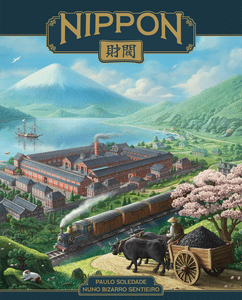
Nippon: Zaibatsu is the tenth-anniversary reimagining of Nippon. Manage an industrial conglomerate, hire colored workers, build factories, supply regional markets, and compete for three rounds of Influence and final prestige.
Nippon: Zaibatsu supports 1–4 players; community best: 4 players; playing time: 60–120 minutes. A WANGO browser trial has not been confirmed.
Background & introduction
Nippon: Zaibatsu is set against Japan’s industrialization in the mid-nineteenth century. Players manage competing industrial conglomerates, investing in research, mining resources, building and modernizing factories, producing goods for local markets, and developing contracts, railroads, and ships. Each zaibatsu must create its own path through resource conversion, production, and national influence, with the aim of proving it most worthy of the Emperor’s favor through three regional scorings and final corporate scoring.
The game combines worker selection and area control. On a turn, a player takes a Worker from the Hiring area, places it in the lowest empty space on their board, and performs the corresponding action; an action usually must be resolved at least once, but many can be activated multiple times. Worker colors connect to departments, while the Hiring queue and round pace make timing important. If a player does not want or cannot act, they may Consolidate to gain income and bonuses, choose endgame scoring objectives, and clear their workers for another cycle.
Goods from factories can be delivered to local markets to influence regional strength and earn bonuses; Trains and Ships extend control and diplomatic development. Each of the three Periods ends with an Influence scoring, and the game concludes by evaluating Contracts, factories, transport and development through chosen Personal Objectives, then adding leftover goods and money. The core rules include a solo competitive mode against an Automa. Standard and Emperor’s Editions share the core, while optional factory and common-goal modules vary by box.
Core rules & scoring
Objective and mode: Manage an industrial zaibatsu through investment, factories, production, local markets, contracts, railroads, ships, and technology. The game has three Periods, each ending in regional Influence scoring, followed by final corporate scoring. The highest total wins. CrowD lists 1–4 players, 60–120 minutes, and age 15+; the rules include a competitive solo Automa.
Setup and resources: Use Demand tiles to set regional markets, then randomly place Workers in the Hiring area and Worker Queue. Each player takes a Zaibatsu board, starting factory, ships, machines, trains, Influence, Contracts, Favor, and track markers. Starting tokens give asymmetric resources and bonuses. Resources include Money, Coal, Goods, Silk, and Iron; Silk can be used as money at 1:1, while Iron is used for Ships, Trains, and Machine upgrades.
Normal turn: Choose a Main Board action, take one Worker from the matching Hiring space, place it in the lowest empty Worker space on your board, and resolve the action. You must be able to resolve the chosen action at least once, though many actions allow multiple activations. If you do not want or cannot act, or need to clear your Worker area, Consolidate. Worker colors are primarily tied to Department bonuses and are not a universal restriction on taking the action.
Nine action types: R&D and Mining advance tracks; Factory builds and activates a factory; Machines upgrade factories and Production increases goods output; Trains and Ships expand regional or diplomatic influence and provide workers or Department upgrades; Investment & Contracts converts resources into finance or contract rewards; Local Markets spends goods to place or replace Influence in regions and collect bonuses. Costs and repeat activations depend on the action and available resources.
Workers and rounds: At the end of a turn, a round ends if a Hiring space is empty and the Worker Queue cannot refill it. Check whether the current Period’s last round has been reached and score Influence if so, then advance the marker. In ordinary rounds, add one worker to each Hiring space with fewer than three and rebuild the Queue for the player count. The final limited-turn sequence uses a separate procedure without worker replenishment.
Consolidation: With at least one worker, take a Favor token beside the topmost worker and place it on an empty Personal Objective space, where it stays. Discard all Money and Coal, retaining Silk, Iron and Goods. Gain the lowest worker’s Department reward; only with at least four workers and different top/bottom colors also gain the top reward. Gain Mining and Finance income, pay three Money per worker color while retaining the last Money, lose one point per unpaid Money, and return the workers.
Regional Influence scoring: At the end of each Period, score regions one by one, comparing player Influence and qualifying Trains together with the printed Overseas Companies. Award points by rank; tied players split the relevant rank values, rounded down. Overseas Companies affect rank but do not accumulate player points. In a two-player game, remove the second-place value. Influence placement and railroad choices can affect both period scoring and an opponent’s market space.
Final three turns: When the first marker reaches the first bright space occupied by the second marker, give the second marker to the player on the left. Beginning there, every player has three turns total remaining. Advance the marker after everyone has taken one turn, without refilling Hiring or the Queue. After those three turns each and the last Influence scoring, all players perform Final Consolidation simultaneously, even with no workers. Do not add a fourth personal turn.
Final scoring: Favor tokens on Personal Objectives determine what scores and at which level. Ships, Machines, Trains and the R&D, Mining and Finance tracks score 5/8/10 for level-1/2/3 Favor at the lower threshold, or 10/16/20 at the upper threshold. Factories and Contracts use the rightmost position’s printed value for the Favor level. Do not score those same assets independently again. Combined Goods, Coal, Silk and Iron yield one point per three, and Money one per five, discarding remainders. Most points wins; the tied player taking the final turn last wins.
Edition and solo boundaries: BGG 434367 is the tenth-anniversary reimagining, not the 2015 Nippon ruleset. Standard and Emperor’s Editions share core rules, while the latter includes extra content; use the specific box setup for Late-Game Factories and Common Goals. The base game includes a competitive solo Automa. A July 2026 errata item is listed on BGG, but its text was not verified here, so no unconfirmed factory cap or ship-building exception is asserted.
Rules & gameplay questions
What is the objective of Nippon: Zaibatsu?
Build an industrial conglomerate by researching, mining, constructing and upgrading factories, producing goods, supplying regional markets, fulfilling contracts, and expanding rail and sea routes. The game has three Periods, with regional Influence scored at the end of each, followed by final scoring for the company’s objectives and assets. The highest score wins. It is a competitive economic and area-control game.
How do I take an action on my turn?
Choose an action on the Main Board, take a Worker from the corresponding Hiring space, place it in the lowest empty Worker space on your board, and perform that action. You normally need to be able to resolve the action at least once, while many actions may be repeated if resources allow. If you cannot or do not want to act, you Consolidate to gain benefits and clear your Worker area.
When does a round end because the Hiring area is empty?
Check at the end of a player’s turn: if a Hiring space is empty and the Queue cannot refill it, the current round ends. During ordinary rounds, check the marker for Influence scoring, advance it, replenish Hiring and rebuild the Queue. The final limited-turn sequence does not refill workers. Do not wait until every Hiring position is empty before checking this condition. Consult the rulebook version and errata for the edition being played.
What are the nine action types?
R&D and Mining advance development tracks; Factory constructs factories; Machines upgrades them; Production increases output; Trains and Ships extend regional or diplomatic presence; Investment & Contracts converts resources into money or contract rewards; and Local Markets uses Goods to place or replace Influence and take regional bonuses. Costs and repeat activations vary, so check the action space and your available resources before acting.
What happens during Consolidation?
Consolidation resets the company after a run of actions. Choose a Favor token based on your uppermost Worker and assign it to a Personal Objective, discard the required Money and Coal while retaining Silk, Iron, and Goods, gain Department bonuses based on Worker positions and colors, take income from Mining and Finance, pay salaries, and return Workers. The board clears so you can recruit into another cycle, while the Favor choice defines part of final scoring.
How does the game score regional Influence?
At the end of each Period, compare player Influence in each region together with qualifying Trains and the printed Overseas Companies. Points are awarded according to rank, and tied players split the relevant rank values, rounding down. Overseas Companies affect the ranking but do not earn player points themselves. In a two-player game, remove the second-place score, making control of a region especially important.
What is different about the final Period?
Once the first marker enters the first bright space, every player has three turns total remaining, beginning with the player holding the second marker. Each round gives one turn to each player, with no Hiring or Queue refill. There is no additional fourth turn after these three. Complete the last Influence scoring, then everyone makes Final Consolidation simultaneously, even with no workers, before Personal Objective and leftover-resource scoring.
How is the final score calculated?
Assets principally score through the Favor tokens already committed to Personal Objectives. Do not score a Ship, Machine or Train objective and then add a second independent asset award. Development objectives use lower or upper thresholds and Favor level; Factory and Contract objectives use the rightmost position’s matching value. Combined Goods, Coal, Silk and Iron yield one point per three, and Money one per five. Keep earlier Influence points; the last player to take their final turn wins a total-score tie.
Does the base game include official solo play?
The base game includes an Automa, but selected Solo Goals determine victory rather than a final score comparison with it. Failing any selected Goal causes an immediate loss, without Final Consolidation or scoring. Meeting them all wins; then use the final personal score to rate performance. The automa creates competition on the map, and solo setup, turn and difficulty instructions still apply. No expansion is required, and this is not a shared cooperative objective.
What is the difference between Standard and Emperor’s Edition, and can I use the original Nippon rules?
Standard is the core edition without the extra content; Emperor’s Edition adds modules and deluxe components while sharing the core flow. Common Goals and Late-Game Factories depend on the box and setup. BGG 434367 is the redesigned Nippon: Zaibatsu, not a reprint of the 2015 game’s rules. It changes resources, ships, actions, and Consolidation, so use the Zaibatsu retail rules rather than the original Nippon manual.
Rules & introduction sources
- Edition
- This entry covers CrowD Games’ anniversary redesign Nippon: Zaibatsu (BGG 434367), not the 2015 original. Its primary rules baseline is the publisher-authored Emperor’s Edition retail English manual hosted by a third party, cross-checked with the official product page. Publisher-uploaded BGG records list a February 2026 v2; the full v2 and July errata have not been compared page by page. Unverified card exceptions are excluded. Standard and Emperor’s Edition share the core, with optional modules by edition. Solo Goals decide solo victory; points rate performance afterward.
- Rule references
- CrowD Games — Nippon: Zaibatsu official product page (edition, specs, core loop, solo mode)
- CrowD Games — Kickstarter launch notice distinguishing Standard and Emperor’s Editions and current rules
- CrowD Games — Nippon: Zaibatsu updated English Emperor’s Edition rules, retailer-hosted 24-page copy (pp. 1–23)
- BoardGameGeek — official Standard Edition v2 English rulebook file entry (posted February 2026)
- BoardGameGeek — official Emperor’s Edition v2 English rulebook file entry (posted February 2026)
- BoardGameGeek — Nippon: Zaibatsu, game ID 434367 and files index, including July 2026 errata listing
- Introduction source
- BoardGameGeek
WANGO editorial
| Parameter | Recorded value |
|---|---|
| BGG overall rank (snapshot) | #350 |
| Complexity Weight | 3.61 / 5 |
| Best player count (community) | 4 |
| Player range | 1–4 |
| Playing time (minutes) | 60–120 |
| Core mechanisms | Area Majority / Influence · Contracts · End Game Bonuses · Income · Open Drafting · Solo / Solitaire Game · Variable Set-up · Worker Placement · Worker Placement, Different Worker Types |
| Chinese publication | Unconfirmed |
| WANGO browser play | No confirmed WANGO trial |
| Year published | 2026 |
| Suggested age | 12+ |
BGG statistics are stored snapshots, not live rankings. Source checked:2026-09-27
Player questions
What is the best player count for Nippon: Zaibatsu, and can I play online?
Nippon: Zaibatsu supports 1–4 players; community best: 4 players; playing time: 60–120 minutes. A WANGO browser trial has not been confirmed. Recorded mechanism tags: Solo / Solitaire Game.
How complex is Nippon: Zaibatsu, and which mechanisms does it use?
Weight: 3.61 / 5. Mechanisms: Area Majority / Influence · Contracts · End Game Bonuses · Income · Open Drafting · Solo / Solitaire Game · Variable Set-up · Worker Placement · Worker Placement, Different Worker Types. Chinese publication: Unconfirmed.
Where can I learn Nippon: Zaibatsu?
No rule guide, strategy article or WANGO trial has been confirmed for this record.