Chaos in the Old World
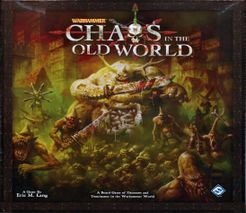
An asymmetric struggle among four Chaos gods, using followers and regional cards to compete for domination points, corruption rewards and a separate dial victory.
Chaos in the Old World supports 3–4 players; community best: 4 players; playing time: 60–120 minutes. A WANGO browser trial has not been confirmed.
Background & introduction
Khorne, Nurgle, Tzeentch and Slaanesh share the same map but value its opportunities differently. Their powers, decks and dial conditions encourage distinct routes to victory, while every deployment changes the space available to rivals.
The Summoning phase makes timing a resource. Spending heavily can establish a strong position, but smaller actions may keep you active after another god runs out of power. Cards occupy only two slots per region, so a useful effect also consumes a scarce opportunity.
Battle, domination and corruption reward different investments. A single large daemon is still only one figure for ordinary domination, while surviving Cultists place corruption. A region approaching ruination can pay several gods, yet its destruction also changes the remaining map and the game’s clock.
Core rules & scoring
The original base game supports 3–4 players using Khorne, Nurgle, Tzeentch and Slaanesh. Prepare an Old World deck of eight cards for three players or seven for four; use each chosen god’s own figures, Chaos deck, sheet and dial.
Rounds proceed through Old World, Draw, Summoning, Battle, Corruption and End. Interdependent actions use god order: Khorne, Nurgle, Tzeentch, then Slaanesh. Old World cards add events and token changes before deployment.
During Draw, follow your god’s card-drawing instructions and reset power to the indicated amount, including upgrades. Unused power does not carry over; Chaos cards have no hand limit and an exhausted personal deck is reshuffled from its discards.
In Summoning, take turns either summoning one figure or playing one Chaos card, paying its power cost. You may resummon a figure already on the map. Place figures where you have presence or adjacent to it; with no figures on the board, your first placement may be anywhere. Passing sets power to zero and ends further turns in that phase.
Each region has two Chaos-card slots. Play into an empty slot and resolve its text; cards generally affect their own region unless stated otherwise. Card effects and their timing can modify ordinary placement, combat and scoring.
Battle resolves region by region. Roll dice equal to eligible attack values and effects; each4–6 hits, and each6 adds another die that can also explode. Assign enough hits to kill a target rather than storing partial damage; ordinary killed figures remain to contribute their dice until all players finish that region’s battle.
First resolve domination during Corruption. Your normal value is figure count plus printed costs of your Chaos cards there, not figure costs. You must be the sole highest player and strictly exceed Resistance to score the region’s Conquest Value.
Then each Cultist places one corruption token. A total of12 corruption, including Warpstone for this threshold, ruins a region if a ruination card remains. Under FAQ2.0, every god that placed at least one corruption there during the current round receives the immediate ruiner reward; End-phase majority rewards use all accumulated corruption.
In End, remove Chaos cards, resolve Heroes and Old World effects, score newly ruined regions, then advance dials. Anyone with an advancement counter gains one tick; the sole player with most counters gains an extra tick. Ties for most get no extra tick. Resolve revealed instructions and remove the counters.
At End check victory in order: a Victory dial result, at least50 points, five ruined regions, then an empty Old World deck. Multiple dial winners compare points, then share a remaining tie. Point/ruination victories compare points then Threat. If the deck is empty without an earlier victory, all players lose.
Rules & gameplay questions
Does Khorne get a dial counter for every figure killed?
No. FAQ2.0 awards a counter for killing one or more enemy figures in a region during battle, not one per victim. Repeated battles within that region’s same Battle phase do not repeat the fulfilled condition. Peasant tokens are not enemy figures.
Does Slaanesh need both a Noble and a Hero to advance?
No. The corrected condition requires placing at least two corruption in a region with a Noble or Hero during the Corruption step. Either token type is enough; the printed Power Sheet condition is corrected by the FAQ.
Can one magic symbol and one Warpstone satisfy Tzeentch’s condition?
Yes. With at least two corruption placed there, the qualifying total can be two magic symbols, two Warpstones or one of each, as clarified by FAQ2.0.
Does corruption placed earlier in the round count for the immediate ruiner reward?
Yes. FAQ2.0 changes the old rulebook wording: placement anywhere during that round qualifies, not only the Corruption step. The later first/second rewards count the full corruption total, including earlier rounds.
Does the biggest or most expensive figure automatically dominate?
No. Ordinary domination counts figures, not their costs or attack strengths, then adds printed Chaos-card costs. A tied highest total wins nothing, and merely equalling Resistance is insufficient unless an applicable effect changes the calculation.
Rules & introduction sources
- Edition
- Original Chaos in the Old World base game for3–4 with its four original gods and base decks, applying relevant base sections of FFG FAQ v2.0 dated2011-08-22. Excludes The Horned Rat, fifth-player rules, Morrslieb replacement decks and expansion upgrades. Publisher-authored rules and FAQ were read through explicitly identified mirrors because historical direct FFG downloads returned access errors.
- Rule references
- Introduction source
- BoardGameGeek
WANGO editorial
| Parameter | Recorded value |
|---|---|
| BGG overall rank (snapshot) | #222 |
| Complexity Weight | 3.19 / 5 |
| Best player count (community) | 4 |
| Player range | 3–4 |
| Playing time (minutes) | 60–120 |
| Core mechanisms | Action Points · Area Majority / Influence · Area Movement · Dice Rolling · Events · Hand Management · Role Playing · Take That · Variable Player Powers |
| Chinese publication | Unconfirmed |
| WANGO browser play | No confirmed WANGO trial |
| Year published | 2009 |
| Suggested age | 13+ |
BGG statistics are stored snapshots, not live rankings. Source checked:2026-09-27
Player questions
What is the best player count for Chaos in the Old World, and can I play online?
Chaos in the Old World supports 3–4 players; community best: 4 players; playing time: 60–120 minutes. A WANGO browser trial has not been confirmed.
How complex is Chaos in the Old World, and which mechanisms does it use?
Weight: 3.19 / 5. Mechanisms: Action Points · Area Majority / Influence · Area Movement · Dice Rolling · Events · Hand Management · Role Playing · Take That · Variable Player Powers. Chinese publication: Unconfirmed.
Where can I learn Chaos in the Old World?
No rule guide, strategy article or WANGO trial has been confirmed for this record.