Tigris & Euphrates
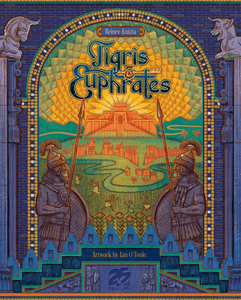
Build kingdoms in Mesopotamia by placing civilization tiles and leaders, contesting power and raising monuments. Your weakest of four scoring colors determines your result, making balance as important as growth.
Tigris & Euphrates supports 2–4 players; community best: 4 players; playing time: 60–120 minutes. A WANGO browser trial has not been confirmed.
Background & introduction
Tigris & Euphrates puts you in charge of a dynasty rather than a fixed territory. Every player has black, red, blue and green leaders and is identified by a dynastic symbol. Different players’ leaders can coexist peacefully in one kingdom when their colors differ; tiles do not belong to individual players.
A new civilization tile usually scores for the matching leader in its kingdom, so expansion can help someone else. Introducing a competing leader causes an internal revolt, while joining kingdoms can cause external wars. Those conflicts use different sources of strength and have very different consequences.
Your four scores remain behind a screen until the end, when the lowest color matters first. Monuments provide recurring points and a trader can collect treasures that become wild points. A dramatic military success may still leave your civilization’s weakest sphere behind.
Core rules & scoring
Standard setup and turns: use the gold-bordered board with ten temple-and-treasure spaces. Each player has six hand tiles and two catastrophes. Take up to two actions per turn, repeating if desired: position or withdraw a leader, place a civilization tile, play a catastrophe, or replace up to six hand tiles. At turn end affected players refill to six. Connections use shared edges, not diagonals.
Placement: leaders require an empty non-river space adjacent to a temple and cannot unite kingdoms. A leader losing its last adjacent temple is withdrawn. Blue farms go only on rivers; the other colors go only on land. One tile cannot unite more than two kingdoms.
Ordinary scoring: a placed tile gives one point of its color to the owner of the matching leader in its kingdom. If that leader is absent, the black king may collect it instead. No placement point is awarded without an eligible leader, outside a kingdom, or for the tile joining two kingdoms.
Internal revolt: placing a leader into a kingdom containing another of the same color starts a revolt. Count only red temples adjacent to each competing leader. The attacker, then defender, may each commit red hand tiles once. Higher strength wins; ties favor the defender. Withdraw the losing leader, award the winner exactly one red point, and remove committed hand tiles from the game.
External war: joining kingdoms containing matching leaders creates wars in those colors. Count connected matching tiles on each leader’s original side, then let attacker and defender each commit matching hand tiles once, in that order; ties favor the defender. Remove the losing leader and that side’s matching supporters, awarding one matching point per leader or tile actually removed, never for committed hand tiles. In red wars protect temples holding treasure or adjacent to other-colored leaders. The active player chooses conflict order; a split kingdom can cancel later wars.
Monuments: when your tile completes a same-color 2×2 square, you may immediately flip the four tiles and build an available monument containing that color, after resolving any war. Facedown tiles still connect the kingdom but no longer support conflicts or count as temples. At your turn end each of your matching leaders scores one point per matching monument in its kingdom. A king cannot substitute for other colors here.
Treasure and catastrophe: if a kingdom has multiple treasures at action end, its green trader takes all but one, prioritizing special-border spaces. Without a trader they stay. Each treasure becomes one point of any chosen color at game end. Catastrophes permanently block connections and may cover ordinary tiles or empty spaces, but never leaders, treasures or monuments.
Ending and victory: end when only one or two treasures remain at turn end, or when a required tile draw cannot be fulfilled because the bag is empty. Allocate treasures, then compare each player’s four color totals from lowest upward. Highest lowest total wins; ties compare the next-lowest totals in turn. Identical totals in all four colors share victory.
Rules & gameplay questions
Does each dynasty score only one color?
No. Dynasties are identified by symbols; everyone needs all four colors. Different players can control different-colored leaders in the same kingdom, so your tile placement can score points for a rival.
Can my king replace any missing leader for every reward?
No. A king substitutes only for ordinary tile-placement scoring when the matching leader is absent. It cannot collect treasures instead of a trader or score another color’s monument.
Does an internal revolt against a blue leader use blue tiles?
No. Every internal revolt uses adjacent red temples and red hand tiles, regardless of leader color. External wars use the competing leaders’ color and connected matching supporters on their original sides. Both favor the defender on a tie.
Do hand tiles committed in a war score points for the winner?
No. Only the losing leader and matching supporters actually removed from the board produce war points. Committed hand tiles are removed from the game without scoring. Protected red temples left on the board do not score removal points.
Do I win by adding all four color scores together?
No. First assign each treasure to a color, then compare your lowest total with everyone else’s lowest total. If tied, compare the next-lowest color, and so on. A large surplus in one color cannot directly replace a shortfall in another.
Rules & introduction sources
- Edition
- Tigris & Euphrates, Fantasy Flight Games ©2014 English rules, 2–4 players on the standard gold-bordered board. Revolts and wars correspond to internal and external conflicts. Excludes civilization buildings, advanced blue-bordered board, Wonder and English variants, and later-edition variants.
- Introduction source
- BoardGameGeek
WANGO editorial
| Parameter | Recorded value |
|---|---|
| BGG overall rank (snapshot) | #133 |
| Complexity Weight | 3.47 / 5 |
| Best player count (community) | 4 |
| Player range | 2–4 |
| Playing time (minutes) | 60–120 |
| Core mechanisms | Area Majority / Influence · Chaining · Connections · Force Commitment · Hand Management · Hidden Victory Points · Highest-Lowest Scoring · Income · Set Collection · Square Grid · Take That · Tile Placement |
| Chinese publication | Unconfirmed |
| WANGO browser play | No confirmed WANGO trial |
| Year published | 1997 |
| Suggested age | 14+ |
BGG statistics are stored snapshots, not live rankings. Source checked:2026-09-27
Player questions
What is the best player count for Tigris & Euphrates, and can I play online?
Tigris & Euphrates supports 2–4 players; community best: 4 players; playing time: 60–120 minutes. A WANGO browser trial has not been confirmed.
How complex is Tigris & Euphrates, and which mechanisms does it use?
Weight: 3.47 / 5. Mechanisms: Area Majority / Influence · Chaining · Connections · Force Commitment · Hand Management · Hidden Victory Points · Highest-Lowest Scoring · Income · Set Collection · Square Grid · Take That · Tile Placement. Chinese publication: Unconfirmed.
Where can I learn Tigris & Euphrates?
No rule guide, strategy article or WANGO trial has been confirmed for this record.