Harmonies
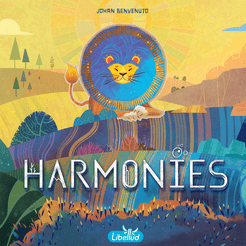
Harmonies asks players to build trees, mountains and buildings from colored tokens, then settle animals by matching their habitat patterns, earning points for both landscapes and animals.
Harmonies supports 1–4 players; community best: 2–3 players; playing time: 30–45 minutes. A WANGO browser trial has not been confirmed.
Background & introduction
Each player creates a landscape on a personal board. Green canopies and brown trunks form trees of different heights, gray tokens form mountains, and blue tokens form a river or separate islands. A space can contribute both to landscape scoring and to an animal habitat.
On each turn, take one complete group of three tokens from the central board and place them individually. Taking an Animal card is optional; its pattern determines where animals can settle. Taking a card and placing animal cubes can be interspersed with token placement.
Placed animals stay where they are and prevent further stacking on their spaces. A token can contribute to several habitat patterns, so sharing landscape features and completing cards to free capacity matter alongside building the landscape itself.
Core rules & scoring
Take and place: Once per turn, take all three tokens from one central-board space and place them on your board. Use empty spaces or the permitted tree, building and mountain stacks; never insert tokens underneath existing tokens or cover an animal.
Stacking combinations: A tree is a green token over zero, one or two brown tokens; a mountain is one to three gray tokens; a building is a red token over one red, brown or gray token. Blue water and yellow fields cannot be stacked.
Animal cards: Take at most one faceup Animal card per turn, with at most four unfinished cards at a time. Fill its spaces with cubes when taking it. Match the habitat and exact heights, then move the lowest cube onto its indicated unoccupied token; this optional action can be repeated during your turn.
Landscape scoring: Trees and mountains score by height, but isolated mountains score nothing. Each connected field of at least two yellow tokens scores five points. A building scores five only with at least three different top-token colors around it. Side A scores only the best river; side B scores five per island.
Rivers and islands: On side A, count the shortest path between the river’s ends and score only your best river; each token beyond six adds four points. Do not add every branch. On side B, each island separated by blue tokens scores five; there is always at least one island even without blue separation.
Animal scoring: Each card scores its highest uncovered value, even if unfinished. A card with all cubes still on it scores zero. A completed card moves beside your board and no longer counts toward the four-card limit.
Ending: An empty pouch when refilling the central board, or a player ending a turn with at most two empty personal-board spaces, triggers the end. Finish the round for equal turns. Add landscape and animal points; ties favor more placed Animal cubes, then share victory.
Solo: Use three token spaces and three faceup Animal cards. After each turn, remove the six unchosen tokens from the game and refill all three groups. If you took no Animal card that turn, you may replace one faceup card. Challenge your sun rating for the score and board configuration used.
Rules & gameplay questions
Must an animal leave if its habitat changes later?
No. Once legally placed, an animal stays even if other parts of its original habitat change. Its own space cannot receive further tokens.
Can the same tokens support different animals?
Yes. A token can belong to several identical or different habitats, but each destination space must be unoccupied and can hold only one Animal cube.
Does an unfinished Animal card lose points or score zero?
There is no extra penalty. Score its highest uncovered value; only a card whose cubes are all still on it scores zero.
Are Nature’s Spirits compulsory in the base game?
No. They are an optional advanced module included in the box and are not active in this base-game procedure. If used, choose one of two dealt Spirits; it occupies a card slot until completed. Place its cube by matching its pattern before earning its additional landscape-based endgame points.
Rules & introduction sources
- Edition
- Current Libellud English base rules (official file path July 2026, 2024 credits) and current official FAQ; 1–4 players. Covers board sides A/B and solo. Nature’s Spirits are explained only as an optional module, outside the base procedure. Excludes Pulse, Crescendo and other expansions.
- Introduction source
- BoardGameGeek
WANGO editorial
| Parameter | Recorded value |
|---|---|
| BGG overall rank (snapshot) | #52 |
| Complexity Weight | 2.01 / 5 |
| Best player count (community) | 2–3 |
| Player range | 1–4 |
| Playing time (minutes) | 30–45 |
| Core mechanisms | Chaining · Hexagon Grid · Open Drafting · Pattern Building · Set Collection · Solo / Solitaire Game · Tile Placement · Variable Player Powers |
| Chinese publication | Unconfirmed |
| WANGO browser play | No confirmed WANGO trial |
| Year published | 2024 |
| Suggested age | 10+ |
BGG statistics are stored snapshots, not live rankings. Source checked:2026-09-27
Player questions
What is the best player count for Harmonies, and can I play online?
Harmonies supports 1–4 players; community best: 2–3 players; playing time: 30–45 minutes. A WANGO browser trial has not been confirmed. Recorded mechanism tags: Solo / Solitaire Game.
How complex is Harmonies, and which mechanisms does it use?
Weight: 2.01 / 5. Mechanisms: Chaining · Hexagon Grid · Open Drafting · Pattern Building · Set Collection · Solo / Solitaire Game · Tile Placement · Variable Player Powers. Chinese publication: Unconfirmed.
Where can I learn Harmonies?
No rule guide, strategy article or WANGO trial has been confirmed for this record.