Civolution
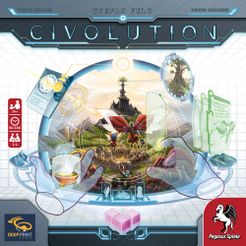
A heavy civilization game powered by dice combinations: expand tribes, pursue inventions and biological mutations, and shape an engine around changing priorities across four eras.
Civolution supports 1–4 players; community best: 2–3 players; playing time: 90–180 minutes. A WANGO browser trial has not been confirmed.
Background & introduction
In Civolution, players act as local deities taking a civilization-design examination on a shared continent. Buildings and inventions sit alongside biological adaptations, with a personal console connecting those paths into an evolving action system.
Activating a module requires matching dice values, so the dice determine both available fuel and practical options. A Reset retrieves spent dice but advances the shared era clock, making the timing of expansion and research part of the challenge.
Era scoring, nine final categories and installed console components all contribute to success. Reading the priorities of the current game matters more than following a fixed technology order. This entry covers the base game with the 2025 official errata.
Core rules & scoring
Setup: prepare the continent and public boards for the player count and randomize the scoring categories and their values. Each civilization sets up its console, tribes, dice and starting resources. The rulebook provides introductory starting configurations.
Structure: play four eras, each with eight phases: New cards, New goals, Extra find, Action, Site, Feeding, Event and Income. Final scoring follows the fourth era's income.
Actions: starting with the starting civilization, take clockwise turns choosing either to activate one module or, when eligible, do a Reset. A normal module requires exactly two activation dice matching its values; planning or focus markers can replace dice as specified.
Dice and upgrades: each idea marker changes one die by one step, with 1 and 6 adjacent. The console has 15 main modules with three levels, six feature modules and a Sleep module. Sleep accepts any two dice to gain ideas or focus.
Develop the continent: migration and procreation shape tribe distribution, production and transport turn raw materials into stored materials, exploration reveals sites, and building offers farms, boats, settlements and statues. Follow each module's terrain and action requirements.
Install components: research cards and goal, income and attribute chips occupy the console. A type and its first column become associated, while income chips can appear in different columns. Research cards use the lowest free stage in their column, require its costs and provide instant bonuses and continuing abilities.
Reset: this is allowed only with three or fewer activation dice remaining on the dice spaces; planning markers do not count. Retrieve spent dice, optionally include unused dice, and roll them again; advance the shared reset indicator. Reaching the player-count end space finishes the current action round and then allows one complete final round.
Era upkeep: resolve revealed sites, feed tribes and score strong tribes, resolve weather, events and the era category, then gain income and score statues. An unfed strong tribe becomes weak; an unfed weak tribe dies. Farms and abilities can reduce feeding costs.
Final scoring: after fourth-era income and statues, score all nine categories: five progress tracks, Evolution, Prosperity, Population and Expansion. Then score console stages and card bonuses. Stages four and five require activation for stage points; column bonuses are resolved separately. Most success points wins, with ties broken by module upgrades and then seating order.
Solo: use the V.I.C.I. rival and its dedicated deck with the public setup for two players. Its cards govern actions and Resets, and the rules provide difficulty adjustments. It does not operate a normal player console.
Rules & gameplay questions
Must I Reset immediately when the dice do not match?
You can spend ideas to adjust values or replace required dice with matching planning markers or flexible focus markers. Reset itself is available only when at most three activation dice remain on your dice spaces, so it is not an unrestricted refresh.
Does everyone stop immediately when the Action phase end is triggered?
No. Finish the current action round, then play a complete final action round giving each civilization one last turn. The Site phase follows afterwards.
Can I split one research-card type between several columns?
No. A type and its first column become associated. Income chips are the exception and can appear in different columns. Research cards normally occupy the lowest free stage of their column, while activation of stages four and five affects their final stage points rather than the placement order.
Can B20 Hooves interact with territories it skips?
Under the 7 July 2025 US/EU errata, Hooves can skip Grassland and Hill territories, including a chain of those types. It cannot return to the territory just left, and skipped territories cause no interaction. This wording replaces the older crossing explanation.
Which other base-game corrections are easy to miss?
With B25 Pouch, A9 Black powder and C3 Navigation apply only to the first tribe, not its follower. B21 Magnetoreception requires a free encampment in a foreign land territory containing another civilization's tribe and none of yours. D13 Mill strengthens all civilizations' weak tribes in the chosen territory, scoring one point each; goals 35–39 require at least space 3 on the matching progress track.
Rules & introduction sources
- Edition
- US/EU base-game rulebook v1.0 and glossary v1.1, applying the official US/EU errata dated 7 July 2025. Covers multiplayer flow and an overview of V.I.C.I. solo play; excludes the Acceptance Letter expansion's level-four modules, starting attributes and creatures.
- Rule references
- Introduction source
- BoardGameGeek
WANGO editorial
| Parameter | Recorded value |
|---|---|
| BGG overall rank (snapshot) | #160 |
| Complexity Weight | 4.26 / 5 |
| Best player count (community) | 2–3 |
| Player range | 1–4 |
| Playing time (minutes) | 90–180 |
| Core mechanisms | Area Movement · Dice Rolling · Events · Income · Modular Board · Open Drafting · Pattern Building · Solo / Solitaire Game · Tech Trees / Tech Tracks · Track Movement · Variable Set-up |
| Chinese publication | Unconfirmed |
| WANGO browser play | No confirmed WANGO trial |
| Year published | 2024 |
| Suggested age | 14+ |
BGG statistics are stored snapshots, not live rankings. Source checked:2026-09-27
Player questions
What is the best player count for Civolution, and can I play online?
Civolution supports 1–4 players; community best: 2–3 players; playing time: 90–180 minutes. A WANGO browser trial has not been confirmed. Recorded mechanism tags: Solo / Solitaire Game.
How complex is Civolution, and which mechanisms does it use?
Weight: 4.26 / 5. Mechanisms: Area Movement · Dice Rolling · Events · Income · Modular Board · Open Drafting · Pattern Building · Solo / Solitaire Game · Tech Trees / Tech Tracks · Track Movement · Variable Set-up. Chinese publication: Unconfirmed.
Where can I learn Civolution?
No rule guide, strategy article or WANGO trial has been confirmed for this record.