Cosmic Encounter
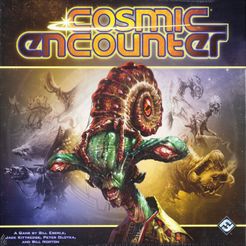
Cosmic Encounter turns the race for foreign colonies into shifting alliances, negotiation, and bluffing: combat totals are only a starting point, alien powers rewrite rules, and an ally can share your victory.
Cosmic Encounter supports 3–5 players; community best: 5 players; playing time: 60–120 minutes. A WANGO browser trial has not been confirmed.
Background & introduction
Each player enters with an alien species and a home system, seeking five colonies in other players' systems. Destiny cards determine the main opponent, after which players choose ships and invite help. Because opponents are not always freely chosen, diplomacy revolves around the current situation: who needs a foothold, who wants resources for military support, and who is close to finishing.
Attack and negotiate cards are chosen facedown and revealed together, leaving room between promises and actual cards. An attack can secure a colony; negotiating against an attack loses but earns compensation; two negotiates open a timed deal. Offensive allies can land after a win, while defensive allies earn cards or recover ships, changing the incentives attached to each side.
Alien powers make each session different by changing normal procedures in specified roles and phases. Explaining those powers lets the table reason about the exceptions. Alliances or deals can give several players their fifth colony together, making the final move a question of how victory is distributed as well as tactics. This guide uses the FFG base edition and does not treat other historical editions, Duel, or expansion exceptions as ordinary base rules.
Core rules & scoring
The FFG base game supports three to five players. Each starts with five home planets and twenty ships, four per planet, and zero foreign colonies. Choose one of the two aliens indicated by the two flares dealt to you. In normal play, shuffle those flares and enough random additional flares to total ten into the cosmic deck; deal eight cards to each player.
Players take turns as offense. An encounter has seven phases: Regroup, Destiny, Launch, Alliance, Planning, Reveal, and Resolution. At turn start, an offense with no encounter cards reveals and discards remaining cards and draws eight. Only winning the first attack or making a successful deal while retaining at least one encounter card permits an optional second encounter; two is the maximum.
Regroup retrieves one of your ships from the warp to a colony. Destiny identifies the system and defense. Drawing your own color allows a redraw or an attempt to drive out one foreign colony in your system. A completely empty home planet may instead be recolonized with up to four ships, counting as a successful encounter.
The offense aims the hyperspace gate at a planet in the specified system and commits one to four ships from any of their colonies. The defense uses their ships already there and cannot freely add or remove them, even defending with zero ships. Other uninvolved colors on the planet are bystanders and do not automatically participate.
The offense invites allies first, then the defense. Beginning to the offense's left and proceeding clockwise, invited players accept or decline, supporting only one side or neither. Each ally commits one to four ships: offensive allies put ships on the gate, while defensive allies put them beside the target planet.
In Planning, each main player secretly selects an encounter card: attack, negotiate, or morph. A defense with no encounter cards reveals and discards remaining cards and draws eight, repeating if necessary. An offense needing an encounter card without having one during the turn ends that turn; offensive and allied ships return to their colonies.
With two attacks, compare each attack value plus that side's participating ships, including allies; ties favor defense. Applicable powers and cards can change the calculation. Morph copies the opposing encounter card when revealed. An offensive win lands all offensive and offensive allied ships, sends participating defenders to the warp, and leaves bystander colonies intact.
A defensive win sends offensive and offensive allied ships to the warp; defensive allied ships return to their colonies. For each ship committed to the successful defense, each defensive ally gains one reward: draw one cosmic card or retrieve one of their ships from the warp, mixing choices if desired. The main defense receives no such reward.
A negotiate normally loses against an attack, but its player takes random compensation cards from the opponent equal to their own ships actually lost to the warp, excluding allied losses. Two negotiates return allies without rewards and give the main players one minute to trade hand cards and/or grant each other one colony on a planet they already occupy. At least one card or colony must change hands; failure costs each main player three ships.
Normally, having ships on five different planets in other players' home systems reaches five foreign colonies; multiple ships on one planet still count once. The 2018 FAQ checks ordinary victory at the end of Resolution, allowing shared wins. Alien powers override general rules while observing their stated role and timing. Fewer than three home colonies immediately disables your power; recovering at least three restores it.
Rules & gameplay questions
Can helping an attack give someone else the game?
Yes. Successful offensive allies also establish or reinforce colonies on the target planet. Several players reaching five foreign colonies together can share victory at the end of Resolution; reinforcing an existing colony adds no extra colony count.
Does making a deal count as winning an attack?
No. The 2018 FAQ distinguishes successful encounters from encounter wins. A successful deal can qualify the offense for a second encounter, but does not automatically trigger powers that mention winning without including deals.
Can I start a second encounter without an encounter card and obtain one later?
No. The 2018 FAQ requires at least one encounter card in hand after the successful first encounter before choosing a second. Finishing an encounter does not automatically draw a replacement card.
Can a deal consist only of promises or an agreement to exchange nothing?
No. At least one hand card or permitted colony must actually change hands, though the exchange may be one-sided. Promises about future actions are unenforceable. Explicit commitments about cards being delivered cannot be false and must be honored. Allies are outside the deal.
After removing the last ship, can returning ships go back to that planet?
Normally no. Removing the last ship loses that colony immediately. Ships returning from an encounter or the warp must use colonies that still exist; recovering an empty home planet requires an allowed mechanism. Losing enough home colonies also disables your alien power.
Rules & introduction sources
- Edition
- Scope: Cosmic Encounter, FFG 2008 base edition. Read the original 16-page English rulebook pp.2-13 and p.16 credits for base procedures and the 2018 FAQ pp.3-6 for relevant general, deal, flare, and timing answers. Normal play includes base flares, but individual cards are not catalogued here. Excludes optional variants such as Tech, expansions, added 42nd Anniversary content, and Duel. Rulebook and FAQ bytes were retrieved from the listed FFG file URLs; edition identity comes from PDF contents and the FAQ's stated 2018 coverage, not product-page upload dates.
- Introduction source
- BoardGameGeek
WANGO editorial
| Parameter | Recorded value |
|---|---|
| BGG overall rank (snapshot) | #234 |
| Complexity Weight | 2.58 / 5 |
| Best player count (community) | 5 |
| Player range | 3–5 |
| Playing time (minutes) | 60–120 |
| Core mechanisms | Alliances · Card Play Conflict Resolution · Hand Management · Interrupts · Negotiation · Prisoner's Dilemma · Race · Simultaneous Action Selection · Take That · Trading · Variable Player Powers |
| Chinese publication | Unconfirmed |
| WANGO browser play | No confirmed WANGO trial |
| Year published | 2008 |
| Suggested age | 12+ |
BGG statistics are stored snapshots, not live rankings. Source checked:2026-09-27
Player questions
What is the best player count for Cosmic Encounter, and can I play online?
Cosmic Encounter supports 3–5 players; community best: 5 players; playing time: 60–120 minutes. A WANGO browser trial has not been confirmed.
How complex is Cosmic Encounter, and which mechanisms does it use?
Weight: 2.58 / 5. Mechanisms: Alliances · Card Play Conflict Resolution · Hand Management · Interrupts · Negotiation · Prisoner's Dilemma · Race · Simultaneous Action Selection · Take That · Trading · Variable Player Powers. Chinese publication: Unconfirmed.
Where can I learn Cosmic Encounter?
No rule guide, strategy article or WANGO trial has been confirmed for this record.