The Vale of Eternity
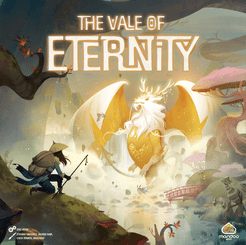
The Vale of Eternity is a fantasy creature tableau-building game. Draft and summon creatures, manage magic stones and tableau space, and combine instant, ongoing, and active effects to score the most points.
The Vale of Eternity supports 2–4 players; community best: 3 players; playing time: 30–45 minutes. A WANGO browser trial has not been confirmed.
Background & introduction
The Vale of Eternity combines tableau building and resource management in a fantasy creature setting. Each player drafts creatures from a shared market and tries to summon them into a personal tableau. Cards have a family, a cost, and a distinct ability: some resolve immediately when summoned, some remain in effect, and others can be activated during each round’s Resolution phase. Players plan around limited tableau space and magic stones while assembling a set of creatures that supports their scoring strategy.
Each round reveals a market of creature cards sized according to the number of players, and two personal markers let each player reserve choices from that market. Players can then sell a selected card for a family-linked magic stone, tame a card into hand, pay to summon a creature, or remove a creature already in their tableau to make room. These choices interact: a card may be a future engine piece, a source of a needed resource, or a contested market option that an opponent may claim.
The game lasts at most ten rounds and can end earlier when a player reaches 60 points at the end of a round. Scores come from summoned creatures and the effects they create, so players must also watch the growing tableau limit, the cap on stored stones, and the timing of each ability. The highest score wins; a tie is broken by the number of summoned cards, with a further tie shared. The base rules do not include solo or cooperative play, and separately sold expansions are outside this entry.
Core rules & scoring
Objective and victory: Summon creatures, combine their abilities, and score more points than the other players. At the end of a round, the game ends if anyone has reached at least 60 points. If nobody has, the game ends after round 10. The player with the most points wins; a tie goes to the player with more summoned cards, and a remaining tie is shared.
Setup: Place the board and round marker, shuffle the 70 creature cards, and prepare the magic stones. Reveal a market according to the number of players, then give each player a personal board and two markers. Starting points depend on turn order: the first player starts with 1, the second with 2, the third with 3, and the fourth with 4. Each player develops a personal tableau; the base rules do not specify a hand limit.
Families and effects: Base cards belong to five families: Fire, Water, Earth, Wind, and Dragon. Each card shows a cost, family, and ability. Instant effects resolve when the card is summoned; Permanent effects remain active while the card is in the tableau; Active effects may be used during Resolution. Check timing, target, and any stated conditions before using an ability; an Instant effect is not a recurring effect.
Hunting each round: Reveal a number of creature cards equal to twice the player count. In clockwise order, each player places one marker on a market card. Then, starting with the last player and moving counterclockwise, each player places their second marker. This gives every player two marked choices, with the last player choosing second first. The markers identify options for the Action phase; a card does not move to a hand or tableau until an action resolves.
Action phase and markers: Players take turns performing the four action types—Sell, Tame, Summon, and Remove—in any legal order, and may repeat actions when allowed. Sell or Tame retrieves a marker from the selected market card. By the end of the Action phase, each player must take back their remaining markers. Marking a card in Hunting reserves a choice but does not itself sell, tame, or summon it.
Sell and Tame: To Sell, retrieve one marker from a market card, discard that card, and gain the magic stone associated with its family; the card’s printed summoning cost is not paid first. To Tame, retrieve a marker and take the selected card into hand for a later summon. Selling provides a resource now, while Taming preserves the creature and its ability as an option. Choose according to current costs, stones, plans, and the cards opponents could take.
Summoning and stones: To Summon, choose a creature from hand, pay its cost, place it in your tableau, and resolve its Instant effect. Magic stones have values of 1, 3, or 6 according to color, and a player may store at most four stones. Cost-reduction effects can stack, but the minimum cost is zero; excess payment is not returned. The number of cards in a player’s tableau may not exceed the current round number, so the limit grows as the game progresses.
Removing cards and tableau space: To Remove, discard one creature from your own tableau and pay a removal cost equal to the current round number. Removal frees a tableau space but also ends any Permanent effect from that card. The tableau limit equals the round number, rising by one each round. If a card ability changes a cost or restriction, apply its text when resolving the action.
Resolution: Beginning with the first player, each player must use every available Active effect in their area once, in an order of their choice. Do not voluntarily skip an effect that can be performed. Instant effects resolve on summoning and Permanent effects remain active. A card cannot be summoned if any part of its Instant effect cannot be resolved.
Round flow and expansions: A round consists of Hunting, Action, and Resolution, after which the round marker advances and the market is refreshed. Keep base-game cards and rules separate from expansion content. Renegade lists Artifacts and Curse as expansions to the base game; this entry follows the 2024 English base rulebook and does not treat expansion cards or mechanisms as part of the original base set. The first-player marker passes left each round. If you exceed four magic stones, immediately keep four and discard the rest before another action; do not exchange stones with the supply unless a card allows it.
Rules & gameplay questions
What is the goal of The Vale of Eternity, and how do you win?
Summon creatures, use their abilities to build a scoring tableau, and finish with more points than the other players. The game ends at the end of a round when anyone has reached at least 60 points, or after round 10 if no one has done so. The highest score wins. If players tie, compare the number of cards they summoned; if that is still tied, the rules allow a shared victory.
How does the market draft work, and what do the two markers do?
Each round reveals twice as many creature cards as there are players. In clockwise order, everyone places one marker on a market card. Then the second marker is placed in reverse turn order, starting with the last player. Each player therefore marks two choices. A marker does not automatically move a card into hand or tableau; a player must use an Action-phase action to Tame, Sell, or otherwise handle it.
What actions can I take during the Action phase?
There are four action types. Sell discards a marked market card and gives you the magic stone associated with its family. Tame takes a marked market card into your hand. Summon pays a card’s cost and places a creature from your hand in your tableau. Remove pays the current round number to discard one of your summoned cards. Actions can be planned in different orders, subject to each action’s marker, cost, and tableau limits.
What are the magic stones worth, and how many can I keep?
Magic stones pay the costs of summoned creatures. Their colors represent values of 1, 3, or 6, and a player may store no more than four stones. Selling a market card grants the stone associated with that card’s family. Summoning then spends stones according to the card cost. Cost reductions may stack down to zero, but costs cannot become negative, and extra payment is not refunded. If you exceed four stones, keep four and immediately discard the rest before taking another action; you cannot freely exchange stones or take change.
How do Instant, Permanent, and Active effects differ?
An Instant effect resolves immediately when its creature is summoned. A Permanent effect remains in force for as long as that card stays in your tableau. An Active effect is used by choice during the Resolution phase, once per card each round. Check the printed timing and conditions before using it. Do not repeat an Instant effect every round or use an Active effect outside its stated phase.
How many creatures can I keep in my tableau, and can I remove one?
The tableau limit equals the current round number, so it starts at one card in round 1 and increases as the game advances. You may use Remove to discard one of your summoned cards and pay a cost equal to the current round number. This opens a space, but the removed card and its ongoing Permanent effect leave play, so weigh the new space against the lost ability and payment.
Does the game always last ten rounds? How are ties resolved?
No. Check scores after each round’s Resolution phase. If any player has 60 or more points, the game ends then; if nobody reaches that threshold, play ends after round 10. The highest score wins. A tied score is broken by comparing the number of cards each tied player summoned. If that count is also equal, the players share the win rather than continuing to another tiebreak.
What is the difference between Sell and Tame?
Sell gives an immediate resource: discard a marked market card and gain the magic stone associated with its family. Tame keeps the card available for your own future tableau by taking it into hand. A creature with strong synergy may be worth keeping even if its cost is high, while selling can be better when you need stones to summon another card. Your choice depends on your current engine, costs, and market alternatives.
Can I play solo, and are Artifacts or Curse part of the base game?
The Renegade base product page and rulebook list 2–4 players and provide no official solo or cooperative mode. Artifacts and Curse are listed separately by the publisher as expansions to the base game, so their cards and rules should not be assumed to belong to BGG 385529’s base set. If you use an expansion, follow its own setup and combination rules in addition to the base rules.
Rules & introduction sources
- Edition
- This entry covers the English base game The Vale of Eternity listed as BGG 385529, following Renegade Games Studios / Mandoo Games official base rules. The publisher lists 2–4 players, about 40 minutes, and ages 14+; BGG lists 30–45 minutes, so the time estimates differ. The base game is competitive, with no official solo or cooperative mode found in its rules or product page. Artifacts and Curse are separately listed expansions and are excluded from the base-game rules here.
- Rule references
- Introduction source
- BoardGameGeek
WANGO editorial
| Parameter | Recorded value |
|---|---|
| BGG overall rank (snapshot) | #344 |
| Complexity Weight | 2.14 / 5 |
| Best player count (community) | 3 |
| Player range | 2–4 |
| Playing time (minutes) | 30–45 |
| Core mechanisms | Hand Management · Multi-Use Cards · Open Drafting · Race · Set Collection · Tags · Turn Order: Progressive |
| Chinese publication | Unconfirmed |
| WANGO browser play | No confirmed WANGO trial |
| Year published | 2023 |
| Suggested age | 14+ |
BGG statistics are stored snapshots, not live rankings. Source checked:2026-09-27
Player questions
What is the best player count for The Vale of Eternity, and can I play online?
The Vale of Eternity supports 2–4 players; community best: 3 players; playing time: 30–45 minutes. A WANGO browser trial has not been confirmed.
How complex is The Vale of Eternity, and which mechanisms does it use?
Weight: 2.14 / 5. Mechanisms: Hand Management · Multi-Use Cards · Open Drafting · Race · Set Collection · Tags · Turn Order: Progressive. Chinese publication: Unconfirmed.
Where can I learn The Vale of Eternity?
No rule guide, strategy article or WANGO trial has been confirmed for this record.