Fromage
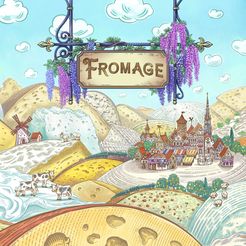
Fromage is a simultaneous worker-placement game. Players assign workers in the creamery quadrant facing them to make cheeses, gather resources, and fill orders. The circular board rotates each round, bringing a new work area into view while aging cheeses and returning previously placed workers over time.
Fromage supports 1–4 players; community best: 4 players; playing time: 30–45 minutes. A WANGO browser trial has not been confirmed.
Background & introduction
Fromage invites players to run a small creamery in the French countryside. Each player assigns workers to make Soft, Hard, or Bleu cheeses while gathering Structures, Livestock, Fruit, and Orders. Cheese spaces specify both a type and an age: Bronze, Silver, or Gold. A placement can therefore tie up a worker for several turns while preparing a more valuable product. Players balance long-term aging with the need to keep their creamery productive in the present.
The central circular board is divided into four quadrants, each facing a player. Everyone places workers simultaneously in the quadrant currently in front of them, choosing to make cheese or gather resources. After the actions are complete, the board rotates ninety degrees clockwise. Players face a new part of the creamery, and the board's movement advances the workers they previously sent out until those workers become available again. Planning when each worker returns matters as much as choosing where to place it.
Making cheese requires a token on an empty cheese space and a matching worker. More valuable spaces ask players to wait longer before the worker returns. Resource actions provide Structures, Livestock, Fruit, or Orders, each enabling a different part of the engine: upgrade abilities, make bonus cheese, add fruit flavors, or fulfill customer requests. The four Venues—Villes, Festival, Fromagerie, and Bistro—reward different arrangements and combinations of cheese.
Players build a creamery engine through production timing and resource use. They must keep workers cycling back while creating cheeses that fit their scoring plans. One player may focus on a few Venues and age valuable cheeses; another may complete Orders, expand regional influence, or unlock Structures. The base game includes a solo Corporation challenge. In multiplayer games, players compete for Prestige across the Venues and other scoring sources until the end-game trigger is reached.
Core rules & scoring
Objective and setup: Players operate individual creameries, make and age cheese, gather resources, and earn Prestige at Villes, Festival, Fromagerie, and Bistro. Choose the quadrant inserts for the player count and assemble the central board; two-player games seat players opposite one another, while four-player games use a square arrangement. Each player takes cheese tokens, Workers, Worker Bases, and a random Player Board, then receives starting Resources as directed.
Turn structure and simultaneous play: At the start of a turn, each player retrieves any used Workers that are facing them. All players then act simultaneously in the quadrant currently facing them. Using available Workers, each player may perform one Gather Resources action and one Make Cheese action, in either order. After everyone finishes, rotate the Board ninety degrees clockwise. Workers move with it and return to a player's supply when they face that player again.
Make Cheese: Choose an empty Cheese space in the current quadrant, place one of your Cheese Tokens there, and put the matching Soft, Hard, or Bleu Worker on top. Each space specifies a Cheese Type and Age. Bronze cheese ages in one turn, Silver in two, and Gold in three. Board rotations advance the cheese's age; longer aging usually improves the scoring opportunity but keeps the Worker unavailable for longer. A player can take only one Make Cheese action per turn.
Gather Resources: Place an available Worker on an empty numbered space in the Resource quadrant and immediately take the indicated number and type of Resources from the tray. Structures, Livestock, Fruit, and Orders support different creamery abilities. Higher-value spaces provide more Resources but take longer before their Worker returns. The type of Worker does not matter for gathering, and Resources may be used on the same turn they are acquired. A player can Gather Resources only once per turn.
Fruit and Jam: Put Fruit Tokens in the basket on your Player Board. When making a cheese on a space marked Fruited Cheese or Jam, spend the required Fruit by moving it to the used area. At game end, score Fruit according to the number used for Fruited Cheese multiplied by the number used for Jam. Fruit also grants access to some Cheese spaces that would otherwise be blocked.
Livestock and bonus cheese: Store Livestock on the pasture shown on your Player Board. Move the required number of animals to a Milking Parlour to use its ability and immediately place that Parlour's Bonus Cheese without assigning a Worker. Each Milking Parlour can generally be used once. The Bonus Cheese still has to match an available space's Type, Age, and any Fruit requirement, and it can be placed in the same turn as the regular Make Cheese action.
Structures and Orders: Spend Structure Resources to unlock the Structure abilities on your Player Board. Once the required spaces are filled, move the Structure Tokens as instructed and use the unlocked ability or score its end-game bonus. Order cards show a Cheese Type and Age requirement. When you place a matching cheese, you may immediately complete one Order and score it. You do not have to complete an Order if another Cheese space better supports your Venue plan.
Scoring the Venues: Festival scores orthogonally adjacent groups of cheese; diagonal spaces do not count as adjacent. Fromagerie scores the shelves occupied and their Display Sign bonuses. Bistro scores cheese pairings placed on the same table according to the board's chart. Villes divides its map into six regions and rewards influence: Bronze affects one region, Silver two, and Gold three. Each Venue has its own scoring rubric, so resolve them separately at game end.
End game and winner: When any player places their final Cheese Token, they announce the end-game trigger. All players finish the current turn, then the game ends. Remove Workers from the Board, but count all Cheese Tokens whether or not they have fully aged. Score the Venues, Structures, Orders, Fruit, and Resources as directed; every two unused Resources are worth one Prestige Point. The most Prestige wins. Ties go to the player who made more cheese; if still tied, victory is shared.
Solo and advanced play: The rulebook includes a solo Corporation opponent with selectable difficulty levels. Follow the standard rules, then let the Corporation act first each turn by drawing an Order and placing one of its Cheese Tokens; it uses no Workers or starting Resources. The Corporation's last Cheese Token triggers the end game, when its track, customer tokens, and completed Orders determine its score. For experienced groups, an optional Structure Tile draft can replace the abilities printed on Player Boards.
Rules & gameplay questions
What kind of board game is Fromage?
Fromage is a simultaneous worker-placement game about running a cheese creamery. Players make cheeses of different Types and Ages, gather Resources, and complete Orders in the quadrant facing them. The circular Board rotates each round, changing the available work area and cycling previously placed Workers back toward their owners. The goal is to earn the most Prestige across four Venues.
How many people can play Fromage?
Asmodee Canada's product page lists Fromage for one to four players, ages fourteen and up, with a playing time of about thirty to forty-five minutes. The rulebook includes a solo Corporation mode. In multiplayer games, players sit by separate Board quadrants; two players sit opposite one another, and four players use a square arrangement around the circular Board.
What can I do on my turn?
At the start of a turn, retrieve any used Workers that are facing you. Then all players act simultaneously in the quadrant currently facing them. With available Workers, you may take one Gather Resources action and one Make Cheese action, in either order. Once everyone has acted, rotate the Board ninety degrees clockwise to begin the next turn.
How do I make and age cheese?
Place one of your Cheese Tokens on an empty Cheese space, then put a matching Soft, Hard, or Bleu Worker on top. The space indicates the cheese Type and Age. Bronze spaces age for one turn, Silver for two, and Gold for three. Longer-aged cheeses can offer more valuable scoring, but the Worker used to make one takes longer to return.
What is the difference between the three Worker types?
Soft, Hard, and Bleu Workers make the corresponding Cheese Types, as required by the Cheese spaces in the quadrant. Worker type does not matter when gathering Resources: any available Worker can be sent to an empty Resource space. Used Workers rotate with the Board and are retrieved when they face their player again.
How do I gather and use Resources?
Place a Worker on an empty numbered space in the current Resource quadrant and take the indicated Structures, Livestock, Fruit, or Orders from the tray. A higher-numbered space gives more Resources but keeps that Worker unavailable for longer. Resources improve creamery abilities, pay Fruit requirements, provide bonus cheese through Livestock, or let players produce cheeses that fulfill customer Orders.
Do the four Venues score in the same way?
No. Festival looks at groups of orthogonally adjacent cheeses; Fromagerie scores its occupied shelves and their bonuses; Bistro scores pairs of cheeses on the same table; and Villes awards customer markers for influence across map regions. Cheese Age changes some values or influence ranges. At game end, use the scoring rubric printed for each Venue rather than combining them into one shared formula.
When does Fromage end?
The end game is triggered when any player places their final Cheese Token. Everyone finishes the current turn, then players score their Venues, Structure abilities, completed Orders, Fruit, and unused Resources. Every two unused Resources score one Prestige Point. The player with the most Prestige wins; a tie is broken by who made more cheese, and a remaining tie is shared.
Can I play Fromage solo?
Yes. The rulebook includes a solo mode in which you compete against the Corporation. Use the Corporation Board and choose a difficulty level, then follow the standard rules with the solo exceptions. The Corporation does not use Workers or starting Resources; it draws an Order and places one of its Cheese Tokens each turn, and its score is calculated when its supply runs out.
Are Structure Tiles required?
No. The rulebook presents Structure Tiles as an advanced setup option. For a first game, players can use the Structure abilities already printed on their Player Boards. Experienced groups may instead draft Structure Tiles and place their chosen abilities over the printed ones. Agree on one setup before play so every player uses the same rules.
Rules & introduction sources
- Edition
- This entry covers R2i Games' Fromage base game and the solo Corporation mode included in its rulebook. Asmodee Canada lists 1–4 players, ages 14+, and 30–45 minutes. The rulebook also offers an optional advanced Structure Tile setup. Formaggio (BGG 430533) is a separate product and is not part of this entry.
- Rule references
- Introduction source
- BoardGameGeek
WANGO editorial
| Parameter | Recorded value |
|---|---|
| BGG overall rank (snapshot) | #370 |
| Complexity Weight | 2.37 / 5 |
| Best player count (community) | 4 |
| Player range | 1–4 |
| Playing time (minutes) | 30–45 |
| Core mechanisms | Area Majority / Influence · Bias · Chaining · Contracts · End Game Bonuses · Rondel · Simultaneous Action Selection · Worker Placement |
| Chinese publication | Unconfirmed |
| WANGO browser play | No confirmed WANGO trial |
| Year published | 2024 |
| Suggested age | 14+ |
BGG statistics are stored snapshots, not live rankings. Source checked:2026-09-27
Player questions
What is the best player count for Fromage, and can I play online?
Fromage supports 1–4 players; community best: 4 players; playing time: 30–45 minutes. A WANGO browser trial has not been confirmed.
How complex is Fromage, and which mechanisms does it use?
Weight: 2.37 / 5. Mechanisms: Area Majority / Influence · Bias · Chaining · Contracts · End Game Bonuses · Rondel · Simultaneous Action Selection · Worker Placement. Chinese publication: Unconfirmed.
Where can I learn Fromage?
No rule guide, strategy article or WANGO trial has been confirmed for this record.