Age of Innovation
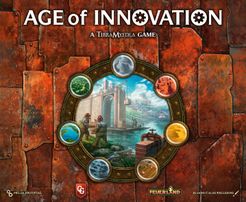
Terraform land, build cities and advance knowledge across six rounds, scoring through construction, innovations and science. Factions, native terrains and Palace abilities form different combinations.
Age of Innovation supports 1–5 players; community best: 4 players; playing time: 40–200 minutes. A WANGO browser trial has not been confirmed.
Background & introduction
Each faction builds only on its native terrain, so expansion often requires paying Spades to terraform. Sailing and bridges determine reach; proximity to another faction reduces the coin cost of upgrading Workshops into Guilds while giving neighbors opportunities to gain power.
Upgrading buildings changes income and abilities: Schools and the University grant Competencies and associated knowledge, while the Palace unlocks its selected ability. Innovations can grant special actions, immediate points or additional buildings. Books pay for public actions as well as innovations; Books, Scholars and science Levels are distinct resources.
Visible round objectives and Science Bonuses help players time their construction. Passing ends participation in the current round, rather than ending the game. Final scoring rewards the largest connected building group and rankings in four Disciplines, so city count alone does not determine the winner.
Core rules & scoring
Play six rounds with Income, Actions, and Science Bonuses and preparation. In turn order, perform one action at a time until everyone passes. The first round also grants income; after everyone passes in round six, proceed directly to final scoring without Science Bonuses.
Terraform an undeveloped hex within reach along the shortest route toward your native terrain. A new Workshop must occupy native terrain and normally costs an additional one Tool and two Coins. Spades must be used immediately and cannot be saved.
Upgrade one step at a time. A Workshop-to-Guild upgrade normally costs two Tools and six Coins, reduced to three Coins beside another faction’s building. Schools and the University grant Competencies, with no duplicates allowed. Under standard setup, choose an available Palace ability when you build the Palace.
Develop an Innovation by paying at least five Books as specified by its column, plus any extra Books required by your second or third personal Innovation space. Without a built Palace, also pay five Coins. Each player may develop at most three Innovations.
Power cycles I→II→III: move tokens from I to II while any remain in I, then from II to III. Spend only from III, returning spent tokens to I. Advancing a Discipline from Level 7 to 8 requires a City Key assigned to that Discipline; Level 9 grants extra income, and only one player can reach Level 12 in each Discipline.
A standard City requires at least four adjacent buildings not already in a City, with total Power value at least seven. A University reduces the count to three and a Monument to two, while the Power requirement remains. Founding immediately grants a City tile, its rewards and a Key.
Final scoring awards 18/12/6 points for the largest connected building groups and 8/4/2 in each Discipline; Level 0 earns no science ranking points. Ties pool the occupied places and divide points, rounded down. Convert remaining resources into Coins using the conversion rules, then score one point per five Coins. A final tie shares victory.
Rules & gameplay questions
Can I resume taking actions after passing?
No. Resolve your Pass bonuses and take a different Round Bonus tile. Passing order sets next round’s turn order. In round six, resolve only Pass bonuses without exchanging tiles or setting a new turn order.
Is power gain based on the new building’s Power value?
No. Add the Power values of your own buildings adjacent to that building. Choose whether to gain that power, normally paying points equal to power gained minus one. Exceptions limit the gain to what you can cycle or afford without dropping below zero points.
Do two players rank only against each other?
No. Set up science markers and an Area Score tile for a non-player faction; reveal its area number at the start of round six. Include this faction in final rankings. It occupies places without actually earning points.
Are these the old cult tracks and unchanged faction powers?
The four Disciplines are Banking, Law, Engineering and Medicine, with this game’s rewards and Key rules. The base game has 12 factions and 17 Palaces. Owners of older Illusionist, Mole and Navigator tiles should check the official September 2024 balance update; do not substitute Terra Mystica or Gaia Project abilities.
Rules & introduction sources
- Edition
- Feuerland complete 24-page English base rules v1.1 (©2023), covering 2–5 players and the two-player rules on page 19, checked against the official September 2024 three-faction balance update incorporated in v1.2. Excludes the separate Automa rules, drafting variant and Future & Past expansion. Does not substitute Terra Mystica or Gaia Project rules.
- Rule references
- Introduction source
- BoardGameGeek
WANGO editorial
| Parameter | Recorded value |
|---|---|
| BGG overall rank (snapshot) | #57 |
| Complexity Weight | 4.27 / 5 |
| Best player count (community) | 4 |
| Player range | 1–5 |
| Playing time (minutes) | 40–200 |
| Core mechanisms | Contracts · End Game Bonuses · Hexagon Grid · Income · Modular Board · Network and Route Building · Tech Trees / Tech Tracks · Turn Order: Pass Order · Variable Player Powers · Variable Set-up · Victory Points as a Resource |
| Chinese publication | Unconfirmed |
| WANGO browser play | No confirmed WANGO trial |
| Year published | 2023 |
| Suggested age | 14+ |
BGG statistics are stored snapshots, not live rankings. Source checked:2026-09-27
Player questions
What is the best player count for Age of Innovation, and can I play online?
Age of Innovation supports 1–5 players; community best: 4 players; playing time: 40–200 minutes. A WANGO browser trial has not been confirmed.
How complex is Age of Innovation, and which mechanisms does it use?
Weight: 4.27 / 5. Mechanisms: Contracts · End Game Bonuses · Hexagon Grid · Income · Modular Board · Network and Route Building · Tech Trees / Tech Tracks · Turn Order: Pass Order · Variable Player Powers · Variable Set-up · Victory Points as a Resource. Chinese publication: Unconfirmed.
Where can I learn Age of Innovation?
No rule guide, strategy article or WANGO trial has been confirmed for this record.