Nemesis: Retaliation
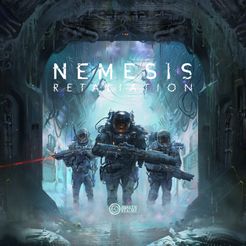
Nemesis: Retaliation sends an armed squad into an alien-infested facility, balancing exploration, firepower, and oxygen while each player chooses which objective to pursue beneath the public mission.
Nemesis: Retaliation supports 1–5 players; community best: 4–5 players; playing time: 120–180 minutes. A WANGO browser trial has not been confirmed.
Background & introduction
Players enter as equipped marines while exploration gradually reveals the facility. Rooms and corridors serve different tactical roles: characters stay in rooms, while intruders approach through corridors. You must judge when to clear routes, when to advance cautiously, and whether resources will last long enough to reach a dependable escape or hibernation option.
Action cards provide character abilities and pay for basic actions. A round contains several short turns per player, with movement, room use, combat, and supplies drawing on different card costs. Each of your turns can also cost oxygen or cause fire damage. Two cheap actions therefore need not be better than a careful plan, and ammunition and life support shape the squad's pace.
The semi-cooperative tension comes from the gap between shared survival and personal agendas. The public mission need not be every marine's chosen winning condition, and escaping still leaves infection checks. The core box also provides explicit solo and fully cooperative rules with shared tasks. This guide distinguishes those modes, describes basic systems without revealing objective solutions, and keeps earlier games and expansion aliens outside its rules.
Core rules & scoring
The core game supports one to five players. Standard semi-cooperative play reveals one Mission Task and gives each player one Mission Objective and one Private Objective. Winning requires escaping or hibernating, surviving the final procedures, and fulfilling the retained objective. Several players may win, or none. Solo and cooperative play use the separate task system described below.
Each round has Player, Intruder, Event, and Cleanup phases. Starting with the first player and proceeding clockwise, players take short turns: normally perform two actions, then resolve oxygen loss and fire damage. Players who have not passed keep taking turns until everyone passes; two actions is not a player's entire round allowance.
Pay the basic Action-card costs shown on the character board: normal movement, shooting, bursting, and item use generally discard one card; room use and cautious movement generally discard two. Playing an Action card has no additional basic card fee, but its effects may require further payment. Cards discarded as payment do not resolve their abilities. Actions marked Not In Combat cannot be used while sharing a room with an intruder.
Passing is an action, not an automatic result of running out of cards. Discard any number of hand cards, including Contaminations, and skip further turns that round, while retaining eligible Reactions. Cleanup passes the starting token clockwise, refills each hand to five, and advances time. When a required draw finds an empty Action deck, reshuffle the discard pile.
At the end of each of your turns, including the turn in which you pass, lose one oxygen if that section's life support is inactive. Active life support does not refill personal oxygen. An oxygen supply token restores three, to a maximum of seven. Once Suffocating, the next oxygen loss kills you; gaining oxygen or ending a turn in a section with active life support removes Suffocating.
Characters move from one room through an adjacent corridor into another room and never stop in corridors. Intruders in the departure room or chosen corridor cause opportunity attacks first, to a maximum of three. Entering a discovered room still requires a Noise roll even if characters or intruders are present. Undiscovered locations use an Exploration card to place rooms, corridors, markers, and entrance effects; only explicit effects waive noise.
A numbered Noise result affects adjacent corridors with that number. For each corridor, resolve these checks in order: if it contains an intruder, move the largest one into the room; if it contains a Noise marker, remove and resolve it through a bag draw and help sheet; if it has no Noise marker, place one. No matching corridor means no effect. A Hazard result instead uses the bag's room procedure. Intruders newly entering a room immediately attempt to attack a character there.
Shooting targets an intruder in your room and requires a working, loaded ranged weapon in hand. Normally deal one hit, then roll: a numbered result no greater than accumulated hits or a critical symbol kills an Adult; only the specific ammo result spends ammunition. Bursting targets an adjacent corridor without a closed door blocking it, always spends ammo, and distributes Burst-die hits. Corridor Adults and Larvae die to one hit each; a Drone needs two hits assigned in that burst. The Queen uses a separate health deck.
New Contamination cards enter your discard pile, later occupying hand space without paying for actions. At game end, safe escaped or hibernating characters without a Larva draw their entire deck and discard pile into hand and scan Contaminations for the Infection Procedure. Characters with a Larva gain one Contamination, reshuffle their whole deck, and draw four for Eclosion; any Contamination drawn kills them. Escaping alone does not secure victory.
The game ends after round fourteen or when every character is dead, escaped, or hibernating, followed by final checks. Characters still in the facility without hibernating die; facility destruction also kills hibernating characters. Official solo and cooperative play draws one Solo/Coop task per character instead of normal objectives. Complete every task and have at least one survivor, satisfy repeated requirements separately as specified, and apply the FAQ restriction on incompatible tasks.
Rules & gameplay questions
Does completing the public mission make every survivor a winner?
Not in standard semi-cooperative play. Each player needs their own retained objective, a safe escape or hibernation, and survival through final checks. Mission Tasks, Mission Objectives, and Private Objectives are distinct. Official cooperative play instead requires all Solo/Coop tasks and at least one survivor.
Do I roll Noise when someone is already at my destination?
Yes. Retaliation expressly requires it when moving into a discovered room containing characters or intruders, unless a special effect explicitly waives it. Do not import a different game's occupied-room exception.
Can one Use Any Tactical Gear action use several supplies?
Yes. Official FAQ v1.2 allows multiple tactical tokens in one action, choosing them sequentially, such as resolving one grenade before deciding to throw another. Each token still follows its own use rules.
Does a room malfunction also disable its computer icon?
No. FAQ v1.2 says Malfunction markers do not themselves affect computer icons unless a specific item or effect says otherwise. A broken room function does not erase every computer connection.
If autodestruction is active but everyone escapes early, does the explosion get skipped?
No. FAQ v1.2 resolves autodestruction before the endgame sequence even if the game has already ended. Destroying the facility kills characters hibernating inside, so hibernation and actual escape are different safety states.
Rules & introduction sources
- Edition
- Scope: the final English forty-page core rulebook for Nemesis: Retaliation (2025), the lowres file listed in the current official download catalog. Read pp.6-7,12-18,24-25,33-36,38-40, plus applicable base-game portions of official FAQ v1.2 (2026-06-08), pp.1-3 of its actual four pages. Standard semi-cooperative play is primary; solo and cooperative rules apply only where explicitly identified. Excludes expansions, comic plot, original Nemesis, Lockdown, crowdfunding drafts, and individual objective solutions.
- Rule references
- Introduction source
- BoardGameGeek
WANGO editorial
| Parameter | Recorded value |
|---|---|
| BGG overall rank (snapshot) | #239 |
| Complexity Weight | 3.77 / 5 |
| Best player count (community) | 4–5 |
| Player range | 1–5 |
| Playing time (minutes) | 120–180 |
| Core mechanisms | Cooperative Game · Dice Rolling · Hidden Roles · Modular Board · Player Elimination · Semi-Cooperative Game · Solo / Solitaire Game · Traitor Game · Variable Player Powers |
| Chinese publication | Unconfirmed |
| WANGO browser play | No confirmed WANGO trial |
| Year published | 2025 |
| Suggested age | 14+ |
BGG statistics are stored snapshots, not live rankings. Source checked:2026-09-27
Player questions
What is the best player count for Nemesis: Retaliation, and can I play online?
Nemesis: Retaliation supports 1–5 players; community best: 4–5 players; playing time: 120–180 minutes. A WANGO browser trial has not been confirmed. Recorded mechanism tags: Solo / Solitaire Game.
How complex is Nemesis: Retaliation, and which mechanisms does it use?
Weight: 3.77 / 5. Mechanisms: Cooperative Game · Dice Rolling · Hidden Roles · Modular Board · Player Elimination · Semi-Cooperative Game · Solo / Solitaire Game · Traitor Game · Variable Player Powers. Chinese publication: Unconfirmed.
Where can I learn Nemesis: Retaliation?
No rule guide, strategy article or WANGO trial has been confirmed for this record.