Great Western Trail: New Zealand
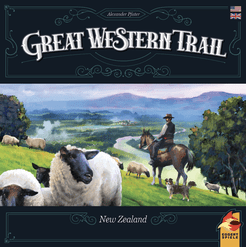
Develop a sheep-farming business on New Zealand's South Island through trail deliveries, wool trading and overseas harbours.
Great Western Trail: New Zealand supports 1–4 players; community best: 3 players; playing time: 75–150 minutes. A WANGO browser trial has not been confirmed.
Background & introduction
Great Western Trail: New Zealand follows family-run sheep stations on the South Island around the turn of the twentieth century. Players guide different breeds of sheep toward Wellington, hiring workers, constructing private buildings and improving their decks along the trail, then investing their earnings in future growth.
Sheep have both breeding value and wool value. Wellington deliveries use breeding value, while shearing depends on wool value and the number of shearers available. The sea routes map adds another avenue of development: reaching harbours lets your ship establish storehouses or upgrade facilities, unlocking foreign deliveries and other rewards.
This is a standalone New Zealand edition. Its sheep, sea routes, pathfinder track and bonus tiles market shape its business cycle, and four neutral buildings flip during the game to change the available actions. Victory comes from several final-scoring categories rather than the income from a single delivery.
Core rules & scoring
Each turn has three phases: A, move; B, use the reached location; and C, draw up to your hand limit. Move your runholder forward at least one location without exceeding your step limit; empty spaces are not locations, and you must stop in Wellington. At your own or a neutral building, use each local action at most once, or forgo all local actions for one single auxiliary action. At opponents' buildings and hazard locations, only a single auxiliary action is available.
Fees and business costs: Immediately pay fees when passing or stopping at a hazard or opponent's building with hand symbols: one pound for a black hand and two for a green hand. Only these fees allow you to pay what you can and continue if short of money. Other costs, such as building actions, hiring, buying sheep and construction, must be met in full. Newly acquired sheep and other cards usually enter your personal discard pile and reach your hand after later reshuffling.
Income in Wellington: Reveal any number of different sheep breeds, at most one card per breed. Add their breeding values, your permanent certificates and any temporary certificates you choose to spend, then take that many pounds. Discard only the revealed cards; unrevealed duplicates and other cards remain in hand. Wool value, printed victory points and non-sheep cards do not contribute to breeding value.
Delivering and unlocking: Choose an available trading post whose requirement does not exceed your total breeding value. Place a disc from your player board, pay transport and disc-removal costs, and resolve the delivery rewards. Then resolve the A and B foresight tiles in order and return to the trail's start. Normally you cannot deliver to a post already holding one of your discs; local posts 0 and 21 are exceptions. Foreign posts must be unlocked, and the white- and dark-corner restrictions on disc spaces and destinations still apply.
Shearing and wool trade: Reveal at most as many different sheep breeds as the number of shearers you use. Add their wool values and unlocked permanent wool, take that many pounds and discard the revealed sheep. Certificates do not add wool value. If the total meets a wool trading post's requirement, you may place a disc there and pay the costs. Normally you cannot repeat your own wool delivery to the same post; wool post 13 is the exception. Each shearer not used for shearing may instead draw one card and discard one card.
Shipping: Move your ship up to the distance allowed by its action, in either direction along sea routes. On reaching a sea space connected to a harbour, spend one additional movement step and meet the costs to place a storehouse or upgrade the harbour with a disc; that shipping action then ends. Small, medium and large harbours give different rewards. Foreign trading posts require the corresponding storehouse, and you may upgrade each harbour only once.
Markets and the ending: Wellington's foresight tiles enter the hazard areas, worker market or bonus tiles market. As the bonus tiles market token follows its arrows, refill the sheep market or flip the four neutral buildings as instructed. Placing a bonus tile in the market's final space sends the token out along the red arrow: take it immediately and finish your turn, which is your last. Every other player then gets one final turn. No player performs phase C on their final turn.
Final scoring: Add the twelve score-pad categories, covering cash, private buildings, trading posts and harbours, pathfinder progress, sheep and bonus cards, objectives, harbourmasters, workers and player-board unlocks, and collected hazards and bonus tiles. The player holding the end-triggering market token scores five extra points. Objectives already in your objective area must score, positively or negatively; those still in your deck may be left out. The same fulfilled task cannot satisfy multiple objective cards. Most points wins; tied players share victory.
Rules & gameplay questions
Can two sheep of the same breed both add to a Wellington delivery?
No. Reveal at most one card of each breed for breeding value; duplicates can stay in your hand. Once income is determined, discard only the cards you revealed, rather than your entire hand.
Do certificates increase shearing income?
No. Certificates increase breeding value for Wellington deliveries. Shearing uses the wool values of different sheep breeds plus permanent wool, with the number of breeds limited by the shearers used. These two values are separate.
Can I place another disc at a trading post I have already supplied?
Normally not. Local sheep-delivery posts 0 and 21 allow repeats, as does wool post 13 when shearing. Other local, foreign and wool posts still prohibit repeat deliveries by the same player, even if there appears to be space for another disc.
After revealing sheep for their value, can I use an exchange token to change the hand and recalculate?
No. Revealing sheep to calculate breeding value in Wellington or wool value when shearing is a snapshot. At that calculation point you cannot use an exchange token or a card that draws more cards to change the revealed group. Arrange your hand beforehand at a permitted time.
Rules & introduction sources
- Edition
- Great Western Trail: New Zealand, the standalone 2023 edition from eggertspiele / Plan B Games, using the base rules for 2–4 players. Checked against Asmodee Germany's official 20-page DE-GWT_NZ_Rulebook_final_v8.pdf and cross-read with the original 20-page English rules. Turns and Wellington are on pages 6–11, shipping and shearing on pages 15–16, and objectives and card timing on pages 17–20. Excludes the Sarah solo rules; does not substitute rules from the original game, Second Edition or Argentina. Individual building and bonus-card effects follow the New Zealand appendix.
- Rule references
- Introduction source
- BoardGameGeek
WANGO editorial
| Parameter | Recorded value |
|---|---|
| BGG overall rank (snapshot) | #73 |
| Complexity Weight | 3.99 / 5 |
| Best player count (community) | 3 |
| Player range | 1–4 |
| Playing time (minutes) | 75–150 |
| Core mechanisms | Deck, Bag, and Pool Building · Hand Management · Ownership · Rondel · Set Collection · Solo / Solitaire Game · Track Movement · Variable Set-up |
| Chinese publication | Unconfirmed |
| WANGO browser play | No confirmed WANGO trial |
| Year published | 2023 |
| Suggested age | 12+ |
BGG statistics are stored snapshots, not live rankings. Source checked:2026-09-27
Player questions
What is the best player count for Great Western Trail: New Zealand, and can I play online?
Great Western Trail: New Zealand supports 1–4 players; community best: 3 players; playing time: 75–150 minutes. A WANGO browser trial has not been confirmed. Recorded mechanism tags: Solo / Solitaire Game.
How complex is Great Western Trail: New Zealand, and which mechanisms does it use?
Weight: 3.99 / 5. Mechanisms: Deck, Bag, and Pool Building · Hand Management · Ownership · Rondel · Set Collection · Solo / Solitaire Game · Track Movement · Variable Set-up. Chinese publication: Unconfirmed.
Where can I learn Great Western Trail: New Zealand?
No rule guide, strategy article or WANGO trial has been confirmed for this record.