The White Castle
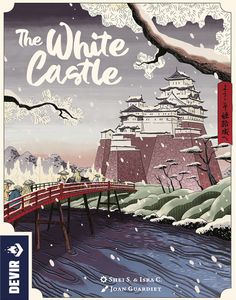
Lead a clan at Himeji Castle, choosing dice from bridges to send gardeners, warriors, and courtiers into positions that earn clan points and influence at court.
The White Castle supports 1–4 players; community best: 3 players; playing time: 80 minutes. A WANGO browser trial has not been confirmed.
Background & introduction
Each player manages a clan seeking a foothold at the White Heron Castle. Gardeners tend the gardens, warriors enter training yards, and courtiers move from the gate to higher floors. Their placements trigger immediate actions and provide different forms of final scoring.
There are three rounds of three turns per player, giving each player only nine main turns. A bridge die’s color and value shape the available actions and coin exchange. Taking the low die at the left end also activates your Lantern Area, so choosing the largest die is not always best.
Sending out clan members reveals rewards on your personal domain. Promoting courtiers changes your action card and expands your lantern income. Resources, cards, and deployed members form connected opportunities, while warrior scoring also depends on how many courtiers have entered the castle.
Core rules & scoring
Rounds and dice: Play three rounds, taking three main turns per player each round in turn order. Take one die from either end of the coral, black, or white bridge, never directly from the middle. If central dice remain, slide the nearest one to the vacant end without changing its value.
Placement and lanterns: Place the die in a legal space and first compare it with the printed value or top die. Gain coins for a higher value, pay the difference for a lower value, or exchange none for a match. A left-end die then grants every visible reward in your Lantern Area; resolve the space’s actions afterwards.
Castle and domain: A castle room provides only actions matching the placed die’s color; a missing color cannot be placed there. On your domain, coral, black, and white correspond to the courtier, gardener, and warrior rows. Collect that row’s uncovered rewards before its action-card action. Outside the Walls accepts any color and offers one of the space’s two actions.
Warriors and gardeners: Pay iron to send a warrior to any training yard and immediately resolve its rewards; yards have no population limit. Pay food to send a gardener to a garden card and resolve its action, with at most one gardener of your clan per card. Always take the leftmost member remaining in the relevant domain row.
Courtiers: One action can pay two coins to send one courtier to the gate and/or pay two mother-of-pearl to raise one courtier one floor, or five to raise one courtier two floors. Each part is allowed once, and movement cannot be split. Ending on floor one or two moves your old action card into the Lantern Area, takes the room card, resolves one light-background action, and refills the room. If no replacement card exists, resolve the light action without exchanging cards. At the top floor, gain lantern rewards, then claim an available favor.
Resources and seals: Food, iron, and mother-of-pearl each have a limit of seven; excess is lost. Store up to five Daimyo Seals. At any time, exchange one seal for one coin or two seals for one resource of your choice. Advancing past a seasonal checkpoint on the Passage of Time track requires its indicated seal payment.
Round end: Reorder turns by influence on the Passage of Time track; the top marker wins a tied position. After rounds one and two, each gardener beneath a bridge still holding dice activates once, then reroll the dice for the next round. After round three, update turn order and proceed directly to final scoring without garden activations.
Final scoring: Add one point per five coins and seals combined; each resource scores one point for three to six remaining, or two for seven. Courtiers at the gate and floors one, two, and three score 1/3/6/10 each. Multiply your warriors’ total yard value by your courtiers inside the castle, score gardeners by their cards, and add Passage of Time points. The earlier final turn position breaks a total-score tie.
Rules & gameplay questions
Can dice be stacked on occupied action spaces?
With three or four players, most main-board spaces hold at most two dice. Your domain never allows stacking, and two-player games prohibit it. The Well is the exception: it has unlimited capacity and always uses its printed value of one, ignoring earlier dice.
Can a left-end die’s lantern rewards pay its placement difference?
No. Resolve the coin difference first, then collect the left-end die’s lantern rewards, then perform the space’s actions. You cannot borrow the lantern income to cover the earlier payment.
Do lanterns use only the newest card, and do gate courtiers multiply warriors?
A lantern activation grants all visible icons in your Lantern Area, in an order you choose. Warriors count only courtiers inside the castle as their final multiplier, excluding those at the gate. Gate courtiers still score one point each themselves.
Does the personal-domain action icon require another die?
No. The appendix treats it as placing a die showing six in one of your domain spaces, resolving that row’s rewards and action. The same row cannot activate twice in a turn. The Well action icon instead uses a value of one, so it does not generate extra coins from a die-value difference.
Do solo play, Matcha, and Duel use this same summary?
The base box includes a Tokugawa opponent driven by nine solitaire cards, with its own die selection, actions, and round-end coin conversion. Use pages 16–18 for that procedure. This summary covers the two-to-four-player base game and does not incorporate solitaire procedures, the Matcha expansion, or the separate game Duel.
Rules & introduction sources
- Edition
- Devir’s 20-page English base-game rulebook for The White Castle, the updated document including a component list, hosted as an original-rulebook mirror rather than a mirror-authored rules summary. This quick reference covers two to four players, pages 1–15 and 20. Pages 16–18 provide the Tokugawa solitaire mode, mentioned here only to identify its separate procedure. Excludes Matcha, Boeki, and the separate game Duel. Japanese first-printing errata were checked only against the appendix icons; their translated action names are not applied here.
- Rule references
- Introduction source
- BoardGameGeek
WANGO editorial
| Parameter | Recorded value |
|---|---|
| BGG overall rank (snapshot) | #72 |
| Complexity Weight | 3.07 / 5 |
| Best player count (community) | 3 |
| Player range | 1–4 |
| Playing time (minutes) | 80 |
| Core mechanisms | Action Drafting · Area Movement · Dice Rolling · End Game Bonuses · Income · Melding and Splaying · Multi-Use Cards · Open Drafting · Race · Resource Queue · Solo / Solitaire Game · Tech Trees / Tech Tracks · Turn Order: Stat-Based · Variable Set-up · Worker Placement · Worker Placement with Dice Workers |
| Chinese publication | Unconfirmed |
| WANGO browser play | No confirmed WANGO trial |
| Year published | 2023 |
| Suggested age | 12+ |
BGG statistics are stored snapshots, not live rankings. Source checked:2026-09-27
Player questions
What is the best player count for The White Castle, and can I play online?
The White Castle supports 1–4 players; community best: 3 players; playing time: 80 minutes. A WANGO browser trial has not been confirmed. Recorded mechanism tags: Solo / Solitaire Game.
How complex is The White Castle, and which mechanisms does it use?
Weight: 3.07 / 5. Mechanisms: Action Drafting · Area Movement · Dice Rolling · End Game Bonuses · Income · Melding and Splaying · Multi-Use Cards · Open Drafting · Race · Resource Queue · Solo / Solitaire Game · Tech Trees / Tech Tracks · Turn Order: Stat-Based · Variable Set-up · Worker Placement · Worker Placement with Dice Workers. Chinese publication: Unconfirmed.
Where can I learn The White Castle?
No rule guide, strategy article or WANGO trial has been confirmed for this record.