Dune: War for Arrakis
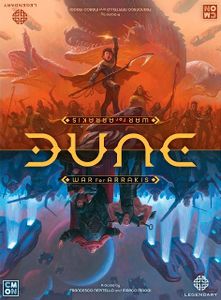
Fight an asymmetric war on Arrakis: the Harkonnens harvest spice to sustain their military machine, while the Atreides combine concealed forces, sandworms, and three Prescience tracks to fulfill a secret victory condition.
Dune: War for Arrakis supports 1–4 players; community best: 2 players; playing time: 120 minutes. A WANGO browser trial has not been confirmed.
Background & introduction
The two sides in Dune: War for Arrakis pursue different scores. The Harkonnens destroy hidden Sietches to accumulate Supremacy; the Atreides advance three kinds of Prescience toward a Secret Objective. A settlement can therefore be a recruiting base, an intelligence blind spot, and a victory threshold at once.
Action dice determine the tools available each round, but the factions have different action economies. The Atreides always roll just four dice and can interleave Desert Power actions when they have fewer unused dice. The Harkonnens protect Harvesters so spice can satisfy the Imperium; falling short affects future dice, vehicles, and military restrictions together.
Concealed deployments, scouting, and sandworms mean visible figures do not tell the whole military story. Surprise attacks change the first combat round, while Desert Hazards test exposed legions and Harvesters after actions finish. The tension between offensives and harvesting keeps movement methods closely tied to terrain.
Core rules & scoring
In standard two-player play, each player commands one faction. Three or four players share two cooperative factions; Mahdi solo has the player command the Atreides and operate the Harkonnens through dedicated procedures. In two-player setup, draw 1 Atreides Secret Objective and start all three Prescience markers and Supremacy at 0.
At round start, each side draws 1 Planning card from each of its two decks and 3 shared Prescience cards are revealed. Resolve Vehicle Placement, Action Resolution, Desert Hazards, Spice Harvesting, then End of the Round; repeat until a faction wins.
The lowest Imperium marker determines Harkonnen available Action dice and Vehicles. The Atreides always roll 4 Action dice. Two-player dashboards allow at most 3 Harkonnen dice or 2 Atreides dice per result; excess dice change to available results according to the allocation rules.
The Atreides act first, then factions alternate one Action each: spend a matching die for a dashboard Action or any die to play a Planning card. The phase ends immediately after the last available Harkonnen Action; unused Atreides Actions do not grant extra turns.
With fewer unused dice than the Harkonnens, the Atreides may take Desert Power without spending a die: place 2 Wormsign tokens, move 2 different Sandworms, or attack with 1 Sandworm. Strategy instead moves 2 different Legions or attacks with 1; Leadership requires a Leader.
An Area normally holds at most 6 Units. Leaders do not count but must accompany at least 1 Unit. Each concealed Atreides Deployment token counts as 1 Unit for movement and stacking; attacks or scouting reveal it, replace it with its troops, and immediately remove any overstacked Units.
Legions normally move to an adjacent Area without enemy Units, enemy Settlements, or Sandworms; attacking uses the appropriate Action instead. Atreides Sandriding follows consecutive Wormsign/Sandworm Areas. Harkonnen Troop-Transport removes 1 Ornithopter connected to the starting Sector to extend movement or attack by 1 Area, at most once per Legion per turn.
In battle, both sides roll dice based on Units, Planning cards, and other modifiers, capped at 6 dice. Hits inflict damage, Shields cancel Hits, and Leaders convert Special results. Each Hit can remove a Regular, downgrade an Elite to an available Regular (otherwise remove it), or remove a Leader. A victorious attacking Legion may advance together or remain where it was.
Desert Hazards resolves Wormsign and Sandworms, then tests exposed Harkonnen Legions against Coriolis Storms. Surviving Harvesters then yield 1 spice in Desert or 2 in Deep Desert. Each Imperium marker costs 2 spice to maintain or 3 to raise one step; otherwise it drops one step. Activate every Ban corresponding to a dropping marker, plus those at the bottom.
Destroy a Settlement by winning a Legion attack and advancing into its Area; Sandworms or Storms eliminating defenders do not suffice. Destroying a Sietch grants its rank in Supremacy; 10 wins immediately. Destroying a Harkonnen Settlement advances every Prescience marker by its rank. The Atreides normally check all three Secret Objective thresholds at round end, but may win immediately after destroying Arrakeen and advancing Prescience. At most 2 Prescience cards can be claimed each round.
Rules & gameplay questions
Can the Atreides spend leftover dice after the final Harkonnen Action?
No. Action Resolution ends when the Harkonnens have executed all available Actions. Remaining Atreides dice or other available Actions do not create an extra turn.
If several Imperium markers drop, do I choose just one Ban?
No. FAQ 3.1 activates every Ban corresponding to a marker that just dropped. Markers at the bottom also activate their Bans. The earlier one-Ban limit no longer applies.
Must a victorious attacker advance?
No. FAQ 3.1 permits the attacking Legion, including all its Units and Leaders, either to advance into the attacked Area or remain where it was. This choice does not permit freely splitting that Legion.
Can Deployment tokens move or split directly?
They move like Units, but each token counts as one Unit. To separate its contained troops, first reveal it and replace it with figures. Revealed troops remain subject to the Area stacking limit.
Does the base box support solo and four players?
Yes. Mahdi solo has the player command the Atreides and resolve Harkonnen behavior using Tactical cards and dedicated criteria. Three or four players share factions, distribute dice and decks, and follow open communication and Cone of Silence rules. These modes have additional chapters and are not four independent factions.
Rules & introduction sources
- Edition
- Scope: CMON Dune: War for Arrakis revised English base rulebook, Dune_Rulebook_2_web.pdf, 44 pages; actually read pp.7-28,30-31,34-37, plus FAQ 3.1 (November 2024), pp.1-3. Focuses on two-player base play and identifies the 3-4-player and Mahdi solo modes; excludes Spacing Guild, Smugglers, Possible Futures, and Desert War expansions, story progression advice, and solutions to specific situations.
- Introduction source
- BoardGameGeek
WANGO editorial
| Parameter | Recorded value |
|---|---|
| BGG overall rank (snapshot) | #232 |
| Complexity Weight | 3.65 / 5 |
| Best player count (community) | 2 |
| Player range | 1–4 |
| Playing time (minutes) | 120 |
| Core mechanisms | Action Drafting · Area Movement · Dice Rolling · Die Icon Resolution · Events · Hand Management · Simulation · Solo / Solitaire Game · Team-Based Game · Variable Set-up |
| Chinese publication | Unconfirmed |
| WANGO browser play | No confirmed WANGO trial |
| Year published | 2024 |
| Suggested age | 14+ |
BGG statistics are stored snapshots, not live rankings. Source checked:2026-09-27
Player questions
What is the best player count for Dune: War for Arrakis, and can I play online?
Dune: War for Arrakis supports 1–4 players; community best: 2 players; playing time: 120 minutes. A WANGO browser trial has not been confirmed. Recorded mechanism tags: Solo / Solitaire Game, Team-Based Game.
How complex is Dune: War for Arrakis, and which mechanisms does it use?
Weight: 3.65 / 5. Mechanisms: Action Drafting · Area Movement · Dice Rolling · Die Icon Resolution · Events · Hand Management · Simulation · Solo / Solitaire Game · Team-Based Game · Variable Set-up. Chinese publication: Unconfirmed.
Where can I learn Dune: War for Arrakis?
No rule guide, strategy article or WANGO trial has been confirmed for this record.