Heat: Pedal to the Metal
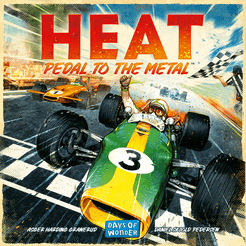
A hand-management racing game of gears, corners and engine heat: push a vintage race car to finish the required laps ahead of the field.
Heat: Pedal to the Metal supports 1–6 players; community best: 5–6 players; playing time: 30–60 minutes. A WANGO browser trial has not been confirmed.
Background & introduction
Heat: Pedal to the Metal, designed by Asger Harding Granerud and Daniel Skjold Pedersen, puts players in 1960s-style race cars on four tracks representing the USA, France, Great Britain and Italy. The base box contains six cars; each track sets its own laps, corners and engine configuration.
Your gear determines how many cards you must play, and their values determine speed. Everyone plans simultaneously, then cars move and react from front to back. Stress adds uncertain speed, while boosting and fast cornering spend Heat from your engine. That Heat enters your discard pile and eventually clogs your hand until cooldown returns it to the engine.
Cars can pass through opponents, but crowded finishing spaces affect positioning. Slipstreaming and the trailing cars’ Adrenaline rewards create opportunities to follow and overtake. The base box also includes optional Garage, automated Legends, Weather and Road Conditions, and Championship modules; a first session can simply be one core race.
Core rules & scoring
Setup and objective: choose a track and use its Heat and Stress configuration. Shuffle each driver’s 12 Basic cards, 3 Starting Upgrades and Stress into a deck; put Heat in the engine, start in first gear and draw seven cards. Race the required laps to finish ahead.
Each round, shift and commit cards simultaneously: stay in gear or shift one step; pay one engine Heat to shift two steps. Gears 1–4 require 1–4 cards respectively, normally excluding Heat. Resolve movement, reactions, corners and replenishment one car at a time from front to back.
Speed and Stress: add the played speed values and move. For each Stress symbol, flip your own deck until a Basic speed card valued 1–4 appears; add it to your play area and discard the other flipped cards. The Starting Upgrade cards valued 0 and 5 are not Basic cards for this purpose.
Heat and reactions: paying Heat moves it from engine to discard. Once per turn you may pay one Heat to boost, adding the flipped Basic card’s speed. First gear provides cooldown 3, second gear cooldown 1; cooldown returns Heat from hand to engine. You cannot freely discard Heat or Stress in the optional discard step. Finally discard played cards and refill to seven.
Adrenaline and slipstream: the last car to move gets an optional extra speed and/or cooldown; with at least five starting cars, the last two qualify. After reacting, a car alongside or immediately behind another may slipstream two spaces once. This does not increase corner-check speed, but corners crossed this way still require checks.
Corners and spinouts: check every Corner Line crossed this turn, paying the positive difference between total speed and each speed limit in order. If you cannot pay, spend all remaining engine Heat and return to the first available space before that corner. Add one Stress to hand from gears 1–2 or two from gears 3–4, then shift to first.
Positioning and finish: cars can pass through others, but if both spots in the destination space are occupied, stop in the nearest free space behind them. The spot nearest the Race Line leads a side-by-side tie. Among cars completing the required laps in the same round, the furthest ahead wins, with Race Line position breaking a tie. Slipstreaming cannot cross the finish or be used after finishing; ignore corners beyond the finish.
Optional modules: Garage replaces the Starting Upgrades with three drafted upgrades. Legends uses a shared deck to control opponents for solo play or a fuller multiplayer field. Weather and Road Conditions modify setup, corners or sectors; a Championship accumulates race points while managing upgrades and sponsorships.
Rules & gameplay questions
Can cooldown recover Heat I just paid into my discard pile?
No. Cooldown returns Heat from your hand to the engine. Newly spent Heat normally has to cycle through your deck before you draw it. Shifting down does not itself retrieve Heat.
Does slipstreaming through a corner avoid its speed check?
You still check every crossed corner, but the two slipstream spaces do not increase your speed. Boosting and any Adrenaline speed you use do increase it. Slipstreaming cannot take you across the finish line.
Does a Stress flip stop at an Upgrade card?
No. Keep flipping until a card with the Basic symbol and speed 1–4 appears. Starting Upgrades valued 0 or 5, Heat, Stress and other non-Basic cards are discarded.
What if Heat clogs my hand so I cannot play enough cards for my gear?
Play as many playable cards as possible and cover the missing cards with Heat under the cluttered-hand exception. On revealing, do not move: shift to first, discard the play area and go directly to replenishment, skipping normal reactions and cooldown.
Does solo play require an expansion?
No. The base box already includes the Legends automated-driver module, using its deck and the Legends Lines on the track. Heavy Rain, Tunnel Vision and the later separately sold Heat: Legends expansion are outside this base-box overview.
Rules & introduction sources
- Edition
- Days of Wonder six-car base box; Rules v1.1 and Advanced Rules v1.1. Includes an overview of optional modules in that box; excludes Heavy Rain, Tunnel Vision and later expansions.
- Introduction source
- BoardGameGeek
WANGO editorial
| Parameter | Recorded value |
|---|---|
| BGG overall rank (snapshot) | #47 |
| Complexity Weight | 2.20 / 5 |
| Best player count (community) | 5–6 |
| Player range | 1–6 |
| Playing time (minutes) | 30–60 |
| Core mechanisms | Catch the Leader · Deck, Bag, and Pool Building · Hand Management · Programmed Movement · Push Your Luck · Race · Simulation · Simultaneous Action Selection · Solo / Solitaire Game · Track Movement · Variable Set-up |
| Chinese publication | Unconfirmed |
| WANGO browser play | No confirmed WANGO trial |
| Year published | 2022 |
| Suggested age | 10+ |
BGG statistics are stored snapshots, not live rankings. Source checked:2026-09-27
Player questions
What is the best player count for Heat: Pedal to the Metal, and can I play online?
Heat: Pedal to the Metal supports 1–6 players; community best: 5–6 players; playing time: 30–60 minutes. A WANGO browser trial has not been confirmed. Recorded mechanism tags: Solo / Solitaire Game.
How complex is Heat: Pedal to the Metal, and which mechanisms does it use?
Weight: 2.20 / 5. Mechanisms: Catch the Leader · Deck, Bag, and Pool Building · Hand Management · Programmed Movement · Push Your Luck · Race · Simulation · Simultaneous Action Selection · Solo / Solitaire Game · Track Movement · Variable Set-up. Chinese publication: Unconfirmed.
Where can I learn Heat: Pedal to the Metal?
No rule guide, strategy article or WANGO trial has been confirmed for this record.