Arcs
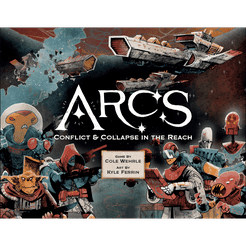
Use action cards to contest initiative, mobilize fleets and influence the Court, while declared ambitions set each chapter’s scoring priorities.
Arcs supports 2–4 players; community best: 3–4 players; playing time: 60–120 minutes. A WANGO browser trial has not been confirmed.
Background & introduction
Arcs, designed by Cole Wehrle, is a competitive game in a declining space frontier. Cities provide resources and capacity, starports enable shipbuilding and long-range movement, fleets control systems, and agents seek Guild support in the Court.
Action cards determine available actions and help decide who leads next round. Leading, surpassing, copying and pivoting provide different action types and quantities. Spending an extra card can seize initiative, but also exhausts your hand sooner.
Only declared ambitions score each chapter, potentially rewarding resources, Captives or Trophies. Development and conflict must adapt to these goals. Power thresholds are checked at chapter end, and the game ends by Chapter 5, with the most Power winning.
Core rules & scoring
Two- to four-player setup: use the matching setup card to cover out-of-play clusters. Three or four players start with eight ships each; two players place ten each as shown. Place each initial city and starport, and give two starting resources and six action cards. Two or three players omit ones and sevens; four use all 28 cards. Reveal three Court cards with two players, otherwise four. With two players, also place six resources matching excluded planets on ambition boxes.
Card play: the initiative holder leads one card and may spend its pips on actions of its suit. Others can Surpass with the lead suit and a higher number to use all their own pips, Copy face down for one lead-card action, or Pivot with another suit for one action on their own card.
Initiative and declaration: before any actions, the leader may declare the card’s ambition, placing the highest available ambition marker and setting the lead number to zero without changing its pips. Another player can seize initiative with an extra facedown card, or by Surpassing with a seven in four-player play. Only one seizure is allowed per round; otherwise the highest Surpass gains next initiative.
Development and control: strictly more fresh ships than each Rival controls a system. Build a city or starport in an empty slot where you have a piece, or one ship at a Loyal starport, once per starport per turn. Pieces built under Rival control enter damaged. Tax a Loyal city or controlled Rival city for a resource, once per city per turn; taxing a Rival also captures one agent from their supply.
Movement and Court: move any number of Loyal ships to an adjacent system. Starting at a Loyal starport allows Catapult moves until entering a Rival-controlled gate or any planet. Influence places one agent on a Court card. Secure requires strictly more agents than each Rival, takes the card, returns Loyal agents, captures Rival agents and refills the Court. Repair restores any one damaged Loyal piece on the map.
Battle and raiding: choose a Rival in a system containing Loyal ships, collecting up to one die per attacking ship, mixing assault, skirmish and raid dice, with at most six of each. Raid dice require defending buildings in the battle system or no defender buildings anywhere on the map. Resolve self-hits and intercept, ship and building hits, then raids if attacking ships survive. Fresh pieces become damaged; another hit destroys them as Trophies. Destroying a city also Provokes Outrage and Ransacks the Court.
Resources and Prelude: after playing a card but before spending its first pip, use resource or card Prelude actions. Material builds or repairs; Fuel moves; Weapons enable card pips to Battle this turn; Relics Secure; Psionics use a lead-card action. Outraged resource types cannot use their normal resource Prelude action, and resource slots limit storage.
Chapter end and victory: end when everyone has no cards or all remaining cardholders pass initiative consecutively. Score declared ambitions only: Tycoon counts Material and Fuel icons, Tyrant Captives, Warlord Trophies, Keeper Relics and Empath Psionics. First and second place gain marker Power; zero counts cannot score. Return scored Trophies and Captives, return ambition markers and flip the lowest unflipped marker. With two players, count ambition-box resources as held by a virtual third player, with Weapons counting as Trophies. End at 27 Power with four players, 30 with three, 33 with two, or after Chapter 5. Most Power wins, ties going earliest in turn order from initiative.
Rules & gameplay questions
Must a Surpass beat every previously played card?
No. It must match the lead suit and exceed only the lead number. Declaring an ambition changes that number to zero, making it easier to Surpass. Pivoting does not change the lead suit.
Can I declare an ambition immediately after seizing initiative?
No. The declaration opportunity belongs to the player leading this round and must be decided before actions. Seizing chiefly guarantees that you lead next round, and only one player can seize each round.
Does only the player declaring an ambition score it?
No, everyone competes for it. Players tied for first each receive second-place Power and other players get none. Tied second place gets none, and a zero count cannot score. Only outright first place earns uncovered city bonuses.
Does damaging a city stop me using its resource type?
Destroying a city makes the destroyer discard resources and Guild cards of that planet type and record Outrage. Outrage blocks that resource’s normal Prelude use, but it may still be taxed and counted toward ambitions. Merely damaging a city does not trigger this procedure.
Does reaching the Power threshold end the game immediately?
No. Check after chapter-end ambition scoring and cleanup: 27 Power with four players, 30 with three, 33 with two, and no later than Chapter 5. This page covers standalone base play, without campaign acts, Fates or finale rules.
Can I redraw a poor hand in two-player play?
Yes. After each six-card deal, the player without initiative may discard all six cards and draw six replacements, which must be accepted. This is only for the player without initiative, not repeated redraws for everyone.
Rules & introduction sources
- Edition
- Standalone base game for two to four players, checked against the March 23, 2026 base rulebook and official living rules and errata. Includes two-player setup, mulligans and virtual-third-player scoring. Excludes The Blighted Reach campaign; Leaders & Lore is optional.
- Rule references
- Introduction source
- BoardGameGeek
WANGO editorial
| Parameter | Recorded value |
|---|---|
| BGG overall rank (snapshot) | #102 |
| Complexity Weight | 3.45 / 5 |
| Best player count (community) | 3–4 |
| Player range | 2–4 |
| Playing time (minutes) | 60–120 |
| Core mechanisms | Area Majority / Influence · Area Movement · Campaign / Battle Card Driven · Dice Rolling · Die Icon Resolution · Hand Management · Negotiation · Resource to Move · Take That · Trick-taking · Turn Order: Claim Action · Variable Player Powers |
| Chinese publication | Unconfirmed |
| WANGO browser play | No confirmed WANGO trial |
| Year published | 2024 |
| Suggested age | 14+ |
BGG statistics are stored snapshots, not live rankings. Source checked:2026-09-27
Player questions
What is the best player count for Arcs, and can I play online?
Arcs supports 2–4 players; community best: 3–4 players; playing time: 60–120 minutes. A WANGO browser trial has not been confirmed.
How complex is Arcs, and which mechanisms does it use?
Weight: 3.45 / 5. Mechanisms: Area Majority / Influence · Area Movement · Campaign / Battle Card Driven · Dice Rolling · Die Icon Resolution · Hand Management · Negotiation · Resource to Move · Take That · Trick-taking · Turn Order: Claim Action · Variable Player Powers. Chinese publication: Unconfirmed.
Where can I learn Arcs?
No rule guide, strategy article or WANGO trial has been confirmed for this record.