Arkham Horror: The Card Game (Revised Core Set)
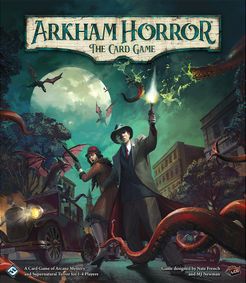
Work together as investigators, collecting clues and testing skills against the chaos bag while doom advances and experience reshapes your decks.
Arkham Horror: The Card Game (Revised Core Set) supports 1–4 players; community best: 2 players; playing time: 45–180 minutes. A WANGO browser trial has not been confirmed.
Background & introduction
The 2021 Revised Core Set of Arkham Horror: The Card Game supports one to four investigators working together against supernatural threats. Each investigator brings a personal deck, special abilities, and weaknesses to the shared investigation.
Connected locations create a space to explore. Investigation uncovers clues, combat removes obstacles, and evasion offers temporary relief from enemies. Limited actions make turn order, protecting teammates, and advancing the act important group decisions.
The act and agenda decks shape the unfolding scenario. Between linked scenarios, players record outcomes, earn experience, and purchase higher-level cards. Setbacks can leave consequences; the campaign guide determines how the story continues.
Core rules & scoring
Set up the investigation: Choose different investigators and legal decks, then follow the scenario instructions for locations, act, agenda, and encounter decks. Build the chaos bag for the chosen difficulty. Normally start with five resources and five cards, with one mulligan; set aside opening weaknesses, replace them, and shuffle them back after the opening-hand step.
Rounds and actions: Resolve mythos, investigation, enemy, and upkeep phases, skipping mythos in the first round. Choose investigator turn order freely, but finish one turn before another starts. An investigator normally has three actions for drawing, gaining resources, moving, investigating, engaging, evading, fighting, playing cards, or activating action abilities. Unused actions are forfeited.
Explore and find clues: Move to a connecting location, revealing it and placing its indicated clues on first entry. A standard investigate action tests intellect against shroud and discovers one clue on success. The group normally spends the act’s required clues to advance without an action; a bold Objective instruction can change the requirements.
Resolve skill tests: Commit cards with matching or wild icons before revealing a chaos token and applying its modifier or effect. Meet or exceed the difficulty to succeed, subject to automatic failure. The tested investigator may commit any number of eligible cards; each teammate at the same location may contribute one. Pay no resource cost for committed cards; discard them and return tokens to the bag afterward.
Handle enemies: A standard fight tests combat against fight value and deals one damage on success. A failed attack against an enemy engaged with a teammate damages that teammate instead. A successful agility test against evade value exhausts and disengages the enemy. While engaged with ready enemies, actions provoke attacks of opportunity except for exempt actions such as Fight, Evade, and abilities with Parley or Resign designators.
Play cards at the right time: Playing an asset or event normally costs an action plus resources. Assets remain in play and obey slot limits; events are discarded after resolution. Skill cards are committed rather than played. Fast cards cost no action but retain timing restrictions; free triggered abilities use player windows, and reactions require their specified triggering conditions.
Mythos and upkeep: Add one doom to the agenda, check all doom in play against its threshold, then draw an encounter card for each investigator in player order. The agenda advances only at that check unless a card explicitly permits advancement. During the enemy phase, ready, unengaged Hunter enemies at locations without investigators move along a shortest path toward the nearest investigator; ready engaged enemies attack. Upkeep resets actions, readies cards, gives each investigator one card and one resource, then enforces an eight-card hand limit.
Resolve the scenario: Damage reaching health or horror reaching sanity defeats an investigator and eliminates them from the scenario, potentially causing campaign trauma. When a resolution is reached or all investigators leave play, follow the appropriate campaign-guide conclusion and record its consequences. Keep resolution text unread until needed.
Build and develop decks: Revised Core investigators use thirty standard player cards chosen within their printed deckbuilding options and requirements, with at most two copies of a player-card title. Investigator-specific cards, weaknesses, and scenario cards added to the deck do not count toward that size. Begin a campaign with level-zero cards, then use experience purchase rules to upgrade. Add a random basic weakness after choosing the other cards.
Rules & gameplay questions
Can four people play with one Revised Core Set?
Yes. The 2021 Revised Core Set supports one to four players. The component limit of the original 2016 core does not apply here, and this entry does not adopt the investigators or rules changes from the 2026 Chapter Two core.
If my skill exceeds the difficulty, do I still reveal a token?
Yes, unless an effect explicitly changes the procedure. Commit cards first, then reveal the token; numerical and symbol effects still matter, and the autofail token causes failure.
Does reaching the doom threshold immediately advance the agenda?
Normally no. Check it after placing doom in the mythos phase, counting doom on other cards in play as well. Effects explicitly allowing agenda advancement are exceptions.
Can I use fast cards or free abilities whenever I want?
No. Fast cards retain their printed timing and restrictions. Free triggered abilities require a player window, reactions require their trigger, and action abilities still require actions and other costs.
Must we choose the worst of two legal options?
No. Apply the relevant choice rules and lead-investigator decisions. The Grim Rule is a temporary way to continue when a rules or timing answer cannot be found. The FAQ’s taboo list is optional and is separate from mandatory errata.
Rules & introduction sources
- Edition
- For the 2021 Revised Core Set: one-to-four-player cooperation, core scenario flow, and introductory deckbuilding, with Chapter One FAQ v2.5. No campaign spoilers, expansion card cases, optional taboo rules, or Chapter Two rules.
- Rule references
- Introduction source
- BoardGameGeek
WANGO editorial
| Parameter | Recorded value |
|---|---|
| BGG overall rank (snapshot) | #105 |
| Complexity Weight | 3.74 / 5 |
| Best player count (community) | 2 |
| Player range | 1–4 |
| Playing time (minutes) | 45–180 |
| Core mechanisms | Action Points · Area Movement · Communication Limits · Cooperative Game · Deck Construction · Events · Hand Management · Map Deformation · Modular Board · Narrative Choice / Paragraph · Role Playing · Scenario / Mission / Campaign Game · Solo / Solitaire Game · Stat Check Resolution · Variable Player Powers |
| Chinese publication | Unconfirmed |
| WANGO browser play | No confirmed WANGO trial |
| Year published | 2021 |
| Suggested age | 14+ |
BGG statistics are stored snapshots, not live rankings. Source checked:2026-09-27
Player questions
What is the best player count for Arkham Horror: The Card Game (Revised Core Set), and can I play online?
Arkham Horror: The Card Game (Revised Core Set) supports 1–4 players; community best: 2 players; playing time: 45–180 minutes. A WANGO browser trial has not been confirmed. Recorded mechanism tags: Solo / Solitaire Game.
How complex is Arkham Horror: The Card Game (Revised Core Set), and which mechanisms does it use?
Weight: 3.74 / 5. Mechanisms: Action Points · Area Movement · Communication Limits · Cooperative Game · Deck Construction · Events · Hand Management · Map Deformation · Modular Board · Narrative Choice / Paragraph · Role Playing · Scenario / Mission / Campaign Game · Solo / Solitaire Game · Stat Check Resolution · Variable Player Powers. Chinese publication: Unconfirmed.
Where can I learn Arkham Horror: The Card Game (Revised Core Set)?
No rule guide, strategy article or WANGO trial has been confirmed for this record.