Andromeda's Edge
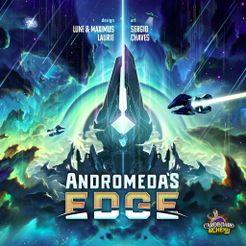
Lead a spacefaring faction rebuilding on Andromeda’s frontier, launching ships for resources and development before recalling them to power station modules and advance five progress tracks.
Andromeda's Edge supports 2–4 players; community best: 3 players; playing time: 80–160 minutes. A WANGO browser trial has not been confirmed.
Background & introduction
Andromeda’s Edge turns worker placement into fleet deployment. Ships leave your station to claim planetary moons, visit Alliance Bases for modules or developments, and sometimes draw nearby raiders into a contested active region.
Recalling the fleet costs a turn but activates station modules. Growing your fleet, repairing modules and arranging ships and energy across rows determine how much one return produces, linking positions on the external map to your internal engine.
Science, industry, commerce, civilization and supremacy offer different opportunities. Developments score from nearby leaders, while events periodically bring scoring and threats. Reaching the terminus triggers final turns rather than declaring a winner before tracks, developments and stations are scored.
Core rules & scoring
Setup: base play is for two to four. Arrange Alliance Bases, random planets/moons and starting raiders by player count, select an event deck, and choose a 50/60/70 VP terminus. Set leaders, resources and tracks by faction; each starts with three transports in the Launch Bay. Seat order determines starting VP.
Choose a Launch or Return to Station turn. An empty Launch Bay forces a return. Use legal free actions during your turn; only slotting moons and playing tactics at their stated times are normally available on other turns. Check resource and hand limits at turn end.
Launch: with none of your ships on the board, first Launch may choose any unoccupied region, subject to abilities such as Attack. Subsequent Launch must be within the launching ship’s range of one of your ships and cannot enter a region already containing your ship, but may enter an opponent’s. Nebulae require Voyage; Alliance Bases require resolving their action.
Activate the destination first: a planet gives its top moon, or its printed resource if empty; a nebula claims its moon and inspects event cards; an Alliance Base performs its action. Then resolve Raider Strike and any battle in the active region. A moon may be abandoned for its benefit or slotted into your station, rather than receiving both uses.
Modules and return: gain a module into its matching row, advance its track and mark printed damage. Returning ships from the board/Repair Barge activate undamaged modules one at a time, at most once each. Energy can activate a row only after a ship has activated that row. A ship activates the Primary Reactor and its other science modules together; energy cannot individually start science modules. Finish by returning every ship and discarding activation energy.
Develop a planet through an appropriate action, paying resources and recruited leaders where your transport occupies an undeveloped planet of the matching type. The transport and leaders become permanent; never consume your last remaining ship. Gain track advancement, a one-use ability and immediate VP for all players’ leaders on/adjacent to that planet, including printed development leaders, capped at ten.
Fleet and combat: an upgrade affects all ships of that type and immediately builds one free if available. Battle resolves escalation, diplomacy, preparation, dice, outcome and damage. Each side rolls at most six dice; energy adds dice and targeting sets mandatory low-result rerolls, capped at five. Compare highest individual dice, then the next on ties, never sums; a complete tie defeats everyone. A winning player advances supremacy and gains applicable raider rewards.
Damage and repair: defeated player ships take damage, absorbed by shields if possible or sent to the Scrapyard; a defeated player may first take Tactical Operations once. Return retrieves Scrapyard ships, but only those on its Repair Barge can activate modules. Repair moves a ship to that barge, repairs a shield or a module; gain one VP instead only when nothing can be repaired.
Events: reaching the event-track end immediately adds a planet and places the marker on the active station. At turn end score the indicated track minus one per damaged module, minimum zero; introduce raiders, resolve the event and reset. Further event advances that turn are ignored while the marker is on the station.
End: reaching the chosen terminus removes the event marker immediately. Finish the current turn, then everyone including its player gets one final turn without triggering events. Add five-track VP, development levels worth five/seven/ten, minus two per damaged module, vault resource points, undamaged end-scoring civilization modules, one per remaining leader and faction effects. Highest VP wins, with module count then resources breaking ties before shared victory.
Rules & gameplay questions
Is launching into an opponent’s region always illegal?
No. An ordinary first Launch requires an unoccupied region, with exceptions such as Attack. A subsequent Launch may enter an enemy-occupied region within range and other restrictions, provided none of your ships is there. Battle resolves at its specified step in the active Launch region, not whenever enemies meet elsewhere.
Can energy activate any module during a return?
No. A ship from the board or Repair Barge must first activate an eligible module in that row before energy activates other modules there. Science modules follow the Primary Reactor’s collective effect instead of individual energy activation. Damaged modules or those missing a required input moon cannot activate.
Does a transport used for development come back next return?
No. It permanently becomes part of that development, and assigned leaders cannot return or be recruited again. You cannot develop with your last ship and leave none. Developments normally do not count as ships occupying regions or prevent opponents visiting their planets.
May I take a repair point simply because I prefer not to repair?
No. Repair eligible ships, shields or modules first. Only when nothing can be repaired does each repair action give one VP. A Scrapyard ship moves to the Repair Barge and cannot Launch again before returning to the Launch Bay.
Does reaching the terminus immediately stop play and win?
No. Finish the current turn, then everyone including that player takes one final turn. Remove the event marker when triggered so no further events occur. Complete final scoring determines victory; the triggering player need not win.
Rules & introduction sources
- Edition
- Andromeda’s Edge two-to-four-player base competition using the first-printing English rules/appendix still linked by the publisher, cross-checked with general clarifications in the official German FAQ dated 19 September 2025. Excludes Escalation solo/fifth player, Genesis, 2v2, optional special regions/destiny cards and a comprehensive account of 2.0 card revisions.
- Rule references
- Introduction source
- BoardGameGeek
WANGO editorial
| Parameter | Recorded value |
|---|---|
| BGG overall rank (snapshot) | #164 |
| Complexity Weight | 3.74 / 5 |
| Best player count (community) | 3 |
| Player range | 2–4 |
| Playing time (minutes) | 80–160 |
| Core mechanisms | Area Majority / Influence · Dice Rolling · End Game Bonuses · Events · Hand Management · Hexagon Grid · Tech Trees / Tech Tracks · Variable Player Powers · Variable Set-up · Worker Placement · Worker Placement, Different Worker Types |
| Chinese publication | Unconfirmed |
| WANGO browser play | No confirmed WANGO trial |
| Year published | 2024 |
| Suggested age | 14+ |
BGG statistics are stored snapshots, not live rankings. Source checked:2026-09-27
Player questions
What is the best player count for Andromeda's Edge, and can I play online?
Andromeda's Edge supports 2–4 players; community best: 3 players; playing time: 80–160 minutes. A WANGO browser trial has not been confirmed.
How complex is Andromeda's Edge, and which mechanisms does it use?
Weight: 3.74 / 5. Mechanisms: Area Majority / Influence · Dice Rolling · End Game Bonuses · Events · Hand Management · Hexagon Grid · Tech Trees / Tech Tracks · Variable Player Powers · Variable Set-up · Worker Placement · Worker Placement, Different Worker Types. Chinese publication: Unconfirmed.
Where can I learn Andromeda's Edge?
No rule guide, strategy article or WANGO trial has been confirmed for this record.