Le Havre
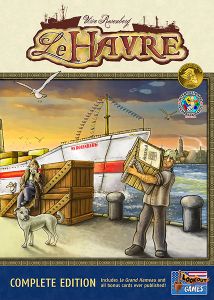
Collect accumulating harbor goods, operate processing buildings, build ships and feed workers, then compare fortunes made up of cash and assets.
Le Havre supports 1–5 players; community best: 3 players; playing time: 30–150 minutes. A WANGO browser trial has not been confirmed.
Background & introduction
Le Havre is Uwe Rosenberg’s harbor economy game. Players share offers of goods and a network of buildings, collecting, processing and constructing to turn raw materials into food, energy and Francs. Buildings supply useful actions and can earn their owners entry fees from visitors.
Goods arrive before every main action, making an untouched offer increasingly attractive. Visiting a building instead requires attention to occupancy, entry fees and materials. Ships continually reduce feeding costs, freeing later actions for processing and investment.
The full and shortened versions have different setups and round counts, and cards are selected by player count. This overview covers the original economic system. Additional special buildings included in complete printings can be mixed in optionally; their individual effects are not universal rules.
Core rules & scoring
Select buildings and round cards for the player count and version. Full games with one through five players last 7, 14, 18, 20 and 20 rounds respectively. Each round contains seven player turns across the whole table, followed by its round-card resolution.
On each turn move your ship marker to the next supply tile and add one of each depicted item to its offer. Then either take every item from one offer space or move your person into an available building and perform its action.
Normally, only constructed buildings without an occupant may be entered, whether owned by you, another player or the town. Pay any entry fee to the owner or supply; your own buildings are free to enter. You cannot stay in your current building to activate it again.
Construction uses a main action: construction buildings let you pay materials for buildings atop the proposal piles, while a Wharf builds ships for materials plus three energy. The first nonwooden ship built at a particular Wharf requires a brick to modernize it permanently. The Dock scoring building is distinct from a Wharf.
Buying is an additional cash transaction during your turn: eligible town buildings, top proposal buildings and the top purchasable ship of each type are available. Buying ships needs no Wharf; Luxury Liners must be built. Buildings and ships sell to the town for half their indicated value, never directly to another player. A building cannot be sold and bought back in the same turn.
Resolve harvest, feeding, town construction and the new ship as indicated at round end. During a normal harvest, at least one grain earns one grain and at least two cattle earn one cattle; no-harvest rounds give neither. Ships reduce food requirements. A Franc replaces one food, but unprocessed grain and cattle have no food value. Food and energy overpayments give no change.
Loans are allowed only when required interest or round-end feeding cannot be paid. Each supplies four Francs; first exhaust the applicable food and cash, but selling assets is optional. At the interest supply tile, a borrower normally pays one Franc total regardless of loan count. Repaying a loan costs five Francs and is allowed at any time.
After the last round, each player takes one final main action, beginning with the starting player. There is no supply, buying or interest. Other players’ occupied buildings may be entered, but not your own current building. Add cash, building and ship values and applicable bonuses, then deduct seven Francs per unpaid loan. Most leftover goods do not score; the Storehouse has its printed exception. Highest wealth wins and ties are shared.
Rules & gameplay questions
Can I take a loan whenever I want to buy a ship?
No. Loans cover otherwise unpayable interest or round-end feeding. They are not freely available investment funding and cannot finance building entry fees.
Does buying a building give me two main actions?
Buying does not consume the main action, so you can buy a building and then enter it. You still have only one main action, and purchasing alone does not activate the building.
Are the Dock and the Wharf the same building?
No. A Wharf provides ship construction. The Dock provides no action and gains additional endgame value according to its owner’s ships.
Is there a solo game?
Yes. The setup table provides seven rounds for a full solo game and four for a shortened solo game, using the solo card selection. The shortened setup also supplies a starting Wooden Ship. This overview adds no artificial opponent or invented victory threshold.
Rules & introduction sources
- Edition
- Original Le Havre core rules, using the Lookout 2016 English rules and appendix; full games for 1–5 players, with the shortened version identified separately. Excludes expert variants and individual additional special buildings. Does not describe the separate two-player game Le Havre: The Inland Port.
- Rule references
- Introduction source
- BoardGameGeek
WANGO editorial
| Parameter | Recorded value |
|---|---|
| BGG overall rank (snapshot) | #83 |
| Complexity Weight | 3.71 / 5 |
| Best player count (community) | 3 |
| Player range | 1–5 |
| Playing time (minutes) | 30–150 |
| Core mechanisms | Automatic Resource Growth · End Game Bonuses · Increase Value of Unchosen Resources · Loans · Ownership · Solo / Solitaire Game · Worker Placement |
| Chinese publication | Unconfirmed |
| WANGO browser play | No confirmed WANGO trial |
| Year published | 2008 |
| Suggested age | 12+ |
BGG statistics are stored snapshots, not live rankings. Source checked:2026-09-27
Player questions
What is the best player count for Le Havre, and can I play online?
Le Havre supports 1–5 players; community best: 3 players; playing time: 30–150 minutes. A WANGO browser trial has not been confirmed. Recorded mechanism tags: Solo / Solitaire Game.
How complex is Le Havre, and which mechanisms does it use?
Weight: 3.71 / 5. Mechanisms: Automatic Resource Growth · End Game Bonuses · Increase Value of Unchosen Resources · Loans · Ownership · Solo / Solitaire Game · Worker Placement. Chinese publication: Unconfirmed.
Where can I learn Le Havre?
No rule guide, strategy article or WANGO trial has been confirmed for this record.