Tiletum
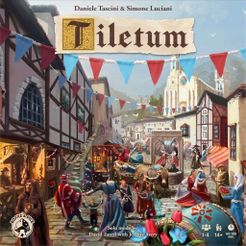
Tiletum is a dice-driven strategy game in which players collect resources and use actions to build, trade, complete contracts, recruit characters, and score fairs and royal influence across four rounds.
Tiletum supports 1–4 players; community best: 2–3 players; playing time: 60–100 minutes. A WANGO browser trial has not been confirmed.
Background & introduction
Tiletum places players in a Renaissance-era European trading network. Each player represents a merchant traveling from Tiletum toward European cities and Venice, building commercial connections and seeking prestige. Roads, cities, fairs, and cathedrals shape where players can expand, while contracts, characters, buildings, and the King track turn trade into lasting development and end-game points. The setting supplies the theme; the game does not ask players to reenact a particular historical event.
The central decision comes from dice that control both resources and action strength. A die's color identifies a resource, and its value determines how many of that resource the player receives. Its linked action provides seven minus the die value in action points. A high die therefore brings more resources but a weaker action, while a low die gives a stronger action and fewer resources. Players weigh that exchange against their plans, bonus tiles still available on the action wheel, and the dice opponents may take first.
A game lasts four rounds, with three main action turns per player in each round. Players can construct buildings, move a Merchant, recruit Characters, fulfil Contracts, adjust their King position, or use a Joker action. Tasks, fairs, and the King phase add further timing and scoring decisions. After the Fair in round four, players score Houses and Pillars on the map, completed buildings, and remaining resources. The game rewards players who plan efficient turns while adapting to several competing scoring routes; the highest Victory Point total wins.
Core rules & scoring
Edition, players, and objective: This entry follows Board&Dice's currently linked Tiletum base rulebook and official FAQ for the multiplayer rules, 2–4 players. The rulebook directs solo players to a separate Solo Rule Book, so this summary does not describe the solo mode. Play four rounds and earn Victory Points through buildings, Contracts, Characters, the King track, and fairs. The Fair in round four is scored before final scoring begins.
Round and action turns: Each round consists of Preparation, Action, King, Fair, and Cleanup phases. During Preparation, roll 8, 11, or 14 dice for two, three, or four players. In the Action phase, every player takes three main action turns. On a turn, choose a die still on the wheel, decide whether to claim its available Bonus tile, take resources, and perform the linked action. A die chosen by one player is no longer available to later players.
Dice and the resource trade-off: Die color identifies the resource gained, and its value determines the quantity. The linked action provides seven minus the die value in Action Points. Before selecting a die, a player may pay two Gold to raise or lower its value by one; each adjustment costs two Gold, and values wrap between one and six. Changing the value changes both the resource amount and action strength. The official FAQ says to move the adjusted die to the new action space and use that space's action and available Bonus tile.
Six actions and Action Points: The action types are Architect, Merchant, Character, Contract, King, and Joker. Architect builds on the map; Merchant moves and places Houses; Character recruits a card; Contract obtains or fulfils a Contract; King moves the King marker; Joker substitutes for one of the other five types. All points from one main action must be spent on that same type rather than split between types. Within the chosen action, use its legal options in the order allowed by its rules. Completing a building can grant a continuing bonus to a specified action.
Tasks, storage, and Bonus tiles: A player may perform listed Tasks at any time during their own action turn, before, after, or between Action Point expenditures. Tasks include paying to fulfil Contracts, placing a Crest, constructing at a Cathedral, or using a Helper; costs and prerequisites still apply. The die sequence is choose a die, optionally claim its Bonus tile, gain resources, and take the action. Place claimed tiles in personal storage, which must have room. Resolve a Helper fully before another tile or the main action; a tile activation must spend at least one Action Point and cannot be used as a free discard.
King phase: The King track determines a round reward, point changes, and turn order for the next round. The player in the leading position takes the listed reward; when there is no reward beside that space in the final round, the leader receives four Victory Points instead. Low positions can lose points, so the track is not a one-way source of bonuses. If players tie, the marker stacked lower at that space has priority; turn order is then set from track position.
Fair phase: A player qualifies if they have a House in the Fair town or have a Merchant there when the Fair is scored. Score the town's printed Victory Points plus the value on the current Fair tile, multiplied by the number of times the player meets that tile's condition. Count the condition as shown on the tile; do not substitute the number of different condition types. Flip the Fair tile after scoring. The fourth-round Fair is scored normally, then Cleanup is skipped and final scoring follows.
Final scoring and ties: After the fourth Fair, multiply each player's number of Houses on the map by their number of Pillars for Victory Points. Score completed buildings by count: one or two score zero, three score five, four score ten, five score twenty, and six score thirty. Each group of four resources remaining in personal supply scores one point. Bonus tiles in storage are not leftover resources. The highest total wins; a tie goes to the player earlier in turn order.
Rules & gameplay questions
Is a high die always the best choice?
No. A higher value normally gives more resources of its color, but it also gives fewer action points: the linked action provides seven minus the die value. A six yields only one action point, while a two provides a stronger action but fewer resources. Compare the die with your storage, building or Contract needs, and the bonus still available on that wheel space instead of choosing by resource quantity alone.
Does an adjusted die stay on its original action space?
No. Pay two Gold for each one-step increase or decrease, then move the die to the wheel space matching its new value. Its resource amount and action both change, and the bonus on the new space is the relevant one. The value can wrap between one and six. The official FAQ explicitly confirms that changing the value also changes the die's physical position on the Action wheel.
What is the order after I take a die?
First choose the die, then optionally take the Bonus tile from its action space, gain the resources shown by its color and value, and finally perform the linked action. Claiming a tile is optional and requires room in personal storage. The tile does not become a resource, and activating a tile later requires at least one Action Point; you cannot simply use a tile to clear storage without spending an action.
Can I split one action's points across two action types?
No. All Action Points gained from a main action must be spent on its chosen type, such as Architect or Merchant, rather than partly building and partly recruiting a Character. The chosen action may offer several legal options, and its rules determine how to sequence them. A building bonus applies to the specified action as described in the rulebook; it does not turn one action into two types.
When may I complete a Task?
You may perform a listed Task at any time during your own action turn, before, after, or between Action Point expenditures. For example, the official FAQ confirms that a player may use a Helper to clear storage before taking a die. Each Task still has its printed cost and prerequisites, so flexible timing does not make it free or allow you to ignore the required pieces or resources.
Must my Merchant be in the Fair town to score?
No. You qualify either by having a House in that town or by having your Merchant there when the Fair is scored. Your score combines the town's printed value with the current Fair tile and multiplies that amount by how many times you meet the tile's condition. Check the tile's icon and count the qualifying occurrences. The Fair tile is then flipped, including after the fourth round's Fair.
Does the King track only award points?
No. The leading position may take the round reward, and the leader receives four Victory Points in the last round when no reward tile remains there. Lower positions can lose points. The track also sets the next round's turn order, and a tie at one position is resolved by the relative vertical placement of the stacked markers. Consider both the immediate reward and the later position before spending a King action.
Do Bonus tiles count as resources at the end?
No. Final scoring gives one point for every four resources left in a player's personal supply, along with points for Houses multiplied by Pillars and for completed buildings. Helpers and other Bonus tiles in personal storage are tiles, not resources, so they do not convert at the four-to-one rate. Completed-building points depend on the total number finished, and turn order breaks a final point tie.
Rules & introduction sources
- Edition
- BGG 351913: Board&Dice's 2022 Tiletum base game. This entry follows the publisher's currently linked English base rulebook and official Rules F.A.Q. It covers the multiplayer rules for 2–4 players. The product listing also advertises one player, but the solo procedure is in a separate Solo Rule Book and is outside this entry. Prospect for Silver, promo cards, and challenge materials are excluded. Chinese mechanism terms are editorial translations, not verified official Chinese labels.
- Rule references
- Introduction source
- BoardGameGeek
WANGO editorial
| Parameter | Recorded value |
|---|---|
| BGG overall rank (snapshot) | #280 |
| Complexity Weight | 3.39 / 5 |
| Best player count (community) | 2–3 |
| Player range | 1–4 |
| Playing time (minutes) | 60–100 |
| Core mechanisms | Action Drafting · Action Points · Contracts · Dice Rolling · End Game Bonuses · Point to Point Movement · Set Collection · Variable Set-up |
| Chinese publication | Unconfirmed |
| WANGO browser play | No confirmed WANGO trial |
| Year published | 2022 |
| Suggested age | 14+ |
BGG statistics are stored snapshots, not live rankings. Source checked:2026-09-27
Player questions
What is the best player count for Tiletum, and can I play online?
Tiletum supports 1–4 players; community best: 2–3 players; playing time: 60–100 minutes. A WANGO browser trial has not been confirmed.
How complex is Tiletum, and which mechanisms does it use?
Weight: 3.39 / 5. Mechanisms: Action Drafting · Action Points · Contracts · Dice Rolling · End Game Bonuses · Point to Point Movement · Set Collection · Variable Set-up. Chinese publication: Unconfirmed.
Where can I learn Tiletum?
No rule guide, strategy article or WANGO trial has been confirmed for this record.